
5 Best AI Voice Agents for WhatsApp and Phone Calls
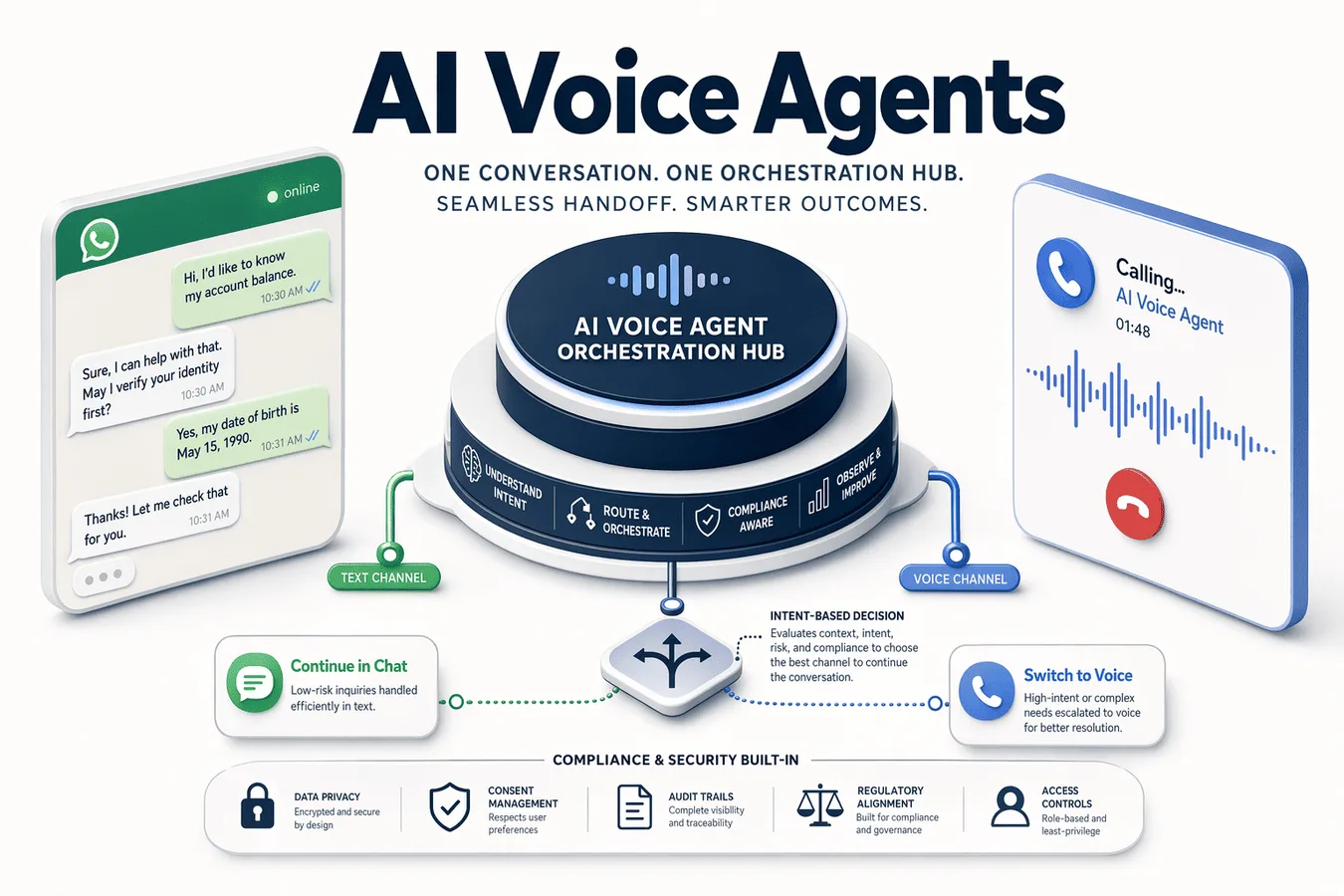
Deploying AI voice agents across WhatsApp and phone calls requires orchestration—not just running separate bots on each channel. Businesses need unified systems that route conversations between messaging and voice based on customer intent, compliance requirements, and real-time context.
Key Takeaways
Orchestration systems route conversations between WhatsApp and voice channels based on intent signals, compliance zones, and customer preference—preventing customers from repeating information when switching channels
Four orchestration patterns serve different use cases: WhatsApp-first for transactional workflows, voice-first for high-urgency intent, parallel deployment for enterprise deals, and auto-routing for learned preferences
India deployment requires DLT registration for voice outreach, DPDP consent covering both channels, TRAI call recording compliance, and Meta template approval for WhatsApp messaging
Bi-directional CRM sync is mandatory for orchestration—real-time conversation history must flow between channels via webhooks and API calls to maintain context
Deployment timelines range from 72 hours with pre-built templates to 90 days for custom enterprise integrations with multi-region compliance audits
Why businesses need WhatsApp + voice orchestration (not single-channel AI)
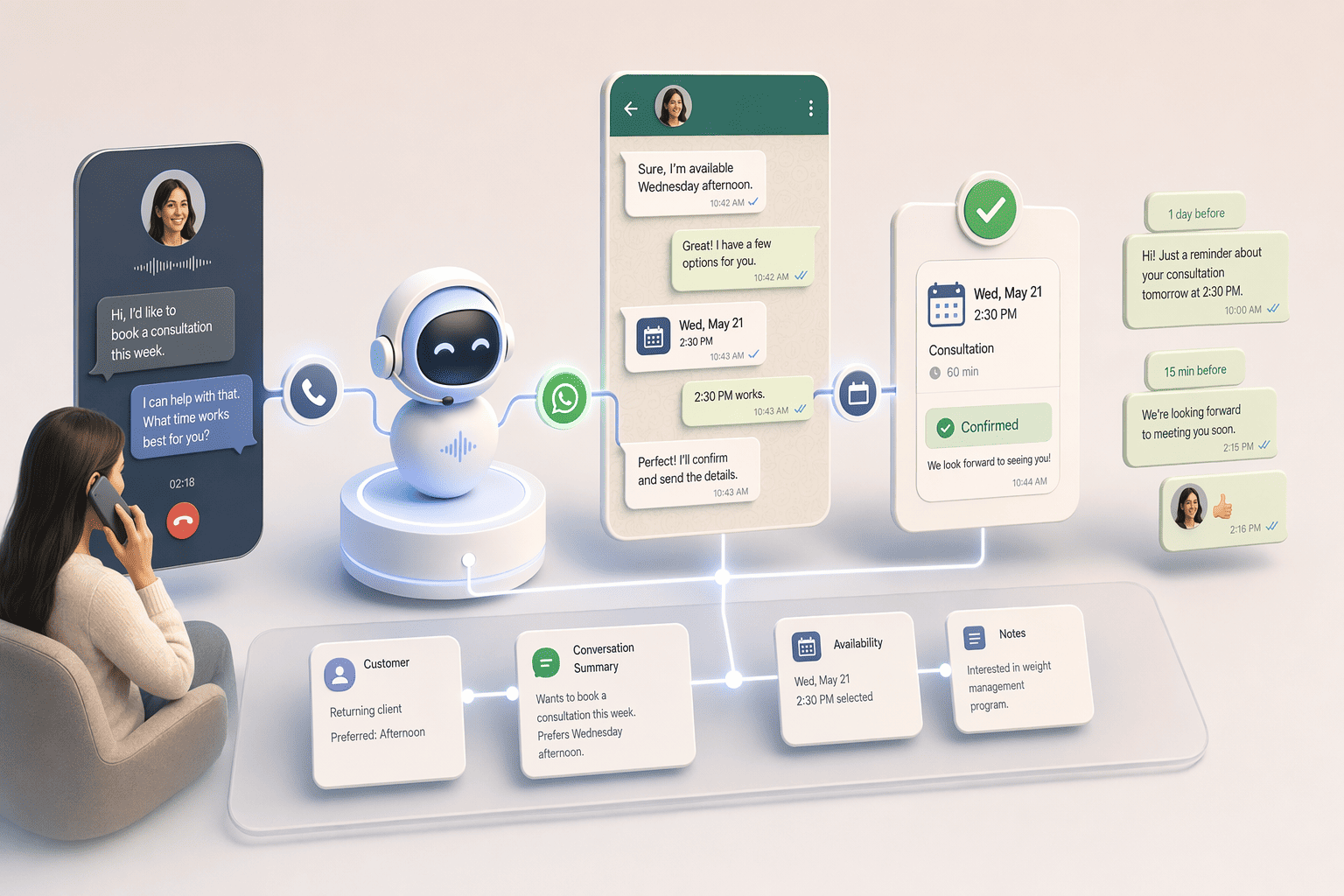
Orchestration means routing conversations between channels based on intent, compliance, and preference—not running parallel-but-separate agents on each channel. An AI voice agent that works across WhatsApp and phone calls handles qualification on a voice call, then transitions the confirmed appointment to WhatsApp for calendar links and reminders, preserving context across both touchpoints.
When single-channel AI creates friction instead of solving it
WhatsApp-only agents fail when customers prefer voice for complex objections. Voice-only agents cannot deliver compliance-gated documents or payment links mid-conversation. Single-channel deployments force customers into the business's preferred modality rather than meeting them where they are.
What orchestration adds: routing logic, compliance zones, and conversation continuity
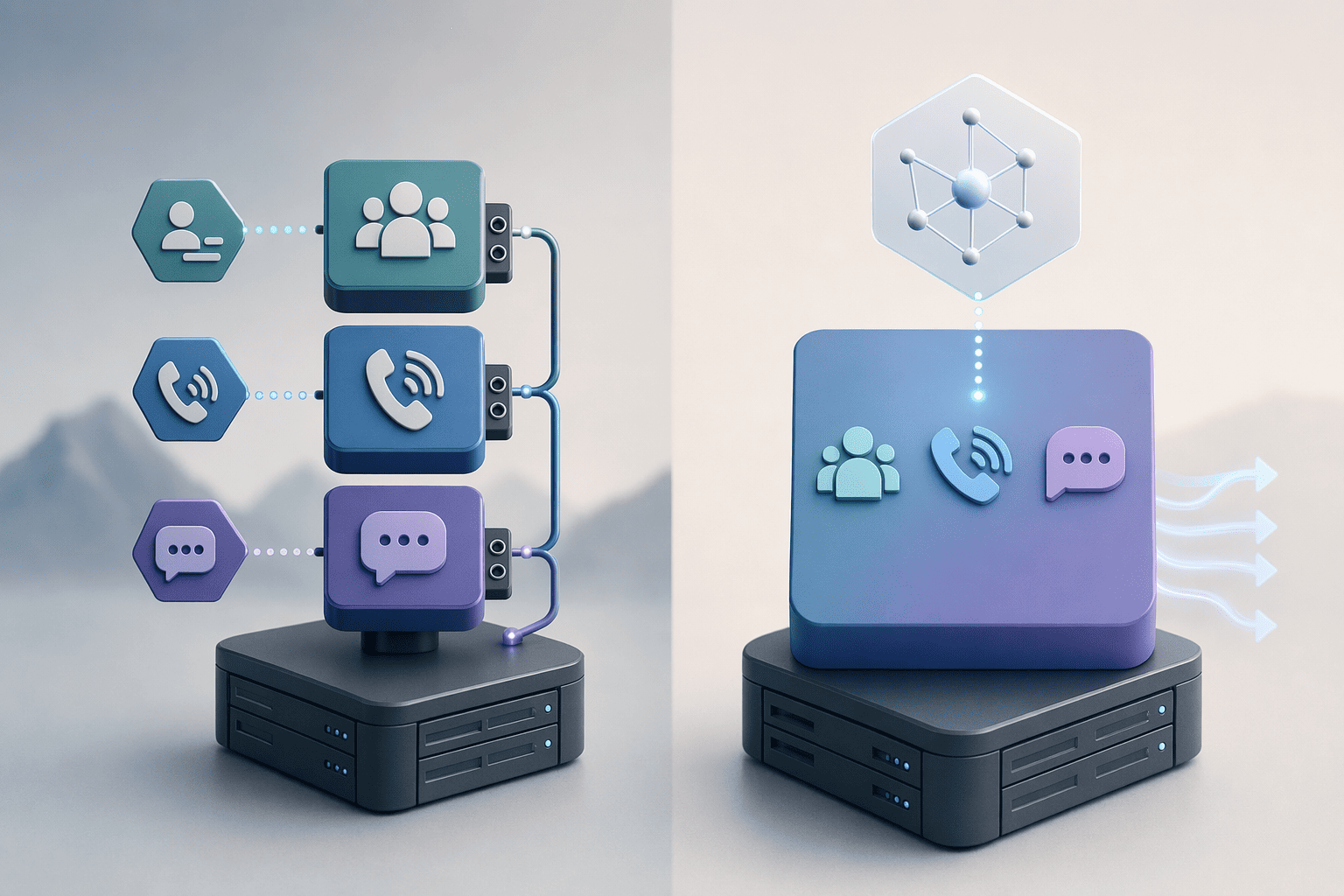
Orchestration layers three components atop single-channel AI: (1) routing triggers that switch channels when a qualification completes or document delivery is required, (2) compliance zones that route sensitive data collection to voice-only paths, and (3) shared conversation context so the WhatsApp agent recalls what the voice agent learned. Platforms like EchoLeads offer omnichannel support across WhatsApp, voice, and CRM —one example of how orchestration platforms unify channels within a single agent architecture.
Business scenarios where orchestration delivers measurable ROI
Lead qualification sees medium ROI when voice qualification triggers WhatsApp follow-up sequences without re-asking budget or timeline. Appointment booking delivers high ROI by confirming slots on voice, then sending calendar invites via WhatsApp within the same conversation. Support escalation gains low-to-medium ROI by routing routine queries to text and complex technical issues to voice callbacks.
Understanding why orchestration matters is the first step—choosing the right pattern for your customer base determines whether your AI voice agent reduces friction or creates new bottlenecks.
The four orchestration patterns: when to use each
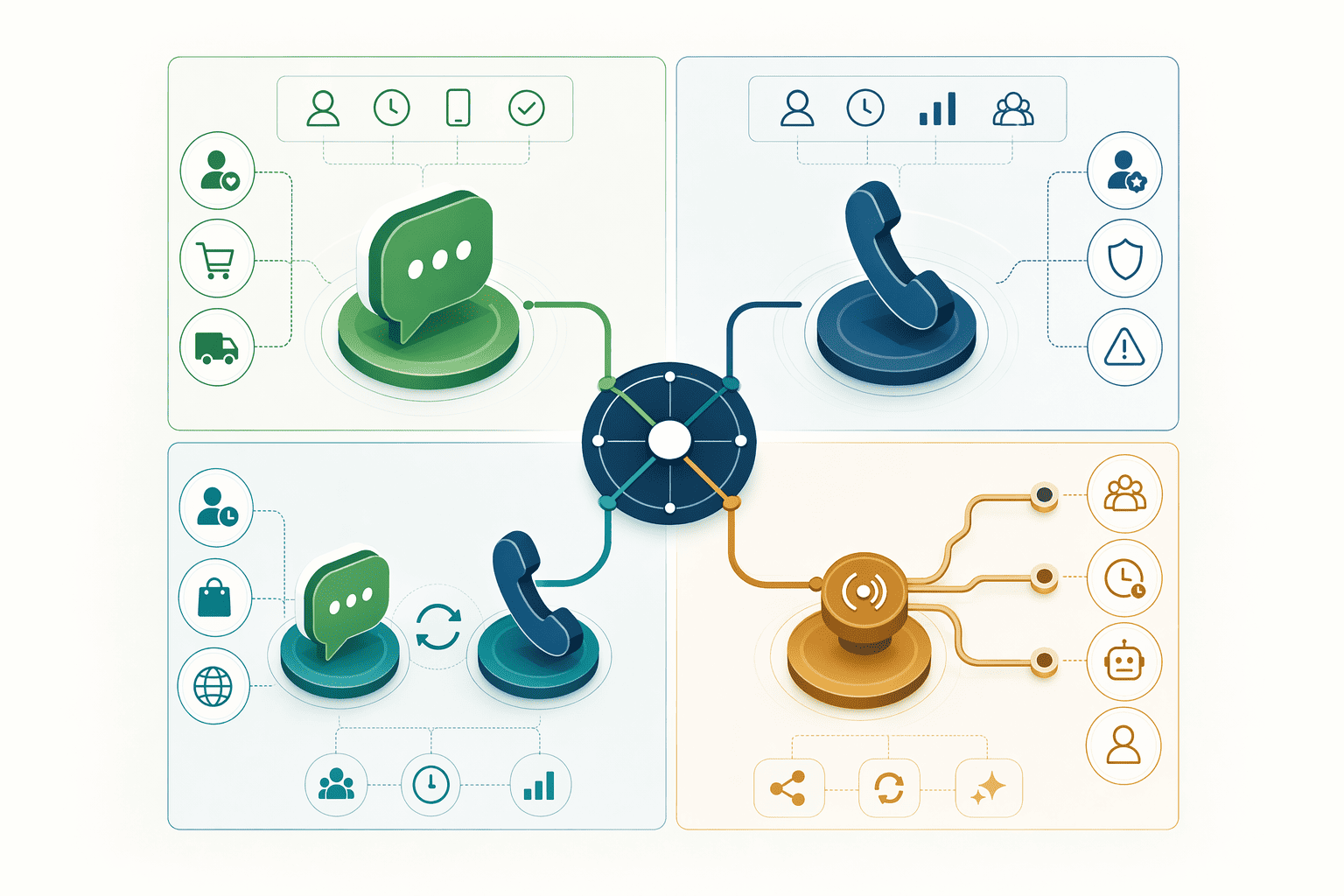
Choosing between WhatsApp-first, voice-first, parallel, or auto-routing orchestration depends on customer demographics, intent signals, compliance constraints, and integration complexity. Industry frameworks like caller.digital's orchestration patterns provide a starting taxonomy, but actionable deployment decisions require mapping each pattern to real-world thresholds.
WhatsApp-first with voice escalation
Start with messaging when your customer base skews younger (18 to 34) or prefers asynchronous channels. Escalate to voice for exploratory queries or multi-step clarifications. This pattern works best for transactional workflows, order confirmations, status updates, where the initial touch needs to be non-intrusive. Compliance is simpler because messaging opt-ins are template-based. Integration complexity is moderate: you need bi-directional CRM sync to preserve context when escalating.
Voice-first with WhatsApp fulfillment
Start with voice when intent signals are high-urgency (service outages, appointment changes) or when your audience expects immediate human-like interaction. Voice agents are handling 1 billion calls, proving adoption for enterprise buyers who default to phone. Follow up via WhatsApp for order confirmations or appointment reminders. Compliance requires TCPA adherence for outbound calls. Integration complexity is higher: you need telephony provider APIs plus messaging platform sync.
Parallel deployment for high-value intent
Run both channels simultaneously for enterprise sales or complex support tickets where response speed and channel choice both matter. This pattern adds cost without ROI when conversation volume is below 100 per month, the anti-pattern is parallel deployment for low-volume workflows. Compliance demands dual consent (voice and messaging). Integration complexity is highest: you need unified conversation history across both channels.
Auto-routing by customer preference
Let customers choose their channel when preference history is available, repeat customers who consistently respond faster on one channel should default to that channel. This pattern reduces friction but requires a preference engine that tracks response rates and sentiment by channel. Compliance is inherited from the chosen channel. Integration complexity is moderate: you need a routing layer that reads CRM preference flags.
WhatsApp-first orchestration works best when your customer base prefers asynchronous messaging but occasionally needs voice escalation for complex objections or urgency.
WhatsApp-first with voice escalation: setup and compliance
WhatsApp Business API setup requirements
Meta-approved provider selection: Deploy the WhatsApp Business API through a Meta-approved provider; this ensures compliance with Meta's technical requirements and message template approval workflows.
Template submission: Submit message templates for Meta review; approval typically takes 24-48 hours; templates must follow WhatsApp's pre-approved format rules.
Opt-in consent collection: Obtain explicit opt-in consent before messaging any customer; WhatsApp requires businesses to use pre-approved message templates for initial outreach and obtain explicit opt-in consent before messaging.
24-hour conversation window enforcement: After a customer replies, you have a 24-hour window to send proactive messages; after that, only template-approved messages are permitted unless the customer re-initiates.
Voice escalation triggers and telephony integration
Escalate to voice when WhatsApp sentiment drops below a preset threshold, when conversation clarity falls below safe autonomy levels, or when the customer explicitly requests a call. Platforms like EchoLeads manage cross-channel consent and trigger voice calls via API handoff when these conditions are met. Research shows that the first 20 seconds decide whether the caller stays or leaves, making greeting quality critical for escalation success. JustCall's hang-up prevention strategies confirm that AI greeting patterns must clearly state options upfront and offer a path to human agents within 8-10 seconds to prevent early hang-ups.
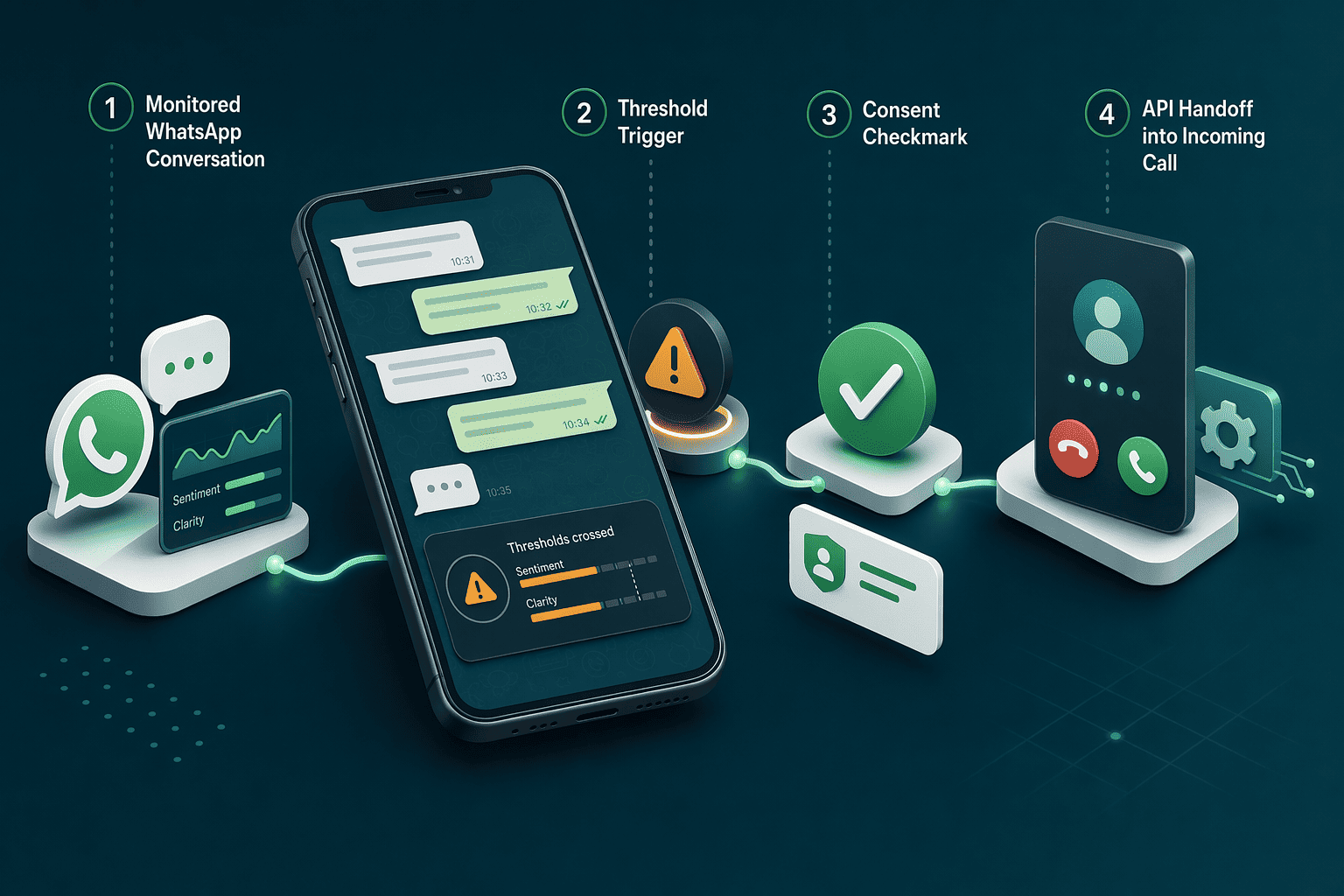
Compliance workflow: Meta's 24-hour window vs TRAI call recording consent
WhatsApp allows 24-hour proactive messaging after customer reply, but voice escalation requires new consent under TRAI for call recording. When the same conversation spans both channels, you must secure explicit consent for voice recording at the time of escalation, WhatsApp opt-in does not carry over to telephony. This dual-consent requirement is often omitted in competitor implementations; omnichannel platforms must surface separate consent prompts before transferring the call, maintaining audit trails for both channels.
Voice-first workflows flip the channel priority, starting with phone calls for high-intent conversations, then using WhatsApp to deliver documents, confirmations, and follow-up materials.
Voice-first with WhatsApp fulfillment: integration requirements
Telephony API integration for voice channel connectivity
Voice-to-WhatsApp workflows require a telephony provider that supports SIP trunking, number provisioning, and call routing. Twilio's TwiML Voice API offers one integration path: the `<Dial><WhatsApp>` noun lets you send a call to any WhatsApp endpoint, after establishing consent using a WhatsApp message template. All WhatsApp calls must use a `callerId` set to a registered, Voice-activated WhatsApp sender. Alternatives include Plivo and other SIP providers; each requires configuring webhook endpoints for call events and number assignment.
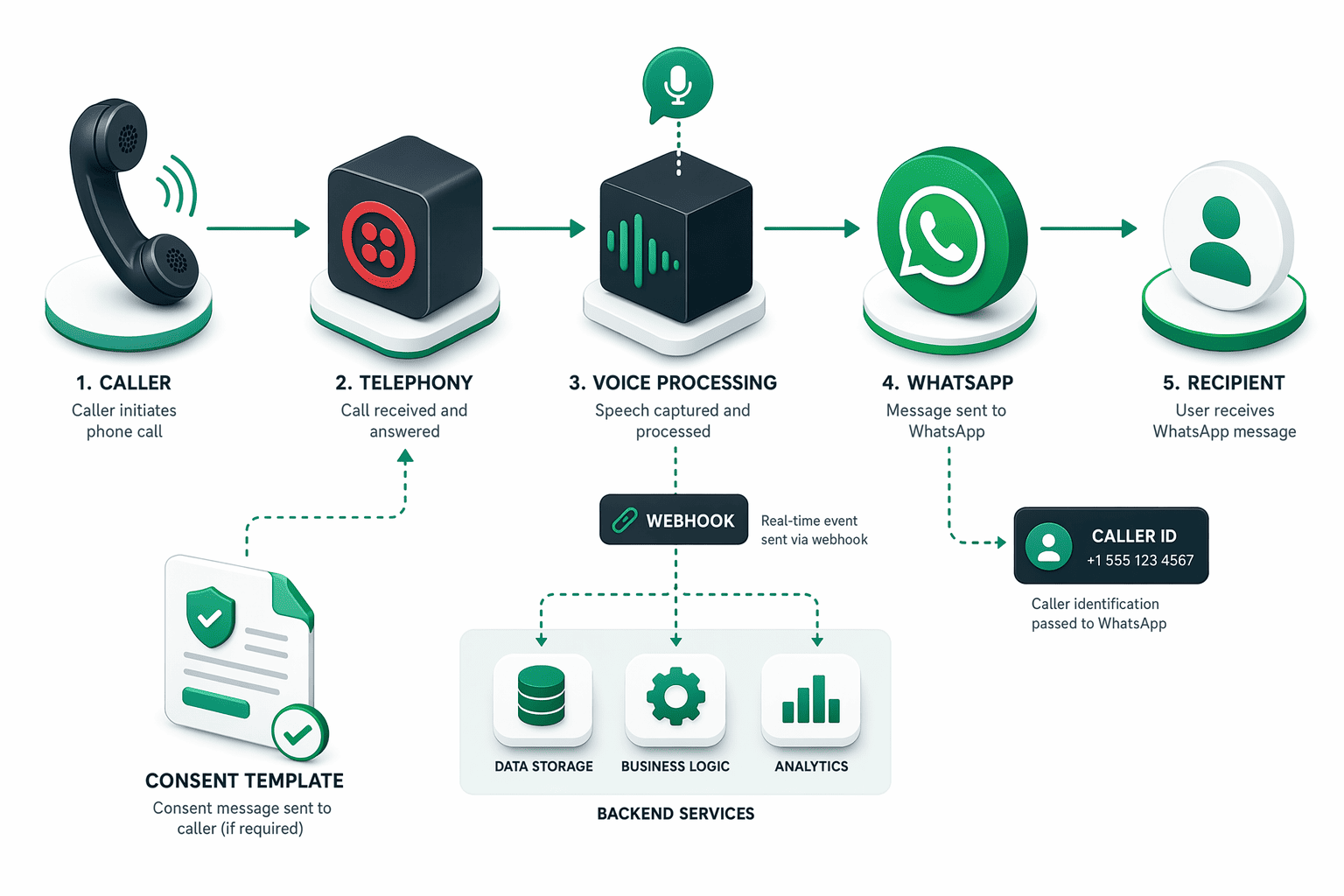
WhatsApp fulfillment workflow: template rules and message triggers
Post-call WhatsApp messages follow strict template compliance: businesses must obtain explicit opt-in consent before messaging and respect the 24-hour conversation window. Template-based triggers include appointment confirmations, order status updates, and follow-up sequences. The workflow typically fires after the voice call ends: a webhook sends the conversation summary to the CRM, which then triggers a WhatsApp template message via API. Organizations should consult legal counsel before deployment, as vendor compliance claims often lack operational detail.
CRM bi-directional sync: API calls, webhooks, and data mapping
Bi-directional CRM sync is a category-level requirement, not a vendor invention, unified platforms and AI reduce customer effort and improve agent efficiency by ensuring shared context allows for smooth transitions. The operational steps are:
API authentication: Generate OAuth tokens or API keys for the CRM and messaging platform.
Webhook endpoint configuration: Register endpoints that receive call-end events, message replies, and booking confirmations.
Data field mapping: Map voice transcript fields (qualification score, next step, sentiment) to CRM contact properties.
Bi-directional update triggers: When WhatsApp reply arrives, webhook fires a CRM contact update; when CRM field changes, trigger a WhatsApp template message.
Platforms like EchoLeads provide bi-directional CRM sync with major platforms, writing back qualification scores, conversation transcripts, and next-step recommendations without manual data entry. This approach manages simultaneous conversations across phone, WhatsApp, and Instagram within one centralized system.
When customer lifetime value exceeds $5,000 and abandonment risk is high, parallel deployment justifies the increased operational cost by capturing intent regardless of channel preference.
Parallel deployment for high-value intent: architecture considerations
When parallel deployment justifies the complexity
Deploy parallel voice and WhatsApp agents when customer lifetime value exceeds $5,000 and abandonment risk sits above 20%. For enterprise sales cycles, complex support tickets, or high-value transactions, running both channels simultaneously ensures you capture intent regardless of customer preference. Platforms like EchoLeads manage hundreds of simultaneous calls and concurrent booking requests across phone, WhatsApp, and web chat, preventing revenue loss when a single-channel system drops the conversation.
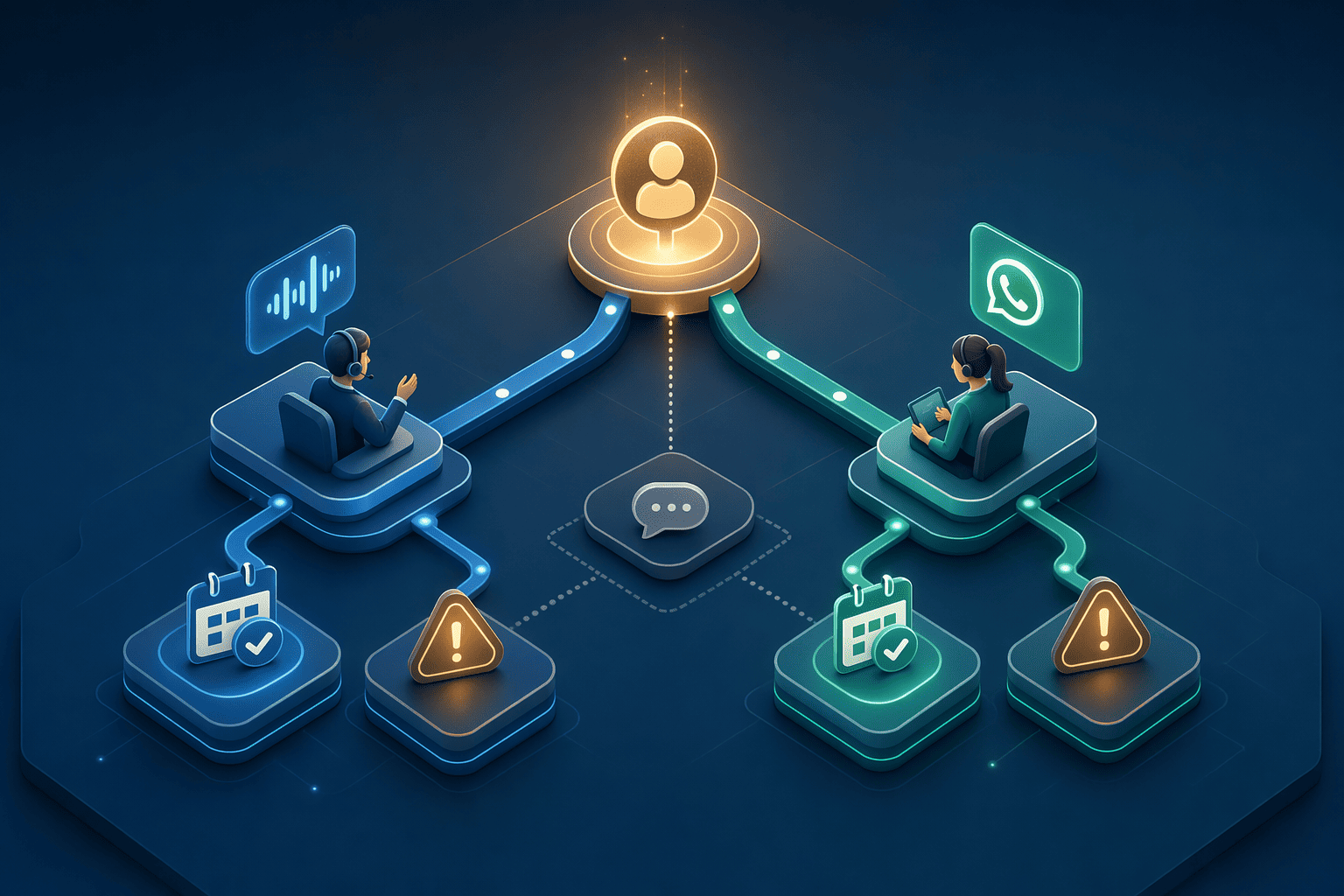
Conversation state synchronization across channels
Real-time context sharing prevents customers from repeating information when they switch from WhatsApp to voice mid-conversation. The system must detect duplicate conversations instantly, if the customer starts on WhatsApp, then calls in, the voice agent retrieves the chat history before the first greeting. Agent handoff logic routes high-intent signals to human reps with full context, not a cold transfer. Without this sync layer, parallel deployment degrades into fragmented experiences.
Cost comparison: WhatsApp message costs vs voice minute costs vs CRM seat costs
WhatsApp messages run ~$0.005, $0.02 per message (low), voice minutes cost ~$0.05, $0.15 per minute (medium), and CRM seats range $50, $150 per user monthly (high). Parallel deployment incurs both WhatsApp and voice costs simultaneously for every conversation, roughly doubling operational spend per interaction. For workflows under 100 conversations monthly or single-channel customer bases, the 2 to 3× cost increase delivers no ROI, stick to sequential escalation instead.
Auto-routing eliminates manual channel selection by learning customer preferences from conversation history, then defaulting to the channel each customer uses most effectively.
Auto-routing by customer preference: technical implementation
Preference detection: historical data vs explicit selection
Auto-routing systems learn customer channel preference through two paths. The historical approach analyzes past interactions, the system reviews the last 10 conversations, identifies the most-used channel (WhatsApp vs voice), and routes accordingly. The explicit selection model presents a menu at conversation start, letting customers choose their preferred channel upfront. Historical detection works best for returning customers with established patterns; explicit selection serves first-time users or those with situational needs.
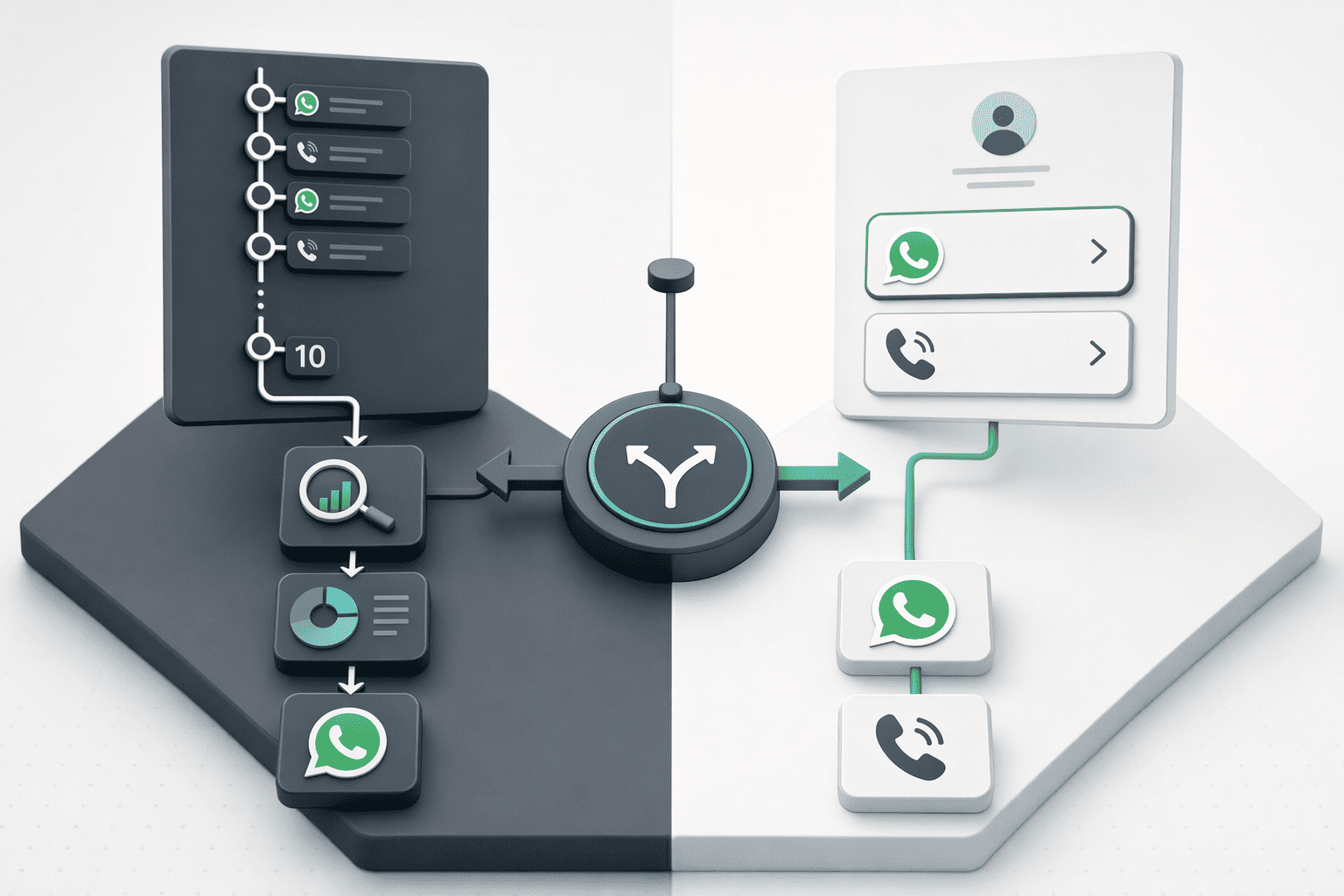
Routing rules and fallback logic
The decision framework maps four scenarios: (1) preference history available → route to preferred channel, (2) no history + high-value intent → default to voice, (3) no history + transactional intent → default to WhatsApp, (4) preferred channel unavailable → fallback with notification. Ithy's call abandonment research shows voice channels exhibit higher abandonment risk when wait times exceed tolerance, if a customer segment shows elevated abandonment patterns on voice, auto-routing defaults to WhatsApp to preserve engagement.
Human escalation triggers: sentiment thresholds and compliance boundaries
AI agents hand off to humans when conversation clarity or sentiment crosses channel-specific thresholds. Oracle's customer experience research on hang-up frustration underscores the need for context-preserving handoffs. EchoLeads' AI customer care agents configure handoff triggers based on conversation keywords, sentiment scores, or explicit prospect requests. Voice escalation triggers faster due to real-time nature: negative sentiment score below threshold or 3+ unanswered customer questions immediately route to human agents. WhatsApp tolerates longer AI engagement before handoff, as asynchronous messaging allows customers to step away without frustration.
Before deploying any orchestration pattern, businesses operating in India must navigate four compliance frameworks that govern commercial messaging and voice outreach.
Compliance checkpoints: DLT, DPDP, TRAI, and Meta policies
DLT registration for voice deployments in India
India's Distributed Ledger Technology (DLT) portal mandates registration for all commercial voice outreach. The five-step process:
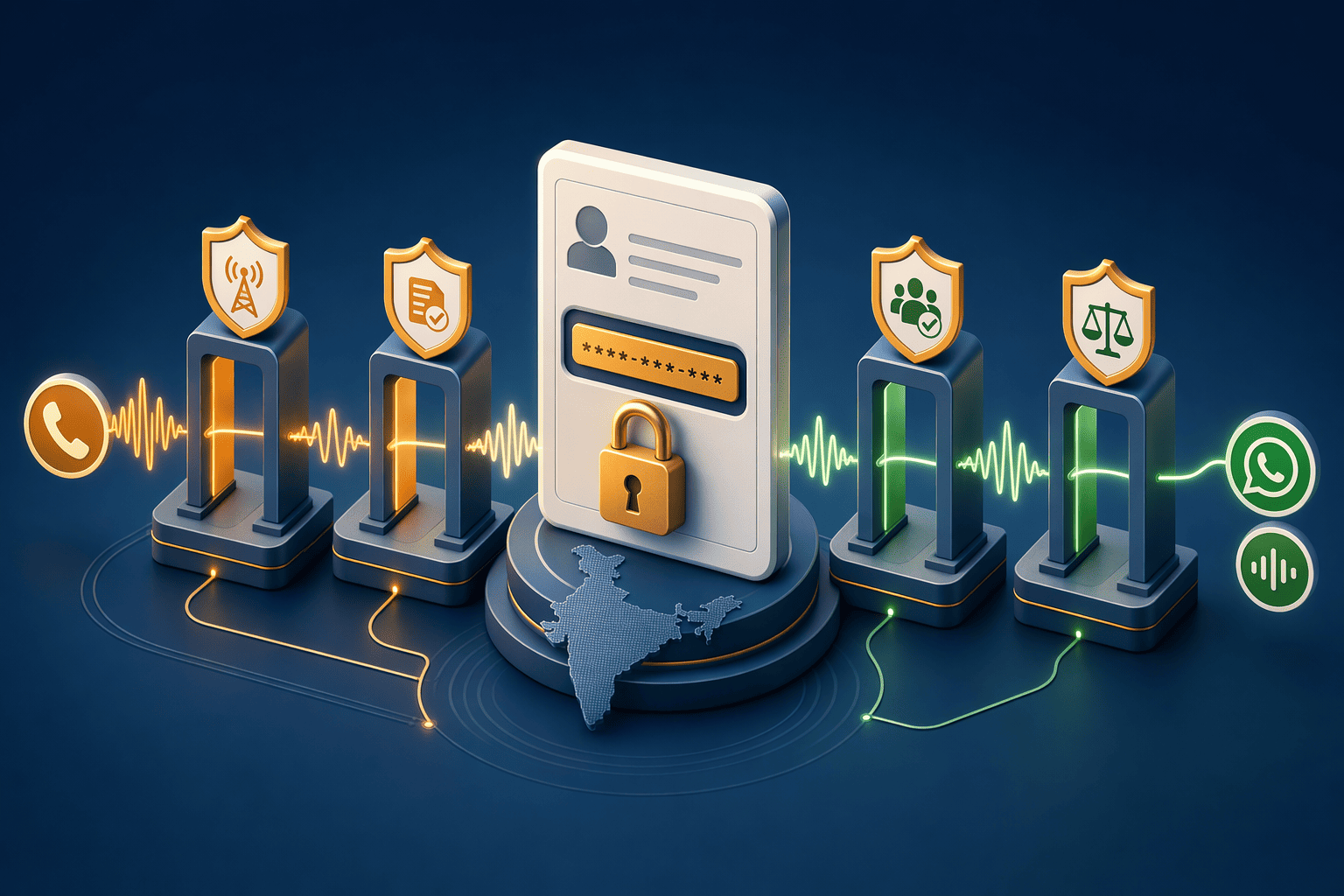
Register your entity on the DLT portal (requires business registration documents)
Obtain an entity ID (unique identifier for your organization)
Register as a telemarketer (separate application within the portal)
Create a header/sender ID (displayed to call recipients)
Register message templates and obtain template IDs (required before initiating calls)
Each template ID corresponds to a specific call script or message type. Voice agents must reference valid template IDs in every outbound call session to remain compliant.
DPDP consent workflows for orchestrated deployments
When conversations span WhatsApp and voice, consent scope must cover both modalities. Single-channel consent ("I agree to WhatsApp messages") is insufficient when the workflow may escalate to voice calls. Organizations should consult legal counsel before deployment to ensure consent language explicitly covers WhatsApp messaging and voice call recording as distinct processing activities under DPDP.
Meta messaging policies and TRAI call recording compliance
Meta's Business Platform allows proactive messaging within 24 hours of a customer reply (no additional consent required). TRAI, however, requires explicit call recording consent before voice call initiation, a separate consent event. Karnataka High Court rulings impose stricter disclosure language for call recording; most vendor documentation lacks Karnataka-specific workflows. Consult local legal counsel for state-specific compliance before deploying voice agents in Karnataka.
Compliance readiness sets the legal foundation, but technical integration determines whether your orchestration system can actually share context between channels in real time.
Integration requirements: CRM sync, telephony APIs, and messaging templates
CRM bi-directional sync setup
Obtain CRM API credentials, Salesforce, HubSpot, or Zoho admin console access.
Configure webhook endpoints, point to your AI platform's real-time ingestion URL for live updates.
Map conversation fields, transcript, sentiment, resolution status to CRM contact/ticket fields.
Test bi-directional sync, run sample conversation; verify CRM record updates in <3 seconds.
Telephony API integration options
Multi-vendor approach (Salesforce CRM + Twilio telephony + Meta WhatsApp API) offers best-of-breed flexibility but requires separate integrations. Unified platforms like Vapi, ElevenLabs, and EchoLeads consolidate CRM, telephony, and messaging in one integration, reducing setup complexity but limiting vendor choice.
WhatsApp messaging template approval timeline
Submit templates via Meta Business Manager. Meta reviews within 24 to 48 hours for policy compliance. Approved templates are usable immediately; rejected templates require edits and resubmission. Platforms like EchoLeads handle template compliance automatically, reducing manual policy overhead.
With orchestration patterns, compliance checkpoints, and integration architecture mapped, the final planning variable is deployment timeline, which varies from days to months based on infrastructure prerequisites.
Deployment timeline: what to expect in the first 90 days
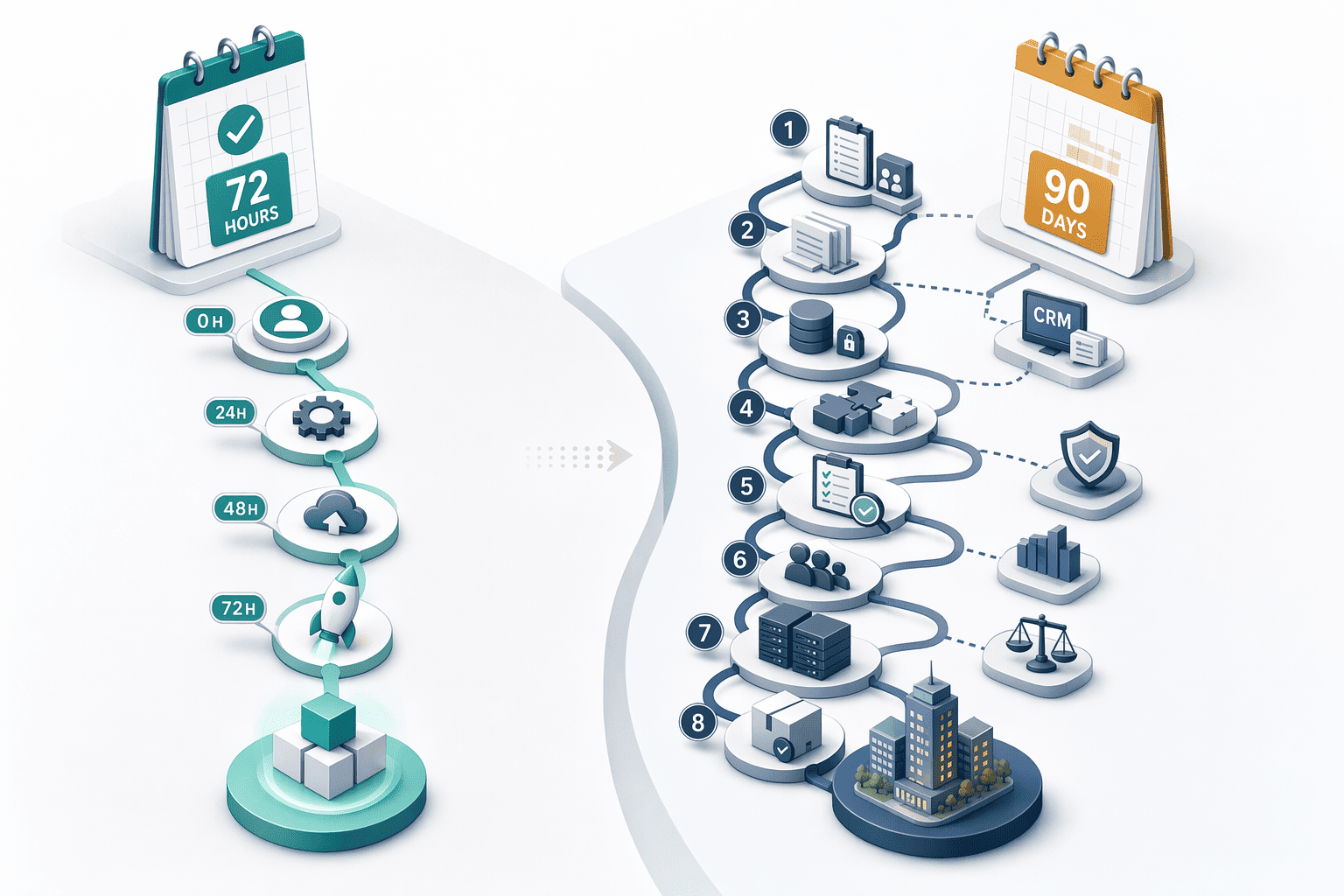
Voice AI deployment timelines vary widely based on infrastructure readiness and integration complexity. Modern platforms like EchoLeads can launch template-based agents in 72 hours, while enterprise rollouts requiring multi-region compliance and custom CRM mapping often span 90 days. The difference hinges on three factors: existing telephony infrastructure, pre-approved messaging templates, and the depth of backend system integration required.
72-hour quick-start with pre-built templates
EchoLeads deploys in 72 hours using industry-specific templates for real estate, insurance, e-commerce, and B2B SaaS. This timeline assumes WhatsApp Business API approval is already complete, your CRM is a standard platform (Salesforce or HubSpot), message templates are pre-approved, and deployment is single-region (no multi-state DLT registration). The platform's 100+ pre-configured workflows handle common scenarios out-of-the-box, eliminating custom conversation design for initial launch.
30-day custom integration timeline
Custom CRM mapping, telephony provider onboarding, and template creation extend deployment to 30 days. Weeks 1-2 focus on CRM field mapping and data schema alignment. Weeks 3-4 cover telephony provider integration and number provisioning. The final two weeks handle custom conversation flow design, template submission to Meta, and internal team training. This path suits businesses with unique qualification logic or non-standard backend systems that can't adopt pre-built templates.
90-day enterprise rollout with compliance audits
Multi-region enterprises requiring compliance audits and phased channel activation follow this timeline:
Weeks 1-2: DLT registration across regions, India's DLT system requires separate registration for each state where calls originate
Weeks 3-4: WhatsApp template submission and Meta approval, initial templates often require 2-3 revision cycles
Weeks 5-6: CRM integration and data mapping, custom objects, field validation rules, and bi-directional sync testing
Weeks 7-8: Telephony provider onboarding, SIP trunk configuration, number porting, and load testing for concurrent call handling
Weeks 9-10: Compliance audit and legal review, especially critical for financial services and healthcare workflows
Weeks 11-12: Phased channel activation and load testing, launch one channel at a time to validate end-to-end workflows before scaling
The 90-day path delivers enterprise-grade deployment with full audit trails, but requires dedicated project management and cross-functional coordination. Most teams launching their first voice AI agent should start with the 72-hour template path, then expand to custom integrations once core workflows prove stable.
Conclusion
Template-based platforms like EchoLeads deploy in 72 hours but assume standard CRM and pre-approved WhatsApp templates, while custom integrations take 30 to 90 days to support non-standard CRM architectures and multi-region compliance. Unified platforms reduce integration complexity by bundling CRM sync, telephony, and messaging APIs; multi-vendor approaches offer best-of-breed flexibility but require engineering resources to maintain separate integrations.
Orchestration will become table-stakes for AI customer support as buyers expect smooth channel-switching, vendor differentiation will shift from 'we support WhatsApp and voice' to 'our routing logic preserves context across five or more conversation switches without forcing customers to repeat information.'
Map your current customer conversations by channel (WhatsApp vs voice vs email) this week to identify orchestration opportunities, then explore EchoLeads' pre-built templates or custom integration options based on your CRM and compliance requirements.
Frequently Asked Questions
What is an AI voice agent that works across WhatsApp and phone calls?
An AI voice agent that works across WhatsApp and phone calls is an orchestration system that routes customer conversations between messaging and voice channels based on intent, compliance requirements, and customer preference. The system implements one of four patterns, WhatsApp-first, voice-first, parallel, or auto-routing, to maintain shared conversation context when customers switch channels mid-conversation.
How long does it take to deploy an AI voice agent across WhatsApp and phone calls?
Deployment timelines follow three scenarios: 72-hour quick-start using pre-built templates like EchoLeads for standard CRM and single-region compliance, 30-day custom integration for non-standard CRM architectures and multi-region DLT registration, and 90-day enterprise rollout with compliance audits and multi-vendor API coordination. Timeline depends on WhatsApp API approval status, CRM webhook readiness, and telephony provider onboarding.
What compliance requirements apply to AI voice agents operating in India?
India requires DLT registration (entity ID, header ID, template IDs) for voice outreach, DPDP consent covering both WhatsApp and voice channels, TRAI call recording consent, and Meta messaging policies including template approval and 24-hour conversation windows. When orchestration spans WhatsApp and voice, consent scope must explicitly cover both modalities, consult legal counsel before deployment to ensure proper opt-in language.
When should I use WhatsApp-first vs voice-first orchestration?
Use WhatsApp-first orchestration when your customer base skews younger (18 to 34) or prefers transactional, asynchronous interactions. Use voice-first for high-urgency intent signals like service outages, appointment changes, or enterprise buyers who expect immediate human-like interaction. Customer demographics and intent signals, not vendor preference, determine the optimal pattern.
What is bi-directional CRM sync and why does orchestration require it?
Bi-directional CRM sync shares real-time conversation history between WhatsApp and voice channels so customers don't repeat information when switching channels. When a voice call ends, a webhook fires the conversation summary to your CRM, which triggers a WhatsApp template message; customer replies update the contact record immediately, ensuring the next voice interaction has full context.
How much does it cost to run parallel deployment across WhatsApp and voice?
Parallel deployment incurs both WhatsApp message costs (~$0.005, $0.02 per message) and voice minute costs (~$0.05, $0.15 per minute) simultaneously for every conversation, roughly doubling operational spend per interaction. Add CRM seat costs ($50, $150 per user monthly) for unified platforms. Parallel deployment is cost-justified only for high-value intent where customer lifetime value exceeds $5,000.
What triggers human escalation in orchestrated WhatsApp and voice workflows?
WhatsApp escalates to humans after three or more unanswered customer questions when conversation clarity falls below the safety threshold. Voice escalates faster when sentiment scores drop below preset levels or customers explicitly request human assistance, since hang-up frustration accumulates more quickly on synchronous channels than asynchronous messaging.