
AI Voice Recognition vs Speech Recognition
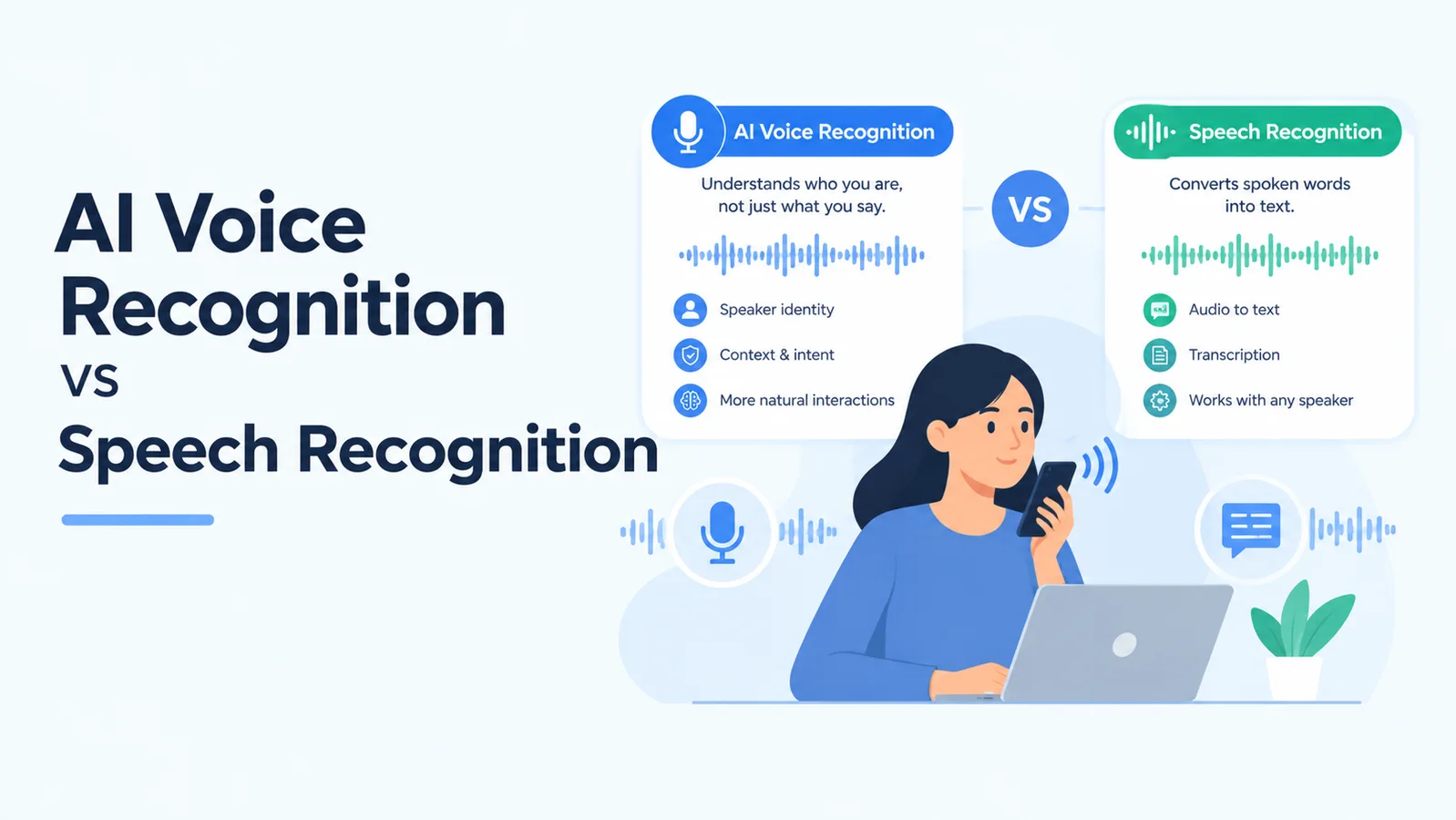
User says a sentence. The system writes it down or acts. This step is almost always written in the language of AI voice recognition products.
In theory, recognizing words and recognizing people are two different problems. Marketing folds them down
Quick Answer Box
Most "AI voice recognition" is speech-to-text (ASR). Speaker recognition identifies who is speaking. Indian English works best with clean audio and is less effective on noisy calls or thick regional accents. Try Google, Sarvam, Deepgram or India contact-centre platforms with your own recordings. An assistant needs intent handling, and a voice to reply.
Difference Between Speech Recognition and Voice Recognition
Term | What it does | Typical use |
Speech recognition (ASR / STT) | Converts spoken words to text | Dictation, captions, voice commands, call transcripts |
Voice recognition / speaker recognition | Identifies or verifies the speaker | Security, personalisation, “who said that” |
Voice biometrics | Speaker verification for authentication | Banking “my voice is my password” style checks |
Ai for voice recognition in search results is usually people looking for the first row. Ai voice dictation app is pure speech recognition. Ai voice companies sell one or both, plus the layers around them.
If a vendor says “voice recognition” and shows a transcript, they mean ASR. If they claim to know it is you from the sound alone, they mean speaker recognition. Ask which one the accuracy number refers to.
How Recognition Fits an Assistant
Capture audio.
Speech recognition turns it into text (streaming for live conversation).
A language layer extracts intent and entities.
Dialog logic decides the next action or reply.
Text-to-speech speaks the answer.
Optional: speaker recognition if you need to know who is talking.
Recognition is necessary. It is not the whole assistant. Latency, barge-in handling and what happens on a failed transcript matter as much as the word error rate on a clean demo.
Best AI Voice Recognition Tools for Indian English Speakers
Major engines work on clean, reasonably neutral Indian English:
Google Cloud Speech-to-Text / Chirp.
Microsoft Azure Speech
Deepgram
OpenAI Whisper (better batch than ultra-low latency)
Assembly AI
performance deteriorates in the presence of heavy regional accent, phone quality audio and code-switching of Hindi and English by the speaker. A 2026 evaluation in the style of “Voice of India” found large gaps. Global models that look strong on multilingual claims can post high error rates on Indian languages and some accents, while India-focused models such as Sarvam ranked at or near the top across many languages and dialects. Google kept on fighting. OpenAI’s transcription models fell well behind on a number of Indian languages, testing showed.
Rule of thumb: if your users are urban professionals speaking Indian English with some code-switching, start with Google or Deepgram and measure. Include India-first engine for base language being Hindi or regional language for tests.
AI Voice Recognition Services with High Accuracy for Regional Accents
Notes: [Independent and vendor notes, 2026]
Sarvam: often ranked high in Hindi, Bengali and other Indian languages in accent and dialect tests.
Google Chirp / Cloud STT: good Indian language coverage and code-switching in multiple comparisons.
India contact-centre specialists (Mihup, Gnani.ai and similar): lower word error rates claimed on real Hindi and Hinglish call audio versus generic cloud engines.
Azure: good enterprise option, good in some languages.
A contact-centre comparison placed Mihup and Gnani in a top tier for real-call Hindi and Hinglish, with global engines good at Indian English but weaker on regional languages and noisy calls. Dravidian languages (Tamil, Telugu etc.) are even more difficult for everybody than Hindi.
“High accuracy” is not a universal number. Word error rate on studio audio is not word error rate on a moving auto with a Bluetooth headset. Demand a test set from your city and your channel.
Top AI Voice Recognition Software for Call Centres in India
Call-centre needs differ from dictation:
Streaming, low latency.
Robustness to noise, compression and crosstalk.
Custom vocabulary (product names, policy numbers).
Speaker diarization (agent versus customer).
Language and code-switch handling.
Options used in India stacks:
Cloud STT (Google, Azure, Deepgram) behind the contact-centre platform.
India voice-AI platforms that bundle recognition tuned on local call audio.
The telephony vendor’s own transcription add-on.
The choice of accent for the reply voice is independent of recognition accuracy, but does affect whether the caller continues. In fact, for many consumer segments, an English voice with an Indian accent or matching regional language often beats a foreign-accented English voice on completion.
Listen to recorded calls from your own queues and then believe a brochure WER.
How to Integrate AI Voice Recognition into Mobile Apps
Choose between live commands (streaming) and recording and transcribing (batch)
Choose an API: Google, Azure, Deepgram, Sarvam or a Whisper compatible endpoint.
On iOS / Android: record audio with the platform recorder, stream or upload through the API.
Handle permissions, background restrictions and offline fallback if needed.
Send only what you require. For many apps, simple commands can be recognized on device — which keeps audio off the server.
Explicitly set the language or locale for Indian users and test code-switched phrases.
Return partial results for response. Display for user when confidence is low.
The simplest are dictation apps. A full assistant adds the steps above for intent and TTS. Never send keys to client. Proxy via your server.
What to Measure
Word error rate on your audio, not the vendor’s demo.
Latency to first partial and to final.
Failure rate on names, numbers and your product terms.
Hinglish or regional sample performance.
Cost per minute at your volume.
A model that is 2 points better on clean English and 15 points worse on your actual callers is the wrong model.
Technical & Performance Data Matrix
Use | Engine starting point | Watch-out | India note |
Dictation, clean Indian English | Google, Whisper, Azure | Studio bias | Good enough to test |
Live assistant, low latency | Deepgram, Google streaming | Cost at scale | Pair with dialog layer |
Hindi / Hinglish calls | Sarvam, Google Chirp, India specialists | Noisy WER | Test real calls |
Regional (Tamil, Telugu, etc.) | India-first + Google | Higher error everywhere | Do not trust English-only claims |
Speaker ID | Dedicated biometrics vendor | Not the same as STT | Consent and security review |
Call-centre QA | Batch Whisper or specialist | Diarization quality | Custom vocab |
The matrix is a test plan. Brochure accuracy is not a column.
Code-switching breaks models that expect one language.
Advice vs Strategic Thinking Matrix
Decision | Generic advice | Strategic thinking |
What it is | “AI that hears you” | STT versus speaker ID |
Indian English | Any big cloud | Measure on your accent and channel |
Regional accents | “Supports 100 languages” | Sarvam / Google / specialist on real audio |
Call centre | Turn on transcription | Latency, noise, diarization, vocab |
Mobile | Drop in an SDK | Language setting, partials, key safety |
Assistant | Recognition alone | ASR + intent + dialog + TTS |
Generic advice trusts the language list. Strategic thinking runs a hundred of its own calls through the API.
People Also Ask
Q: What is AI voice recognition?
In common use, systems that turn speech into text or commands. Strictly, voice recognition can also mean identifying the speaker.
Q: How is it different from speech recognition?
Speech recognition converts words to text. Voice/speaker recognition identifies who is speaking. Most products mean the first.
Q: Best tools for Indian English?
Google, Azure, Deepgram and Whisper are reasonable starting points on clean audio. Always test your users.
Q: High accuracy on regional accents?
India-focused models (Sarvam and similar) and Google often outperform generic global models on Hindi and regional languages. Verify on your recordings.
Q: For call centres in India?
Streaming STT with noise handling, custom vocabulary and diarization. Specialist platforms or Google/Deepgram behind your stack. Pilot on real calls.
Q: How do I integrate it in a mobile app?
Use a cloud speech API or on-device engine, handle permissions, set language, show partials, keep keys server-side.
Q: How do I make an AI voice assistant?
Combine speech recognition, intent understanding, dialog logic and text-to-speech. Recognition is only the input step.
Q: Where does EchoLeads.ai fit?
EchoLeads.ai uses voice agents that incorporate speech recognition for calls. it is not a raw speech to text API vendor and does not sell standalone dictation. If you need an engine to embed try google, sarvam, deepgram or similar directly. Use EchoLeads when the job is the whole calling conversation on numbers you have control over.
Contact the EchoLeads.ai team for a voice agent on live calls, not a trans