
Best AI Voice Calling Platforms for Small Businesses on a Budget (2026)
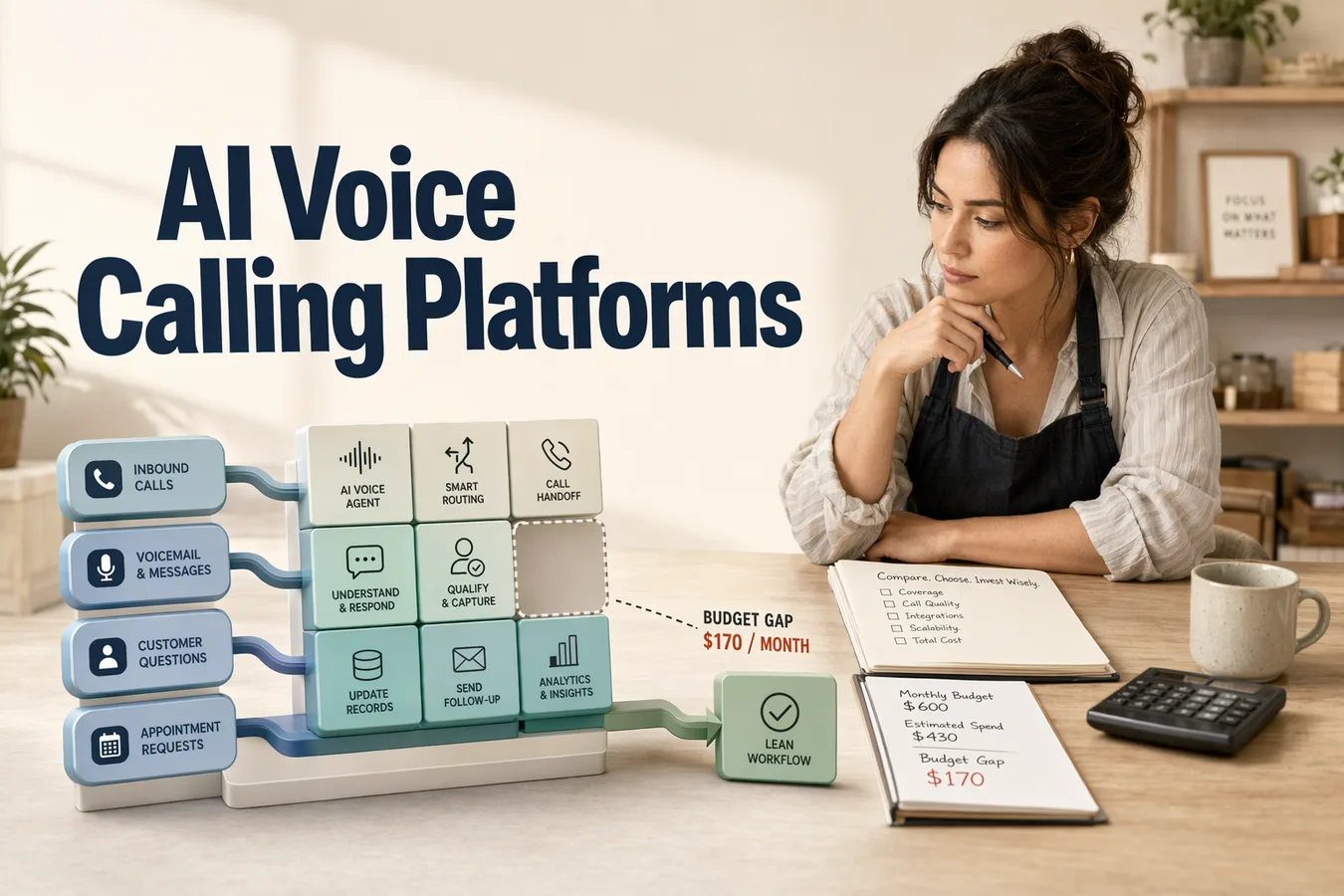
Small businesses juggling tight budgets need AI voice calling platforms that scale with call volume, integrate seamlessly with existing workflows, and deliver natural caller experiences without forcing teams into long-term commitments or flat-rate plans that overshoot their needs.
Key Takeaways
Usage-based pricing models charge per minute ($0.05–$0.15) and work best for teams making fewer than 500 calls monthly, avoiding flat-rate overcommitment.
Sub-800ms voice latency became the 2026 standard for natural caller experience—platforms exceeding 1-2 second delays feel robotic and hurt conversion.
No-code platforms (Synthflow, My AI Front Desk) prioritize speed-to-launch for marketing teams, while developer-first tools (Vapi, Retell AI) offer deeper customization via API configuration.
TCPA compliance safeguards—DNC scrubbing, consent capture, and human escalation—are non-negotiable for outbound AI calling to avoid $500, $1,500 per-violation fines.
The right platform depends on workflow fit across pricing structure, technical capability, CRM integration depth, and compliance safeguards, not popularity rankings.
What Small Businesses Should Look for in an AI Voice Calling Platform
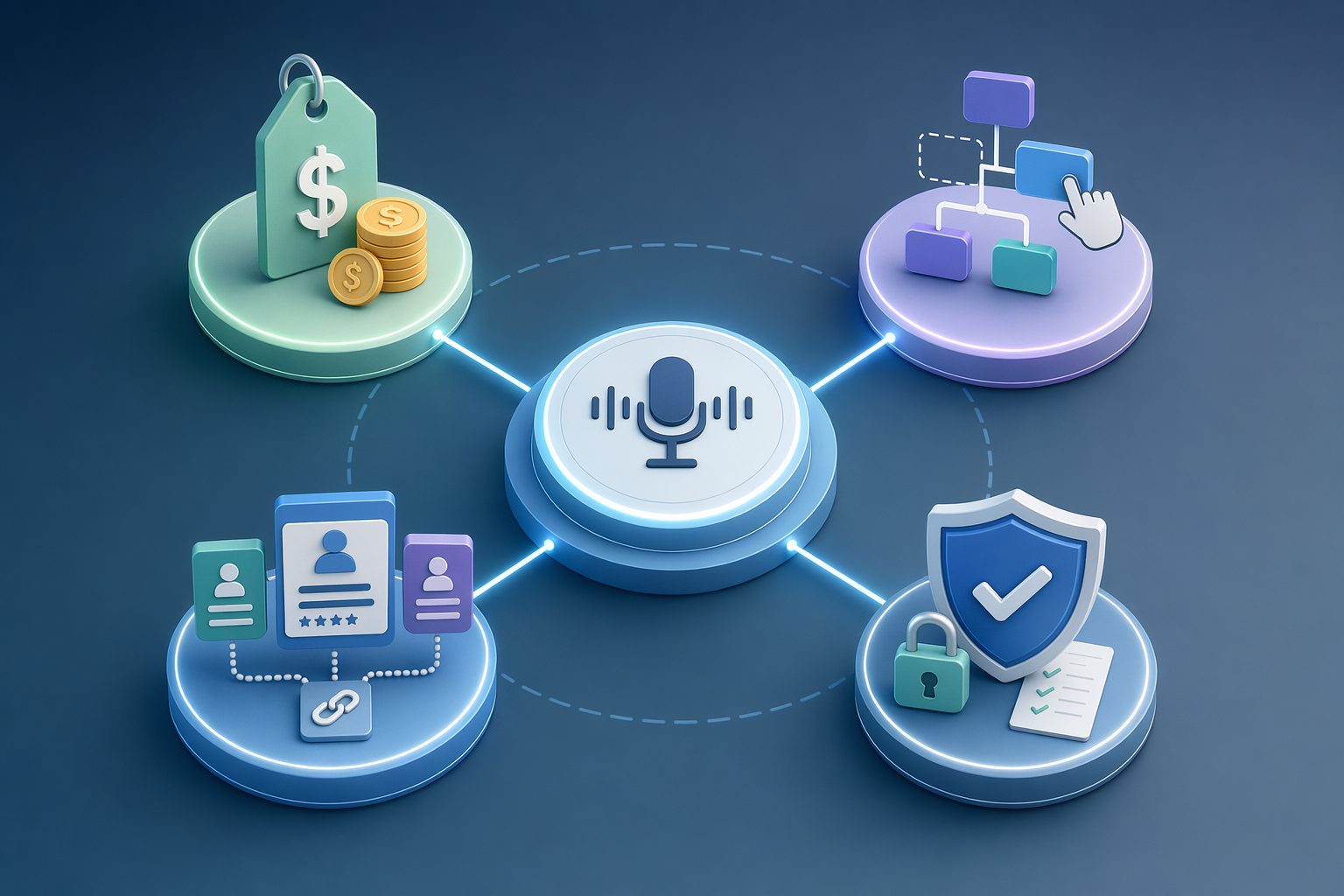
Small businesses evaluating AI voice calling platforms need four decision filters: pricing transparency (usage-based vs. Flat-rate models), no-code setup (drag-and-drop vs. API-first configuration), CRM integration breadth (native connectors vs. Webhook overhead), and compliance safeguards (TCPA/DNC adherence and call-recording consent). Platforms that obscure these four criteria create hidden costs, technical debt, legal exposure, and sales team friction, that cancel out automation gains.
The core use case for budget-conscious teams is outbound lead qualification and follow-up automation. Research shows that 48% of salespeople never make a single follow-up attempt [1], yet 80% of sales require at least five follow-ups to convert[1], creating a $2.3M annual abandoned-pipeline gap per 50-rep team[1]. AI calling agents handle this repetitive prospecting work 24/7, but only if the platform's pricing, setup friction, and compliance posture align with a small team's constraints.
Pricing Models: Usage-Based vs. Flat-Rate vs. Enterprise Custom
Pricing structure determines total cost at scale. Usage-based models (e.g., $0.05, $0.15 per minute) scale linearly with call volume, teams making 500 outbound qualification calls per month pay ~$25, $75, but costs spike during campaigns. Flat-rate plans ($29, $449/month, as seen with Synthflow) offer predictability but may include hidden per-minute charges beyond bundled allocations. Enterprise custom pricing requires sales conversations and often gates feature access (CRM integrations, multilingual support) behind higher tiers.
Small businesses should verify what's included at the sticker price: are CRM webhooks, voice model selection, and call analytics part of the base plan, or do they inflate the effective cost by 40 to 70%? Platforms that separate "platform access" from "per-connected-call" fees (where you pay only when a recipient answers) offer better cost control than all-inclusive bundles that charge for unanswered dials.
No-Code Setup vs. Developer-First Configuration
No-code platforms (Synthflow, AICaller) use drag-and-drop call-flow builders, pre-built templates, and visual script editors, teams without engineering resources can deploy a lead-qualification agent in hours. Developer-first platforms (Vapi, Bland AI, Retell AI) expose API endpoints for custom conversation logic, voice model swapping, and telephony control, powerful for technical teams but requiring JSON configuration, webhook programming, and latency tuning.
For small businesses, ease of setup directly maps to operationalization cost. A platform that needs a developer to configure conditional branching ("if budget > $10K, route to senior rep") adds 10 to 20 hours of setup time; a visual workflow builder lets a sales ops manager launch the same logic in 90 minutes. The trade-off: no-code tools limit customization depth (fixed question sequences, template-based responses), while API-first platforms require ongoing technical ownership.
CRM Integration and Workflow Fit
CRM data flows matter for lead qualification, platforms that auto-log call outcomes (qualified/not qualified, next-step booked, objection noted) into Salesforce, HubSpot, or Zoho eliminate manual data entry. Platforms supporting 6,000+ apps via Zapier reduce setup friction: a five-person team can connect their CRM, calendar, and email sequencer in one afternoon without custom API work.
Integration breadth is a proxy for SMB setup cost. Platforms with native HubSpot/Salesforce connectors offer bi-directional sync (call data flows into CRM; CRM contact updates trigger follow-up calls). Those requiring custom webhooks add 5 to 10 hours of developer time per integration, acceptable for a 50-person sales org with engineering support, prohibitive for a bootstrapped five-person team.
Compliance Safeguards: TCPA, DNC, and Call Recording Consent
Compliance is a filter, not a feature. AI calling requires adherence to the Telephone Consumer Protection Act (TCPA), National Do Not Call (DNC) registry, and state-level call-recording laws, platforms that omit these safeguards expose small businesses to $500, $1,500 per-violation fines. Verify that the platform: (1) scrubs DNC lists before dialing, (2) plays consent disclosures ("this call may be recorded") at call start, (3) logs opt-out requests automatically, and (4) provides audit trails for compliance reviews.
No comparison table can guarantee legal certainty, buyers must verify per jurisdiction. Platforms marketing "TCPA-compliant calling" should specify which compliance workflows are automated (DNC scrubbing, consent logging) vs. Which require manual setup (state-specific recording notices). The absence of compliance documentation is a red flag: if a platform's help center doesn't explain how it handles opt-outs or two-party consent states, assume compliance is the buyer's responsibility.
With those decision filters in place, the next step is comparing specific platforms across pricing models, integration depth, and use-case alignment.
The right AI voice calling platform is less about popularity and leans more on workflow and use-case fit. Below are seven platforms, six competitors plus EchoLeads, each positioned by the use case it serves best rather than a single 'winner' claim.
Platform Comparison: Pricing, Setup, and Core Features
Platform | Starting Price | Usage Cost | Outbound/Inbound | CRM Integrations | Latency |
|---|---|---|---|---|---|
EchoLeads | Usage-based | Scale up or down | Both (phone, WhatsApp, Instagram) | Salesforce, HubSpot, Zoho | Not disclosed |
Bland AI | Pay-per-minute | ~$0.09/min[3] | Outbound-focused | CRM sync | Sub-1-second |
Vapi | Pay-per-minute[2] | ~$0.05–0.10/min[3] | Both (API-first) | Build your own | ~600ms[3] |
Retell AI | Pay-per-minute | ~$0.07–0.15/min[3] | Both (hosted dashboard) | Prompt templates | Sub-1-second |
Synthflow | $29–449/month[2] | ~$0.08–0.13/min[3] | Both (no-code) | Zapier, HubSpot, GoHighLevel[2] | Variable |
My AI Front Desk | Flat monthly | Not disclosed | Inbound-only | Limited | Not disclosed |
Goodcall | Flat monthly | Not disclosed | Inbound-only | Minimal | Not disclosed |
Voice latency dropped below 800ms industry-wide in 2026[3], making sub-second response the new threshold for natural caller experience. Platforms using native speech-to-speech architecture, like those with 100ms time-to-first-audio, now handle interruptions mid-sentence without noticeable delay.
Best for Developer-First Teams: Vapi
Vapi is API-first, bring your own LLM, voice model, and telephony layer[3]. It delivers the fastest latency on the market at approximately 600ms[3], but requires engineering resources to configure. Teams without API expertise will find the learning curve steeper than no-code alternatives.
Best for No-Code Users: Synthflow
Synthflow targets agencies and non-technical teams with a drag-and-drop builder and white-label capabilities[2]. Setup completes in 30 to 60 minutes[2], faster than developer-first platforms. The trade-off: voice quality varies across providers, and customization depth is lower than Vapi's API layer.
Best for Flat-Rate Predictability: Bland AI
Bland AI advertises flat per-minute pricing at approximately $0.09/min[3] for outbound sales campaigns. Budget-conscious buyers prefer this model when usage spikes are unpredictable. Strengths include bulk call campaigns and CRM integration[3]; limitations include voice quality that is good but not top-tier.
Best for 24/7 Inbound Call Answering: My AI Front Desk
My AI Front Desk focuses exclusively on inbound call answering and appointment scheduling, it answers after-hours calls, books appointments into schedulers, and handles Tier-1 questions. It is not designed for outbound prospecting or high-volume campaigns, making it less suitable for sales-driven teams.
Best for Small Service Businesses: Goodcall
Goodcall targets local service providers, HVAC, plumbing, auto service, with simple setup and inbound call handling. CRM integration is minimal, and the platform is not built for outbound campaigns or high-volume calling. Best for businesses needing basic after-hours answering without complex workflows.
Best for Usage-Based Scalability: EchoLeads
EchoLeads uses usage-based pricing that scales up or down as needed, serving businesses of all sizes from early-stage startups to international enterprises. Strengths include CRM integrations with Salesforce, HubSpot, and Zoho, plus multi-channel support across phone, WhatsApp, and Instagram. One limitation: the platform requires human escalation for high-intent conversations rather than handling them autonomously end-to-end.
Best for Low-Latency Sales Calls: Retell AI
Retell AI delivers sub-second response time with a polished hosted dashboard that includes prompt templates, call recordings, and analytics[3]. Latency sits below one second, fast enough for natural sales conversations where delays cause prospects to hang up. The platform costs slightly more than Vapi at approximately $0.07 to 0.15/min[3], but onboarding is easier for teams without engineering resources.
Understanding platform capabilities is only half the equation, choosing the right one requires mapping those features to your team's workflow, call volume, and technical resources.
How to Choose the Right Platform for Your Workflow
Match Pricing Model to Your Call Volume
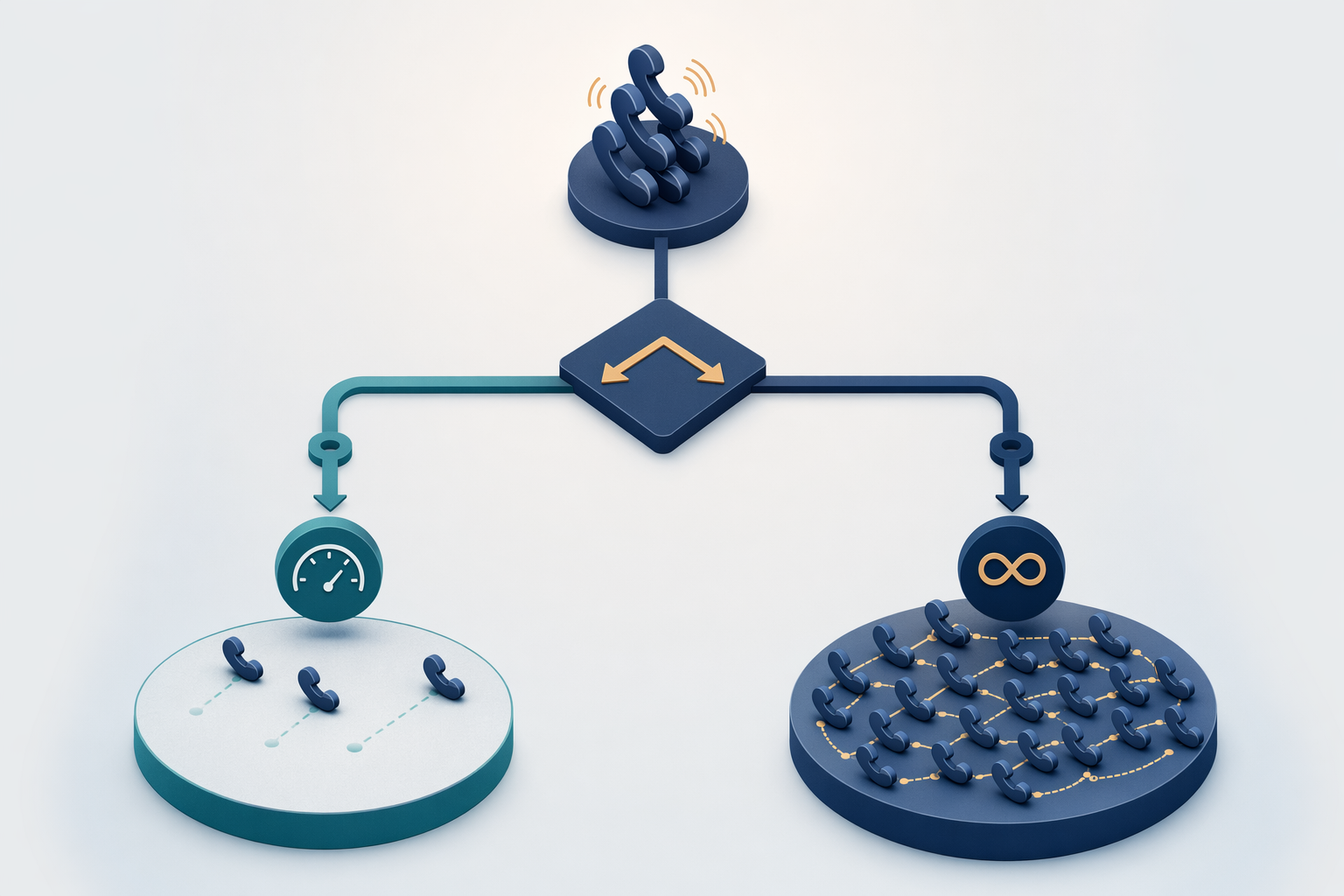
Usage-based pricing works best for teams making fewer than 500 calls monthly, you pay only for connected minutes, avoiding flat-rate overcommitment. EchoLeads offers flat-rate pricing starting at $25/month, while other platforms may use different pricing models. High-volume operations (2,000+ calls monthly) benefit from flat-rate plans, Bland AI's predictable monthly fee eliminates per-call anxiety and simplifies budgeting. Calculate your average monthly call count before committing; startups scaling from 200 to 2,000 calls should start usage-based and switch when overage costs exceed flat-rate thresholds.
Assess Your Team's Technical Resources
Developer-first platforms (Vapi, Retell AI) require API configuration, webhook setup, and custom conversation logic, best suited for teams with engineering support. Marketing-only teams should prioritize no-code builders: Synthflow and My AI Front Desk offer drag-and-drop script editors and pre-built templates that deploy in hours, not weeks. If you lack in-house developers, verify the platform provides visual workflow builders and template libraries before purchase, technical debt from choosing a dev-centric tool without engineering capacity can stall rollout for months.
Prioritize CRM Integration Depth
Integration breadth serves as a proxy for setup friction, platforms supporting 6,000+ apps via Zapier (AICaller, Synthflow) reduce custom-coding requirements [4]. Confirm native connectors for your CRM (Salesforce, HubSpot) exist before purchase; manual data export adds 15 to 30 minutes per day per rep. Bi-directional sync matters: platforms that only push call logs outbound force your team to manually update lead statuses in the calling tool, fragmenting your single source of truth.
Verify Compliance Safeguards Before Launch
Require vendors to confirm DNC scrubbing (automatic removal of do-not-call registrants), call recording consent prompts, and human escalation logging in writing. Platforms without handoff models expose your business to compliance risk and poor caller experience when AI encounters edge cases. No comparison article can guarantee legal certainty, consult your legal team and verify the vendor's compliance documentation covers your jurisdictions (TCPA for U.S., GDPR for EU) before signing.
Developer-first platforms like Vapi and Retell AI deliver deeper customization but require API expertise, no-code tools like Synthflow and My AI Front Desk trade flexibility for faster time-to-launch, making them better for marketing-only teams. Flat-rate pricing offers predictable monthly costs for high-volume teams making 2,000+ calls monthly, while usage-based models save money for teams making fewer than 500 calls but introduce variable cost risk.
As AI voice calling matures, expect latency benchmarks to compress below 100ms and compliance automation, DNC scrubbing, consent capture, to become table-stakes features rather than premium add-ons. Early adopters who prioritize workflow fit over popularity will capture the highest ROI.
Start by documenting your current call volume, team size, and CRM requirements, then test EchoLeads's usage-based pricing to see if scalability fits your workflow better than a flat-rate subscription.
Frequently Asked Questions
What's the difference between usage-based and flat-rate pricing for AI voice calling?
Usage-based pricing charges per minute or call (e.g., $0.05, $0.10) and scales with volume, ideal for teams making fewer than 500 calls monthly [4]. Flat-rate pricing offers predictable monthly costs (e.g., $34/month) and works better for high-volume teams making 2,000+ calls monthly, avoiding per-minute cost uncertainty.
How fast should an AI voice agent respond during a call?
Sub-800ms response became the 2026 threshold for natural caller experience [3]. Platforms with 100ms time-to-first-audio handle interruptions mid-sentence without noticeable delay, while 1-2 second latency feels robotic and hurts conversion. Look for benchmarks between 600-800ms [2] to ensure conversational flow.
Do I need TCPA compliance for outbound AI calling?
Yes, AI calling requires adherence to TCPA, DNC lists, and state-level call recording consent laws [1]. Platforms that omit DNC scrubbing, consent capture, or human escalation logging expose businesses to $500, $1,500 per-violation fines. Verify compliance safeguards with the vendor in writing before launch.
When should AI escalate to a human agent?
High-intent or emotionally charged conversations should move to a human quickly [4]. AI handles repetitive lead qualification and appointment setting, but closing high-value deals or addressing sensitive concerns requires human judgment. Platforms without handoff models expose businesses to compliance risk and poor caller experience.
Do these platforms support languages other than English?
Some do, platforms like Ringg AI and ZENXAI specialize in Indian-language voice agents [4]. General-purpose platforms (Vapi, Bland AI) focus on English; if your business serves non-English callers, verify language support with the vendor before purchase to avoid workflow friction.
When should I NOT use AI voice calling?
AI voice agents are not appropriate for emotionally charged conversations, complex negotiations, or situations requiring nuanced human judgment [1]. Use AI for repetitive outbound prospecting and follow-up automation, not for closing high-stakes deals or handling sensitive customer service issues where empathy and context matter.