
AI Voice Calling Agent vs. Customer Support Agent
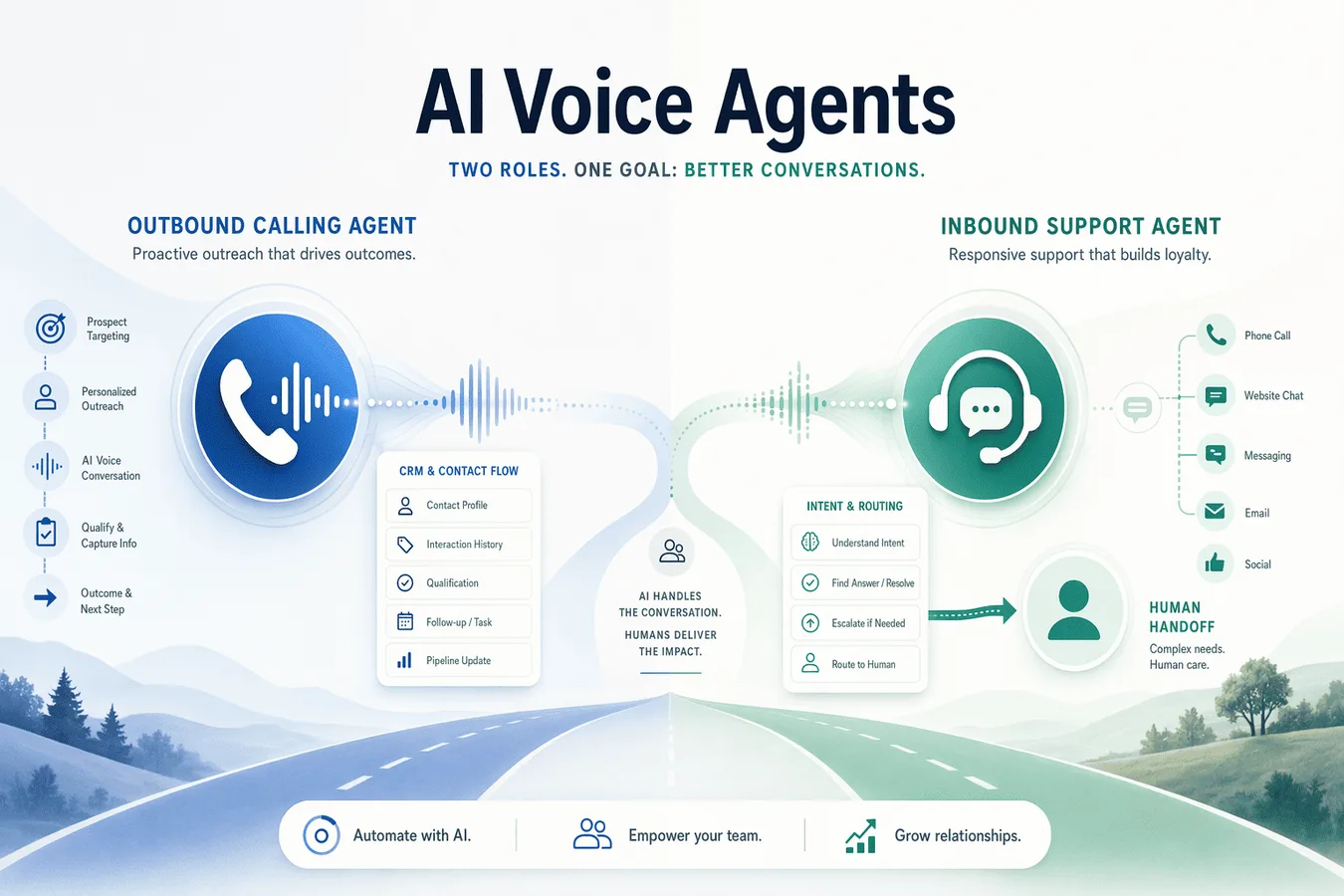
AI voice agents automate phone conversations, but not all agents serve the same purpose. Calling agents initiate outbound prospecting, while support agents respond to inbound requests.
Understanding the functional difference between these agent types shapes how you deploy them, integrate with CRM, and configure human handoff workflows.
Key Takeaways
AI voice calling agents handle proactive outbound workflows—lead qualification, appointment booking, and follow-up sequences—initiating contact with prospects.
Customer support agents handle reactive inbound workflows—troubleshooting, order tracking, and account help, responding to customer-initiated requests.
Calling agents escalate on low confidence, pricing negotiation, or complex comparisons; support agents escalate on fraud, disputes, or emotionally charged scenarios.
CRM integration patterns differ: calling agents sync qualification scores bi-directionally in real time, while support agents update ticket status event-triggered after resolution.
Platforms like EchoLeads support both agent types within a single deployment, unifying CRM sync and human handoff workflows across outbound and inbound use cases.
What Is an AI Voice Calling Agent?
An AI voice calling agent is software that initiates and conducts phone conversations autonomously, handling proactive outbound workflows like lead qualification, appointment booking, and follow-up sequences. Unlike customer support agents that wait for inbound requests, calling agents reach out to prospects first, dialing leads, asking qualifying questions, and scheduling next steps without human involvement. Platforms like TaskVox illustrate this category: they deploy intelligent voice agents that make outbound calls across multiple languages, automating lead generation and appointment scheduling around the clock.
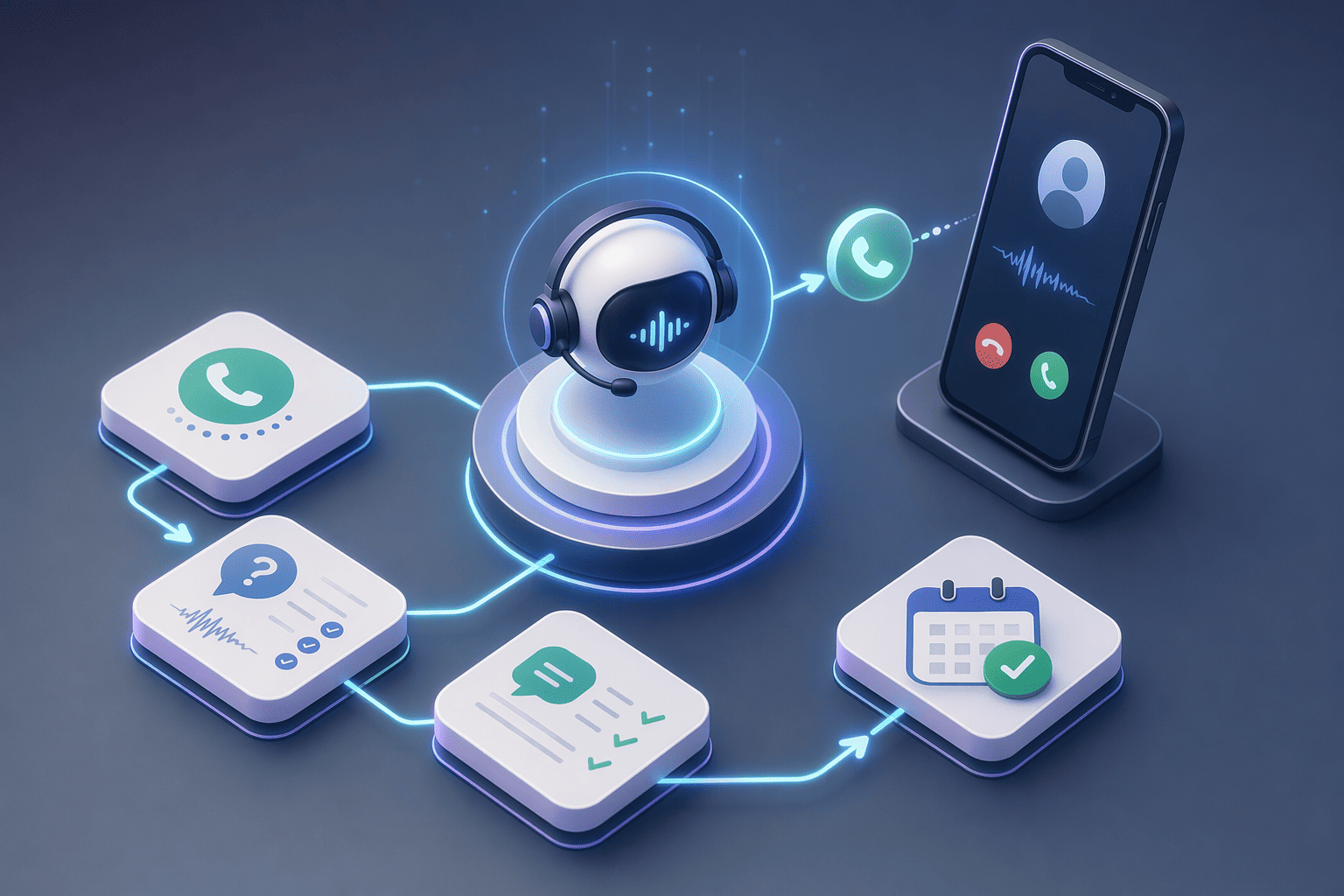
Primary Job: Proactive Outbound Workflows
Calling agents specialize in workflows where the business initiates contact. Lead qualification means the agent phones prospects from a list, asks structured questions about budget and timeline, and scores each conversation. Appointment booking involves calling a lead to propose meeting slots, check calendar availability, and confirm the booking in real time. Follow-up sequences trigger automated callbacks when a prospect requests more information or misses an appointment. These workflows depend on the agent taking the first step, dialing out rather than picking up an inbound call. EchoLeads supports this model, as do other platforms that focus on sales outreach.
How Calling Agents Initiate Customer Conversations
The core distinction is who starts the interaction. A calling agent dials a prospect's number, delivers an opening script, and moves through a decision tree based on the prospect's answers, proactive initiation. A customer support agent waits for a ticket, chat message, or inbound call, then responds, reactive response. Both may use natural language processing and integrate with CRM systems, but the job-to-be-done differs: one generates new conversations, the other resolves existing issues. This difference shapes architecture, compliance obligations (outbound calling regulations are stricter), and success metrics (conversion rate versus first-call resolution).
While calling agents reach out to prospects, support agents wait for the phone to ring. The next section defines the reactive workflows that distinguish support agents from their outbound counterparts.
What Is an AI Customer Support Agent?
An AI customer support agent handles reactive inbound workflows, troubleshooting, account inquiries, post-purchase help, responding to customer-initiated contact rather than initiating conversations. These agents wait for an incoming ticket, phone call, or chat message before engaging, focusing on resolution speed and first-contact accuracy.
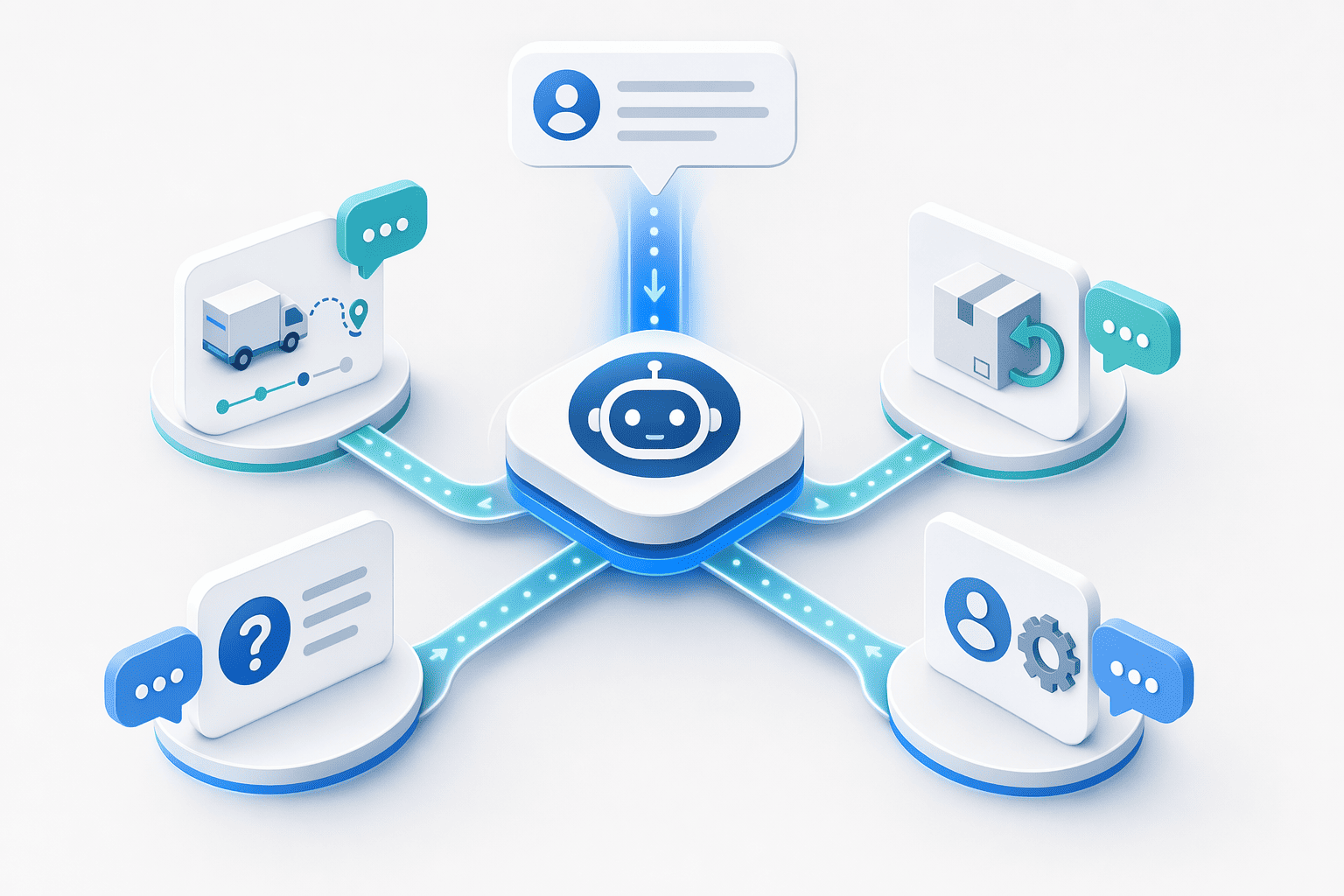
Primary Job: Reactive Inbound Workflows
Support agents answer customer-initiated requests: order tracking, return processing, FAQ resolution, and account troubleshooting. Platforms like Voicory deploy AI support agents for Hindi and English phone calls, while ecommerce chatbot tools handle product questions and instant responses across web and messaging channels. EchoLeads supports both inbound and outbound use cases, deploying AI voice agents that answer every inbound call within 3 seconds.
How Support Agents Respond to Customer-Initiated Contact
The trigger is always inbound: a phone call, chat widget message, or support ticket. The agent's role is to diagnose the issue, provide resolution steps, and escalate to human agents when complexity exceeds safe autonomy thresholds. Contrast this with outbound calling agents, which initiate conversations to schedule demos or qualify leads, support agents never cold-call prospects.
The distinction between calling and support agents becomes operational when you examine workflow direction, escalation triggers, and data flow. The following section breaks down how these agents diverge across four core dimensions.
Key Differences: Calling Agent vs. Support Agent
AI voice calling agents and customer support agents serve distinct roles in the customer journey, and their core workflows differ in direction, job-to-be-done, escalation logic, and data flow. While both use conversational AI to handle phone-based interactions, the structural gap between them, and how platforms bridge it, shapes deployment success.
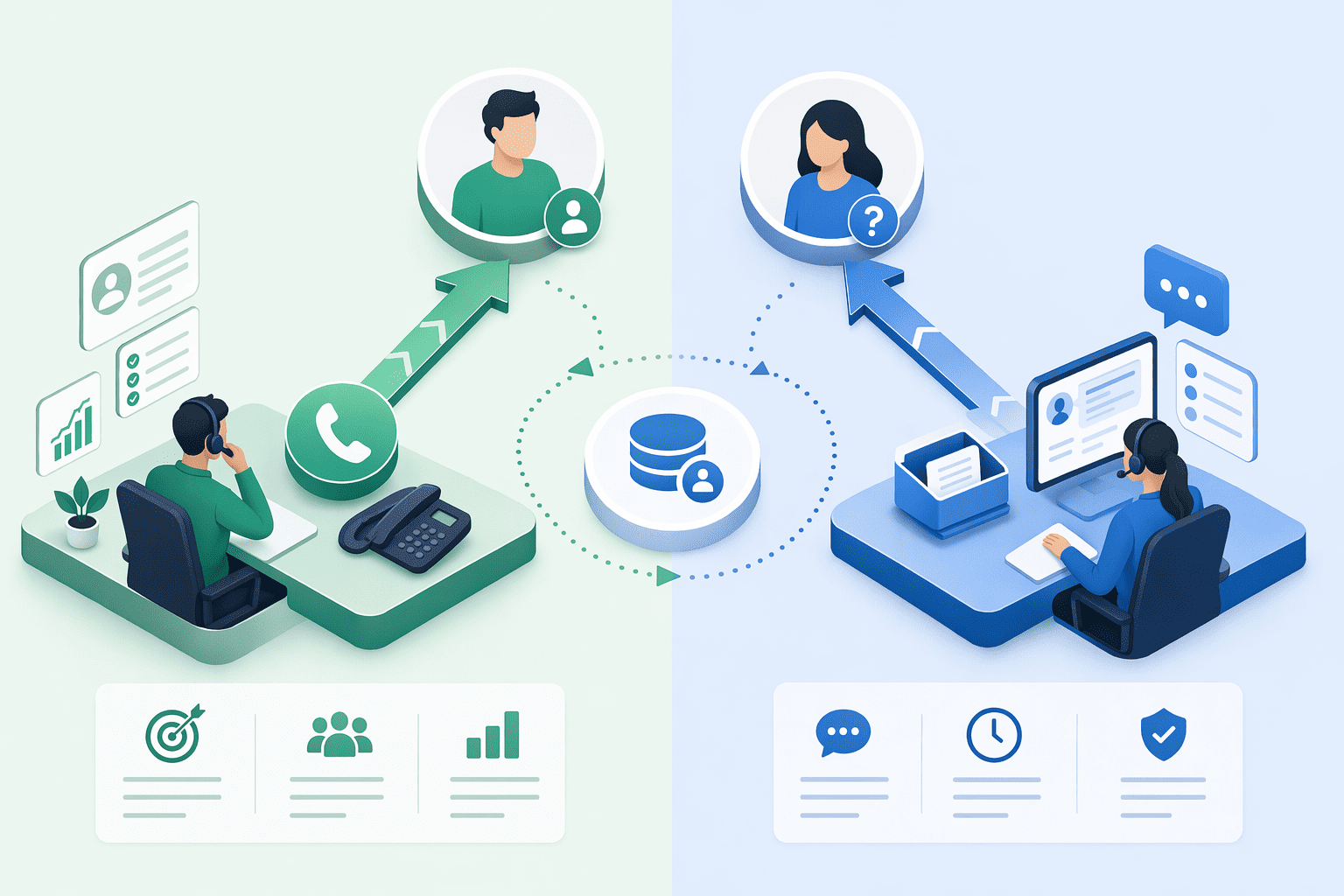
Direction: Outbound vs. Inbound
The foundational difference is workflow direction. Calling agents initiate proactive outbound campaigns, dialing leads, qualifying prospects, and booking appointments before a customer reaches out. Support agents, by contrast, respond to inbound requests: answering calls, triaging tickets, and troubleshooting issues raised by existing customers. Platforms like Bolna AI support both directions by powering thousands of inbound and outbound calls every minute with multilingual intelligence, enabling enterprises to deploy a single voice AI stack across use cases.
Primary Job-to-Be-Done Comparison
Calling agents focus on lead qualification and appointment booking, asking structured questions about budget, timeline, and decision-maker access, then scheduling demos or site visits directly into a CRM calendar. Their success metric is conversion: how many prospects move into the pipeline. Support agents, meanwhile, handle ticket resolution and troubleshooting, verifying account details, diagnosing technical issues, processing returns, or escalating complex disputes to human staff. Their success metric is resolution rate and customer satisfaction (CSAT). In practice, calling agents are often used to convert interest into action, while support agents are typically designed to close open issues, and resources such as EchoLeads' agent comparison resource can help illustrate how conversational AI platforms configure agents for these distinct jobs.
Comparison Table: Four Key Dimensions
Dimension | AI Voice Calling Agent | AI Customer Support Agent | Example Use Case |
|---|---|---|---|
Direction | Outbound: proactively initiates contact with leads | Inbound: responds to customer-initiated calls or tickets | Retell AI (outbound campaigns), Salesforce Service Cloud Voice (inbound support queues) |
Primary Job | Lead qualification, appointment booking, demo scheduling | Ticket resolution, troubleshooting, FAQs, returns/refunds | Expeed AI Voice Agent (qualify & book), AwazIndia.ai (customer care) |
Escalation Triggers | Calling agents escalate when confidence falls below preset thresholds, when customers request pricing negotiation, or when multi-product comparisons exceed the agent's decision tree | Support agents escalate on fraud accusations, identity verification failures, disputes, emotionally charged conversations, and non-standard scenarios | EchoLeads configures handoff triggers based on conversation keywords, sentiment scores, or explicit prospect requests |
CRM Data Flow | Writes qualification scores, next-step recommendations, and booked meeting details into CRM records in real time | Updates ticket status, resolution notes, and customer sentiment; may create follow-up tasks for human agents | Platforms like EchoLeads offer bi-directional sync, writing back conversation transcripts and next-step recommendations without manual data entry |
This four-dimension table clarifies the structural distinction the user query asks for: calling agents create pipeline, support agents preserve satisfaction. Enterprises that deploy both agent types on a unified platform, leveraging shared language models, CRM integrations, and escalation logic, gain the flexibility to automate the full customer lifecycle without channel silos.
Beyond workflow direction, the way each agent type connects to your CRM determines how sales and support teams act on AI-generated insights. The integration patterns differ in sync frequency, data structure, and update triggers.
How CRM Integration Differs Between Agent Types
Calling Agent CRM Data Flow: Bi-Directional Sync
Calling agents execute a four-step bi-directional CRM integration workflow:
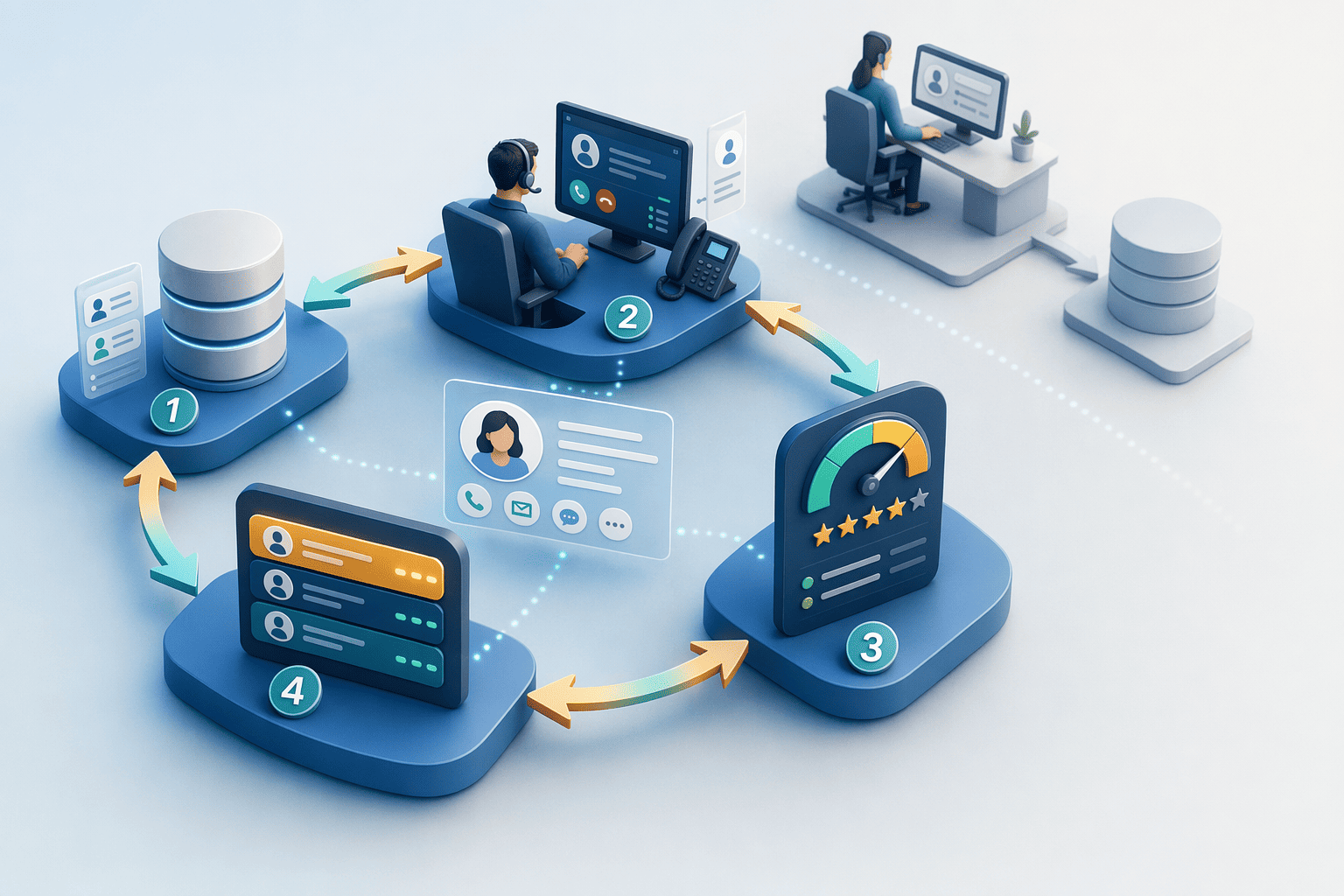
Read lead data from CRM, agent pulls contact details, qualification history, and prior touchpoints before initiating the call
Qualify lead via conversation, agent scores the prospect using budget, timeline, decision-making authority, and buying intent signals
Write qualification score to CRM, platforms like EchoLeads write back qualification scores, call transcripts, and next-action flags in real time
Trigger next-action workflow, CRM routes qualified leads to sales reps or schedules follow-ups automatically
This bi-directional flow enables sales teams to access real-time qualification scores and prioritize high-intent prospects immediately.
Support Agent CRM Data Flow: Ticket-Update Sync
Support agents execute a three-step one-directional or event-triggered sync pattern:
Receive inbound ticket, agent pulls the ticket details and customer account history when the call begins
Resolve issue, agent handles the inquiry, answers questions, or escalates to a human representative when necessary
Update ticket status in CRM, agent writes resolution notes, sentiment flags, and closure status back to the CRM system post-call
Support agents rarely write qualification scores because their objective is resolution, not pipeline progression. CRM updates occur after the interaction rather than in real time, and most platforms update ticket status, resolution notes, and sentiment flags event-triggered rather than continuously.
Conclusion
Single-use platforms specialize in either calling (outbound) or support (inbound) workflows, delivering depth in one area but requiring separate integrations for teams running both. Multi-use platforms like EchoLeads handle both agent types with shared CRM integration and human handoff logic, reducing operational complexity. API-first tools suit engineering teams building custom escalation rules; dashboard platforms like EchoLeads suit go-to-market teams who need pre-built workflows without engineering dependencies.
As AI voice agent adoption accelerates in 2026, the distinction between calling and support workflows will sharpen, enterprises will deploy purpose-built agents for each job-to-be-done rather than generic 'voice assistants,' driving demand for platforms that handle both agent types with unified CRM sync and human oversight.
Explore EchoLeads's platform to see how both calling and support agent workflows operate with bi-directional CRM sync and human handoff logic in a single deployment.
Frequently Asked Questions
What is the main difference between an AI voice calling agent and a customer support agent?
AI voice calling agents handle proactive outbound workflows like lead qualification and appointment booking, initiating conversations with prospects. Customer support agents handle reactive inbound workflows, troubleshooting, ticket resolution, and post-purchase help, responding to customer-initiated contact rather than starting the conversation.
When do AI voice calling agents escalate to humans?
Calling agents escalate when confidence scores fall below preset thresholds, when customers request pricing negotiation, or when multi-product comparisons exceed the agent's decision tree. These triggers ensure complex deal conversations transfer to sales reps equipped to close.
When do AI customer support agents escalate to humans?
Support agents escalate on fraud accusations, identity verification failures, disputes, and emotionally charged conversations. Voice agents should not handle fraud, disputes, or emotionally charged scenarios autonomously; human oversight remains key for high-stakes interactions.
How does CRM integration differ between calling agents and support agents?
Calling agents write qualification scores, call recordings, and next-action flags bi-directionally to CRM in real time. Support agents update ticket status, resolution notes, and sentiment flags in one-directional or event-triggered sync after the interaction concludes, focusing on resolution rather than pipeline progression.
Can the same AI voice platform handle both calling and support agents?
Yes, platforms like EchoLeads support both outbound calling and inbound support workflows within a single deployment. The agent type depends on workflow configuration (proactive vs. Reactive) and dynamic branching logic, not separate products.
Do AI voice agents operate 24/7 for both calling and support workflows?
Both agent types operate 24/7, but human handoff models differ. Calling agents transfer to sales reps for deal closure during business hours; support agents transfer to specialist teams for complex troubleshooting, ensuring around-the-clock coverage with expert escalation paths.
Which agent type should I use for lead qualification?
Use AI voice calling agents for lead qualification. They handle proactive outbound workflows, ask structured questions about budget and timeline, and write qualification scores bi-directionally to CRM. Platforms like EchoLeads offer pre-built qualification workflows with dynamic branching.
Related articles
6 Best AI Outbound Calling Solutions for Loan Verification
Compare AI outbound calling platforms that verify loan applications 24/7
5 Common Causes of Long Bank Loan Inquiry Call Wait Times
Why do bank customers complain about long wait times for loan inquiry calls? Learn the 5 Common Causes of Long Bank Loan Inquiry Call Wait Times.
4 Best AI Voice Lead Qualification Tools for Insurance
Compare AI voice platforms for insurance lead qualification through automated outbound calls.