
Direct Inward Dialing: How It Works and Setup
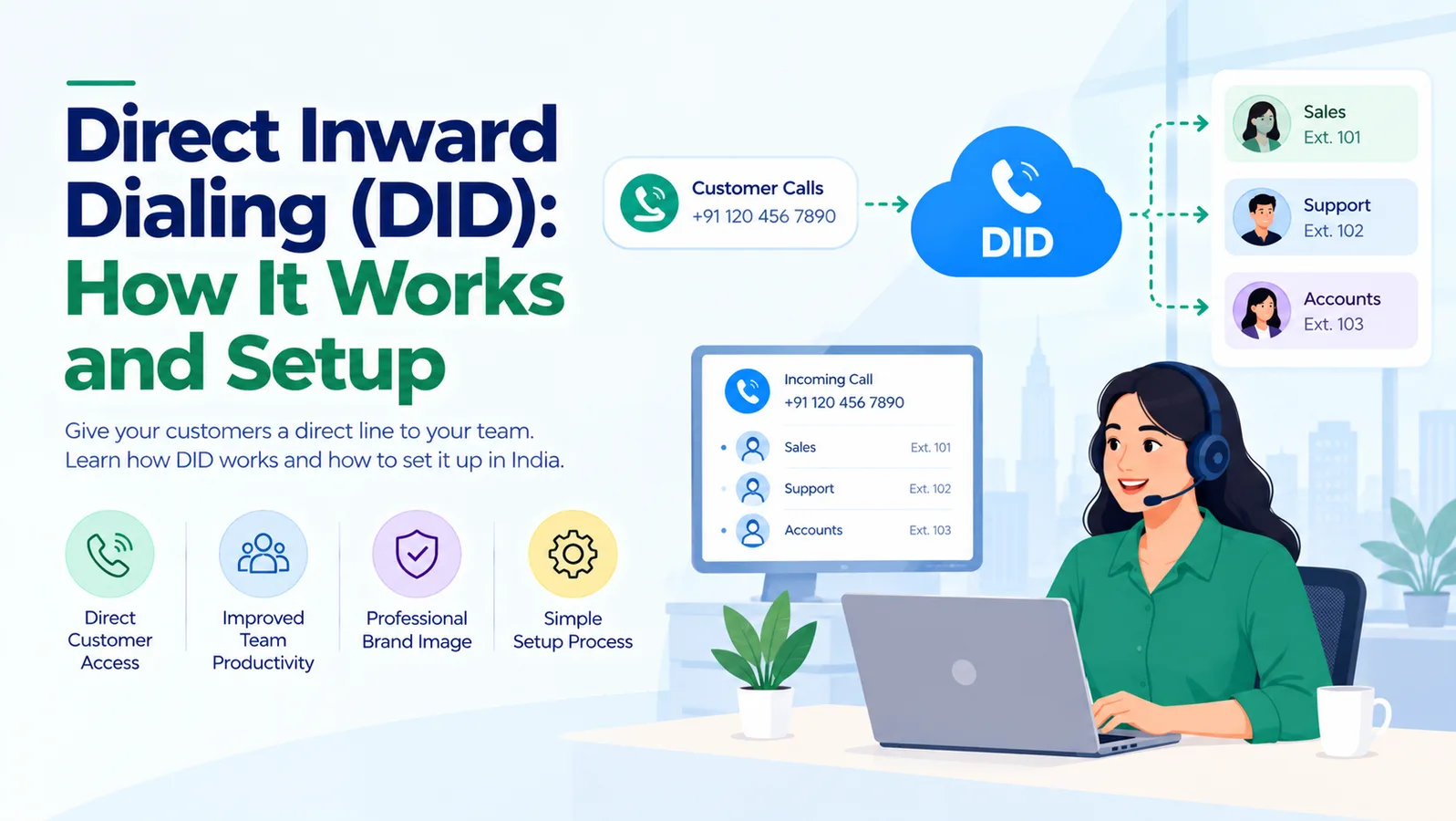
The customer wants the accounts team, not a menu. Direct inward dialing is the feature that gives that team their own number so the call goes straight there.
It is also known as a DID number or in common India usage a virtual landline or virtual number which can be mapped to a person or queue.
Quick Answer Box
DID lets callers dial straight to an extension or department. The provider assigns the number; your phone system routes it. India options include Exotel, Knowlarity, Zoho Voice, Acefone, MyOperator and Tata Smartflo. Setup is KYC plus mapping in the dashboard. International DIDs exist for local presence abroad. Indian numbers still need KYC.
What Is Direct Inward Dialing and How Does It Work?
Direct Inward Dialing (DID) is a telephone service that routes external phone numbers to internal destinations. Instead of all calls ringing a single main number and being transferred, each mapped number rings a specific extension, mobile, queue or IVR path.
A typical example:https://talk.groweasy.ai/feed/guides/virtual-business-number-india
Main company number: 011-4000-0000 (Reception or Main IVR)
Accounts DID: 011-4000-0012 (goes directly to accounts queue).
011-4000-0025 (connects you to the sales team or a specific agent) Sales DID:
How the call goes:
You purchase one or more DID numbers from a provider.
In the phone system (cloud or on-premise PBX) you assign every number to a destination.
A caller calls the DID.
The provider then passes the call to your system.
The system calls the mapped user/queue
or starts the configured IVR.
It works over traditional PSTN or today more common over VoIP/SIP. In India, many cloud platforms consider a virtual landline number as a DID.
The advantages are obvious, fewer transfers, better tracking (who was called), and the ability to advertize department specific numbers.
How Can I Set Up Direct Inward Dialing for My Business Phone System?
Choose a provider that issues Indian numbers (cloud telephony is the usual path for SMBs).
Complete KYC. Typical documents include GST or incorporation papers, PAN, and ID of the authorised signatory. Requirements are similar across Exotel, Knowlarity and others.
Select number type: city landline-style DID (with STD code), 10-digit mobile-style virtual number, or toll-free.
Buy and activate the number(s).
In the provider’s dashboard, map each DID:
To a user or softphone.
To a ring group or queue.
To an IVR that then routes further.
To a mobile number as a simple forward.
Test inbound from an external phone.
Optionally set business hours, voicemail, recording and CRM logging.
If you already have a PBX, the provider may deliver the DIDs as a SIP trunk that you configure on your side. For most small teams the cloud dashboard is enough.
Usually, rentals are charged monthly. Calls (especially outgoing) are billed separately.
Which Telecom Providers in India Offer Direct Inward Dialing Services?
Direct inward dialing providers
Cloud telephony platforms are the practical source for most businesses:
Provider | Typical offer | Notes |
Exotel | Virtual numbers in prepaid packs | Strong APIs, IVR, recording |
Knowlarity | DID / virtual numbers | Often bundled with IVR and routing |
Zoho Voice | Landline-style and mobile-style numbers | Tight if you use Zoho CRM |
Acefone / Servetel | DID included on plans | Seat minimums on some tiers |
MyOperator | Virtual numbers with IVR | Simple for small teams |
Tata Smartflo | DID per licence options | Operator-backed |
Traditional telcos | PRI or SIP with number ranges | For larger on-premise setups |
In a 2026 comparison of virtual business numbers, several of these have published pack prices (Exotel Dabbler-style bundles, MyOperator monthly, Knowlarity annual, Zoho number rental). Verify existing Cards. Landline style DIDs and 10 digit virtual mobiles are common.
These vendors typically provide the number and routing tools as a "Direct inward dialing service." No separate PBX needed for basic use.
Can I Get Direct Inward Dialing Numbers for International Calls in India?
Two different needs:
Indian DID that can receive international calls.
Yes. A standard Indian virtual or landline-style number can be called from outside India. The caller pays international calling rates. It comes to you as a regular inbound in your system. This does not require any special “international DID”.Foreign DID so overseas customers dial a local number in their country.
This is an international DID (like a US or UK number that rings your India team). The global VoIP providers sell these. You still do their KYC. This is not an Indian number, so the Indian TRAI rules for commercial calling only apply when you are making outbound calls from India. The provider’s terms and the rules in that country apply to inbound to the foreign DID.
Some India cloud platforms also resell or interconnect international numbers. If that is what you’re looking for ask for “international DID” or “local presence numbers.” Prices and availability are subject to change by country.
For pure India operations a local city DID or 10 digit virtual number is usually sufficient.
Practical Limits
A DID does not create agents. It only delivers the call.
Recording, CRM pop, and AI answering are extra configuration.
Promotional outbound on these numbers still follows TRAI and DND rules.
Number portability and ownership should be confirmed in the contract if you may switch providers later.
Technical & Performance Data Matrix
Item | What it is | India note |
DID | Number mapped to a destination | Virtual landline or mobile-style |
Routing | Dashboard or PBX rule | User, queue, IVR, forward |
Setup | KYC + purchase + map | GST/PAN/ID typical |
Providers | Cloud telephony platforms | Exotel, Knowlarity, Zoho, etc. |
Inbound international | Works on Indian numbers | Caller pays their rate |
Foreign local presence | Separate international DID | Different KYC and pricing |
Tracking | whaCall logs per number | Useful for campaigns |
The matrix is the buying note. A number without a mapped destination just rings nowhere useful.
Test from outside your office network.
Advice vs Strategic Thinking Matrix
Decision | Generic advice | Strategic thinking |
What it is | Extra phone line | Direct path to a person or queue |
How it works | Magic routing | Provider delivers, you map the destination |
Setup | Call the telco | KYC, buy, map in the cloud dashboard |
Providers | Any virtual number site | Licensed cloud platforms with IVR and logs |
International | One global number | Indian DID for local; foreign DID only for overseas local presence |
Use | Advertise one main number | Department DIDs plus a main IVR |
Generic advice buys a number. Strategic thinking maps it and measures which line converts.
People Also Ask
Q: What is direct inward dialing?
A service that lets callers reach a specific extension or department by dialling a dedicated number, skipping the main switchboard.
Q: How does it work?
The provider assigns the number. Your phone system routes calls on that number to the user, queue or IVR you configure.
Q: How do I set it up?
Complete KYC with a cloud provider, buy the number, and map it in their dashboard. Test inbound.
Q: Which providers in India?
Exotel, Knowlarity, Zoho Voice, Acefone, MyOperator, Tata Smartflo and traditional operators for larger PRI/SIP needs.
Q: Can I get DIDs for international calls?
Indian DIDs can receive international calls. For a local number in another country you need an international DID from a provider that offers it.
Q: Is a virtual number the same as DID?
In India business use, yes for practical purposes. Both are numbers you do not own as a physical line but can route.
Q: Do I need a PBX?
Not for basic cloud setups. The provider’s platform handles the mapping.