
How to Use AI in Finance and Banking Services
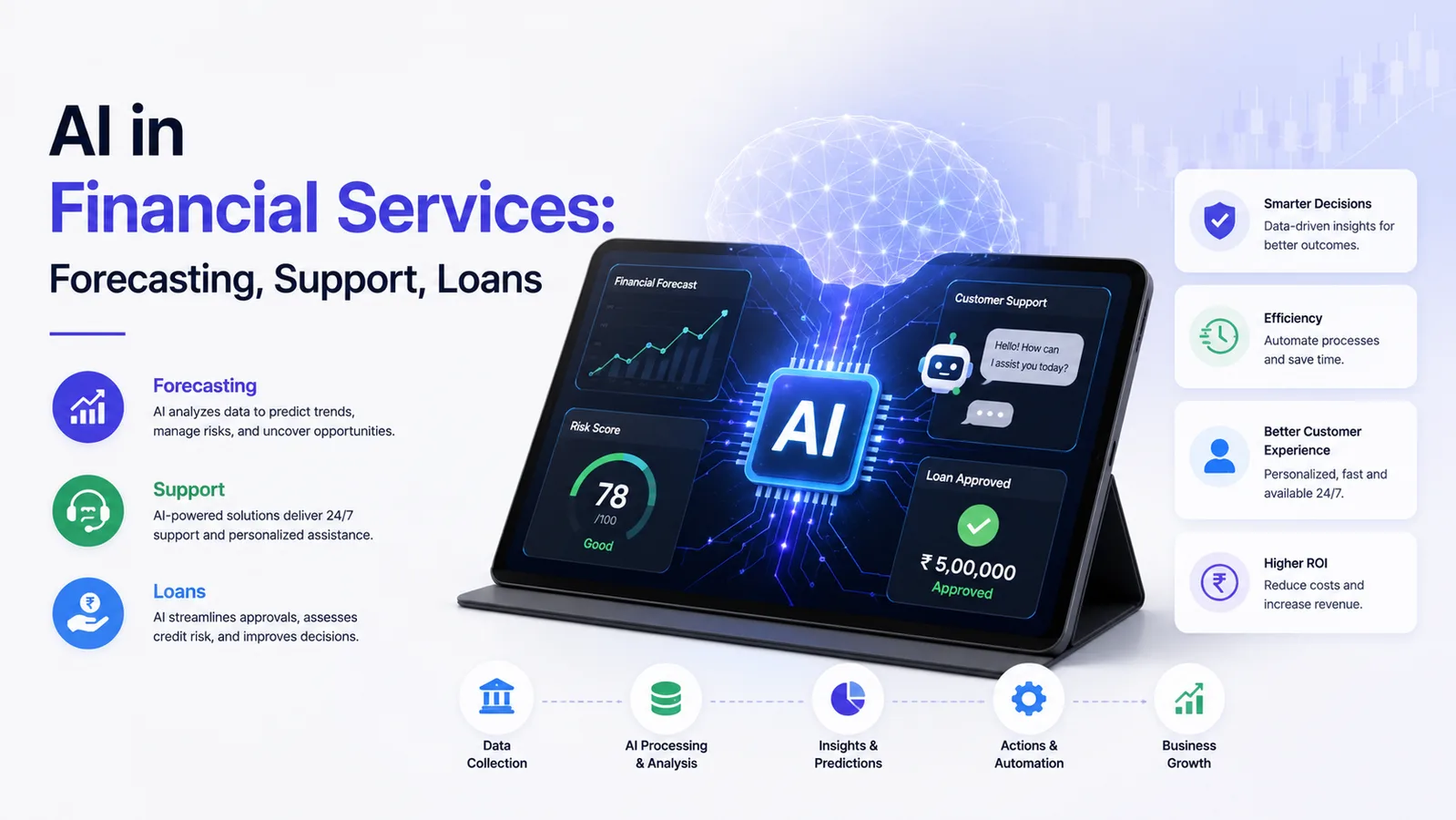
A treasurer was still re-creating the 13-week cash view in Excel every Monday. The disparity was more than 20 percent because bank files, ERP invoices and subsidiary funds were reconciled manually. That is the role of ai in financial services that pays first: not a chatbot that “talks like a CFO,” but a system that collects, matches and alerts exceptions so people foresee the unexpected.
Generative AI is now on the stack. It writes remarks, role-plays scenarios and chats with customers. It is a poor alternative for a proven credit model or a balanced book.”
Quick Answer Box
How to use ai in finance: Begin with data-heavy, auditable activity (reconciliation, support drafts, document review, MSME pre-underwriting). Keep generative models grounded. Never make an inexplicable score the sole reason a loan is accepted or denied.
Role of AI in Financial Services
The role of ai in financial services is four jobs.
See: fraud patterns, AML alerts, document fields.
Decide with rules: credit policy engines, limit checks, routing.
Write and talk: copilot memos, customer replies, call summaries.
Act inside limits: post a ticket, request KYC, schedule a callback.
Classic machine learning still owns the score and detection. Generative models have language and synthesis. Agentic systems stitch both. A bank finds a vendor model generating collection calls it never approved by mixing them with no inventory.
How to Use AI in Finance
How to use ai in finance is a sequence, not a lab day.
Map one process and its system of record (core, LOS, treasury workstation, CRM).
Measure baseline error: forecast variance, handle time, first-contact resolution, approval turnaround.
Automate intake and matching before you generate prose.
Add generative layers for explanation and customer language.
Log prompts, retrieval sources, and overrides.
Review model drift the way you review a scorecard.
How can ai be used in finance in practice: invoice matching, KYC update, earnings Q&A for internal research, RM meeting prep, contact center assist, cash positioning and pre-qualification of thin file borrowers using consented alternative data. Do not say autonomous portfolio manager for every client.
Use of AI in Banking and Finance
Use of ai in banking and finance is already production work.
Volume is key in contact centers. Deloitte’s 2026 bank research indicated that high shares of CEOs are currently utilising or planning to use generative AI in the contact center, chasing happiness and reducing cost per interaction at the same time. Customers are also looking for proactive aid, something most banks don't offer yet.
On the credit front, State Bank of India claimed it used AI and digital data to underwrite approximately ₹1 trillion of MSME loans up to ₹5 crore apiece in FY26, using GST, account data, bureaus and a business rule engine so that relationship managers spend less time gathering files. That’s banking AI as operations, not a showcase.
Even with architecture and audit trails, industry estimates on a McKinsey scale still place the annual banking value of generative AI globally in the low hundreds of billions of dollars. Value leaks when every line of business tunes a private chatbot on unvetted tickets.
Benefits of AI in Finance
Benefits of ai in finance that survive a risk committee:
Hours away from data wrangling (EY notes treasuries still burn most of the week on aggregation).
Frontline support that’s faster and more reliable.
Consent to data for wider credit files for MSMEs and gig workers
Faster fraud and dispute handling when agents build cases.
Standardised writing: SAR stories, policy briefs, call notes.
Benefits that do not survive scrutiny: “the model is always right,” “we can fire the credit team,” “forecasting is solved because ChatGPT read the 10-K.”
Importance of AI in Finance
Importance of ai in finance is not fashion. Payment volume, UPI-scale retail traffic, and GST-rich SME files, outstrip branch capacity. Competitors determine in seconds define customer expectation. Regulators now view ungoverned models as an operational risk.
RBI’s leadership has cautioned against black boxes, inexplicable denials and absence of model inventories, saying AI must stretch the frontier of bankable India using cash flows, GST, utilities and digital footprints. The dual message is the strategy: utilise it, inventory it, explain it.
How Can Generative AI Improve Financial Forecasting Accuracy?
It enhances accuracy if it is a layer on reconciled data, not the forecast itself.
EY India has suggested that agentic artificial intelligence can boost 30-, 60- and 90-day liquidity forecast accuracy to 90 percent where spreadsheet variance still exceeds 20 percent. Agents can consume feeds, simulate and escalate exceptions instead of waiting for Monday’s copy-paste. That is process correctness. It is not a magic on the future.
What generative models actually add:
Narrative of drivers (“collections slipped in west region, not rate shock”).
Scenario language around a statistical engine’s outputs.
Faster refresh when a feed breaks.
Research synthesis for assumption setting.
What they don’t add up on their own: defeating a skilled analyst’s three-statement model. Independent modelling tests still find even good Excel copilots underperforming junior analysts on structure and integrity. Studies like FinanceBench show accuracy collapses when retrieval is chaotic. The retrieval can be perfect up to about 90 percent. Enterprise RAG can fail most hard questions realistic. A fluent memo is not the same thing as a forecast.
Design rule: Numbers are coming from warehouse or ALM engine. The model creates the paragraph and lists the assumptions that it made.
What Are the Top Generative AI Tools for Portfolio Management?
Separate three markets.
Consumer and RIA-adjacent portfolio assistants. Portfolio Genius, PortfolioPilot, Magnifi and Empower-style dashboards that read holdings and recommend allocations. Good for schooling. Tax location hygiene. Not a replacement for a licensed IPS. Independent reviewers still find concrete flaws in bond weights and replacement trades. Use the outputs as a second opinion.
Analyst modeling copilots. Excel’s Claude, Shortcut, Microsoft Copilot, ChatGPT-in-sheets Best speeds for mapping and drafting. Humans still own circularity, balance sheet integrity and audit trail.
Institutional research and OMS stacks. Bloomberg, FactSet and internal RAG over filings and non “generative” at their fundamental execution systems. Risk boundaries are topped with generative UI.
There is no safe “set and forget” generative portfolio manager for clients money. If it’s a tool that can trade, has an investment philosophy, a kill switch and a human who can explain the latest rebalance to a regulator.
Which Financial Services Use Generative AI for Customer Support?
Almost every layer that already had a contact center.
Retail banks and credit unions: Voice and chat assistants for balances, transactions, card controls, and routing. (interface.ai BankGPT-class stacks, in-app assistants like Cora-style journeys at NatWest, huge US assistants at Wells Fargo size.)
Cards and payments: Dispute and chargeback agents that gather evidence.
Insurers: Drafts of FNOL & Q&A on policies.
Wealth: RMs need meeting prep and after-call reports. Watch the advise language.
Indian public sector banks: SBI has said it is going from agent-assist to bots that take basic calls and escalate the rest. AI summits on speedier servicing and fraud warnings are being held by PNB and rivals.
Deloitte is forthright in its work on bank CX: AI only helps if data and servicing platforms are linked. Another IVR is a clever answer that can't see the last debate.
Voice is a first class channel in India.” An app-only support model will lose clients who still call after a failed UPI or a barred card.
Can Generative AI Automate Loan Approval Processes in Indian Banks?
Partly. Not as an unsupervised novelist.
What is already automated:
Data pull through Account Aggregators, Unified Lending Interface (dozens of lenders, various data services).
Rule engines + ML scores on GST, bank statements, bureau and consented footprints.
Some computerised lenders now make customer judgements instantly, with humans relegated to monitoring.
AI + BRE for Large ticket MSME Pre-Underwriting at SBI scale
What generative AI should do in that flow:
Read unstructured bank statements and invoices to fields.
Edit RM and process credit notice
Describe the policy engine decision in the customer’s language.
Queue exceptions (associated party, mismatched GST, adverse media) .
What it should not do alone:
Make cash flows.
Approve a loan since the story is entrepreneur-friendly.
Reject a first time borrower (no reason code).
The RBI draft expectations include explainable automated judgements, disclosure when a client is talking to AI, inventories of all models including vendor tools and board responsibility. Inclusion is also driven by governor-level commentary: some files that humans would reject are approved because the alternate data supports them, not because the chatbot is optimistic. That’s a tougher standard than full automation. And it’s the only bar that survives a credit cycle.
Technical & Performance Data Matrix
Use case | AI type that belongs | Generative AI role | Accuracy / control note | India live pattern |
Cash / treasury forecast | Time series + agentic assembly | Commentary, exceptions | EY: high potential if data is ready | Spreadsheet-heavy mid-market still |
Research / filings Q&A | RAG over 10-K / annual reports | Synthesis | Realistic RAG still hallucinates | Internal copilots |
Portfolio suggestions | Optimizer + LLM wrapper | Explanation of trades | Check weights; no autopilot | Consumer tools + advisor review |
Contact center | Intent + knowledge + voice/chat | Reply, summary, next step | Ground on core banking, not tickets only | SBI-style bot plus human complex |
Disputes / AML cases | Graph + document AI | Case narrative | Human sign-off on SAR-class work | Payments and cards |
MSME underwriting | BRE + ML on GST/AA | Credit memo draft | SBI ~₹1 tn FY26 AI-assisted | Public banks + NBFCs |
Instant consumer loans | Policy engine + score | Customer explanation | Some NBFCs fully front-end automated | Consent and reason codes required |
Inclusion / thin file | Alternative data models | Plain-language offer | RBI: explain and inventory | ULI + AA rails |
The matrix is the honest answer to every prompt in this brief. Forecasting accuracy rises when agents clean inputs. Portfolio tools help humans think. Support is the most deployed generative surface. Indian loan approval is already AI-heavy in data and rules. Generative text is the clerk, not the credit committee.
Risk Analysis Banks Still Under-Price
Customer chat prompt injection. Training on tickets with the former tariff. Voice agents with overly easy password resets. Context window for shadow IT co-pilots with customer PAN. Vendors that can’t produce a model card. Fair lending drift as alternative data proxies for zip code and language.
Controls: inventory, retrieval allow-lists, reason codes, voice recording consent, DPDP purpose limitation, credit override log that an inspector can read
Advice vs Strategic Thinking Matrix
Question | Generic advice | Strategic thinking |
How to use AI in finance | Buy a bank GPT | One process, baseline metric, grounded model |
Benefits | “10x productivity” | Hours, cycle time, inclusion, with error rates |
Forecasting | Ask an LLM for next quarter EPS | Engine first, narrative second |
Portfolio tools | Autopilot the book | Policy, review, kill switch |
Support | Contain every call | Core-aware assist plus staffed transfer |
Indian loan AI | Fully replace credit officers | AA/GST/BRE decide, gen AI drafts and explains |
Importance | Competitive optional extra | Operational and regulatory necessity |
Generic advice chases demos. Strategic thinking keeps a model inventory next to the ALCO pack.
People Also Ask
Q: What is the role of AI in financial services?
Detection, decision making based on policy, production of words, limited actions. AI is still scoring. Generative models write, communicate.
Q: How can AI be used in finance?
Reconciliation, KYC, assistance, research copilots, cash forecasting build-up and pre-underwriting on consented data. Start from where the logs are present.
Q: What are the benefits and importance of AI in finance?
Speed, consistency and thin-file consumer reach. Volume matters, and so does the fact that regulators require inventories and explanations.
Q: How can generative AI improve financial forecasting accuracy?
Collecting clean inputs Writing driver comments Adding more breaks. It should not equal the cash number
Q: What are the top generative AI tools for portfolio management?
Consumer assistants for analysis, Excel copilots for models, and institutional research stacks. None should trade client money unsupervised.
Q: Which financial services use generative AI for customer support?
Retail banks, credit unions, cards, insurers, and wealth RMs. Voice plus chat works only when both see the core system.
Q: Can generative AI automate loan approval in Indian banks?
It can draft and explain. Decisioning already uses AI plus GST, bureau, and Account Aggregator data. Fully unsupervised generative approval is not a sound control design.
Q: How can EchoLeads.ai fit financial services AI?
EchoLeads.ai is able to perform controlled voice conversations for collections reminders, application follow-up and service qualification that write back to the bank or NBFC CRM. Generative speech for contact centers can be compared in a controlled pilot with disclosure and audit logs at institutions such as EchoLeads.ai.
Most bank AI systems are stuck on the phone channel. The model can chat, the core is not visible, the call is still a queue. If you want voice follow-up that stays within policy and writes a disposition, contact the EchoLeads.ai team for a scoped financial-services pilot.