
Interactive Voice Recognition Systems: Accuracy and India
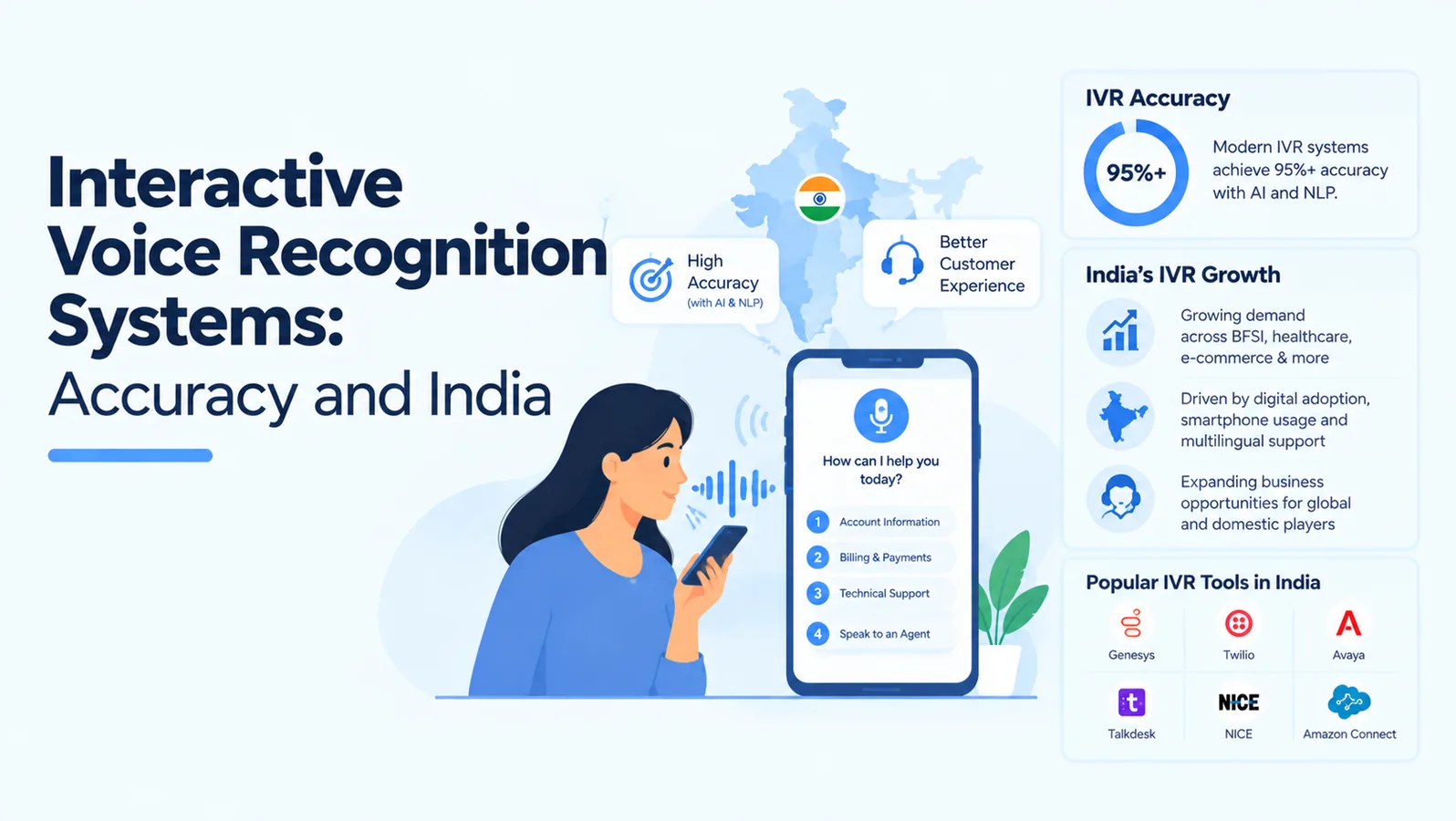
A caller says “check balance” instead of pressing 1. Interactive voice recognition systems are the setups that turn that speech into an action.
They sit on top of, or replace parts of, a traditional IVR.
Quick Answer Box
These systems use speech recognition plus menu or dialog logic. Accuracy is the word error rate on your audio. In India, engines like Sarvam are preferred over generic global models, for telephony and Hinglish. Cloud IVR or voice-AI platforms used by call centers. Small businesses should test before they depend on speech. Home automation is another product category.
How Voice Recognition Works
The audio is from the phone or the microphone.
Then, a speech recognition model (ASR) converts the sound into text. Streaming models do this in near real-time.
The text maps to an intent or menu item.
The system then plays the next prompt, and routes the call or finishes a task.
If confidence is low, it asks again or falls back to keypad or to a person.
Interactive voice response ivr phone system traditionally uses DTMF (key presses). Adding recognition makes it “speak or press.” Full conversational agents go further and handle free-form turns.
Interactive voice response applications include balance checks, appointment booking, order status, surveys, and simple routing. The recognition layer is what lets the caller avoid the keypad.
How Accurate Is Voice Recognition?
Accuracy is usually reported as word error rate (WER). Lower is better.
On clean, standard English, modern engines can be very strong. On Indian conditions the picture changes:
Phone audio is usually noisy at 8 kHz.
Speakers use Indian English, Hindi or regional languages or Hinglish (code switching inside one sentence).
Names, numbers and product terms fail more frequently than common words.
2026 benchmarks and comparisons show India-focused or Indic-trained models often out-performing generic global cloud engines on Hindi, Hinglish and regional telephony audio. Sarvam Saaras was among the lowest WER on 8 kHz Indian telephony in one ranking with other specialist and adapted models running close behind. In broader notes, generic engines are up (often around 20%+ on some Indian-language sets), and Indic-trained models are down.
NASSCOM 2026 voice-AI readiness assessment. Limited production is replacing pilots in adoption and multilingual accuracy continues to be a priority investment area. Few had climbed all the way.
“Best accuracy” is the engine that wins on your recordings, not the lowest number in someone else’s paper.
Top Interactive Voice Recognition Products for Call Centres in India
Layer | Options | Notes |
Cloud IVR with speech | Exotel, Knowlarity, Ozonetel, MyOperator and similar | DTMF plus optional speech |
Specialist voice AI | Platforms tuned on Indian call audio | Better Hinglish in many tests |
Recognition engines | Sarvam, Google, Deepgram, Azure, others | Plugged into the IVR or agent |
Full CCaaS | Genesys, NICE, Amazon Connect | Enterprise stacks |
The practical choice for Indian contact centers is usually a local cloud telephony platform for the number and routing and a recognition engine or voice-AI layer that has been tested with Hindi and Hinglish. Global CCaaS will work if the enterprise already has it and can add an ASR capable of India.
Interactive Voice Recognition Services with the Best Accuracy Rates
No universal winner. Direction from 2026 testing:
Indic models like Sarvam tend to do well in conversational Hinglish and Indian telephony audio.
Google Cloud and the like continue to be strong launch points for Indian English and better regional coverage.
Specialist contact-centre platforms claim advantages on “real” calls with noise.
Generic models degrade for code-switching and low-resource languages.
Pilot request: 50-100 of your own calls scored on the words that matter (amounts, dates, names, intents). A 9% WER that gets all account numbers wrong is worse than a higher WER that gets the intent right.”
How to Choose an Interactive Voice Recognition System for Small Businesses
Begin with DTMF. Only add speech for the one or two obvious intents.
Use a cloud IVR from an India provider so the number and hours rules are simple.
If you are adding speech, test Hindi and Indian English on real mobile phones.
Repeat Offer keypad or Transfer Define a unique fallback
Shorten the menu. When options are vague, recognition fails more.
Measure containment and misroutes for two weeks before expanding.
“Don’t buy a full conversational agent until the simple speech path works.
Small businesses don’t need the most accurate research model on day one. They need a reliable route and a graceful way to fail.
BestMeasure containment and misroutes for two weeks and then expand Home Automation in India
This is another category, call-centre IVR.
Consumer options are Google Home / Nest devices and Amazon Alexa. They have their own speech models and work with compatible bulbs, plugs and appliances.
Indoors accuracy on clear speech is often good with commands. Regional accents and code-switching can still create misses.
Local language support has improved but is patchy between devices and skills.
These are not a replacement for a business IVR. They don’t manage customer call queues or CRM routing.
For home use, buy the ecosystem (Alexa or Google) that matches the devices you already own and test the commands you actually say. Keep business phone systems within the IVR and contact-centre tool set.
Technical & Performance Data Matrix
Use | Recognition need | India accuracy note | Starting point |
Simple IVR | Optional speech | DTMF is safer | Cloud IVR |
Call-centre speech | Streaming ASR | Test Hinglish | Sarvam or Google + platform |
Best accuracy claim | Your audio | Specialist often wins telephony | Pilot WER |
Small business | Limited intents | Fallback mandatory | DTMF first |
Home automation | Consumer assistant | Different product | Alexa or Google |
Noisy mobile | Robust model | 8 kHz reality | Specialist or adapted |
Code-switch | Native handling | Global models weaker | Indic-trained |
The matrix separates brochure accuracy from phone-call accuracy.
Fallback to keypad or human is part of a good system, not a failure.
Advice vs Strategic Thinking Matrix
Decision | Generic advice | Strategic thinking |
What it is | Fancy IVR | Speech-to-text plus dialog or menu |
How it works | Magic | ASR then intent then action |
Accuracy | 99% | WER on your 8 kHz Hinglish audio |
Call centres India | One global name | Local telephony + tested engine |
Best rates | Vendor number | Pilot on your calls |
Small business | Full agent | DTMF plus one speech path |
Home | Same as IVR | Alexa or Google ecosystem |
Generic advice trusts the demo. Strategic thinking scores its own recordings.
People Also Ask
Q: What are interactive voice recognition systems?
Systems that take spoken input to a phone or device and act on it, usually as an enhancement to IVR or as a voice agent.
Q: How does voice recognition work?
A speech model turns audio into text, which is then matched to an intent or menu, so the system can respond or route.
Q: How accurate is it?
Depends on audio quality, accent, and language. Cleanenglish is strong. Hinglish, variable on Indian telephony. Measuring call word error rate.
Q: Top products for call centres in India?
Cloud IVR platforms (Exotel, Knowlarity and similar) plus recognition engines or voice-AI layers. Test Hindi and Hinglish.
Q: Services with the best accuracy rates?
Sarvam and other India-centric models often lead telephony benchmarks. Check with a pilot. No one else.
Q: How should a small business choose?
Start with DTMF, add limited speech, require a fallback, and measure before expanding.
Q: Best for home automation in India?
Alexa or Google Home devices matched to your gadgets. These are not business IVR systems.
Q: Where does EchoLeads.ai fit?
EchoLeads.ai uses speech recognition to understand business calls made to its voice agents. It’s not a home-automation device. It’s not a raw speech-to-text API you can embed. If you only need the recognition layer, use a cloud IVR or specialist engine. Use EchoLeads when the job is handling live customer conversations on numbers you control.