
What Is Knowledge Acquisition in Artificial Intelligence
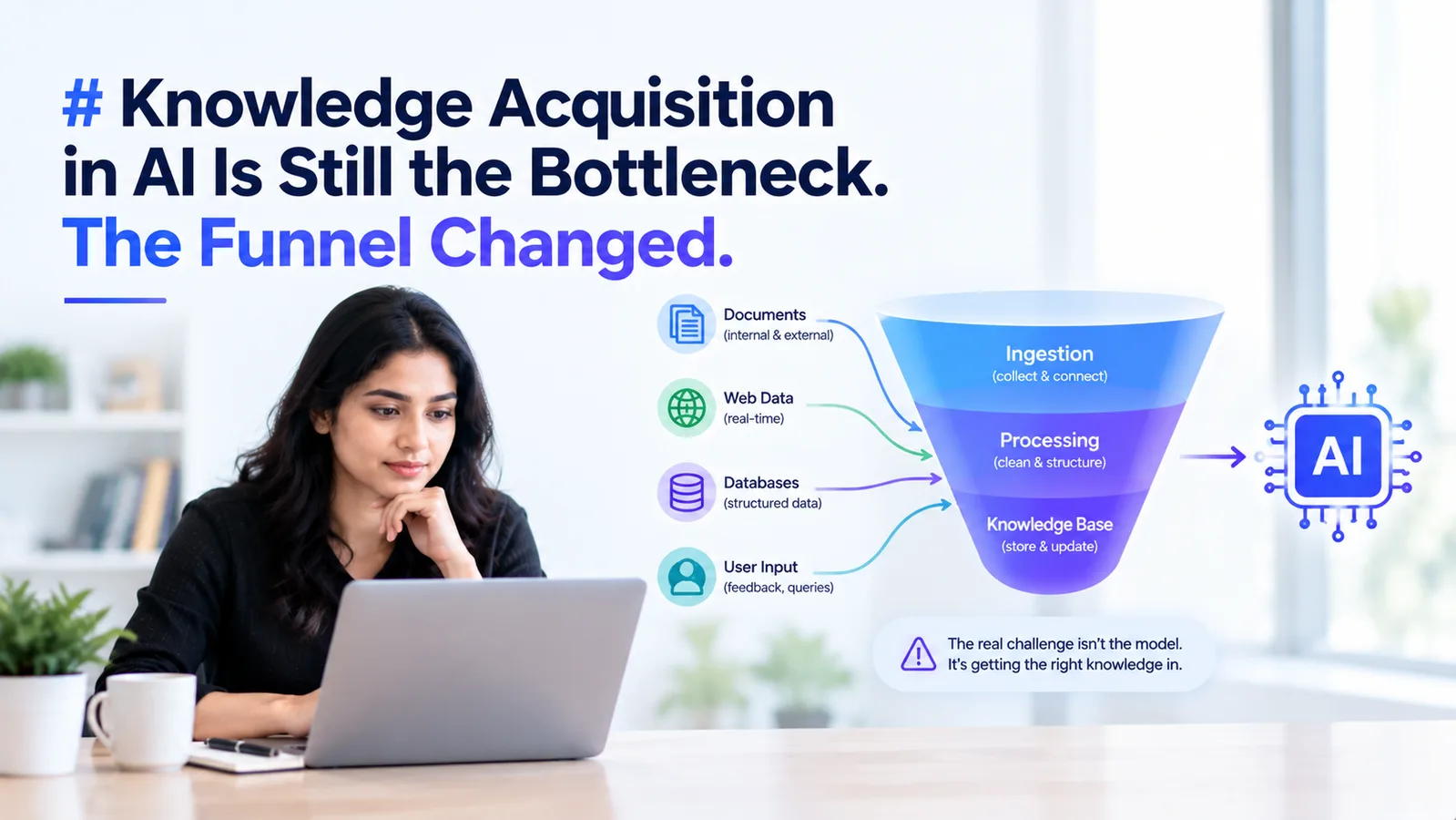
In 1987, an expert system waited six months for a technician to explain how they actually diagnosed a pump. Support bot in 2026 waiting for someone to upload the same PDF with a date on it, Knowledge acquisition in ai is that wait. The problem is not the model. Is the structured, owned, current knowledge.
This is not the same essay as “what is a knowledge based agent. The user of the knowledge is that piece. This is how the knowledge gets in and this is how you know it is not a hallucination with a footer.
Quick Answer Box
Acquisition means elicit, encode, validate, maintain. Knowledge is reusable structure. Meta-knowledge is when and how sure. Heuristics are short cuts you must still test. Shells held rules. RAG holds chunks with citations. India can start on open-source plus a private store.
What Does Knowledge Acquisition Mean?
What does knowledge acquisition mean in plain language: turning what a specialist knows how to do into something a program can use without calling that specialist every time.
Artificial Intelligence is not the phrase in GPT. Because experts are fast at doing and slow at explaining, knowledge engineers sat with domain experts. The bottleneck was well-known: the encoding cost more than the inference engine.
The bottleneck was not removed in 2026. It moved it to document mess, conflicting SOPs and models that will happily speak a retired policy.
What Is Knowledge in AI?
What is knowledge in ai? Not a folder named Knowledge.
Useful working split:
Facts. The refund window is 7 days. Tower X is congested after 6 p.m.
Rules. If the scan is at the hub after the promised window, offer replace or refund.
Procedures. How to raise a field ticket.
Cases. Last Tuesday this invoice pattern was fraud.
Constraints. Never ask for OTP in open chat.
Data is recordings. Information is a transcript. Knowledge is the transcript plus the rule you will run tomorrow. Wisdom, if you want the pyramid, is knowing when not to fire the rule.
Knowledge Acquisition Meta Knowledge Heuristics in AI
Knowledge acquisition meta knowledge heuristics in ai are three layers people flatten into “prompt.”
Object knowledge. The domain content.
Heuristics. Cheap rules that are usually right: “if the customer repeats the order ID, the last agent already failed.” Heuristics are not laws. They expire.
Meta-knowledge. Knowledge about the knowledge:
Source and date (SOP v3.2, June 2026).
Confidence (policy versus tribal habit).
Applicability (India prepaid, not UAE postpaid).
Owner (billing ops, not the intern).
Conflict rule (circular beats WhatsApp rumour).
A knowledge-based agent without meta-knowledge will apply a 2019 heuristic to a 2026 GST invoice. Acquisition that does not capture “who says, as of when” is how you buy a confident wrong bot.
Knowledge Acquisition and Validation Techniques in AI
Knowledge acquisition and validation techniques in ai come in two families that now live in one pipeline.
Elicitation (classic)
Structured interviews.
Protocol analysis (think-aloud while they work a real ticket).
Card sorts and repertory grids for how experts cluster cases.
Observation on the floor, not in a workshop.
Process-mining and, now, LLM-assisted externalisation of process knowledge. Research in 2026 still frames LLM helpers as support for preparation, socialisation, and externalisation, not as a replacement for the analyst.
Induction (data)
Cases to rules.
Active learning: ask the human only where the model is unsure. Trustworthy active learning treats the cost of the human, not only uncertainty scores.
Test-time acquisition: some medical LLM work now writes heuristics back into a living store when the model is confident, and flags gaps when it is not. That is acquisition during use, which is powerful and easy to poison. Capacity control and review matter.
Validation
Consistency: two rules cannot both fire and contradict.
Completeness: every ticket type has a next step.
Face validity with the expert.
Hold-out cases and live A/B against FCR, not against “the bot sounded nice.”
For agentic systems, validate trajectories (plan, tool, side effect), not one Q&A pair. A 2026 survey of agent validation is blunt: component tests are not enough.
Symbolic stores still need ontology and graph checks: orphan classes, broken constraints, stale nodes.
If you only measure BLEU on a FAQ, you have not validated knowledge. You have validated style.
Expert System Shells and Knowledge Acquisition in AI
Expert system shells and knowledge acquisition in ai were the 1980s–90s productisation of this problem.
A shell gave you:
A rule or frame language.
An inference engine (forward, backward, or both).
An empty knowledge base.
Sometimes an interview widget.
CLIPS, JESS, and commercial shells meant the knowledge engineer did not write a matcher from scratch. Acquisition was still interviews plus encoding. The shell did not extract expertise from a PDF.
Keep the lesson. A 2026 “AI platform” that only hosts a model is a shell without a knowledge discipline. RAG, graphs, and policy engines are the new shell. Someone still has to decide what is allowed in.
Best Platforms for Knowledge Acquisition in AI Development
Best platforms for knowledge acquisition in AI development depend on whether you are encoding rules or indexing documents.
Classic / neuro-symbolic: Protégé for ontologies, graph databases, CLIPS-class rule engines, business-rule management systems.
Document acquisition / RAG: vector databases plus an orchestration layer (LangChain-class), enterprise search with citations, connectors to Confluence, Drive, tickets.
Contact-centre knowledge: helpdesk KBs (Freshdesk, Zendesk, ServiceNow) that agents already edit.
Voice and chat grounding: the same KB exposed as tools the agent may call, not a paste into the system prompt.
India private RAG: products that advertise in-country or on-prem retrieval for banks and GCCs. Names change. The requirement does not: citations, RBAC, PII scan, refusal when the store is silent.
NASSCOM-cited enterprise pattern in India explainers: RAG is the default GenAI shape because RBI, GST, and HR circulars will not fit in a frozen training cut.
How Do Knowledge Acquisition Tools Integrate With AI Systems?
How do knowledge acquisition tools integrate with AI systems?
Ingest. PDF, HTML, ticket macros, call transcripts (with consent).
Normalise. Chunk by heading, not by random 512 tokens that split a table.
Label meta-knowledge. Owner, effective date, product line.
Index. Embeddings and/or a graph of entities.
Retrieve. Query plus filters (only prepaid SOP).
Generate with citation. The model may not speak a sentence that lacks a chunk ID.
Write-back. New tickets and approved macros return to the store. Humans accept the write.
Serve. API to chat, voice agent, or search box.
Integration that skips step 3 is how last year’s refund rule ghosts the new one.
Top Companies Offering AI Knowledge Acquisition Services
Top companies offering AI knowledge acquisition services is a mixed market:
Global clouds: Azure AI Search, Vertex, AWS Kendra-class plus model APIs.
Enterprise search and RAG vendors.
Indian SI and GCC-focused RAG firms (private retrieval, Hindi/Indic language claims, air-gap options).
Contact-centre platforms that treat macros as the knowledge store.
Consultancies that still do the unglamorous interview work.
Buy a service that includes an editorial calendar. Acquisition is operations, not a project go-live.
Affordable Knowledge Acquisition Software for AI Projects in India
Affordable knowledge acquisition software for AI projects in India:
Open-source: embeddings + Postgres/pgvector or an equivalent + a thin app. India SMB guides still quote build bands in the low lakhs and monthly cloud in tens of thousands for small corpora, before labour.
Helpdesk native KB if you already pay for Freshdesk or Zendesk. Start there.
On-prem or “data stays in India” RAG engines for teams that cannot send KYC packs to a public chat.
Do not buy a second platform if the knowledge already lives in ServiceNow and nobody updates it. Fix the update SLA first.
Affordable fails when the cheap store has no owner. A Notion dump is not acquisition.
Technical & Performance Data Matrix
Layer | Classic form | 2026 form | Validation |
Facts | Frames | Tables / tickets | Source date |
Rules | If-then in a shell | Policy engine + tool calls | Conflict test |
Heuristics | Expert rules of thumb | Playbooks, few-shot | Live FCR, not demo |
Meta-knowledge | Certainty factors | Owner, version, filter | Stale-doc report |
Cases | Case-based reasoner | Retrieved similar tickets | Anonymisation |
Documents | Manuals on a shelf | Chunks + embeddings | Citation required |
Process | Interviews | LLM-assisted elicitation + analyst | Expert sign-off |
Agents | Expert system session | Multi-step tools | Trajectory tests |
The matrix is the course slide and the RFP. If your vendor only sells the document row, you still need the rule and meta rows.
A voice agent that cannot name the SOP version has not acquired knowledge. It has acquired a vibe.
Advice vs Strategic Thinking Matrix
Question | Generic advice | Strategic thinking |
What KA is | Upload PDFs | Elicit, encode, validate, maintain |
What knowledge is | Anything in Slack | Reusable structure with an owner |
Heuristics | Put them in the prompt | Date them and test them |
Validation | Users liked the demo | Consistency + hold-out + trajectory |
Shells | Obsolete | Lesson lives in RAG + rules |
Platforms | Biggest model | Store + citation + RBAC |
India cheap stack | Public ChatGPT on policies | Private retrieve, human write-back |
Generic advice creates a second unofficial SOP. Strategic thinking creates one store the voice agent is allowed to read.
People Also Ask
Q: What is knowledge acquisition in AI?
The process of getting domain knowledge into a machine-usable store and keeping it true.
Q: What does it mean in simple terms?
Interview the expert, structure the rule, test it, update it when the circular changes.
Q: What is knowledge in AI?
Facts, rules, procedures, and cases with an owner and a date. Not raw logs.
Q: Meta-knowledge and heuristics?
Heuristics are short cuts. Meta-knowledge says when they apply and how sure you are.
Q: How do you validate?
Consistency, completeness, expert review, live metrics, and for agents, whole trajectories.
Q: Are expert system shells still relevant?
As a pattern: empty engine plus disciplined knowledge. RAG is the common shell now.
Q: What platforms and India options exist?
Rule and ontology tools, RAG stacks, helpdesk KBs, and in-country private retrieval. Start with the store you already neglect.
Q: How does EchoLeads.ai use acquired knowledge?
EchoLeads.ai voice agents should call a grounded store (your macros, refund matrix, outage list), not invent policy. Acquisition is your editorial job. The agent is the mouth. If the store is empty, the call will be too.
If the knowledge exists in a PDF and the customer is on a phone, contact the EchoLeads.ai team to put retrieval on the voice path after the store has an owner.