
Knowledge Based Agents in AI: Examples and Platforms
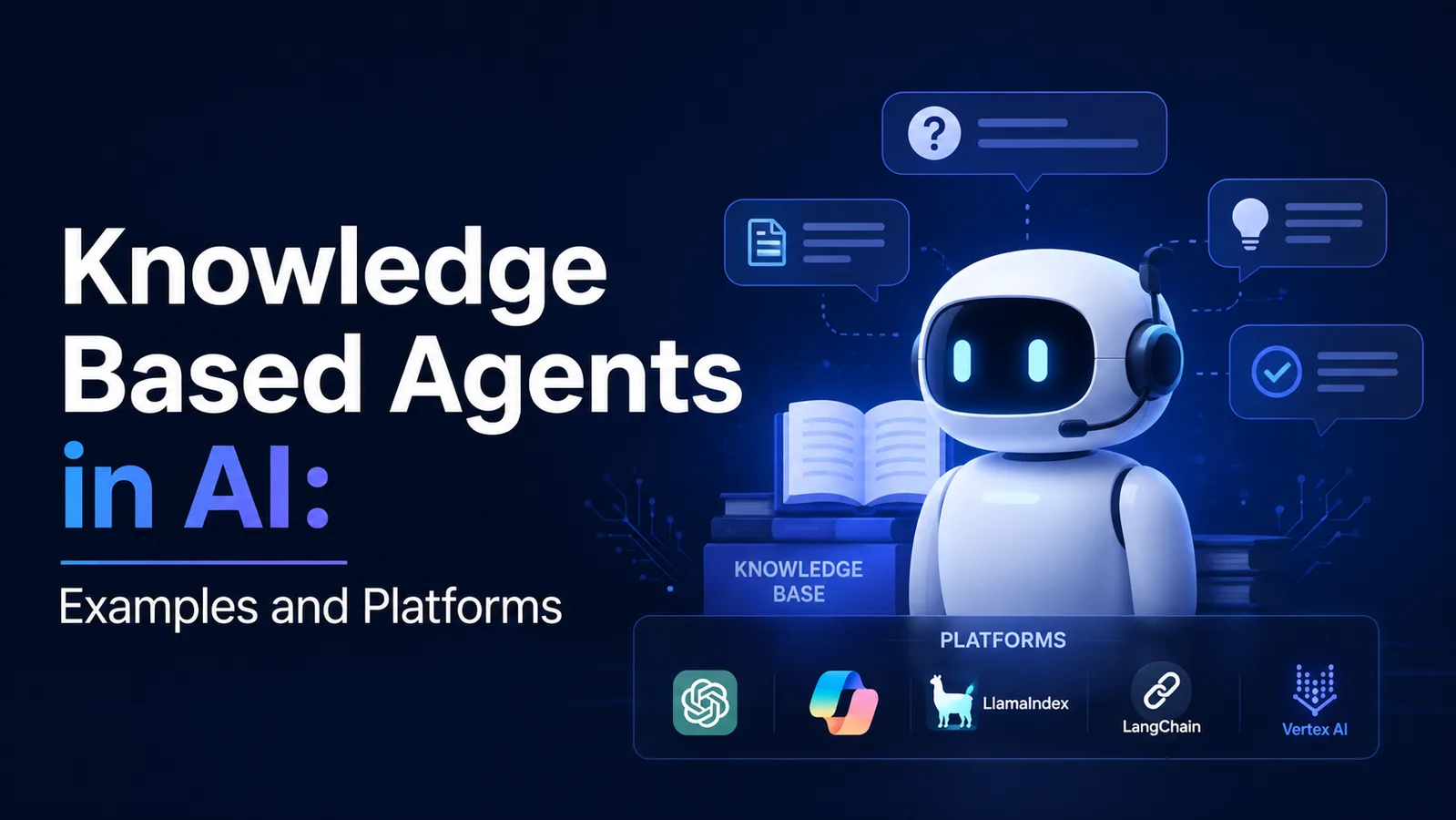
An AI assistant told a support engineer that the refund window was 30 days. The policy PDF on the shared drive said 14. The model was able to speak fluently. The knowledge wasn't right. That gap is what makes knowledge based agents in ai still relevant in 2026. The agent is only as good as the store it is allowed to use.
This was done by classic AI courses in logic . Today, the same idea ships as a help-center-grounded service agent citing article 214 before cancelling an order. The representation was different. The requirement was not that decisions had a source.
Quick Answer Box
A knowledge-based agent reasons from stored facts and rules, not reacts to the last prompt. A knowledge base can be logic sentences, an ontology, or a regulated help center. For automating customer service, begin with the desk you already run (Zendesk, Intercom, Freshdesk, Salesforce), or a separate layer such as Ada. Add content first, tools second.
Knowledge Based Agents in Artificial Intelligence
Knowledge based agents in artificial intelligence are agents with an explicit knowledge base (KB) as main memory. The KB contains facts (“Plan Pro includes phone support”) and rules (“If warranty expired AND damage is accidental THEN deny replacement”). An inference engine or, today, a retrieval-plus-reason loop uses that store to answer or act.
Standard components:
Perception: translate a ticket, utterance, or sensor reading into symbols or a query.
Knowledgebase: The official store.
Inference/retrieval: forward/backward chaining or RAG over embeddings + citations
Reply, update a field, reassign, or decline.
Learning hook (optional): Human edits article, adds a verified fact. Model makes up a fact.
This is different from a simple reflex agent (if dark, turn on light) and a pure statistical classifier (this email looks like spam). It is also more limited than a fully agentic system that plans across many tools. Knowledge is the boundary that prevents agency from being improvisation.
Russell and Norvig define knowledge-based agents as systems that tell the truth about what they know and update beliefs as they see new sentences. Even if the “sentence” is a Zendesk Guide article, that discipline is owed to production stacks.
What Is an Artificial Intelligence Agent?
What is artificial intelligence agent: software that pursues a goal in an environment using sensors, memory, and actuators, with some freedom to choose the next step.
Types you will meet in the same textbook chapter:
Simple reflex
Model-based reflex
Goal-based
Utility-based
Learning
Knowledge-based (the subject of this article)
A 2026 “AI agent” product is usually an LLM wrapper with tools. The wrapper is a knowledge-based agent if answers and actions are to be based on a maintained store only. An agent is anyone who finds a discount on the open web. It is not a knowledge based one .
Notes on AWS and other architectures that distinguish traditional AI tools, bounded software agents, and agentic systems that plan asynchronously. Knowledge-based design may occur in all three layers. The operational test is: Show me the article or rule that justified the last action?
Example of Knowledge Base in Artificial Intelligence
Example of knowledge base in artificial intelligence that a student can picture:
Medical teaching KB (classic):
IF symptom fever AND symptom body_aches AND symptom cough THEN consider influenza
IF influenza AND days_since_onset <= 2 THEN consider antiviral review
Ecommerce service KB (production):
Fact: “Prepaid returns are free within 7 days of delivery for unopened items.”
Fact: “COD orders pay return shipping.”
Rule: “If item opened AND category is earphones THEN replacement only after QC.”
Procedure: “Create RMA, print label, set ticket status Awaiting_parcel.”
Exception: “Influencers on list VIP-A skip QC hold.”
For instance, Amazon's shopping assistant Rufus is an example of an agent that lives on catalogue, reviews, and Q&A knowledge, not a blank model. The same pattern for another domain is a hospital diagnostic assistant sitting on clinical protocols. An engineering agent pulling up “what failed on the last similar bracket” is the same pattern in manufacturing.
A folder of PDFs is not a knowledge base yet. A knowledge base has owners, versions, effective dates and a rule as to what the agent can do when nothing matches.
What Are the Top Companies Offering Knowledge Based Agent Solutions in AI?
Companies cluster by how they sell the knowledge layer.
Helpdesk vendors with native agents: Intercom (Fin), Zendesk, Freshworks (Freddy), HubSpot, Zoho, Gorgias for commerce tickets. They win when the articles already live in their help center.
Standalone CX agent companies: Ada, Sierra, Decagon, Forethought. They sit in front of an existing desk and sell resolution quality, multilingual coverage, or triage.
CRM and platform vendors: Salesforce Agentforce with Data Libraries and knowledge grounding; Microsoft and ServiceNow in employee and IT service contexts.
Knowledge and search infrastructure: Elastic, Glean, Writer, Palantir-class knowledge graphs, plus vector databases behind custom RAG agents.
India-relevant CX and voice stacks: Freshworks (Chennai roots), plus voice specialists that must ground call scripts in the same policy store or they will say the refund window wrong on the phone.
There is no global “best company.” There is a best owner of the source of truth. If articles live in Confluence and tickets live in Freshdesk, the vendor that cannot ingest both will hallucinate the gap.
Which Platforms Provide Knowledge Based Agents for Customer Service Automation?
For automation of customer service, 2026 shortlists usually look like this.
Intercom Fin. Strong documented resolution on help-center grounded chats. Often billed near $0.99 per resolution plus seats. Fits product-led SaaS already on Intercom.
Zendesk AI agents. Best when the team already runs Zendesk workflows, macros, and Guide. Mix of seat add-ons and per-resolution meters depending on pack.
Freshdesk Freddy. Value path for mid-market and many Indian teams. Customer-facing agent sessions can meter separately from copilot seats.
Ada. Standalone conversational layer, multilingual, sits in front of a desk you keep.
Sierra and Decagon. Enterprise builds, outcome commercial models, longer implementation, branded experiences.
Gorgias. Knowledge plus order actions for Shopify. The “knowledge” includes order state, not only FAQs.
Salesforce Agentforce Service. Knowledge grounding with Data Libraries and Knowledge articles. Subagents plus article grounding is now the Salesforce documentation way to avoid writing a novel of instructions for each case type.
Eesel, My AskAI, Tidio Lyro. Faster, cheaper deflection layers for smaller desks.
Independent tests in 2026 still show a familiar trade-off: More accurate published resolution often means a louder per-resolution invoice. Always test on your 200 top tickets, not the vendor's demo corpus.
How Can I Integrate a Knowledge Based AI Agent Into My Business Software?
Integration is content, state, action, and governance.
1. Inventory sources. Public help center, internal Confluence or Notion, policy PDFs with owners, macros and last 90 days of closed tickets. Past tickets show the questions real people ask.
2. Clean before you connect. Deduplicate, mark expired promos, add effective dates, split "what is true" from "how an agent should speak"
3. Connect the system of record. Tickets for the helpdesk. CRM account status. Commerce or billing for refunds. The agent that can quote policy but not see order status will fail.
4. Choose the hook. Zendesk or Intercom native app. API or iPaaS into custom knowledge base. Salesforce Data Library Voice platform prompt that retrieves the same article IDs that the chat agent uses. Do not train a second non-official FAQ for the phone team.
5. Set refusal and handoff. If retrieval confidence low, transfer with the snippets the agent considered. The 30 day refund story begins with a silent guess
6. Ground actions. Cancel, refund, and password reset should hit APIs with policy checks not free text promises
7. Evaluate weekly. Sample grounded vs. ungrounded answers. Monitor citation click-through, reopen rate and human edit rate on articles used by the agent.
A practical path is 30 articles covering 50 percent of volume, then tools, then voice. Turn that on its head, and you automate confident error.
What Are the Leading Products That Use Knowledge Based Agents in AI?
Products, not just platforms:
Help center agents Freddy Zendesk AI Help Scout Answers
Commerce agents that view orders as knowledge: Gorgias, certain retail agents
1. CRM service agents: Service Assistant Agentforce -
Expert system descendants: medical decision support, insurance underwriting rules engines, IT operations runbook agents
Shopping and Catalogue Agents: Rufus-like assistants on product and review graphs
Internal knowledge agents: Glean-like workplace Q&A with permission-aware search
Voice agents in contact centers that only speak live account fields and retrieved scripts.
The leading product in a given company is the one whose knowledge owners actually update articles the same week as policy changes. A famous logo on a stale Guide space is a liability.
Technical & Performance Data Matrix
Product / layer | Knowledge store it expects | Inference style | Service automation fit | Integration note |
Classic expert system | Rules, ontology | Forward / backward chaining | Narrow, explainable decisions | Custom, brittle at scale |
Intercom Fin | Help center, connected sources | LLM + retrieval + actions | In-app and omnichannel SaaS | Native; per-resolution meter |
Zendesk AI agents | Guide + macros + apps | Desk-native agent | Existing Zendesk operations | Fast if already on Zendesk |
Freshdesk Freddy | Freshdesk KB + tickets | Copilot + customer agent | Mid-market value | Watch session metering |
Ada / Sierra / Decagon | Imported KB + systems | Standalone reasoning layer | Brand-heavy enterprise CX | Sits in front of the desk |
Agentforce | Knowledge + Data Libraries | Subagents + grounding | Salesforce Service Cloud shops | Admin and data quality bound |
Gorgias | Shopify objects + macros | Action-taking retail agent | DTC order issues | Weak outside commerce |
Custom RAG agent | Vector index + citations | Retrieve then generate | Unique internal workflows | You own evaluation |
The matrix: why all chatbots don't need to be knowledge-based agents. No store , no citation path , no update owner . You have a talkative reflex system .
Classic logic still pays its way in regulated steps (eligibility, disclosure, consent). Language is where LLMs make their money. The architecture is robust and hybrid: retrieve the rule, and then phrase the sentence.
Failure Modes Unique to Knowledge-Based Agents
Articles conflicting with no effective date. Shadow FAQs in Notion that the agent is not able to see. Permissions that leak an internal runbook to a customer Fine-tuning on tickets with the old policy. Talk and message to other stores. > Deflection was measured when the agent closed the ticket by promising an impossible refund.
Fix the shop. Then tune model temperature Never the other way around.
Advice vs Strategic Thinking Matrix
Question | Generic advice | Strategic thinking |
What is the agent | “ChatGPT on our website” | Goal + KB + inference + allowed actions |
Knowledge base example | Dump PDFs | Versioned facts, rules, procedures, exceptions |
Best company | Highest G2 score | Who already owns your source of truth |
Service platform | Turn on AI tomorrow | Ground on top 30 articles, then expand |
Integration | Connect every drive | Approved corpus, CRM state, refusal path |
Leading product | Biggest demo | Same KB on chat and voice, with citations |
Success | Containment rate | Grounded resolution and reopen rate |
Generic advice buys fluency. Strategic thinking buys answers you can audit.
People Also Ask
Q: What are knowledge based agents in AI?
Agents that decide using an explicit knowledge base of facts and rules, plus inference or grounded retrieval, instead of only reacting to the latest input.
Q: What are knowledge based agents in artificial intelligence used for?
Diagnostics, policy-bound customer service, eligibility checks, runbook automation, catalog Q&A, and any workflow that must cite a source.
Q: What is an artificial intelligence agent?
Software that pursues a goal with sensors, memory, and actions. A knowledge-based agent is the subtype that must reason from a maintained store.
Q: What is an example of a knowledge base in artificial intelligence?
A help center plus return policy rules plus order-state facts. A medical protocol table is the textbook cousin. A raw PDF dump is not sufficient.
Q: Which companies offer knowledge based agent solutions?
Intercom, Zendesk, Freshworks, Salesforce, Ada, Sierra, Decagon, Forethought, Gorgias, and infrastructure vendors that host retrieval. Pick by where your articles already live.
Q: Which platforms automate customer service with these agents?
Fin, Zendesk AI, Freddy, Ada, Agentforce Service, Gorgias, and lighter layers such as eesel or Tidio Lyro.
Q: How do I integrate a knowledge based AI agent into business software?
Clean and version content, connect helpdesk and CRM state, add tool permissions, force citations or refusals, then evaluate on real tickets every week.
Q: How can EchoLeads.ai use knowledge based agents?
EchoLeads.ai enables voice and outbound agents to be grounded on the same approved policies and product facts as a helpdesk agent, so the phone channel doesn’t invent a different refund window. Teams can try EchoLeads.ai as a voice action layer on top of an existing knowledge store.
A chat-only knowledge based agent still has the call center guessing the answer. If you want voice and outbound conversations to be connected to the same source of truth as your help center, reach out to the EchoLeads.ai team to scope a grounded pilot.