
The Formula of Attrition in BPO Is Exits Over Average Headcount
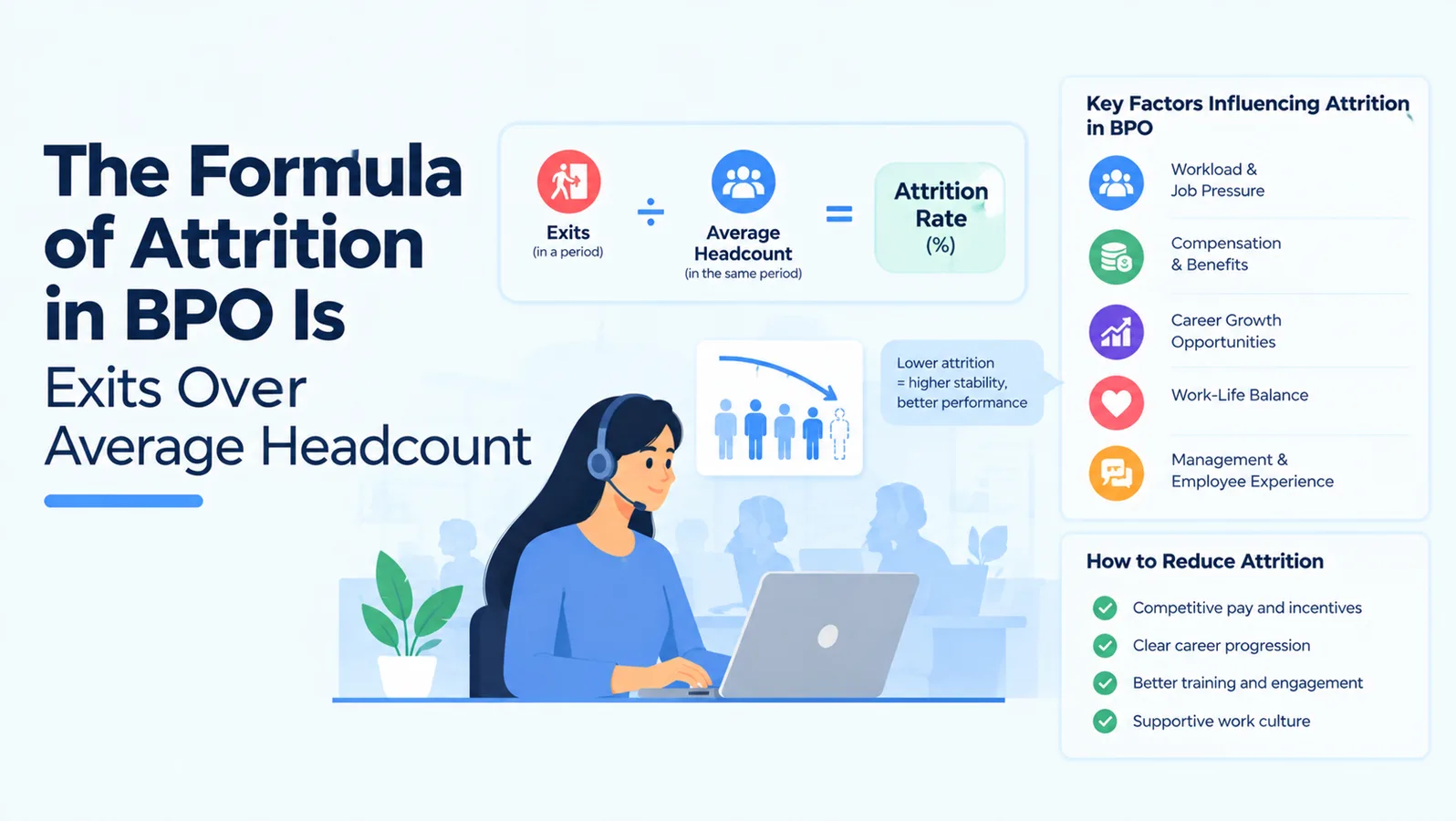
Formula of attrition in bpo is no special equation. This is just the normal attrition rate for a fast moving agent population.
How attrition is calculated?
Well, it boils down to three consistent choices: who is a leaver, what is the average headcount, and what time period you use.
Quick Answer Box
Attrition % = (number who left ÷ average headcount) × 100. Average headcount = (opening + closing) ÷ 2. Shrinkage is a different formula based on unproductive hours. BPO teams usually run the attrition number monthly on agents.
Formula for Attrition
Formula for attrition
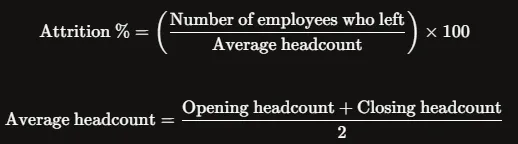
Average = (500 + 480) / 2 = 490.
Monthly attrition = 25 / 490 × 100 = 5.1%.Source: Dialnexa
Using opening headcount alone (25 / 500) overstates the rate. Using closing alone understates it when the base is falling. Average is the standard fix.Source: Indianhrm
How Leading BPO Firms Calculate Attrition Rates
Conventions that matter:
Population. Most operational reports count frontline agents only. Support staff are excluded so the number reflects the production floor.
Period. Monthly is the working view because headcount moves quickly. Annual or last-twelve-months is used for client and board reporting.
Leavers. Decide whether to include resignations only, or also terminations, absconding and end of contract. State the rule.
Average headcount. Opening plus closing, divided by two, for the same population and period.
Annualisation. Two methods exist:
Simple: monthly rate × 12.
Compound: 1-(1-monthlyrate)12.
Multiplying 2% by 12 gives 24%, and multiplying 1.02 by itself 12 times gives 21.5%. Here's the humanized text: It’s time to look at the humanized text: Used: Humanized Text. Source: Upgrowth
The Indian BPO annual attrition is often quoted in a wide range of 25-40%, some voice ops higher. One industry slogan. Compare with your own trend and process.
What Is Shrinkage and Attrition in BPO?
Shrinkage and attrition formula in bpo
Metric | What it measures | Formula |
Attrition | People who permanently left | (Leavers ÷ average headcount) × 100 |
Shrinkage | Paid hours not available for productive work | (Unproductive hours ÷ total paid or scheduled hours) × 100 |
Shrinkage splits into external (leave, absence) and internal (training, meetings, breaks, system downtime).
Example shrinkage: 100 agents × 40 hours = 4,000 scheduled hours. 650 planned unproductive + 200 unplanned = 850. Shrinkage = 850 / 4,000 × 100 = 21.25%. A common healthy range cited for centres is roughly 20–30%, depending on what is included.
Staffing implication:
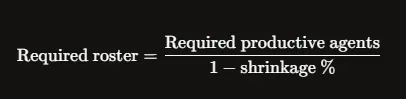
If you need 100 on calls and shrinkage is 30%, you roster about 143.
Attrition is not shrinkage. High attrition causes extra shrinkage because new hires spend time in training and empty seats create unplanned gaps.
How to Control Shrinkage and Attrition in BPO
AttritionExit interviews that result in 1 change, not a report.
Exit interviews that produce one change, not a report.
Shift and roster fairness.
Clear pay and incentives in the first 90 days where many leave.
Visibility of career path outside of the floor.
manager quality People leave the team lead, not the company.
Shrinkage levers (protect productive hours)
Train during lower volume windows.
Unplanned absence cap with clear policy and early flags.
Keep the system from crashing all the time. They are internal shrinkages.
Don't cut coaching to "improve" the number. Quality and repeat contacts tend to deteriorate.
Use the roster formula so you don't under-staff, then burn the rest of the team.
You need both; one alone doesn’t work. Reducing training reduces shrinkage on paper and increases attrition and errors down the line.
Which Software Tools Help Track the Attrition Formula in the BPO Sector?
Tool type | Examples | What it holds |
HRIS / HCM | Workday, SAP SuccessFactors, Darwinbox, Keka, greytHR | Joiners, leavers, headcount |
Workforce management | NICE, Verint, or platform WFM | Schedules, adherence, shrinkage hours |
Contact-centre suite | Genesys, Amazon Connect analytics, local platforms | Occupancy beside headcount |
Spreadsheet or BI | Excel, Google Sheets, Power BI, Tableau | The actual formula when fed clean data |
The formula is not complicated. The tool is designed to ensure that the opening headcount, closing headcount and leaver counts are defined consistently month on month. Many centers still calculate attrition in a controlled spreadsheet that is fed by the HRIS export, and then view shrinkage inside the WFM system.
Newer WFM tools apply AI features to flag increasing early attrition or predict shrinkage, but the root calculation is still the same ratio.
How to Interpret Attrition Formula Results in BPO Workforce Management
Confirm the period and the population. A 5% monthly agent rate is not the same as a 5% annual company rate.
Split voluntary and involuntary if you can. Different actions follow.
Look at the tenure. If you see a lot of people quitting in the first 90 days, it usually means there are problems with hiring or onboarding. Career or pay – high exits a year later.
Shift and process compare. Nite voice is often different than day chat.
Translate to high load. A 5% monthly rate on 500 agents means about 25 people leaving each month, plus training time that adds to shrinkage.
Don't annualize a bad month and make it your destiny. Rolling view.
Pair shrinkage. You'll see it in the next training wave as rising attrition, but you won't see it yet in shrinkage.
Even a low number can mask a problem if only high performers are leaving. Expect and plan for a high number on a new ramp. Check the time frame and population. It is not the same as a 5% company rate per year. As agent rate it is 5% monthly. If you can separate voluntary from involuntary. Then different actions. not punished.
Technical & Performance Data Matrix
Item | Formula or rule | Typical BPO use | Interpretation trap |
Attrition | Leavers ÷ average HC × 100 | Monthly on agents | Wrong denominator |
Average HC | (Open + close) ÷ 2 | Same period and group | Using start only |
Annualised simple | Monthly × 12 | Quick view | Overstates |
Annualised compound | 1 − (1 − m)^12 | Cleaner | Must label |
Shrinkage | Unproductive ÷ paid hours × 100 | Daily or weekly | Mixing with attrition |
Roster | Productive ÷ (1 − shrinkage) | Staffing | Ignoring training from attrition |
India band | Often 25–40% annual cited | Context only | Not a target |
Tools | HRIS + WFM + sheet | Consistent definitions | Two systems, two numbers |
The matrix stops a monthly rate from being quoted as an annual rate.
Write the definition on the report. The number alone is not interpretable.
Advice vs Strategic Thinking Matrix
Decision | Generic advice | Strategic thinking |
Formula | Leavers over total | Leavers over average headcount |
Period | Annual only | Monthly operational, annual for clients |
Shrinkage | Same as attrition | Hours unavailable, not people left |
Leading firms | Secret method | Same formula, strict population rules |
Software | One magic tool | HRIS for people, WFM for hours, one definition |
Interpret | Lower is always better | Tenure, voluntary split, hiring load |
Control | Pizza and slogans | Onboarding, roster fairness, protect coaching |
Generic advice multiplies by 12 and moves on. Strategic thinking states the denominator and the population.
People Also Ask
Q: What is the formula of attrition in BPO?
(Number of employees who left ÷ average headcount) × 100, where average headcount is (opening + closing) ÷ 2.
Q: How is attrition calculated?
Count leavers in the period for a defined group, divide by the average headcount of that group, multiply by 100. Run it monthly for agents.
Q: What is the shrinkage formula?
(Unproductive paid hours ÷ total paid or scheduled hours) × 100. It measures temporary unavailability, not permanent leaving.
Q: What is shrinkage and attrition in BPO?
Attrition is people who left. Shrinkage is paid time not available for productive work. High attrition increases shrinkage through training and gaps.
Q: How do leading firms calculate it?
Same core formula, usually monthly on agents only, with a clear rule on which exits count, plus an annual or annualised view.
Q: Which software tracks the formula?
HRIS for headcount and leavers, WFM for shrinkage hours, and a controlled spreadsheet or BI layer that applies one definition.
Q: How do I interpret the result?
Check period, population, voluntary split and tenure. Translate into monthly hiring load and the training hit on shrinkage.
Q: Where does EchoLeads.ai fit?
EchoLeads.ai is not a workforce management system, and does not calculate attrition or shrinkage. It can handle routine voice volume, so the remaining human capacity can be used on complex work. Your WFM and HRIS have staffing formulas. Use EchoLeads for the automated calling layer on consented traffic only.
Move routine call volume to AI voice to relieve human shrinkage and hiring pressure. Contact the EchoLeads.ai team.