
Types of AI Agents: Textbook, Service, Commerce
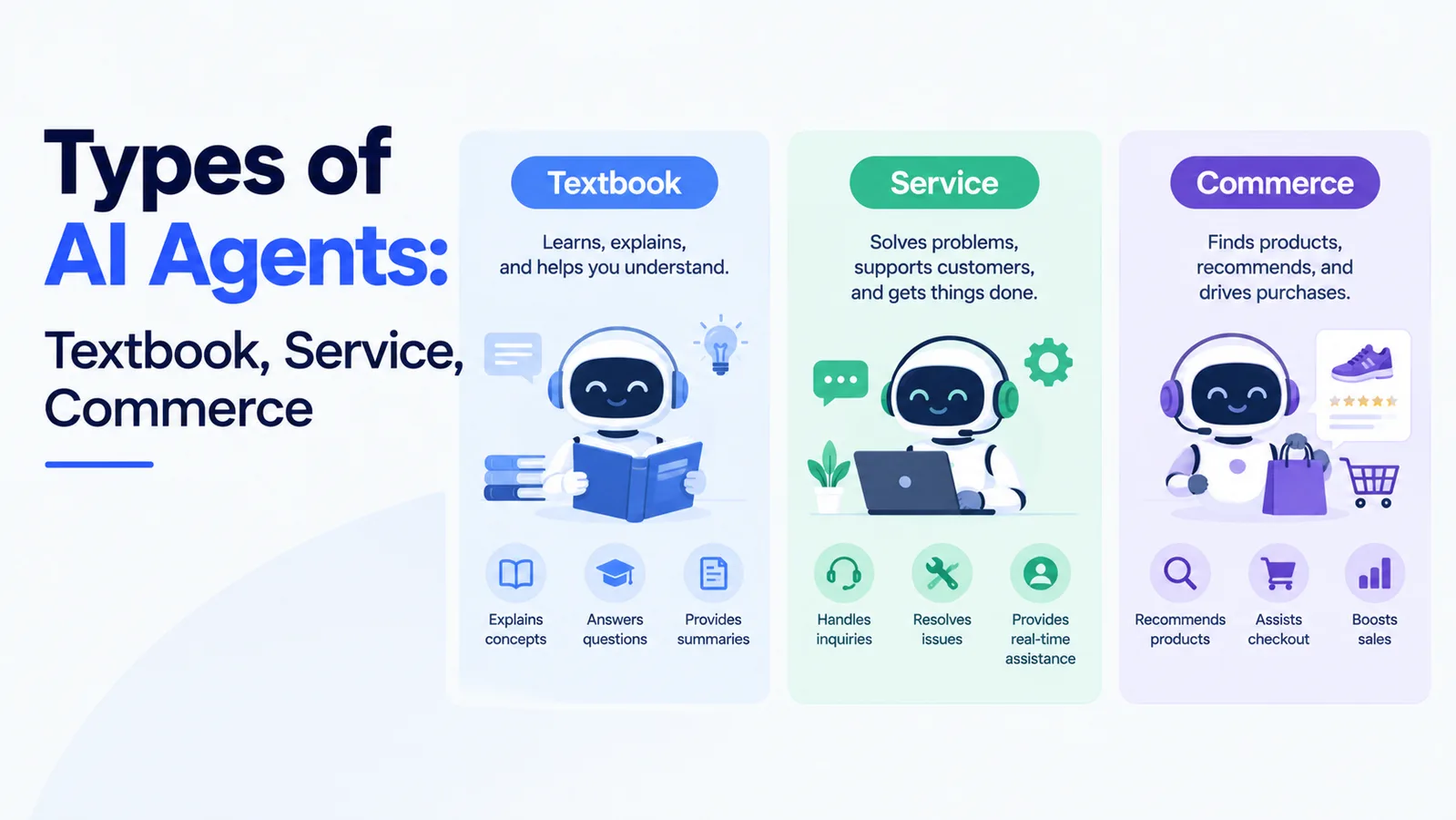
An exam paper asks how many types of agents are there in artificial intelligence. A vendor deck answers “ours.” Both can be honest if they name the scheme. Types of ai agents are not a fixed menu like pizza sizes. They are grades of memory, goals, and learning.
Quick Answer Box
List of standard courses: 5 (simple reflex, model based reflex, goal based, utility based, learning). Extra pair: hierarchical & multi-agent (common) Customer service and e-commerce reuse those grades on tickets, carts and stock. A reflex bot does not strategise. Don't buy one if you expect the latter.
How Many Types of Agents Are There in Artificial Intelligence?
How many types of agents are there in artificial intelligence?
Five, you follow the standard Russell and Norvig teaching sequence used in all Indian CSE papers and Scaler-style explainers: simple reflex, model-based reflex, goal-based, utility-based, and learning.
Six, if the course breaks multi-agent systems as a type.
Seven, if the 2026 commerce blogs add hierarchical and multi-agent systems on top of the five.
No ISO number, no BIS number. The scheme is mentioned in the first sentence of the interview answer. Then list.
A different cut that operators use. Reactive vs. proactive. Single-task vs. multi-task vs. orchestrator That cut is about when and how many jobs, not the internal architecture. You could have a reactive reflex agent, you could have a proactive utility agent. The cuts pile up.
Types of Intelligent Agents in AI With Examples
Types of intelligent agents in ai / types of agents in ai with examples.
1. Simple reflex agent
Only the current percept. If. Then. No history.
Examples: thermostat < 18 °C; IVR press 1; spam rule for one keyword; hide Buy if stock=0.
Falls when the world needs remembrance. “Customer already paid” will not be visible if you only see the last line of chat.
2. Model-based reflex agent
Same rules, but with a mental picture of the world.
robot hoover that maps a room; ticket bot that knows the order is in 'packed' state; cart agent that remembers the coupon already applied.
Fails when you need a plan, not a reaction. Knowing the parcel left Pune does not by itself choose the next sentence.
3. Goal-based agent
Has a desired state and searches for actions that move towards it.
GPS to pin; “book Saturday 6 p.m. colour with Anu”; “get this ticket to resolved”
Fails when many goals clash. One flag is quick resolution vs legal-safe refund.
4. Utility-based agent
Scores outcomes. Picks the better good, not merely a goal.
Examples of these are: cab route that trades time versus tolls; contact centre router that trades AHT versus CSAT and compliance; bid agent that trades margin versus volume.
Fails, if the utility function is a slogan. ‘Maximise happiness’ isn't a number.
5. Learning agent
Has a critic and a learning element. Performance changes with feedback.
Examples: product recommender; QA model that flags new anger phrases; personalisation that stops offering gold jewellery after you only buy cotton.
Fails when feedback is the wrong reward. Click-through is not lifetime value.
6 and 7. Hierarchical and multi-agent (optional extras)
A hierarchical agent divides strategy from execution. A multi-agent system is a number of agents to negotiate or transfer. These often claim Shopify-style stacks in 2026 where ads, stock and support each have a specialist. The product is coordination. The failure is chaos.
What Are the Main Types of AI Agents Used in Customer Service?
What are the main types of AI agents used in customer service?
Map the textbook onto the floor:
Floor job | Textbook grade | Honest example |
Keyword IVR / canned chat | Simple reflex | “Hours” → recorded line |
Ticket with order state | Model-based | “Your AWB is scanned at Hubli” |
Resolve or book | Goal-based | Close WISMO, lock a slot |
Queue and offer policy | Utility-based | Cheap refund vs retain + coupon |
QA and routing that drift | Learning | Anger detector retrained monthly |
Voice and chat are channels, not kinds. A voice agent can still be a reflex, when it simply matches “balance.” A text agent can be utility-based when it chooses the cheapest legal way
Handoff to a human is not a sixth species, It’s a tool the goal-based agent might call.
Which Companies Offer AI Agents for Virtual Personal Assistants?
Who are the providers of AI agents for virtual personal assistants?
Consumer PA (life chart):
Amazon Alexa+ on Echo, Fire TV and the Alexa app (Hindi and Hinglish, launching in India in 2026)
Google Gemini for Android and smart home devices
Apple Intelligence / Siri where mobile supports
ChatGPT app as a general assistant with optional tools
Microsoft Copilot: The Work-Adjacent Cousin
These are suites of products, not one type of agent. Home model + goal-based: Alexa+ trying to shop and set a reminder. Gmail's Gemini draft is more like a tool-using goal agent on the Google graph.
A business “virtual assistant” on an 1800 is a different buyer: CCaaS plus a voice agent with CRM write-access. Play client accounts over the kitchen loudspeaker.
How Do AI Agents Differ in E-commerce Platforms?
How do AI agents differ in e-commerce platforms?
Three camps get flattened into one slide:
Shopper-side. WISMO, refund, size rec, on-site concierge. Gorgias-class, Intercom Fin-class, Tidio-class, Zendesk AI. Lives on the storefront and helpdesk.
Operator side. Price, ads, inventory, flows. Acts in Shopify admin or in warehouse.
Buying agents owned by shoppers. Google AI Mode. Amazon “Buy for Me.” ChatGPT shopping They work for the customer, not your brand. Your catalogue feeds them or they disappear from that path.
Reflex examples: conceal Buy stock at zero. Model-based: cart includes SKU you just restocked. Goal-based: deliver the order by Friday. Utility based: increase price £0.40 till margin holds. Learning: stop suggesting the colour that always comes back.
Store expects to buy one “AI agent,” and all three camps to implement none of them well.
Best AI Agent Solutions for Automating Business Processes?
Best AI agent solutions for automating business processes?
Process agents are goal-oriented tool users on top of RPA, iPaaS or an LLM-with-functions layer.
Look for:
Written procedure (invoice match, KYC chase, appointment no-show)
Systems the agent can write to (ERP, CRM, calendar)
Utility cap (never pay more than X, never send marketing template in support window)
Logs that a human can replay
Not a crown, categories:
Enterprise automation suites (Power Automate, Automation Anywhere-class, ServiceNow-class) [00:09:00]
agent wrapper ipaas
Vertical Agents (Collection, COD Check, Clinic Booking)
warehouse internal ops associate
But the best solution is the one that’s a process you can name in one sentence. “Automate the business” is not a destination.
Technical & Performance Data Matrix
Type | Memory | Decides by | Service example | Commerce example |
Simple reflex | None | Current if-then | Press-1 hours | Hide OOS button |
Model-based reflex | State | If-then on model | AWB status | Cart + coupon flag |
Goal-based | State + goal | Plan to target | Resolve ticket | Deliver by Friday |
Utility-based | State + score | Best trade-off | AHT vs CSAT | Price vs conversion |
Learning | State + feedback | Improved policy | QA model drift | Recs that drop returns |
Hierarchical | Layers | Strategy then act | L1 bot, L2 human | Ads plus stock plus site |
Multi-agent | Shared / negotiated | Coordination | Voice + WhatsApp + desk | Shopper + operator agents |
The matrix is the RFP language. If a vendor cannot point to a row, they are selling a chat theme.
A learning badge on a reflex script is a lie you will find in week three.
Advice vs Strategic Thinking Matrix
Decision | Generic advice | Strategic thinking |
How many types | “There are 5” forever | Name the scheme, then count |
Types | Buzzword list | Memory, goal, utility, learning |
Customer service | One CX agent | Reflex FAQ ≠ refund planner |
Personal assistants | Same as contact centre | Home graph vs company graph |
E-commerce | Install one agent | Shopper vs operator vs buyer-agent |
Process automation | Agentic everything | One named process, write-access, cap |
Generic advice buys a mascot. Strategic thinking buys a row in the matrix.
People Also Ask
Q: How many types of AI agents exist?
Five in the standard textbook. Six or seven if you add hierarchical and multi-agent. Say which list you are using.
Q: What are the five?
Simple reflex, model-based reflex, goal-based, utility-based, learning.
Q: Example of each?
Thermostat; mapped vacuum; GPS; toll-versus-time router; recommender.
Q: Customer service types?
The same five, applied to IVR, ticket state, resolution, trade-offs, and QA.
Q: Personal assistant companies?
Alexa+, Gemini, ChatGPT, Copilot, Apple where supported.
Q: E-commerce difference?
Shopper-side help, operator-side ops, and the customer’s own buying agent.
Q: Best for process automation?
The suite that can write to your systems on one named process with a cap.
Q: Where does EchoLeads.ai sit?
EchoLeads.ai is a goal-oriented voice agent with a model of the customer record: book, remind, contain, hand-off. It's not a simple reflex IVR and it's not a home PA. Utility comes when you put caps on things (never say you will refund something that is against policy). QA retraining results in learning. Stay honest with the type in the SOW.
If the bot you bought is still a reflex script and the job is “resolve or book on the phone” call the EchoLeads.ai team.