
Public Switched Telephone Network PSTN Explained
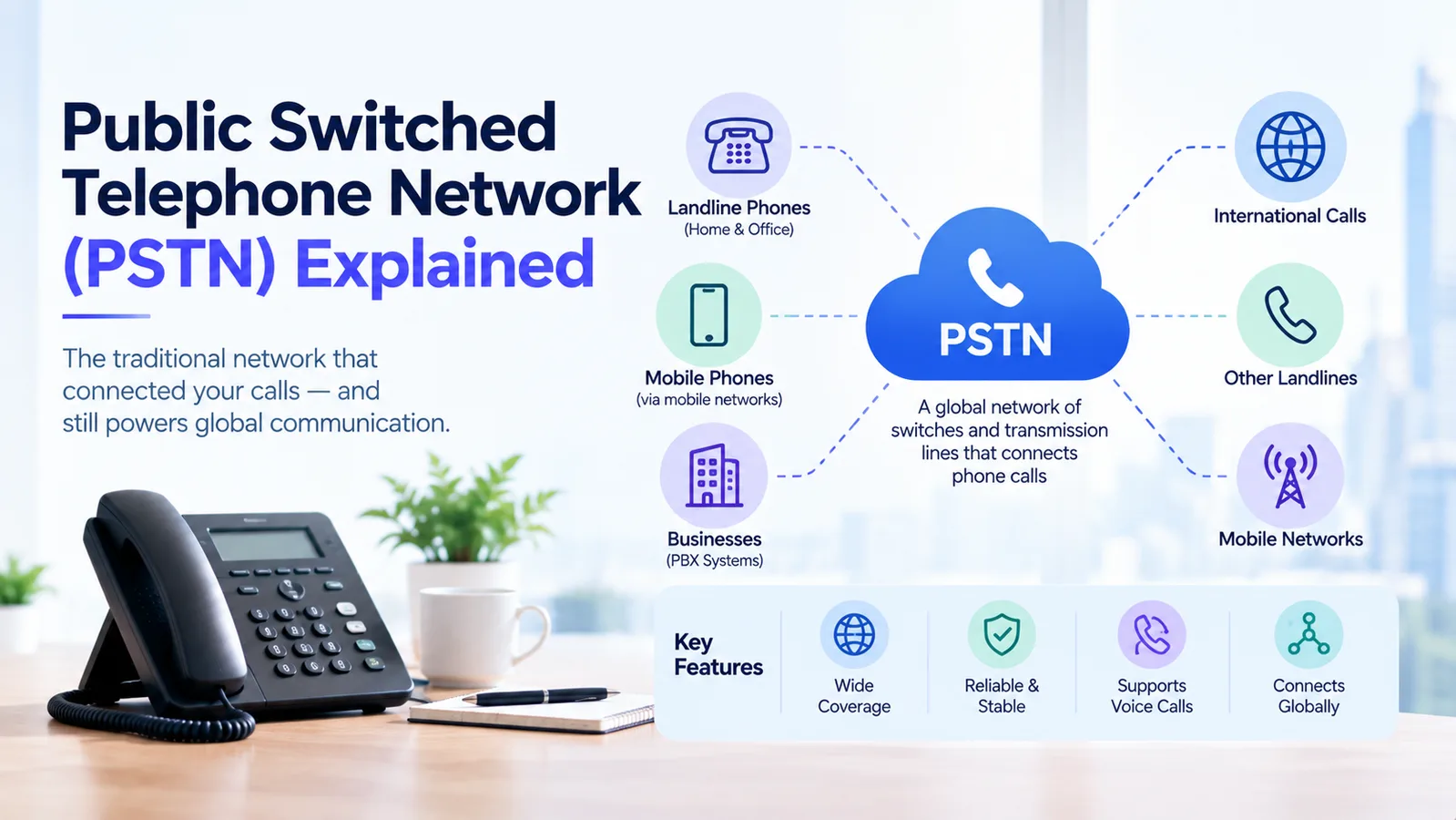
A student looks up public switched telephone network ppt and downloads a black rotary phone 2009 slide. When you dial +91 it still picks up the network in 2026 but the middle is fibre and IP and radio. What is a public switched telephone network is not “the landline” It is generally believed that a number can find another number across the operators.
Quick Answer Box
PSTN is the interconnected world public telephone network: numbering, switching, interconnect. Access in India is via licensed TSPs. Your mobile connects through a point of interconnect and the cellular network. Country codes and gateways are used for international calls . WhatsApp to WhatsApp is not equal to a business SIP trunk blasting Indian mobiles.
What Is a Public Switched Telephone Network and How Does It Work?
What is a public switched telephone network and how does it work?
The working definition of Wikipedia is still valid: PSTN is the sum of telephone networks operated by national and local operators, built from lines, fibre, microwave, cellular, satellite and undersea cables, interconnected by switches so that any subscriber can call any other. It was analogue to start with. The core is now largely digital. Cellular and satellite are part of the reachable public network, not another planet.
Three properties remain if you strip the copper:
Public. Anyone who pays for a service can join. It is not a company PBX.
Switched. The network builds a path for this call, then tears it down. It does not hard-wire every phone to every other phone.
Numbered. ITU-T E.164: country code plus national digits, at most 15 digits. That is why +91 40 … means Hyderabad to a switch in Frankfurt.
How a classic call works
You lift the handset or press Call. The digits are received by the local exchange or mobile switch .
Signalling (primarily SS7 in the past, with ISUP messages between exchanges) asks the next hop to reserve a voice channel and reports ringing, answer or busy. The signalling runs on a plane parallel to the voice path.
Voice on the old digital PSTN is often G.711 at 8 kHz, 8 bit, in a 64 kbit/s timeslot (DS0). The slot is yours whether you speak or stay silent. That’s what circuit-switched means.
The far end chimes. The answer is on the path. Hang-up lets it go.
Hierarchy in plain language
Local loop: last metres or kilometres to a home or a cell site.
Local exchange / MSC: where your line or IMSI lives.
Tandem and long-distance switches: between cities and circles.
International gateway: out of the country.
Modern cores may carry the same call as IP packets after a media gateway. To the user it is still “a phone call to a phone number.” To regulation it still hits licensed interconnect.
Public Switched Telephone Network PDF and PPT
There is no single official public switched telephone network pdf or public switched telephone network ppt that replaces standards.
Use these as the spine of a deck:
ITU-T E.164 numbering.
SS7 / ISUP call-setup overview.
TRAI Telecommunication Interconnection Regulations (including PSTN-to-PSTN point-of-interconnect rules).
Your operator’s tariff and ISD page.
A campus PPT that stops at “analog copper” will fail a 2026 viva. Add one slide: core digital, access mixed, identity still the number.
Which Companies Provide Public Switched Telephone Network Services in India?
Which companies provide public switched telephone network services in India?
Anyone with the right authorisation to offer public voice and to interconnect.
Fixed / landline access (the picture people still call PSTN)
The 2026 TRAI fixed-line share snapshots still have the big names like Jio, Airtel, Tata Teleservices, BSNL and MTNL, plus smaller licensees. BSNL and MTNL are still the historic PSU copper and fibre plant. Modern Fixed Voice Broadband from Jio and Airtel. Tata is a huge fixed base. Vi's fixed footprint is small compared to its movable book.
Mobile (PLMN interconnected with PSTN)
BSNL, Airtel, Jio, Vi, A mobile to landline call is two licensed networks meeting at a point of interconnect (POI). Where operators cannot agree on where those POIs should be, TRAI has identified the general locations of them within a service area. That paperwork is the PSTN in legalese.
National and international long distance
The same large groups plus specialised NLD/ILD licensees carry calls between circles and out of India.
Enterprise voice
Cloud PBX and CPaaS companies don’t turn into “the PSTN.” They buy termination from licensed TSPs or they are breaking the law. In India, domestic VoIP dial-out to a mobile or landline is still perceived as restricted. International IP-to-IP and a lot of OTT app calls are a different bucket. First, design the architecture. Buy a pretty dashboard.
How to Connect to a Public Switched Telephone Network From a Mobile Device
How to connect to a public switched telephone network from a mobile device?
You already do, every time you dial a normal number from the Phone app.
Path:
Handset radio attaches to a 2G/3G/4G/5G cell (or VoWiFi).
The mobile core (MSC or IMS for VoLTE/VoNR) authenticates the SIM and reads the digits.
If the B-party is on another mobile network or a landline, the call leaves through an interconnect toward that operator’s switch.
The far phone rings on PSTN or PLMN numbering.
You do not configure a “PSTN setting.” You need:
A licensed SIM in a coverage area.
The number written in E.164 or national format.
For Wi-Fi calling, the operator’s VoWiFi profile.
Dialling +91 from a mobile overseas uses international roaming and foreign interconnects, not some magic PSTN app. Calling an Indian landline from Jio is mobile to PSTN interconnect and charged as a mobile call.
The intra-circle roaming on select rural towers funded by DoT can put a Jio, Airtel or BSNL 4G user on to another operator’s radio for coverage. The number and the home operator are yours. The radio-hop moves. This is still the public network.
Grey “softphone to Indian mobile” apps that bypass licensed termination are not a supported how-to.
Can I Use a Public Switched Telephone Network for International Calls?
Can I use a public switched telephone network for international calls?
Yes. That is what country codes and international gateways are for.
From an Indian PSTN or mobile line:
Prefix the destination with the international access code (00) plus country code, or use + on a mobile.
The originating operator hands the call to an ILD route.
The far country’s operator terminates it on their PSTN or mobile network.
Quality and price are determined by the route. ISD direct operator is the consumer compliant path. Calling cards and some VoIP apps can reduce the international leg. They are not a substitute for a business CLI that Indian networks will accept.
India-specific business caution:
Indian PSTN numbering is not dialled by OTT app-to-app (WhatsApp call to WhatsApp).
The sensitive case is the unlicensed VoIP to Indian PSTN outbound.
Commercial outbound that needs to show a legitimate CLI increasingly needs to use TRAI aligned series (including 160-series for many service calls), not a random foreign DID.
So: yes, PSTN can call the world. No, “international VoIP” is not a free pass to look like a local Indian mobile on the receiving handset.
Technical & Performance Data Matrix
Piece | What it is | India face | User action |
Number | E.164 public identity | +91 + national number | Dial as usual |
Access | Local loop or radio | Copper, FTTH, cell | Landline or SIM |
Switch | Sets up and tears down the call | Local exchange, MSC, IMS | None |
Signalling | SS7 / SIP after a gateway | Operator core | None |
Voice channel | Historically 64 kb/s reserved | Now often IP after MGW | Talk |
Interconnect | POI between licensees | TRAI POI rules | Call another network |
Mobile to PSTN | PLMN then POI | Jio/Airtel/Vi/BSNL to landline | Phone app |
International | ILD gateway | 00 + country code | ISD tariff |
CPaaS / cloud PBX | Application on top | Must buy licensed termination | Do not grey-route |
The lecture slide is the matrix. The rows are PSTN for number , switch and interconnect . The last row is your contact-centre vendor.
If a PDF is still pulling just copper pairs, add the mobile and IP rows or the doc is history not a network.
Advice vs Strategic Thinking Matrix
Question | Generic advice | Strategic thinking |
What PSTN is | Old landline | Public numbering + switching + interconnect |
How it works | Copper analog forever | Digital core, mixed access, reserved or gated path |
India providers | Only BSNL | BSNL/MTNL plus Airtel, Jio, Tata, mobiles at POIs |
Mobile connect | Install a PSTN app | SIM + Phone app + interconnect |
International | Use any VoIP | ISD on-net, or licensed route; watch CLI and Indian law |
PDF / PPT | First Google deck | E.164 + TRAI interconnect + current tariff |
Generic advice retires the network in a sentence. Strategic thinking keeps the number and the licence.
People Also Ask
Q: What is a public switched telephone network?
The interconnected public phone system that routes calls between official numbers using switching and operator interconnects.
Q: How does PSTN work?
Digits signal a path. A voice channel is reserved or gated through exchanges. Hang-up releases it.
Q: Who provides PSTN in India?
Licensed TSPs: BSNL, MTNL, Airtel, Jio, Tata and others on fixed; Jio, Airtel, Vi, BSNL on mobile interconnecting with that plant.
Q: How does a mobile connect?
Through the operator’s radio and core, then a point of interconnect. No special PSTN client.
Q: Can PSTN make international calls?
Yes, via country codes and international gateways. App-to-app VoIP is a different path.
Q: Is there an official PDF or PPT?
Use ITU numbering and TRAI interconnection texts. Treat random campus slides as incomplete.
Q: Is WhatsApp the PSTN?
No. It is an OTT overlay unless a call is handed into a licensed number.
Q: How does EchoLeads.ai use the PSTN?
EchoLeads.ai makes and receives voice on licensed Indian routes so calls reach real mobiles and landlines. That is not a grey softphone, that is PSTN or PLMN termination. Ask for CLI & DLT aligned numbers, not some foreign DID which will be stripped by Indian networks.
If your “cloud calling” stack isn’t telling you what licensed POI ends in India, jump on a quick call with the team at EchoLeads.ai before you scale outbound.