
What Is an Auto Attendant System? Setup Guide
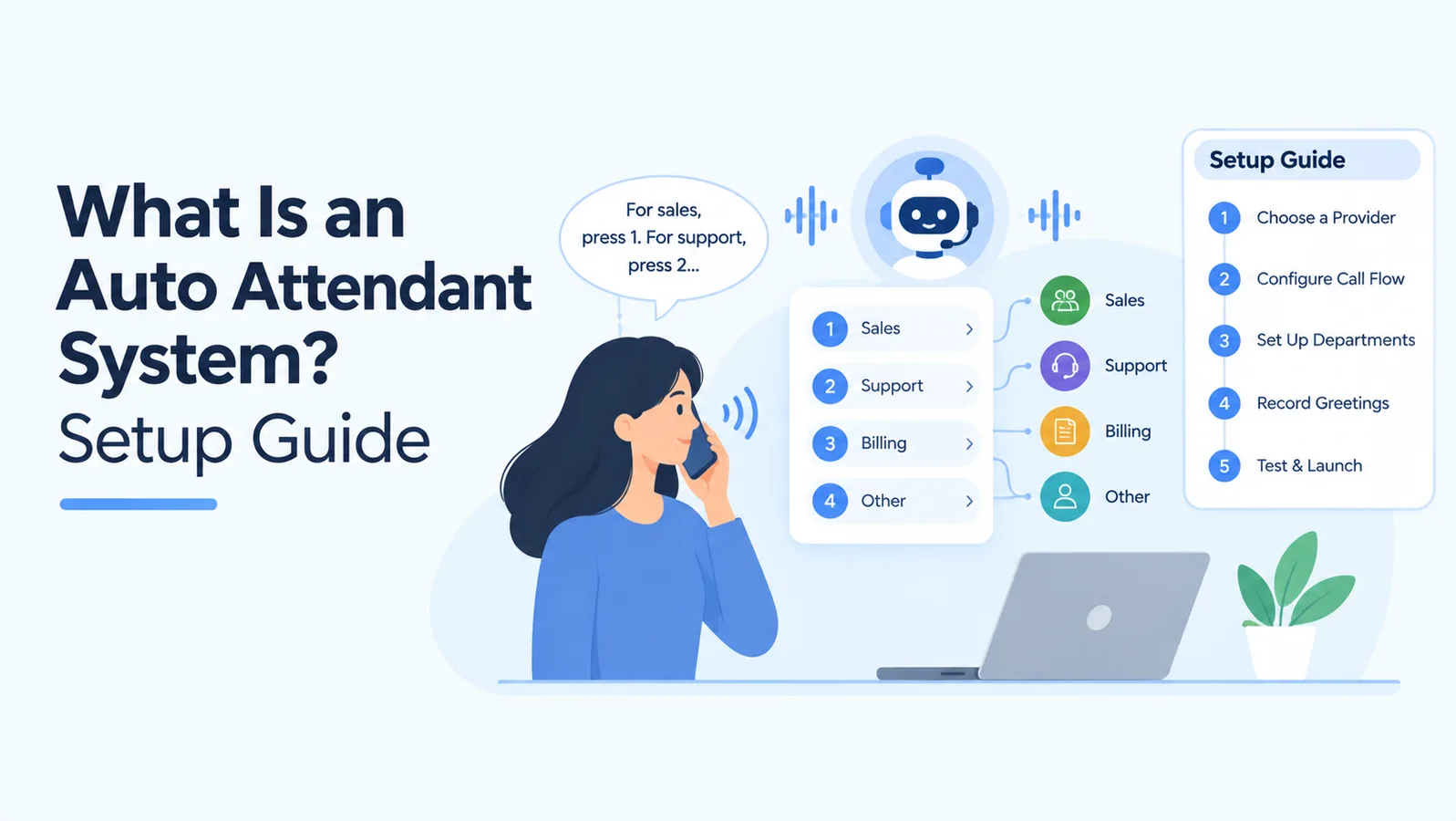
The phone rings. A voice announces the company name, the hours and where the call is being directed. An auto attendant system is that automated front door.
It’s not an employee attendance monitor. Sometimes the two are mixed up in searches due to similar wording. This article is about the telephone system.
Quick Answer Box
Auto attendant: Answers callers, routes according to your rules. IVR adds a menu they select from. India cloud options Exotel, Knowlarity, Zoho Voice, MyOperator, Acefone, Ozonetel. Setup is number, greeting, hours, destinations, overflow. Cloud builders are making multi-tier flows normal for small teams.
What an Auto Attendant Does
An auto attendant plays a greeting and sends the call according to rules the business defined. Examples:
During hours, ring the sales queue.
After hours, play a message and offer voicemail.
Route by the number dialled (different DIDs to different teams).
Announce a holiday closure and give an emergency path.
In pure form, callers don't get to choose from a menu. The system makes the decision.
An IVR might ask a caller to press 1 for sales, or say “billing.” Many platforms will blur the names and give you both a greeting and an optional menu. The obvious distinction is that the attendant follows you. The IVR waits for input .
In India cloud telephony, the feature comes in the same product as virtual numbers, queues and recording. You rarely buy a “stand alone auto attendant box” anymore.
Best Auto Attendant Systems for Small Businesses in India
Platform | Fit | Notes |
Zoho Voice | Already on Zoho | Simple attendant and routing, ecosystem fit |
Exotel | API and prepaid packs | Multi-level IVR / attendant in bundles |
Knowlarity | Fast virtual number + IVR | India-based, common for SMBs |
MyOperator | Small team, straightforward | Lower admin for basic flows |
Acefone | Seat-based centre later | Attendant inside broader plans |
Ozonetel | When you outgrow simple routing | Fuller contact-centre tools |
2026 India setup guide says same providers for IVR and routing and that most SMBs need a number plus rules, sometimes a menu, long before full queue analytics. Published pack sketches move (Exotel bundles from the ₹9,999 range, Knowlarity per-agent cards, Zoho number rental). Live confirmation.
A cloud attendant that forwards to mobiles is enough for a shop or a five person team. Don’t buy a 50 seat center for a greeting.
How to Set Up an Auto Attendant System for a Call Center
Get a number (city DID, mobile-style virtual, or toll-free) from the cloud provider. Complete KYC.
Decide the greeting: recorded human voice or text-to-speech. Keep it short. State the company and what happens next.
Set business hours and holiday rules.
Map destinations: queue, ring group, specific agent, external mobile, or voicemail.
Add overflow: if the queue is full or wait exceeds a limit, offer callback, another queue, or voicemail.
If you need choices, add an IVR layer on top of the attendant greeting.
Turn on recording and CRM logging if the platform supports it.
Test from an outside mobile at different times of day.
Train agents on transfers and on what the caller already heard.
Most of the providers have a visual editor. Drag the queue and the time check and the greeting Go public." Can you change the holiday message without an engineer.
If you have a real call center, then add queue reporting (waiting time, abandonment) when the attendant is stable. The attendant responds to the call in the right place. The center tools show if anyone replied.
Top Auto Attendant Service Providers with Indian Support
Exotel
Knowlarity (Gurugram)
Zoho Voice
MyOperator
Acefone / Servetel
Ozonetel
Tata Smartflo
These are the practical India options with local numbers, INR billing and support who understands TRAI and DLT context when you send SMS as well. There are global CCaaS platforms but they are rarely the first buy for an Indian SMB attendant.
Quality of support varies. Before you rely on the line for customers, ask for India business-hours coverage and a named onboarding contact.
Compare Features of Cloud-Based Auto Attendant Systems
Compare features of cloud-based auto attendant systems:
Feature | Typical cloud | Why it matters |
Visual flow builder | Yes on major India platforms | Change greetings and routes yourself |
Business-hours routing | Standard | After-hours message without a person |
Multi-level menu (IVR) | Usually included | Caller choice when rules are not enough |
Speech or DTMF | DTMF everywhere; speech on higher tiers or via AI add-on | Hands-free or accessibility |
Overflow and voicemail | Standard | No silent failure |
Recording | Common | QA and disputes |
CRM / lead create | Varies (strong on Zoho, available on others) | Call becomes a record |
Mobile app for agents | Common | Answer from anywhere |
AI voice agent behind the attendant | Add-on or separate | Handles the conversation after routing |
Cloud means no hardware PBX. You log in, edit the flow, and it’s used on the next call. Older PBXs still have on-premise auto attendants. They are an exception in the new India setups.
Don’t just look at the “attendant included” line. Look at total cost number of rental + minutes + seats.
Attendance Systems Are a Different Product
The terms automated attendance system, automatic attendance system and automatic attendance system using face recognition are all referring to employee time-tracking (badge, app or camera). Those products don’t respond to customer calls. If that's the case, check out HR or access-control vendors. The guide is still on the phone auto attendant the setup prompts describe.
Technical & Performance Data Matrix
Need | Layer | India starting point | Limit |
Greeting + hours | Auto attendant | Any major cloud platform | No caller choice |
Caller menu | IVR on top | Same platforms | Keep options few |
Queue and wait data | Contact centre | Ozonetel or fuller plan | Overkill for tiny teams |
Speech input | ASR add-on | Google-class or platform speech | Accent testing required |
AI conversation | Voice agent | Separate or integrated | Not a simple attendant |
Face attendance | HR system | Different category | Does not route calls |
The matrix keeps the phone job separate from biometric attendance.
Test the after-hours path. Most failures hide there.
Advice vs Strategic Thinking Matrix
Decision | Generic advice | Strategic thinking |
What it is | Fancy IVR | Rules-based greeting and route |
Small business India | Full call centre | Number + attendant + mobiles |
Call-centre setup | Buy seats first | Greeting, hours, queue, overflow, then measure |
Providers | Global brand | Exotel, Knowlarity, Zoho, MyOperator with India support |
Cloud features | Long checklist | Builder, hours, overflow, recording, CRM |
Face recognition | Same product | Different category entirely |
Generic advice upgrades too early. Strategic thinking gets one clean greeting and a reliable route live.
People Also Ask
Q: What is an auto attendant system?
An automated phone feature that greets callers and routes them by rules you set, without requiring the caller to choose.
Q: How is it different from IVR?
Attendant follows your path. IVR waits for the caller to press or speak a selection. Platforms often include both.
Q: Best for small businesses in India?
Zoho Voice, Exotel, Knowlarity, MyOperator or Acefone. Start with routing to mobiles.
Q: How do I set one up for a call centre?
Number, greeting, hours, queue or ring group, overflow, test from outside, then add reporting.
Q: Providers with Indian support?
Exotel, Knowlarity, Zoho Voice, MyOperator, Acefone, Ozonetel, Tata Smartflo.
Q: What do cloud systems typically include?
Visual builder, hours routing, menus, recording, overflow, mobile apps, and often CRM hooks.
Q: Is face-recognition attendance the same?
No. That tracks employees. It does not answer or route customer calls.
Q: Where does EchoLeads.ai fit?
EchoLeads.ai can act as the conversational layer after the attendant routes a call, or handle simple intents by voice. It is not the auto attendant platform and does not replace Exotel, Knowlarity or Zoho Voice for numbers and basic routing. Use the cloud attendant for the greeting and rules. Use a voice agent when the call needs a real back-and-forth.
If the attendant is live and callers still need a spoken conversation instead of a transfer, contact the EchoLeads.ai team.