
What Is an Escalation? A Handoff With a Note, Not a Shrug
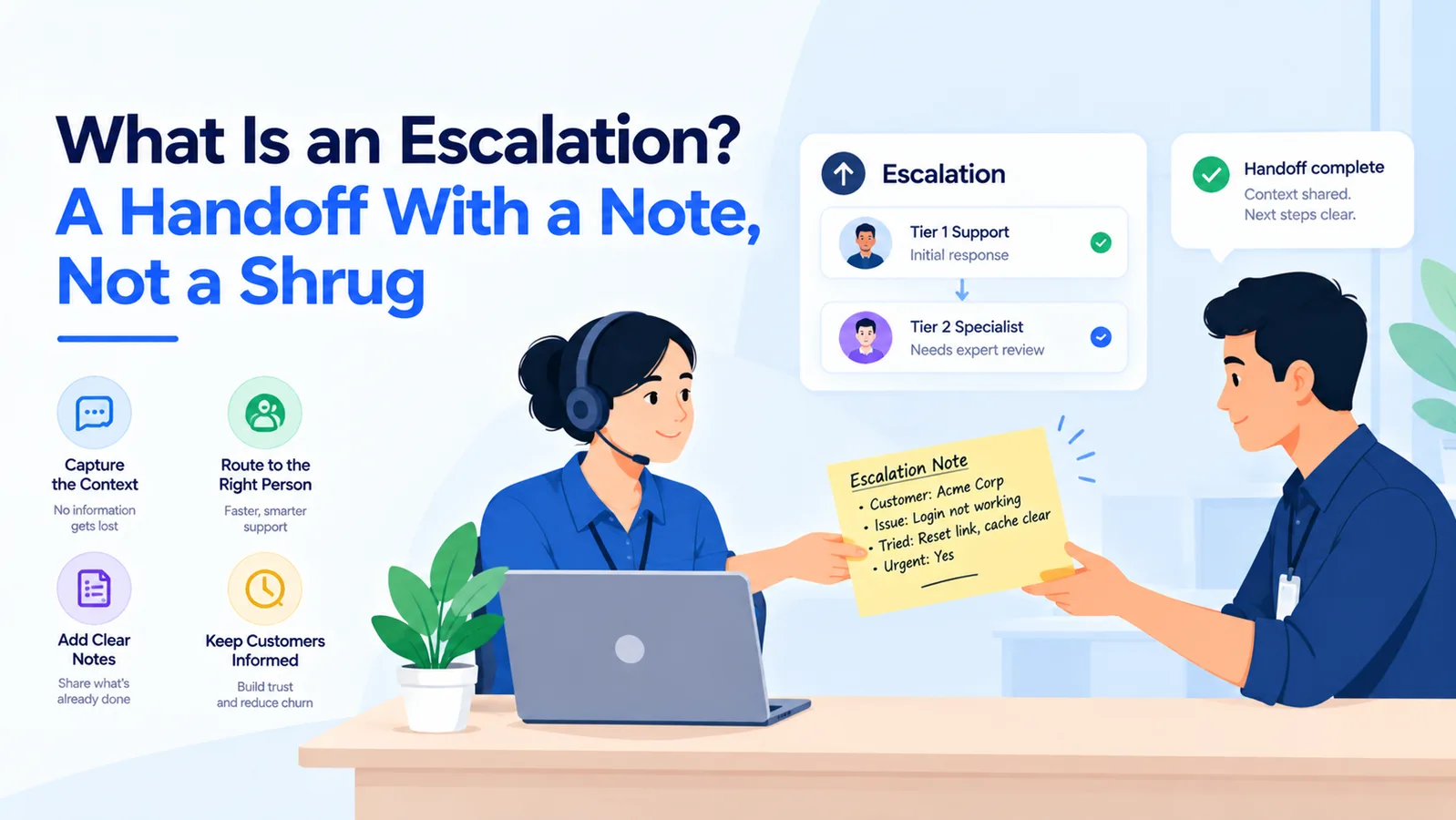
The customer has explained the failed payment twice. The agent says they are escalating and transfers the call. The next person asks for the order number again. That was not an escalation. That was a drop.
What is an escalation: It is the formal act of moving a problem to someone who can actually finish it, with the facts already attached.
Quick Answer Box
Escalation means a higher skill or a higher authority takes the case, on a clock, with a written note. Functional L1 to L2 Hierarchical tells a manager. A ticket with “user has issue” is not an escalation. Projects drive decisions, not every slip.
What Does Escalation Mean?
In business: Current owner has reached a ceiling The limit is skill, access, time or policy. They make the case rather than guess.
Two types appear on ITIL-style desks:
Functional. The payroll login needs someone who can see the app server. Skill changes.
Hierarchic. The outage is outside of the promised window or the customer is a named account. Change in authority. You tell a manager. The tech may still be the one fixing it.
They can both happen on one case. They’re not synonyms for “angry.”
Escalation Ticket
An escalation ticket is the record of that move. It should carry:
What the user wanted.
What they see now, including any error text.
What was already tried.
Account or order ID.
Priority and the SLA clock.
Who owns it next.
If the note is user has issue with payment the next tier has to start from beginning. Support teams that audited this pattern found large shares of L2 volume were password resets and status checks that L1 should have closed, because the handoff was empty.
What Is Escalation in Customer Service Processes?
The path a contact takes when the first agent cannot resolve it inside the script or the time box.
Typical triggers:
The customer has called about the same AWB three times.
The ask needs a refund above the agent’s cap.
A safety or fraud flag.
The SLA will breach in the next interval.
The caller asks for a supervisor. That request is a trigger, not an automatic admission that the company is wrong.
A clean service escalation tells the customer who to escalate to and when they will receive a response. It doesn't say "I'm escalating" and then hang up.
Payload is a chat ticket on a voice floor. Disposition, order ID, what was offered, what was refused. Without that the supervisor is a complete unknown.
How Does Escalation Work in IT Support Systems?
Levels are scopes, not ranks of politeness.
Level | Who | Typical work | Escalate when |
L0 | User, portal, bot | Password reset, how-to | The article does not match |
L1 | Service desk | Known fixes, access, status | Time box ends or access is missing |
L2 | Technical support | Config, hardware, logs | Root cause is outside the runbook |
L3 | Engineering or vendor | Code, design, security | L2 cannot change the system |
L1’s job is to first contact resolve known issues and then do a documented handoff. L2 can see things in the system that L1 can’t. L3 is for design and defects, not for a password miss. Some large providers add a L4 vendor tier. The little firms stop at three.
Tools like ServiceNow, Freshservice or Jira Service Management keep the clock going. If they are near a breach they can inform a manager. That notification has a hierarchy to it. The assignment to L2 is functional. “Do not confuse the email to a director with the fix.
Levels of Escalation
Levels of escalation in a company procedure are usually numbered, and they are not the same as L1, L2, L3.
A corporate ladder might be:
Agent or owner tries inside their cap.
Team lead, if time or tone crosses a line.
Function head, if money, legal, or a named client is involved.
Director, if the SLA penalty or a regulator is in play.
The matrix should have two columns, one for management tiers and one for IT skill tiers. A password reset never requires a director. Even if L1 caught it, a data leak always makes noise.
What Is an Escalation Process?
Steps that hold in a corporate environment:
Name the limit. Skill, money, time, or risk.
Attach evidence. Screens, IDs, what was tried.
Assign one owner. A group inbox is not an owner.
Set the next update time.
Tell the customer or the stakeholder that time.
Close or return with the outcome written on the same ticket.
Review repeats weekly. A case that escalates three times is a broken script, not a hero story.
Skip step 2 and the process is a transfer button.
What Is Escalation in Project Management and How Is It Handled?
Here the word means a stuck decision, not a helpdesk tier. The project manager has no authority to move a date, a vendor or a scope change, so they will take it to the sponsor or the steering group.”
Well played:
A sponsor can read one problem, one sentence.
Evidence of impact to date, cost or scope.
The decision you want, when you want it.
Options not a complaint.
A log so the same block doesn't come back next Friday as a surprise.
It’s for the hard stuff: a vendor who’ll miss a regulatory date, a budget gap, a risk that stops the critical path. Not for a task one day late and still in the team. The practice is led with identify and then evidence and then the authority who can actually choose.
If you have a project escalation, and you don't ask for a decision, it's a status report.
Technical & Performance Data Matrix
Setting | Move | Payload | Fail |
Service voice | Agent to lead | Order ID, offer, refusal | “Escalating” and a hang-up |
Service chat | Queue change | Transcript plus next ask | |
IT functional | L1 to L2 | Steps tried, error, access needed | “User has issue” |
IT hierarchical | Notify manager | SLA clock, impact | Director on a password reset |
Corporate | Cap exceeded | Money, legal, client name | Group inbox |
Project | Sponsor | Decision, date, options | Every late task |
The matrix is the procedure. A row without a payload is a transfer.
Three escalations of the same AWB means the first script is wrong.
Advice vs Strategic Thinking Matrix
Decision | Generic advice | Strategic thinking |
Meaning | Pass it up | Skill or authority, with a note |
Ticket | Raise priority | What was tried, who owns it next |
Service | Supervisor on request | Cap, repeat, or risk, then a time |
IT | More tiers | L1 closes known issues |
Corporate | Email the director | A ladder with evidence |
Project | Escalate delays | Escalate decisions you cannot make |
Generic advice inflates priority. Strategic thinking writes the handoff.
People Also Ask
Q: What is an escalation?
A formal move of a problem to more skill or more authority, with the facts attached and a clock.
Q: What does it mean on a ticket?
The case left the first owner. The note should say what was tried and who has it now.
Q: Levels?
In IT: L0 to L3 by skill. In a company: agent, lead, head, director by authority. Do not mix the columns.
Q: Customer service?
Trigger on cap, repeat contact, risk, or a looming SLA miss. Tell the customer when they will hear back.
Q: IT support?
Functional to L2 or L3. Hierarchical to a manager if time or impact grows. The manager email is not the fix.
Q: Corporate steps?
Limit, evidence, one owner, update time, tell the stakeholder, write the outcome on the same ticket.
Q: Project management?
A blocked decision for the sponsor, with options and a date. Not every slip.
Q: Where does EchoLeads.ai fit?
EchoLeads.ai should escalate only with a payload: account, intent, what was already offered, and the queue. It should not say “I am escalating” and drop the call. A handoff without the order ID is a failed contain, not a process.
If the bot or the IVR still transfers without the order number and the offer already made, contact the EchoLeads.ai team.