
What Is Customer Service in Aviation Industry
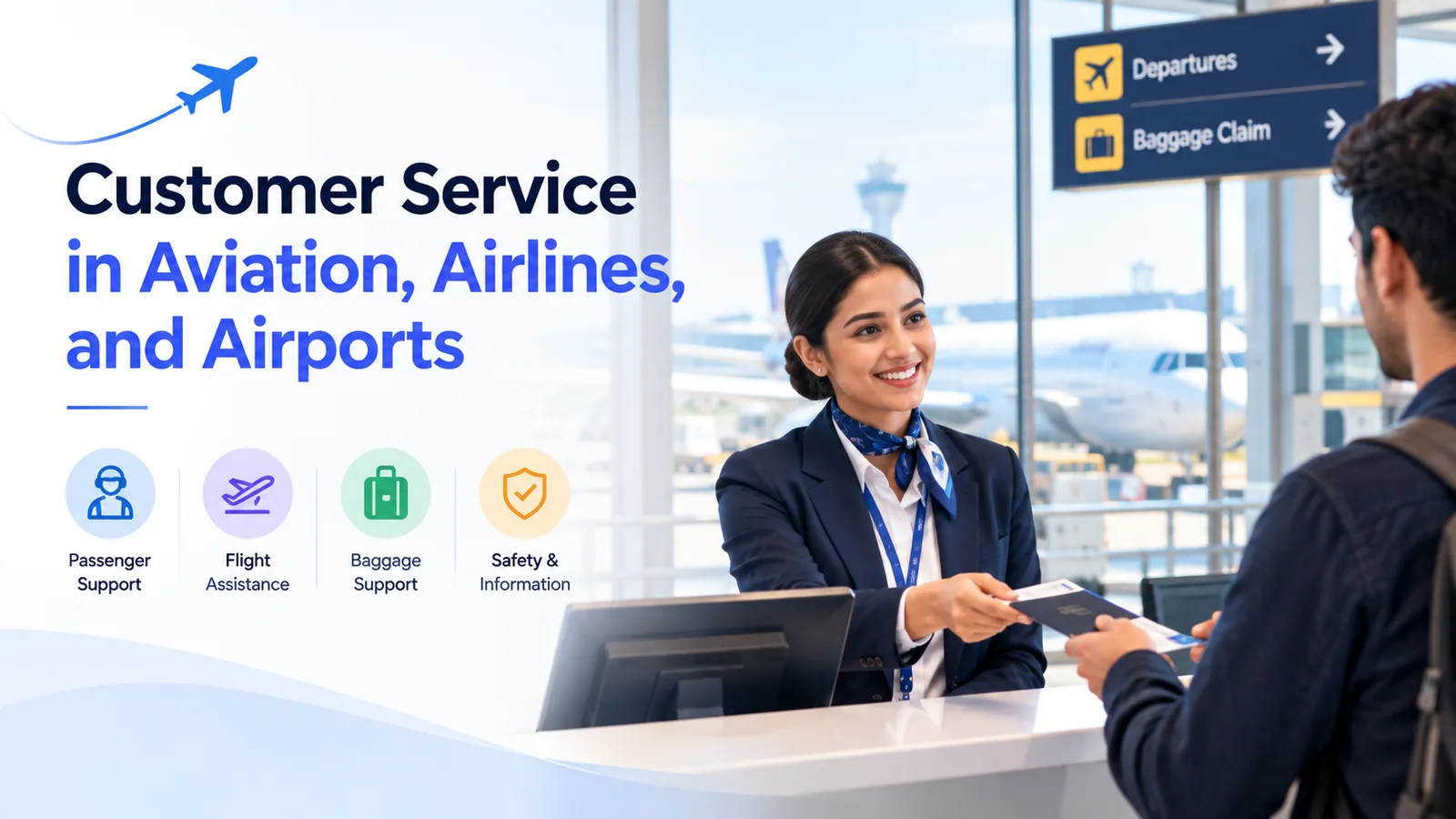
A passenger does not acquire “aviation.” They have a ticket that still says 14:10, a board that says 16:40 and a queue that says nothing. What is customer service in aviation industry work is closing that gap before the person in seat 18A makes up their own story.
It is not a smile only at boarding time. It’s the system that tells them the new departure, the hotel rule, the bag tag and who will answer the phone when the app fails.
Quick Answer Box
Aviation customer service is journey completion and recovery.” The contract belongs to the airlines. The airports own the building. The ground staff is the face at the check-in and the gate. When status is bad, excellence is the same status on every screen and person.
What Is Customer Service in Aviation?
What is customer service in aviation: the design and delivery of aid in a multi-party trip. The airline sells the passenger a place to sit. They are walking through a company airport. They meet the security and the immigration that are not working for the brand on the tail. Bags go through a handler. The passenger still calls the airline when any piece falls.
Service here is therefore:
Proactive information (delay reason, new time, options).
Transactional help (seat, meal, wheelchair, UM, refund).
Recovery (rebook, hotel, meal voucher, bag trace).
Care (PRM assistance, medical, families).
Trust (safety briefings that are clear, not theatrical).
KPMG’s work on CX in India airlines has continued to highlight the same drivers: timely communication on delays, hospitality of staff and support that can actually change a seat or a ticket. A large share of travellers said they would switch after a hospitality or reliability miss. A smaller but sharp share said they'd pay more for support that makes changes, refunds less painful.
What Is Customer Service in Airline?
What is customer service in airline operations is the brand the passenger sued in their head.
Airline-owned moments:
Website, app, call centre, chat, social.
Check-in rules, boarding groups, cabin service.
Irregular operations (IROPS): cancel, misconnect, crew duty, weather.
Loyalty and complaint handling, including regulator portals.
Airline service fails in two well-known ways. One is a cheap feeling cabin. The other is a contact center which grows eight to ten times in a disruption while the passenger still has no new PNR. Indian commentary on disruption has viewed the latter more as a problem of communication than as a problem of weather. What you remember is silence.
Digital is not necessarily service. A 2026 storm at a major US hub demonstrated the impact of reduced counters and the “use the app” policy, until the app can’t rebook everyone. “QR codes don’t re-accommodate a family when inventory is out.” Someone in authority does.
What Is Customer Service in Airport?
What is customer service in airport work is the place, not the ticket.
Airport-owned or airport-led moments:
Wayfinding, cleanliness, seating, washrooms.
Information desks and terminal announcements.
Security and immigration experience (often a state function, scored as “the airport” anyway).
Retail and food as part of dwell time.
PRM routes and landside-to-airside handoffs.
SKYTRAX’s 2026 best-airport-staff list continues to reward attitude and efficiency at help desks, security, shops and F&B, not just the airline lounge. The leaders were Narita, Centrair and Changi. That award is a reminder that passengers judge the building’s people even when the delay was the airline’s fault.
Demand for empathy and proactive staff rose even as biometrics and off-airport bag drop rose – a finding from ACI World’s traveller survey work, which continues into 2026. Technology is welcome when it cuts a queue. It is resented when it replaces the only human being who can open a broken process.
Importance of Customer Service in Aviation Industry
Importance of customer service in aviation industry is commercial, regulatory, and operational.
Loyalty and switch. Support quality shows up as both ambassador and switcher logic in India airline CX studies. People will change carriers after a hospitality miss.
Willingness to pay. Travellers report paying more for trusted operations and for support that can reschedule without a day of calling.
Cost of silence. One missed inbound wave becomes hotel claims, social posts, AirSewa tickets, and repeat calls. India’s Ministry of Civil Aviation set up a 24x7 Passenger Assistance Control Room that, by mid-2026 reporting, had closed tens of thousands of disruption grievances at a high redressal rate. That exists because ordinary channels drown.
Safety culture, visible. A crew that briefs clearly and a gate team that does not shout conflicting times are service and safety at once.
Contract and DGCA / passenger-rights rules. Compensation and facility duties during long delays are service obligations, not PR.
Service is cheaper than rebuilding trust after a televised queue.
Customer Service in Airline Industry PDF
Searchers want a customer service in airline industry pdf. There is no single official pamphlet that replaces an ops manual.
Use these instead of a random file:
IATA Passenger Services Conference Resolution Manual and passenger-experience manuals (industry rules for passengers and bags).
IATA Global Passenger Survey highlights (PDF-style insight pack).
Airline conditions of carriage and the country’s passenger-rights circular.
Airport ASQ / SKYTRAX methodology notes if you are benchmarking staff.
Core Components of Excellent Customer Service in Air Travel
What are the core components of excellent customer service in air travel?
Truth, branded by time. New departure, reason class (crew, weather, tech), next update time.
One record. One. Same PNR state was read by App, SMS, gate screen, agent.
Power on the edge. 40 minute call. Someone at the desk can issue a hotel or a confirmed seat without the.
Access. Wheelchair, neurodivergent queue design, language, hearing loops.
The truth about bags Track, trace, deliver, do not invent “it will come on the next flight” without a tag event.
Cabin care commensurate with the fare. A budget airline can still be honest and kind.
A human exception route. Regular self service. Staff for broken days. A helpful industry comment on where Southwest’s 2026 passenger experience stands is that you should get a person if you want to call, and tools free agents to walk the lobby.
TSA’s Ace agent is the other side of the same coin for a government touchpoint: automated routine packing questions with officers kept on the checkpoint. This is the aviation service division. This is by design.
How Major Airlines Ensure Consistent Passenger Experience Across Touchpoints
How do major airlines ensure consistent passenger experience across different touchpoints?
They do not, unless they treat status as a product.
Working pattern:
Single passenger record and a disruption playbook with template messaging
Push to app and SMS prior to the inbound spike.
Gate agents on devices with the same inventory as the contact center.
Airport handlers were briefed on the airline’s hotel and meal matrix, not a local hunch.
Social team looking at the same IROPS board.
Nite audit: Was the 22:00 SMS delay the same as the 22:05 gate announcement?
The usual failure is lack of consistency.” the app says go to the gate. Wait for hotel, the agent says. The board reads cancelled. That's three brands in five minutes.
Carriers in India with better scores for delay communication aren’t magically punctual. They warn the passenger in time to change to the connecting train.
Role of Ground Staff in Delivering Quality Aviation Customer Service
Explain the role of ground staff in delivering quality aviation customer service.
Ground staff and GHA agents are the airline on the floor:
Check-in and bag drop: document check without humiliation, weight honesty, PRM start.
Gate: boarding discipline, family boarding, last-minute seat saves, denied-boarding dignity.
Arrival: misconnect desks, bag desks, wheelchair handoff.
IROPS tents: the least loved and most valuable job in the building.
Ground staff can’t fix a missing plane. They can avoid the second injury: contempt, conflicting times, disappear from the counter.IATA passenger-handling supervision courses cover this as customer skills and standards: MCT, baggage rules, denied boarding, conflict, listening. The idea is the double brief. You'll be stuck without a DCS, even with soft skills. A skill-less DCS of conflict will go viral.
Providers of Customer Service Training Programs for Airline Personnel
Find providers of customer service training programs for airline personnel:
IATA Training: Airline Customer Service, Passenger Handling Supervision, Passenger Experience Excellence Diploma, service-design and data-insight courses. The industry default for transferable certificates.
Airline academies: in-house schools at full-service and large LCC groups. Best for brand standards and local language.
Ground handlers: Menzies, dnata, AISATS, Celebi-class GHAs train to IGOM plus the airline’s addendum.
Airport operators: ASQ-linked service programmes for information-desk and terminal staff.
Hospitality and CX firms: useful for empathy labs; weak if they skip IROPS law and DCS.
DGCA / national aviation academies where the state requires specified modules.
Buy training that includes a live disruption drill: 200 people, two counters, one broken printer. A slide on “delight” will not survive that room.
Technical & Performance Data Matrix
Touchpoint | Owner | Service job | Failure passengers remember | Training home |
Book / change | Airline digital + contact centre | Honest inventory, fare rules | Hidden fees, dead holds | Airline academy, IATA CS |
Check-in / bag drop | Airline or GHA | Documents, bags, PRM start | Queue with no update | Passenger handling |
Security / immigration | State + airport | Clear rules, pace | Surprise confiscation | Airport + agency |
Gate | Airline / GHA | Same status as the app | Boarding scrum | Gate + conflict |
Cabin | Airline crew | Safety + care matching fare | Rude brief, ignored call bell | Cabin safety + service |
Bags on arrival | Airline + handler | Trace with a tag event | “Next flight” fiction | Baggage standards |
IROPS | Airline ops + all above | New plan + clock | Silence | Disruption drill |
Regulator / AirSewa | Airline + MoCA | Close the loop | Open ticket, no owner | Complaint SOP |
The matrix is the map of the industry. Aviation customer service is not one team. It is eight owners who have to share one status.
If training is all about cabin smiles, the contact center will drown on a foggy morning.
Advice vs Strategic Thinking Matrix
Question | Generic advice | Strategic thinking |
What it is | Friendly staff | Journey completion plus recovery |
Airline vs airport | Same smile | Contract versus building |
Importance | Reviews | Loyalty, switch, surge cost, rights |
Download any guide | IATA manuals + current IROPS matrix | |
Core components | Delight scripts | Timestamp, one record, edge authority |
Consistency | Same logo on cups | Same PNR state on app, SMS, gate |
Ground staff | “Front line heroes” | DCS plus conflict plus hotel matrix |
Training | Motivational day | IATA + live disruption drill |
Generic advice buys a video. Strategic thinking buys a shared flight status and a staffed exception.
People Also Ask
Q: What is customer service in the aviation industry?
Help that lets a passenger finish the planned trip and recover when the plan breaks, across airline, airport, and handlers.
Q: What is customer service in an airline?
Ticket, cabin, rebooking, refunds, and the contact centre. The airline owns the contract even when the airport owns the queue.
Q: What is customer service in an airport?
Wayfinding, cleanliness, information, and the human path through security and the terminal. Staff awards score the whole building.
Q: Why does it matter?
Loyalty, switch risk, willingness to pay for support, and the cost of silent delays.
Q: Where is the PDF?
Use IATA passenger-experience manuals and the Global Passenger Survey, plus the carrier’s conditions of carriage.
Q: What do ground staff actually do?
Check-in, gate, arrival, bags, and IROPS desks. They turn a system status into a sentence a passenger can act on.
Q: Who trains airline service staff?
IATA, airline academies, GHAs, airport ASQ programmes, and national aviation schools. Demand a disruption drill.
Q: How can EchoLeads.ai fit aviation service?
EchoLeads.ai is able to tap into the high-volume voice work airlines are already doing: delay notices, rebooking eligibility questions, bag-trace status, and callback when the app shows a new time. It’s not a replacement for a gate agent who has hotel authority. Use it to keep the contact center standing when IROPS cause inbound calls to multiply.
Disruption days mean service stops when all passengers call at the same time. If your airline or GHA requires outbound and inbound voice that repeats the same timestamp the app already has, then reach out to the EchoLeads.ai team.