
What Is SDR in Sales: Role, Salesforce Agent, Tools, and Career Path
A software company hired two Account Executives and expected to see a pipeline. The AEs would spend mornings scouring for emails and afternoons on unqualified demos. Lost Discovery time on companies that were never a fit, so win rates remained low. When the company added Sales Development Representatives, the work split neatly. SDRs researched accounts, had introductory calls, and only passed meetings that fit the ideal customer profile. AEs did better discovery, and closed more of what they touched. The simplest answer to what is sdr in sales is that split.
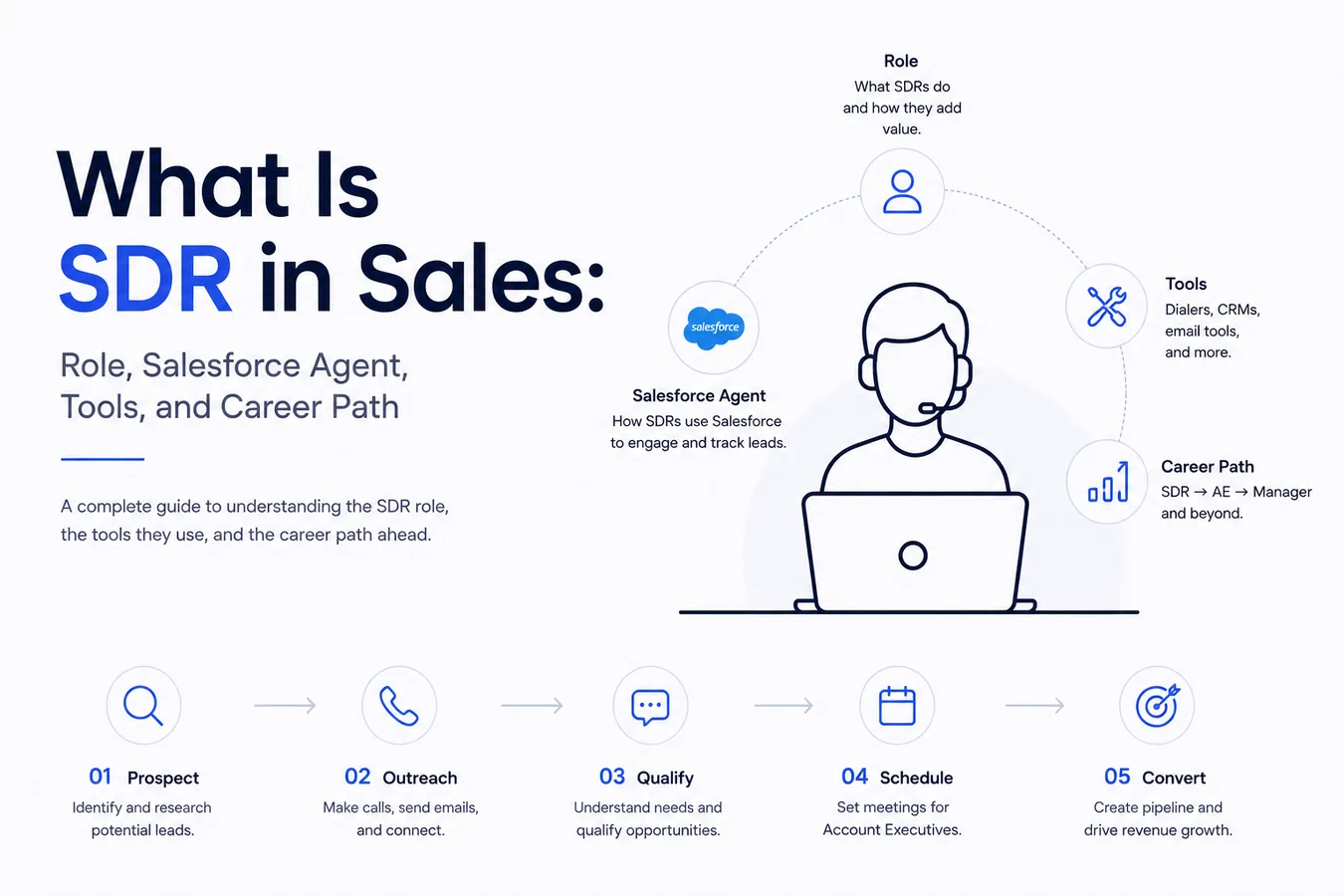
SDR is short for Sales Development Representative. In business it is the role that sits on top of the sales funnel. Find potential buyers, start a conversation, qualify fit and timing and book a meeting for someone that can close. The SDR is not part of the whole thing. The SDR owns creating qualified opportunities.
Quick Answer Box
What is SDR in sales: a Sales Development Representative is a pre-sales specialist who prospects, qualifies leads, and schedules meetings for Account Executives. The role exists so closers spend time on real opportunities instead of cold research and first-touch outreach.
What Is SDR in Business and What Is an SDR Role in Sales?
What is sdr in business is as much a question of process as it is a job title. Companies that sell to other companies have a long cycle, many stakeholders and expensive closing time. Capacity collapses if every closer has to build lists and chase cold replies. The SDR role is the specialised layer that converts raw names and inbound forms into meetings that are worthy of an AE calendar slot.
What is an sdr role in sales in daily work:
Target accounts and contacts research against an ideal customer profile
Run outbound sequences across email, phone and LinkedIn or work inbound leads from marketing
Qualify using frameworks such as BANT or a lightweight discovery scorecard
Schedule a meeting and draft a handoff note that the AE can utilize right away.
Record each attempt and result in the CRM
The role is measured on qualified meetings, accepted opportunities and sometimes pipeline value created, not on closed revenue. That’s deliberate metric design. Adding closing quota into the SDR job usually kills prospecting volume and meeting quality.
Titles differ. Some organisations name inbound qualifiers SDRs and outbound hunters BDRs. others exchange those names or use one for both. The work is the same idea, open the funnel so closers can close it.
What Is the Role of an SDR in a Sales Team?
The handoff chain is typically marketing to SDR to Account Executive to Customer Success on a full B2B team.
Marketing creates awareness and creates interest. The SDR reacts quickly to incoming interest and creates additional interest through outbound. The AE handles discovery, demo, proposal and negotiation. Customer Success onboards and grows the account.
The SDR is the quality filter and the volume engine. Without that filter, AEs get lost in curiosity calls. Without that engine the company is just relying on inbound luck.
Great SDR teams feed the rest of the company, too. Every conversation generates objections, competitor names and mismatches on ICP. This feedback helps to improve messaging, targeting, and product positioning. In that sense the SDR is as much a pipeline worker as an early warning system for go-to-market quality.
Team design in 2026 is leaner than the big calling floors of the past decade. Many companies have smaller SDR teams with more tools. AI drafts research and initial emails. Humans choose the accounts, run the live chats and determine what is really qualified. The Bridge Group’s latest research continues to demonstrate meaningful pipeline per SDR when the function is managed as a system vs. raw activity.
How Do SDRs Contribute to the Sales Process in Technology Companies?
Technology companies, particularly SaaS and B2B software, need SDRs because the product is complex, the buyer committee is large, and marketing alone rarely leads to sales-ready conversations.
Contribution can be measured in four ways.
First speed on inbound A content-led or product-led tech company drives trials, demo requests and content downloads. An inbound SDR responds when interest is high, confirms use case and authority, and books the AE or recycles the lead.
Second, coverage of target accounts. Enterprise and mid-market tech sales rarely close from a single contact. SDRs multi-thread, pinpoint economic buyers, champions and technical evaluators within the same account and start more than one conversation.
Third, AE time protection. Tech AEs need hours for discovery, security reviews, custom demos. Every hour on unqualified first touches is an hour not spent on a deal that could close this quarter.
Fourth, signal gathering. Tech markets change fast. SDRs hear what integrations buyers ask about, what competitors come up and what pricing objections come up again and again. "When leadership applies that intelligence it is as valuable as the meeting itself."
SDRs at tech companies take a messy top of funnel and turn it into a predictable meeting machine, so product-led growth and sales-led growth can coexist.
What Is SDR Agent in Salesforce?
What is sdr agent in salesforce is a different question from “what is a human SDR.”
The Agentforce family from Salesforce includes AI sales agents that automate portions of top-of-funnel work inside the CRM. The template historically known as SDR Agent is documented in 2026 as Agentforce Engagement or Lead Nurturing. It can email leads, answer common questions, follow up and book meetings so human reps spend more time on live selling. Other related capabilities include website or messaging lead capture and meeting booking. The Salesforce documentation also discusses other sales agents like Sales Coach and employee-facing agents.
The practical distinction:
A human SDR is an employee who researches, judges fit and has conversations.
A Salesforce SDR Agent is a software that leverages your data, messaging and calendar rules to nurture and route work that is already in Salesforce.
The agent is only as good as the ICP definition, the lead data and the routing behind it Confidence without relevance: A vague value proposition leads to outreach. Successful teams see the agent as additional capacity on clean inbound or tightly defined outbound, not as a replacement for judgement on strategic accounts.
What Tools Do SDRs Commonly Use to Generate Leads?
SDR lead generation is a stack, not a single application.
CRM is the system of record. Most common in B2B technology: Salesforce & Hubspot. Every call, email and meeting should be on there.
Data and enrichment tools find and fill contacts. Apollos uses sequencing and a large contact database. We use clay a lot to waterfall a lot of data sources and build account lists from signals. ZoomInfo is still dominant in big orgs that are already buying it.
Sales engagement platforms set the cadence. Outreach and Salesloft are the enterprise standards for multi-step email, call and task sequences with coaching and governance. Apollo often wins for smaller teams who want data and sequences all in one place. Some teams split sending to tools focused on deliverability and leave the CRM as the source of truth.
Dialler, call recording, LinkedIn. Tools for conversation. With conversation intelligence platforms, managers can coach based on real calls, not just activity counts.
AI is everywhere in the stack: research summaries, first-draft emails, meeting notes, and in some companies, autonomous nurture agents. The rule for production in 2026 is easy. Let AI do the first draft. "Let the SDR check before anything customer facing goes out.
How to Become a Successful SDR in the B2B Sales Sector
Success is not the number of activities. AEs only accept and convert consistently qualified meetings.
Step one: Build ICP fluency. If you can’t explain who the company sells to, why they buy now and who shouldn’t be in the pipeline, volume will create noise. Listen to won-deal records Shadow discovery calls. Rewrite the ICP in your own words so that a manager cannot find flaws in it.
Make a daily operating system. Research a set list of accounts. Combine calls, emails, and social touches. And look at yesterday's results before adding new names. The best people treat the calendar like a factory: same blocks, same review habit, same definition of a qualified meeting.
I have done the homework. The generic templates are filtered. One specific trigger, one relevant problem, one clear ask. Beats a long pitch.
Qualify with honesty. A win is not booking a meeting where the AE immediately says no. Validate need, timing and a stakeholder who can drive the process. Then create a handoff with context, not just a calendar link.
Learn the tools; don't become a tool operator. The career market in 2026 rewards people who can run AI assisted research and still have a live conversation. “Software is winning on list-building and first drafts,” says Zuker. “Employers are hiring more for judgement and quality of talk track.
A practical differentiator for people breaking in with little experience is to attach a small target-account list and sample outreach to the application. It means you know the job before anyone hires you to do it.
In US B2B SaaS, the career path is typically SDR to AE, in 18 to 24 months, faster for those that consistently quota and have high meeting to opportunity conversion. Other paths are senior SDR, team lead, RevOps, customer success. Often the time in the seat is purposely short. The role is more of an apprenticeship on pipeline and conversation than a permanent title.
Technical & Performance Data Matrix
Element | Typical SDR focus | How it is measured | Common 2026 tools |
Inbound qualification | Fast response to marketing leads | Speed to lead, SQL rate | CRM + engagement sequence |
Outbound prospecting | Net-new accounts that fit ICP | Meetings from outbound, account coverage | Apollo, Clay, Outreach, Salesloft, dialer |
Qualification | Fit, timing, stakeholder | AE accept rate, opp conversion | Scorecards, call notes |
Handoff | Context the AE can use immediately | Show rate, AE feedback | CRM fields, call recording |
Salesforce AI layer | Nurture, FAQ, meeting booking | Meetings booked by agent, opt-outs | Agentforce Engagement / Lead Nurturing |
Coaching loop | Improve talk track and targeting | Call quality rubric, quota trend | Conversation intelligence |
The matrix explains why activity-only dashboards fail. Calls and emails do not count unless they result in accepted meetings. The middle of the table is where tech companies that scale SDRs well instrument: qualification quality and handoff quality. Tools on the edges (more data, more AI drafts) help only as long as those middle measures stay healthy.
Comp plans are typically base salary plus variable pay for meetings or pipeline. In 2026, published US ranges tend to hover around a mid-five-figure base, with on-target earnings higher when quota is achieved, and considerable variation by city, segment, and company stage. Local markets vary. Ramp is a more useful planning number. Most teams expect to be partially productive in the first 60 days and at full run-rate near day 90 if the training is real.
AI shifts research, first-touch drafting left; alters matrix. It doesn’t eliminate the need for a human who can hear a vague “send me information” and decide if that’s curiosity or a real buying motion.
Risk Analysis and Role Design Considerations
Common failure modes: spray-and-pray outreach that wrecks domain reputation, booking unqualified meetings to hit a metric, and treating the Salesforce agent as a set-it-and-forget-it closer. Mitigation includes tight ICPs, AE accept-rate as a quality gate, deliverability monitoring and human review of AI generated messages.
Another risk is activity theatre burnout. Celebrating dials doesn't build long tenure and weak pipeline. Leaders who celebrate accepted opportunities and clean CRM data retain both people and forecast quality.
Advice vs Strategic Thinking Matrix
Situation | Generic Advice | Strategic Thinking |
Defining the SDR job | “Just book meetings” | Book meetings AEs accept and that convert to opportunities |
SDR vs BDR titles | Argue about the acronym | Decide inbound versus outbound ownership and measure each fairly |
Salesforce SDR Agent | Turn it on for every lead | Use it on clean data and approved messaging; keep humans on strategic accounts |
Tool stack | Buy every popular platform | Cover CRM, data, cadence, and conversation with as little overlap as possible |
Personal success | Maximize daily touches | Maximize verified conversations with ICP accounts |
Career growth | Wait to be promoted | Hit quality quota, document talk tracks, and show AE-ready discovery skills |
Tech company process | Copy a famous SaaS org chart | Size the SDR layer to inbound volume plus named-account coverage |
Generic advice optimizes motion. Strategic thinking optimizes pipeline quality and the next role the SDR is being trained to hold.
People Also Ask
Q: What is SDR in sales in simple words?
An SDR is the person that finds the potential customers, starts the first conversation, qualifies if they are a good fit, and sets up a meeting for the salesperson who will close the deal.
Q: What is SDR in business?
In business it’s the specialised function that creates qualified pipeline. It is between marketing and closing so that the expensive closers aren’t spending all day doing cold research.
Q: What is an SDR role in sales compared with an AE?
SDR opens and qualifies. The Account Executive is responsible for discovery, demo, negotiation and close. The SDR is measured on meetings and opportunities generated. AE is measured on revenue.
Q: What is an SDR Agent in Salesforce?
It’s an AI sales agent inside Salesforce. Written in 2026 as Agentforce Engagement or Lead Nurturing (previously SDR Agent). It can email leads, answer frequently asked questions and set up meetings. It’s a software capacity, not a human hire.”
Q: How do SDRs contribute in technology companies?
They respond swiftly to inbound product interest, prospect named accounts, multi-thread buying committees, protect AE time on complex deals, and feed market signals back to product and marketing.
Q: What tools do SDRs use to generate leads?
CRM (Salesforce or HubSpot), data tools (Apollo, Clay, ZoomInfo), engagement platforms (Outreach, Salesloft, Apollo sequences), a dialler, LinkedIn, and more and more AI for research and first drafts.
Q: How do you become a successful SDR in B2B?
Know the ICP well, do the same day in day out, customise outreach, qualify honestly, write great handoffs, and use AI as a drafting engine, not as an unsupervised sender. Track AE acceptance rate. Not just volume.
Q: How can EchoLeads.ai support SDR and sales development teams?
EchoLeads.ai provides AI voice and omnichannel outreach for top-of-funnel contact, follow-up and meeting setting. For teams looking for voice capabilities beyond human SDRs, EchoLeads.ai is able to be part of a modern sales development stack.
If a sales organization wants to increase qualified first conversations without increasing headcount, it can combine a strong SDR process with intelligent outreach. Contact the EchoLeads.ai team to learn more about AI voice support for prospecting, follow-up and appointment setting.