
Most Affordable WhatsApp Automation for B2B Lead Qualification (2026)
Finding cost-effective WhatsApp automation for B2B lead qualification requires balancing platform subscriptions, Meta conversation fees, compliance requirements, and response-speed impact on conversion rates.
True affordability isn't about lowest monthly pricing—it's about minimizing total cost per qualified lead while maximizing revenue impact through instant response and compliant automation.
Key Takeaways
Total cost of ownership includes platform fees ($40–$400/month), Meta conversation charges ($0.005–$0.08 per message), compliance risk, and revenue lost to slow response times
Official WhatsApp Business API is legally required for automation—non-API shortcuts risk permanent account suspension and lack compliance safeguards
AI-powered qualification justifies premium pricing for multi-turn discovery and BANT qualification, while rule-based automation suffices for simple yes/no triage
Compliance-first platforms with automated opt-in workflows, 24-hour window enforcement, and CRM integration deliver better ROI than low-cost tools lacking these safeguards
Response speed matters: replying within 5 minutes is 21X more effective than waiting 30 minutes for B2B lead conversion [1]
The most affordable WhatsApp automation platform for B2B lead qualification isn't the one with the lowest monthly fee, it's the one that minimizes total cost of ownership while maximizing revenue impact. True affordability factors in platform subscription, Meta conversation charges, hidden compliance and setup costs, and the revenue lost to slow manual responses.
The Three-Tier Cost Model: Platform, Usage, and Hidden Expenses
Evaluating WhatsApp automation requires understanding three cost layers. Platform subscription covers software access, ranging from $40 to $400+ monthly depending on feature depth and user seats. Meta conversation fees, charged per 24-hour conversation window, add $0.005 to $0.09 per interaction depending on your market. Hidden expenses include setup labor (API integration, workflow design), compliance risk (policy violations can suspend your Business Account entirely), ongoing maintenance, and training time. A $50/month platform with no API access may require 15 hours of manual work weekly, effectively costing more than a $300/month solution that automates the same tasks in minutes.
Why the Cheapest Platform May Be the Most Expensive
Low-cost platforms often lack official WhatsApp Business API access, forcing teams to use consumer accounts that violate Meta's Terms of Service and risk permanent bans. They also defer critical tasks, lead routing, qualification logic, CRM sync, to manual workflows that slow response times. Research shows responding within 5 minutes is 21X more effective [1] than responding after 30 minutes. When a $99 automation platform cuts your response time from 45 minutes to under 5, the revenue lift from improved conversion rates dwarfs the monthly subscription difference. The cheapest tool becomes expensive when it costs you qualified leads.
Understanding true affordability starts with recognizing the compliance divide that separates legitimate automation from risky shortcuts.
The Hidden Cost of Non-Compliant WhatsApp Automation
Official Business API vs Non-API Tools
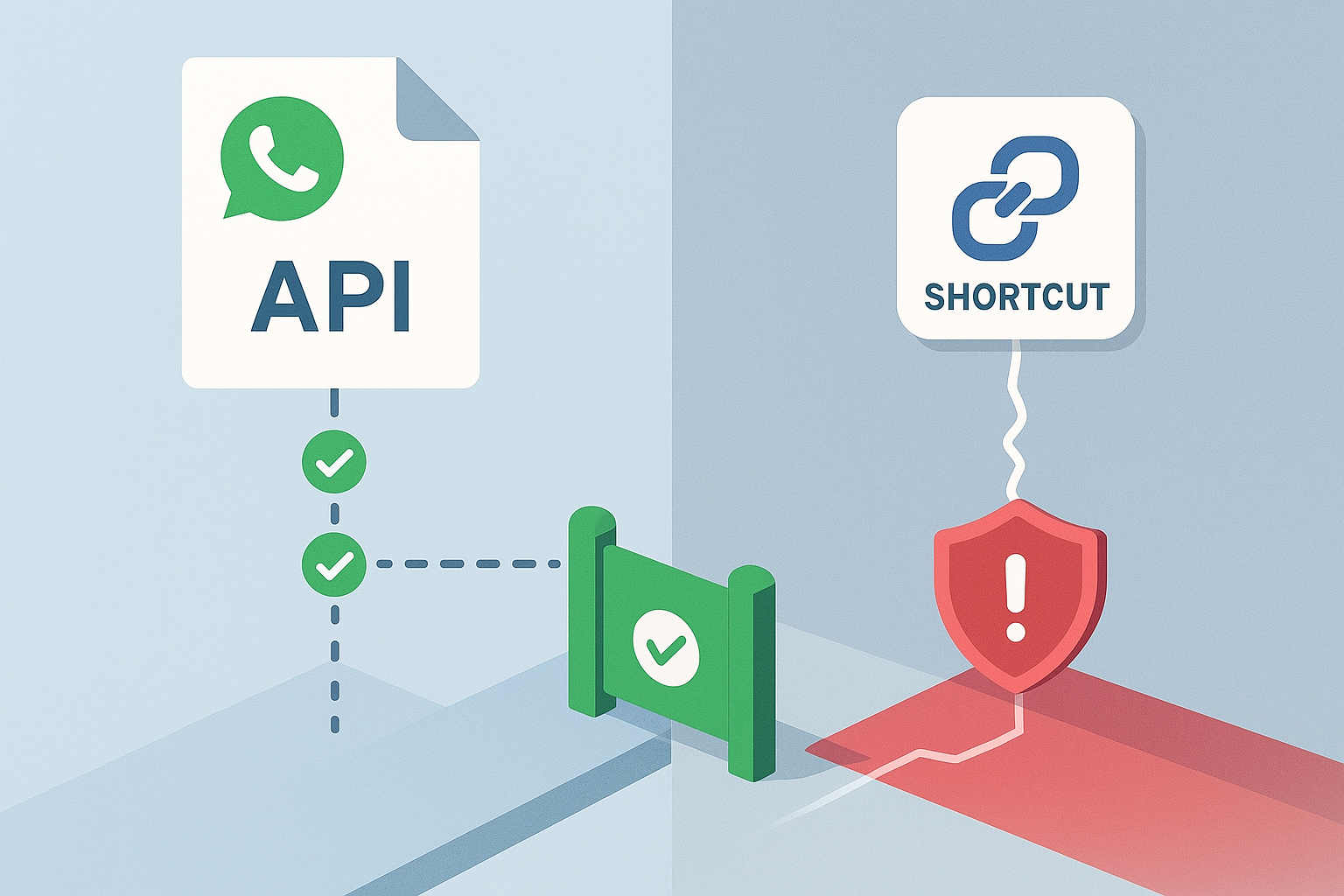
The WhatsApp automation market splits into two fundamentally different categories: platforms built on the official WhatsApp Business API and non-API shortcuts that scrape the consumer app. Official API access requires Meta verification and partner onboarding, a 3-7 day approval process [3], but it's the only compliant path. Non-API tools promise faster setup and lower upfront costs, yet they operate in a gray zone that Meta actively polices. The compliance gate isn't bureaucratic overhead; it's the difference between sustainable automation and account suspension risk.
What WhatsApp Compliance Actually Requires in 2026
Meta enforces four non-negotiable rules for business messaging. First, opt-in consent: every recipient must explicitly agree to receive messages before you send the first one. Second, the 24-hour conversation window: after a customer messages you, you have 24 hours to reply freely; outside that window, you can only send pre-approved templates. Third, template approval: all outbound messages must use templates Meta reviews and approves in advance, no ad-hoc promotional blasts. Fourth, rate limits and quality scores: Meta throttles accounts that trigger blocks or reports, and pricing now ties directly to message delivery [2], ranging from $0.005 to $0.08 per template depending on the recipient's country. Non-API tools bypass these checks, exposing businesses to permanent bans and the manual cost of rebuilding contact lists on compliant infrastructure.
With compliance requirements clear, the next decision point is choosing a pricing model that aligns with your monthly conversation volume and budget predictability needs.
Pricing Models Compared: Usage-Based vs Flat-Rate for Lead Qualification
How Per-Conversation Pricing Works and When It Scales
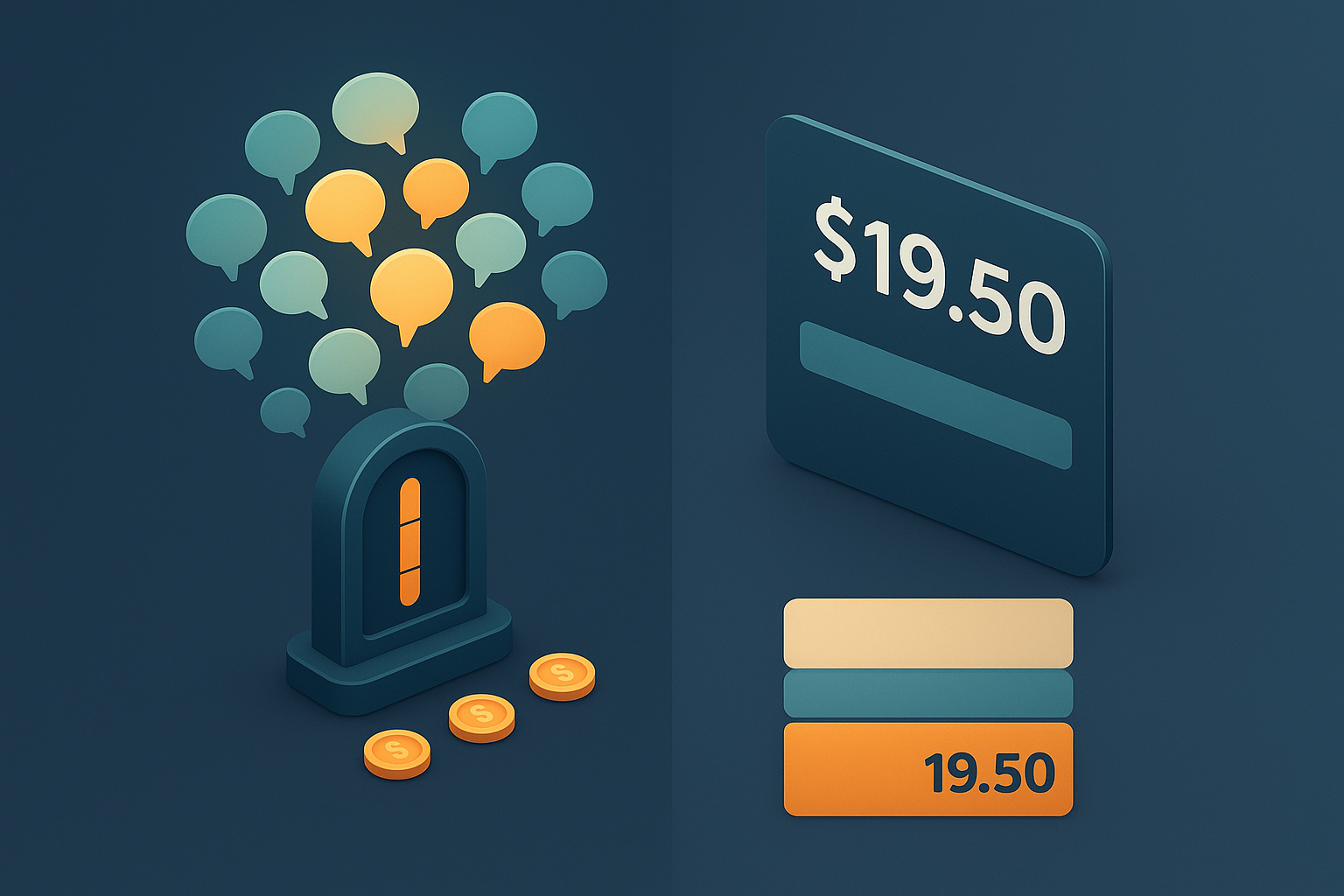
Meta's conversation-based billing [2] charges per template message delivered, with rates varying by recipient country, typically $0.005 to $0.08 per message. Provider platforms layer their own markup on top, often adding 20 to 40% to the base fee. For a B2B team qualifying 500 conversations monthly at an average $0.03 per conversation plus 30% markup, total cost runs approximately $19.50/month. Light-volume scenarios favor this model because you pay only for active leads, avoiding fixed overhead when inbound flow is unpredictable or seasonal.
Flat-Rate Pricing for High-Volume B2B Lead Qualification
Fixed monthly subscription plans, ranging from ₹2,000 to ₹3,000 ($24, $36) for mid-tier tiers, deliver predictable budgeting and become cost-efficient above roughly 1,200 conversations per month at the $0.03 effective rate. High-volume B2B pipelines exceeding 5,000 monthly conversations see the steepest savings: flat-rate caps total spend regardless of surges, whereas usage-based billing can balloon to $200+ during peak quarters. Hybrid models that combine a base subscription with discounted overflow rates offer a middle path for teams with moderate but variable lead flow.
Pricing models set the budget framework, but the features you select determine whether that investment converts leads efficiently or simply automates mediocrity.
Key B2B Lead Qualification Features Worth Paying For
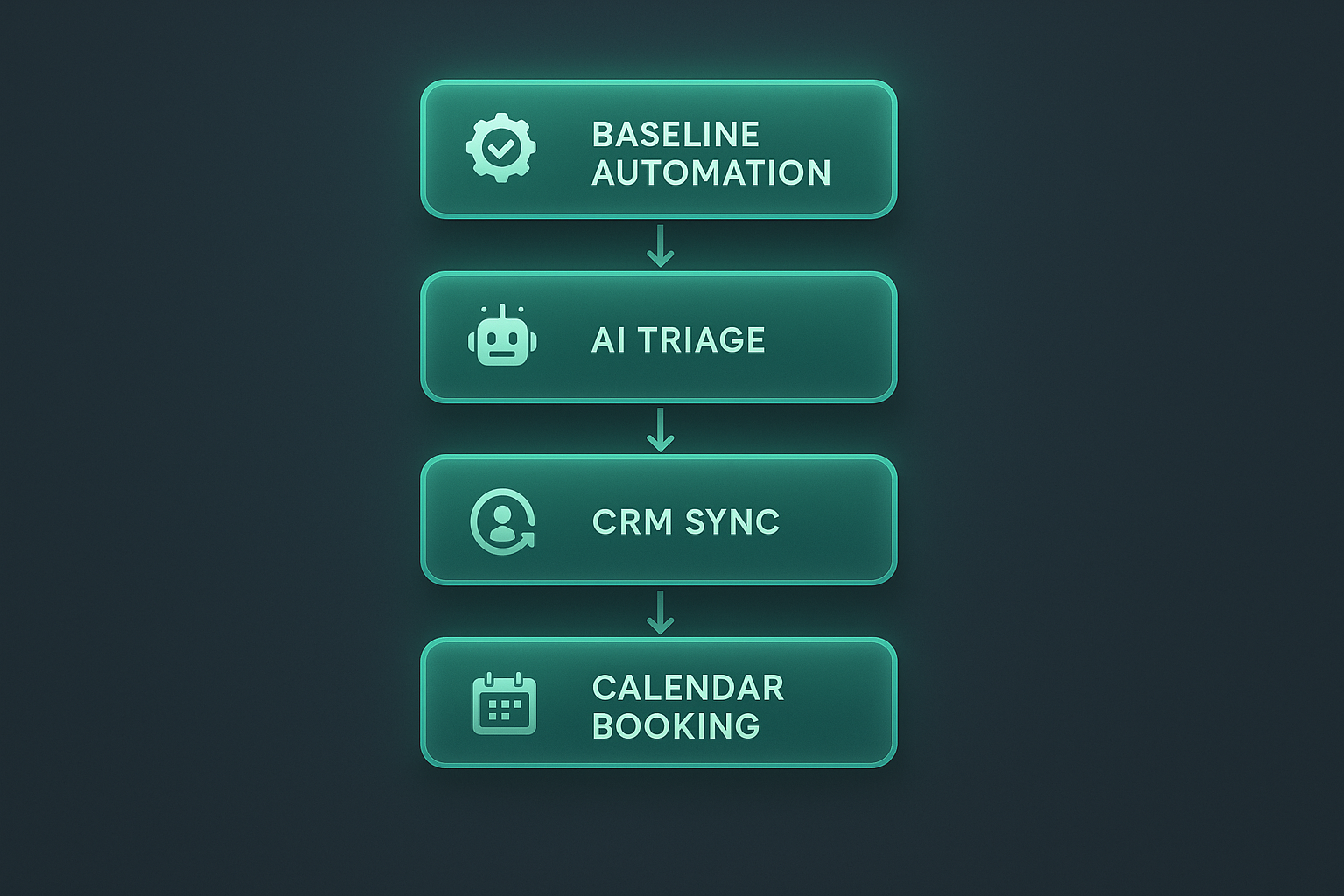
Not all WhatsApp automation delivers the same return. The B2B lead qualification baseline, AI triage, CRM sync, calendar booking, and conversation continuity, separates platforms that save time from those that waste it [8]. Here's what justifies premium pricing.
AI Qualification Logic vs Template-Based Responses
Template-based automation relies on keyword triggers: if a prospect types "pricing," the bot fires a predefined message. AI qualification understands intent across multi-turn conversations, asking follow-up questions about budget, timeline, and decision authority without rigid scripts [7]. Platforms using AI-driven lead qualification report 45-60% higher conversion rates [4], justifying the premium when your sales cycle depends on nuanced triage. Rule-based bots cost less upfront but create friction when prospects answer in unexpected ways, forcing manual handoffs that erase efficiency gains.
CRM Integration and Calendar Booking for B2B Workflows
Platforms lacking native CRM sync force reps to manually copy WhatsApp data into Salesforce or HubSpot, erasing the affordability promise. Top-tier WhatsApp platforms with automated lead nurturing and CRM integration reduce sales cycles by up to 30% [5] by syncing qualification data in real time. Calendar booking is equally non-negotiable: qualified leads should book discovery calls without leaving the WhatsApp thread [7]. Solutions that require manual scheduling or external links add friction at the highest-intent moment, losing prospects who won't jump through extra hoops.
Choosing the right feature depth requires understanding when simple automation suffices and when AI-powered conversation intelligence justifies premium pricing.
When to Choose Rule-Based vs AI-Powered WhatsApp Automation
A simple heuristic: if your qualification is a fixed set of yes/no questions, rule-based automation may suffice. If it requires multi-turn discovery, asking follow-ups based on answers, clarifying ambiguous input, or steering the conversation toward budget, authority, need, and timing, AI is the safer bet.
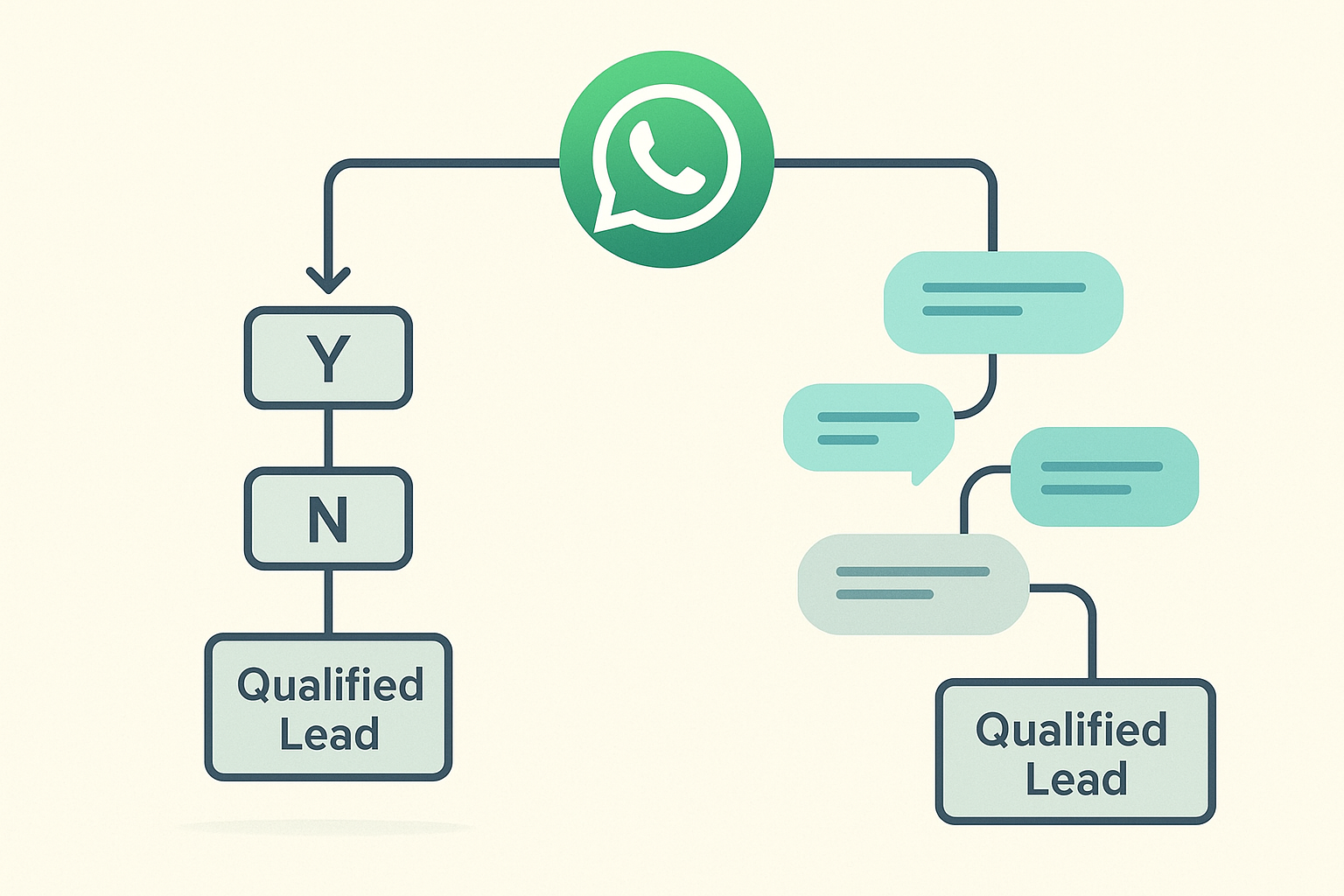
Rule-Based Automation: When It Works and When It Breaks
Rule-based tools excel at simple FAQs, appointment confirmation, and order status [6]. They break down when leads give ambiguous input ("I'm interested in the premium option, maybe"), need multi-step nurture sequences that branch on prior answers, or when your product fit depends on nuanced intent. Constant template maintenance becomes the hidden cost: every new edge case demands a new rule, and coverage degrades fast.
AI-Powered Qualification for Complex B2B Sales Cycles
AI justifies premium pricing when your sales cycle involves multi-stakeholder buying, budget/authority/need/timing (BANT) qualification, and intent signals buried in conversational context. Modern AI agents handle 70 to 85% of incoming chats end-to-end [6], update CRM records in real time, and trigger workflows without human handoff. The cost of slow or inaccurate qualification, missed opportunities, wasted rep time, often dwarfs the monthly platform fee in B2B environments where each qualified lead carries four- or five-figure revenue potential.
How EchoLeads Balances Affordability with Compliance-First Architecture
EchoLeads Pricing and Feature Set
Platform | Pricing | API Support | AI Qualification | CRM Integrations |
|---|---|---|---|---|
EchoLeads | $25/month flat rate | WhatsApp Business API | AI-driven adaptive logic | Bi-directional sync |
Wati | From $49/month | WhatsApp Business API | Template-based | Third-party integrations |
Interakt | From $79/month | WhatsApp Business API | Basic automation | Limited CRM sync |
AiSensy | From $59/month | WhatsApp Business API | Rule-based flows | Standard integrations |
EchoLeads offers flat-rate pricing starting at $25/month, providing automated WhatsApp sales and support workflows with compliance-first architecture. The platform implements an automated opt-in system and message monitoring safeguards to maintain WhatsApp policy compliance, while AI-driven qualification logic adapts to prospect responses. Template compliance is handled automatically, and the platform deploys in 72 hours using pre-configured industry templates.

Strengths and Limitations for B2B Lead Qualification
Strengths: EchoLeads excels in compliance automation through built-in opt-in workflows and rate-limiting safeguards, adaptive AI qualification that responds to prospect behavior rather than static templates, and multi-channel continuity across WhatsApp, voice, and SMS. Bi-directional CRM sync ensures lead data flows seamlessly without manual entry.
Limitations: Custom workflow complexity may require consultation beyond the 72-hour standard deployment window. Pricing transparency for highly tailored implementations requires direct engagement. The platform is not positioned as a full substitute for human sales teams in all scenarios; high-intent prospects and complex objections escalate to human agents.
Conclusion
Low-cost platforms like IDB2B ($49/month) may reduce upfront spend but often lack AI qualification and compliance safeguards, creating downstream costs through manual work and policy violations. Premium platforms like Wati (₹4,899/month ) include deep CRM integrations and proven track records (4.6/5 on Capterra, $35M in sales) but may exceed budget for small-volume use cases.
As WhatsApp tightens compliance enforcement in 2026 and AI qualification becomes table-stakes for B2B sales, the affordability equation will continue to shift from headline pricing to total cost of ownership, platforms that automate compliance and accelerate response time will deliver the best ROI.
Compare EchoLeads, Wati, Interakt, and AiSensy using the total-cost framework outlined in this guide, or explore EchoLeads' WhatsApp automation to see how it fits your B2B lead qualification needs.
Frequently Asked Questions
What is the average cost of WhatsApp automation for B2B lead qualification in 2026?
WhatsApp automation costs combine two components: platform subscriptions ranging from $40 to $400+ monthly depending on features, and Meta conversation fees of $0.005 to $0.08 per message [1]. Total cost typically runs $100, $1,500 monthly depending on conversation volume, feature depth, and whether you choose rule-based or AI-powered qualification.
Do I need the WhatsApp Business API for lead qualification, or can I use WhatsApp Business app?
The WhatsApp Business app supports only manual conversations and cannot automate lead qualification. Any automation requires the official WhatsApp Business API. Non-API tools that scrape the consumer app violate Meta's Terms of Service and expose businesses to permanent account suspension [2][3]. For B2B lead qualification, Meta-compliant API platforms are the only legally viable option.
How does WhatsApp's 24-hour conversation window affect lead response time?
After 24 hours of prospect inactivity, businesses can only send pre-approved message templates, free-form replies are blocked [3]. This makes instant automated response critical, since responding within 5 minutes is 21X more effective than waiting 30 minutes [1]. The 24-hour window transforms response speed from a nice-to-have into a revenue-critical automation requirement.
When is AI-powered WhatsApp automation worth the extra cost vs rule-based automation?
AI-powered automation justifies premium pricing when qualification requires multi-turn discovery, understanding nuanced intent (budget/authority/need/timing), or engaging multiple stakeholders [7]. Platforms using AI-powered qualification report 45 to 60% higher conversion rates compared to keyword-triggered templates [4][5]. Rule-based automation suffices for simple yes/no triage, FAQs, and appointment confirmation [6].
What compliance safeguards should a B2B WhatsApp automation platform include?
Platforms must include automated opt-in workflows that capture explicit consent, 24-hour conversation window enforcement to prevent policy violations, pre-approved template management for message approval tracking, and rate limiting to avoid spam flags [1]. Platforms lacking these safeguards create account suspension risk and potential regulatory penalties that erase any cost savings from lower subscription fees.
How do I calculate total cost of ownership for WhatsApp automation beyond the subscription fee?
Calculate five cost components: platform subscription ($40, $400/month), Meta conversation fees ($0.005, $0.08 per message), setup labor for technical configuration, compliance violation risk including potential account bans, and revenue lost to slow response times [1]. The revenue cost of delay often exceeds platform fees, responding 25 minutes slower can reduce conversion by 95%.
Can I use non-API WhatsApp automation tools like Walytic to save money?
Non-API tools that scrape WhatsApp Web or use linked-device methods are not officially supported by Meta and carry permanent account suspension risk [2]. While cheaper upfront, they lack compliance safeguards, official support, and legal protections. For B2B lead qualification where reputation and data integrity matter, official Business API platforms deliver safer long-term ROI despite higher initial cost.
Related articles
6 Best AI Outbound Calling Solutions for Loan Verification
Compare AI outbound calling platforms that verify loan applications 24/7
5 Common Causes of Long Bank Loan Inquiry Call Wait Times
Why do bank customers complain about long wait times for loan inquiry calls? Learn the 5 Common Causes of Long Bank Loan Inquiry Call Wait Times.
4 Best AI Voice Lead Qualification Tools for Insurance
Compare AI voice platforms for insurance lead qualification through automated outbound calls.