
What Tools Let AI Agents Handle Complex Customer Queries Automatically? (2026)
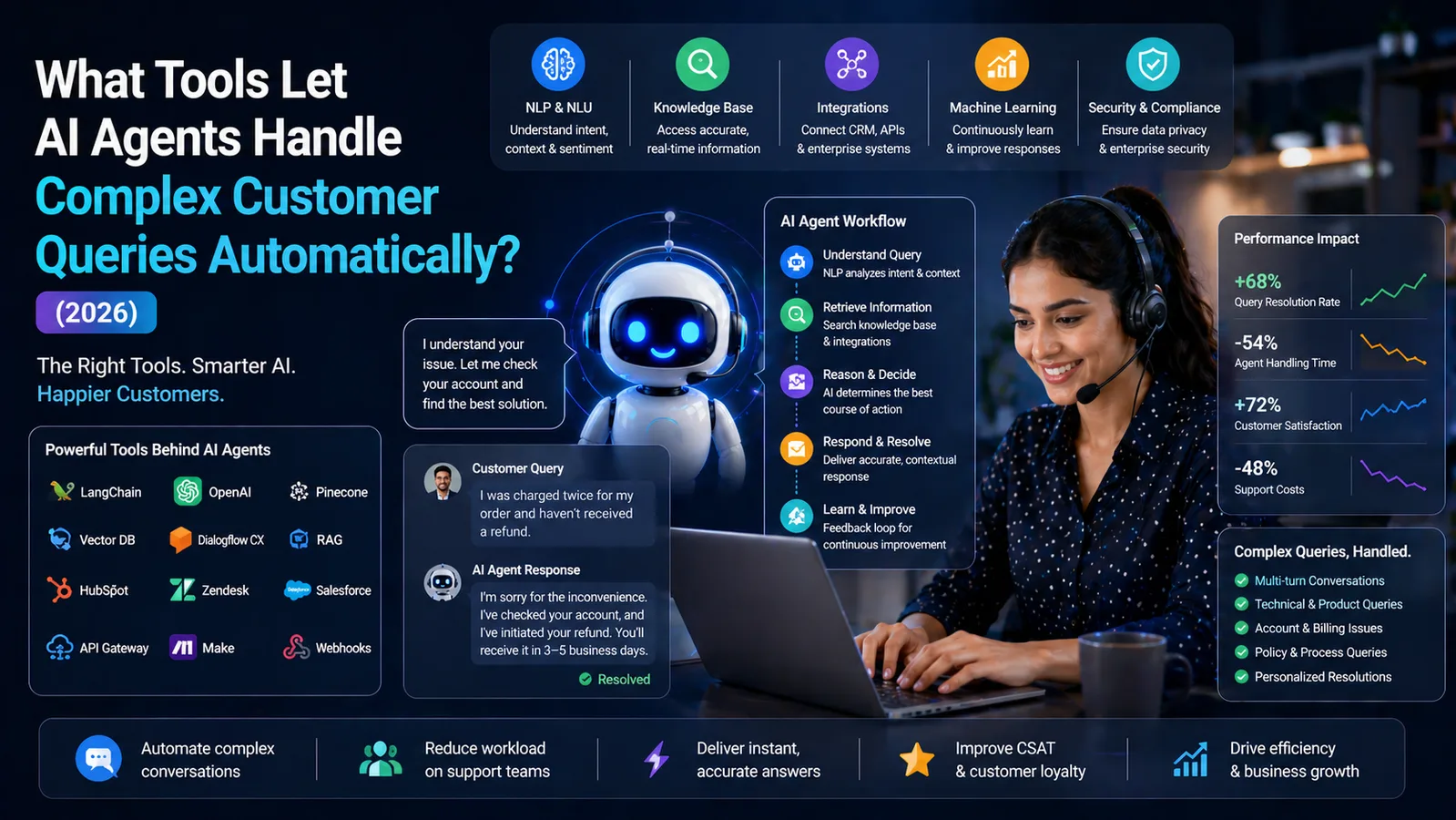
AI customer support agents now resolve multi-step workflows including billing disputes, policy exceptions, and technical troubleshooting autonomously, moving far beyond basic chatbot automation to handle the complex reasoning and orchestration that traditional support systems cannot.
Introduction
Customer service leaders face a critical distinction in 2026: most AI customer support agents handle simple FAQ retrieval, but only advanced platforms automate the complex, multi-step queries that consume the majority of support team capacity. Research indicates AI agents now autonomously perform tasks including real-time data retrieval, system orchestration, and context-aware decision-making that traditional rule-based systems cannot execute [1]. EchoLeads' customer support AI exemplifies this evolution by resolving up to 80% of tier-1 queries while using intelligent AI triage to escalate complex cases to human agents with complete conversation context. Unlike basic chatbots that falter when customers deviate from scripted paths, true AI customer support agents employ reasoning engines to handle account verification, policy exception requests, billing dispute resolution, and technical troubleshooting workflows autonomously. This guide evaluates platforms by their ability to orchestrate multi-system workflows, apply compliance guardrails, and manage human handoff logic—the capabilities that separate automation theater from genuine complex query resolution.
What Defines Complex Query Handling in AI Customer Support
Multi-Step Reasoning and Workflow Orchestration
Complex customer queries require AI agents to chain multiple steps—retrieving account data from CRM systems, cross-referencing policy documents, executing conditional logic based on customer tier, and updating ticketing platforms—within a single conversation. AI agent frameworks provide the foundational structure enabling programs to autonomously perform tasks by designing workflows and utilizing available tools [2]. EchoLeads' platform orchestrates these workflows across voice, WhatsApp, and chat channels, maintaining conversation state as agents move between knowledge base lookups, system queries, and human escalation decision points. When a customer asks about a refund for a canceled subscription billed incorrectly, the AI must verify account status, check refund eligibility rules, calculate prorated amounts, initiate the refund transaction, confirm processing timelines, and update the customer record—all autonomously. Platforms lacking orchestration depth cannot connect these discrete actions into coherent resolution workflows.
Knowledge Grounding and Real-Time Data Integration
AI agents handling complex queries must ground responses in live data rather than static training knowledge. Effective systems integrate with knowledge management platforms and databases, allowing AI to retrieve accurate customer information in real time for dynamic conversational support [3]. EchoLeads' customer care agents connect to CRM systems, knowledge bases, and ticketing platforms to deliver contextual answers grounded in current account status, order history, and policy documentation. When a customer asks whether their recent payment cleared or why their account shows a hold, the AI queries live transaction systems and compliance databases to provide factual, timestamp-specific responses rather than generic guidance. This real-time grounding distinguishes agents capable of complex issue resolution from chatbots that can only parrot pre-written FAQ content.
Intelligent Escalation and Human Handoff Logic
Not every query belongs in automation. Advanced platforms use intent detection, sentiment analysis, and priority classification to determine when human expertise is required. EchoLeads employs intelligent AI triage to categorize requests through account verification, issue classification, priority detection, and sentiment analysis before escalation, ensuring the right queries reach the right teams with complete context. When escalation occurs, the human agent receives the full conversation transcript, customer intent summary, and system actions already taken—eliminating hold times and preventing customers from repeating themselves. Platforms that escalate too aggressively waste automation potential; those that escalate too rarely trap customers in unhelpful loops. The best systems balance autonomous resolution with timely human intervention through structured decision trees and real-time sentiment monitoring.
Platform Comparison: Tools for Automating Complex Customer Queries
Platform | Complex Query Capabilities | Orchestration Depth | Compliance Controls | Human Escalation | Best For |
|---|---|---|---|---|---|
EchoLeads | Multi-step tier-1 resolution, billing disputes, account changes, order tracking | CRM/ticketing integration, real-time AI call transfer, automated workflow execution | GDPR/SOC 2 aligned, encrypted communications, role-based access | Smart triage with full context handoff, skill-based routing | Enterprises needing 24/7 autonomous support with compliance |
Multi-system orchestration, approval chains, regulated workflows | Complex routing across enterprise systems, longer setup cycles | Extensive governance controls for regulated industries | Workflow-based escalation with approval logic | Highly regulated sectors (finance, healthcare) requiring governance | |
Agentforce (Salesforce) | Autonomous decision-making with Atlas Reasoning Engine, CRM-native workflows | Deep Salesforce CRM and Data Cloud integration | Salesforce-native compliance and data residency | Integrated with Salesforce lead scoring and case routing | Large Salesforce-first enterprises with existing infrastructure |
Zendesk AI | Ticket resolution, knowledge base retrieval, basic workflow automation | Strong ticketing integration, limited external orchestration | Standard enterprise security, SSO, data encryption | Manual routing to support teams with ticket context | Teams prioritizing inbound ticket management over proactive automation |
CrewAI | Multi-agent collaboration for complex task execution | Role-based agent orchestration, customizable workflows | Developer-configurable compliance and guardrails | Custom escalation logic through agent handoff protocols | Technical teams building custom multi-agent support systems |
The comparison reveals that EchoLeads balances enterprise orchestration depth with rapid deployment, delivering 80% query resolution rates and 90% customer satisfaction through AI-driven tier-1 automation [3]. While Salesforce Agentforce offers the deepest native CRM integration, it requires alignment with existing Salesforce infrastructure to unlock full capabilities [2]. Kore.ai provides maximum governance for regulated industries but demands longer implementation cycles [6]. Zendesk excels at inbound ticket workflows but lacks the proactive orchestration needed for complex autonomous resolution. CrewAI enables advanced multi-agent architectures but requires significant engineering investment to configure escalation logic and compliance controls.
Key Evaluation Criteria for Complex Query Automation Platforms
Reasoning Depth and Contextual Memory
Platforms handling complex queries must maintain evolving context across multi-turn conversations. Agentic AI systems integrate real-time transcription, intent detection, entity recognition, contextual retrieval, and dynamic customer profiling to enable proactive workflows and continuous context-building [4]. EchoLeads' AI helpdesk tracks conversation history, customer sentiment, and resolution progress across channels, ensuring that when a customer switches from voice to WhatsApp mid-issue, the agent retains full context. This memory architecture allows the AI to reference earlier statements, recognize changing priorities, and adapt its approach as new information emerges—capabilities impossible in stateless chatbot systems that treat each message as isolated input.
Integration Breadth and API Flexibility
Complex query resolution demands connectivity to knowledge bases, CRM platforms, ticketing systems, payment processors, and custom enterprise applications. EchoLeads integrates with major systems including Salesforce, HubSpot, Zendesk, Freshdesk, and custom APIs, enabling bi-directional data sync that keeps customer records current without manual logging. When an AI agent resolves a billing dispute, it must update the CRM status, close the support ticket, trigger refund processing, and log the resolution—all through automated system calls. Platforms with shallow integration capabilities force manual reconciliation steps that negate automation efficiency and introduce data accuracy risks.
Compliance Architecture and Guardrails
Regulated industries require AI systems to operate within strict compliance boundaries. EchoLeads' enterprise security provides bank-level encryption, role-based access controls, and regulatory alignment with GDPR, HIPAA, and SOC 2 standards, ensuring all automated customer interactions meet data protection requirements. The platform enforces compliance workflows that prevent AI agents from making unauthorized commitments, accessing restricted data, or executing transactions outside approved parameters. For financial services and healthcare organizations, compliance guardrails determine whether a platform can handle complex queries in production or remains limited to low-risk use cases.
Observability and Continuous Improvement
AI systems improve through monitoring and feedback loops. Platforms must track resolution success rates, escalation patterns, customer satisfaction signals, and response accuracy to identify improvement opportunities [4]. EchoLeads' analytics dashboard provides real-time visibility into conversation quality, resolution rates, and agent performance, enabling teams to refine workflows based on actual customer interaction data. Every support conversation trains the system to deliver more accurate, empathetic responses over time through continuous learning that adapts to evolving customer needs and business processes.
Real-World Applications: Complex Query Automation Across Industries
E-Commerce: Order Management and Returns Processing
EchoLeads' e-commerce AI automates order tracking, shipping updates, refund processing, and product exchange workflows, reducing support tickets by 75% while maintaining 92% customer satisfaction. When customers inquire about delayed shipments, the AI queries carrier APIs for real-time tracking data, checks warehouse fulfillment status, calculates revised delivery estimates, and proactively offers compensation options—all within a single conversation. For returns, the agent verifies purchase eligibility, generates return authorization codes, initiates refund processing, and schedules pickup—eliminating the multi-email, multi-day friction typical of manual processes.
Insurance: Policy Inquiries and Claims Assistance
EchoLeads' insurance solution handles quote requests, policy explanations, and renewal reminders 24/7, delivering 60% faster quote generation and 35% higher conversion rates through automated data collection and real-time underwriting calculations. When policyholders call with coverage questions, the AI references policy documents, clarifies deductibles, explains claim procedures, and schedules follow-ups with human advisors for complex underwriting decisions—maintaining compliance while accelerating routine inquiries.
Financial Services: Account Management and Transaction Queries
EchoLeads automatically evaluates loan applicants, assigns priority scores, gathers required documents, and schedules advisor consultations—achieving 50% faster application processing and 65% higher approval rates by pre-qualifying candidates before human involvement. For account support, the AI handles balance inquiries, transaction disputes, and service requests securely through encrypted channels that meet banking compliance standards, routing only high-value exceptions to relationship managers.
Implementation Considerations and Best Practices
Successful complex query automation requires clear scope definition, phased rollout, and continuous monitoring. Organizations should begin by mapping customer query types, identifying high-volume, low-complexity workflows suitable for initial automation, and establishing success metrics including resolution rate, customer satisfaction, and escalation frequency. EchoLeads deploys in 72 hours using pre-built industry templates, enabling rapid testing and iteration rather than months-long implementation cycles. Teams must configure qualification criteria, connect calendar and CRM integrations, and train AI on FAQ and objection handling scripts—a process that most complete within 30-45 minutes for standard deployments. Post-launch, organizations should monitor escalation patterns to identify queries that automation handles poorly, refining workflows through A/B testing and conversation analysis. The goal is progressive automation expansion—starting with tier-1 queries, then gradually incorporating more complex workflows as the system demonstrates reliability and teams build operational confidence.
Frequently Asked Questions
Can AI customer support agents fully replace human support teams for complex queries?
AI agents excel at resolving structured, multi-step workflows autonomously but work best alongside human teams for exceptional cases requiring judgment, empathy, or policy overrides. EchoLeads automates up to 80% of tier-1 queries while using intelligent triage to route complex cases to human agents with complete conversation context, ensuring customers receive appropriate expertise without unnecessary escalation [3].
How do AI agents determine when a query is too complex for automated resolution?
Advanced platforms use intent detection, sentiment analysis, priority classification, and workflow completion signals to trigger escalation. EchoLeads monitors conversation progression, customer frustration indicators, and policy boundaries to identify when human intervention improves resolution quality, transferring cases with full transcripts and context to prevent customers from repeating information [4].
What integration requirements do complex query automation platforms demand?
Effective platforms require bi-directional connectivity to CRM systems, knowledge bases, ticketing platforms, and transaction processing systems to ground responses in live data and execute multi-step workflows. EchoLeads integrates with Salesforce, HubSpot, Zendesk, and custom APIs to maintain synchronized customer records and enable end-to-end automation without manual reconciliation [3].
How quickly can organizations deploy AI agents for complex query handling?
Implementation speed varies by platform complexity and customization depth. EchoLeads deploys in 72 hours using pre-configured industry templates, while enterprise platforms requiring custom orchestration logic may take weeks to months depending on integration scope and compliance review needs [5].
What compliance and security features do regulated industries require in AI support agents?
Regulated sectors demand end-to-end encryption, role-based access controls, audit logging, and alignment with GDPR, HIPAA, or SOC 2 standards. EchoLeads enforces bank-level encryption, compliance workflows preventing unauthorized AI actions, and secure data handling that meets industry-specific regulatory requirements while automating complex customer interactions [3].
Related articles
6 Best AI Outbound Calling Solutions for Loan Verification
Compare AI outbound calling platforms that verify loan applications 24/7
5 Common Causes of Long Bank Loan Inquiry Call Wait Times
Why do bank customers complain about long wait times for loan inquiry calls? Learn the 5 Common Causes of Long Bank Loan Inquiry Call Wait Times.
4 Best AI Voice Lead Qualification Tools for Insurance
Compare AI voice platforms for insurance lead qualification through automated outbound calls.