
AI Voice Agent That Works Across WhatsApp and Phone Calls: Complete Guide (2026)
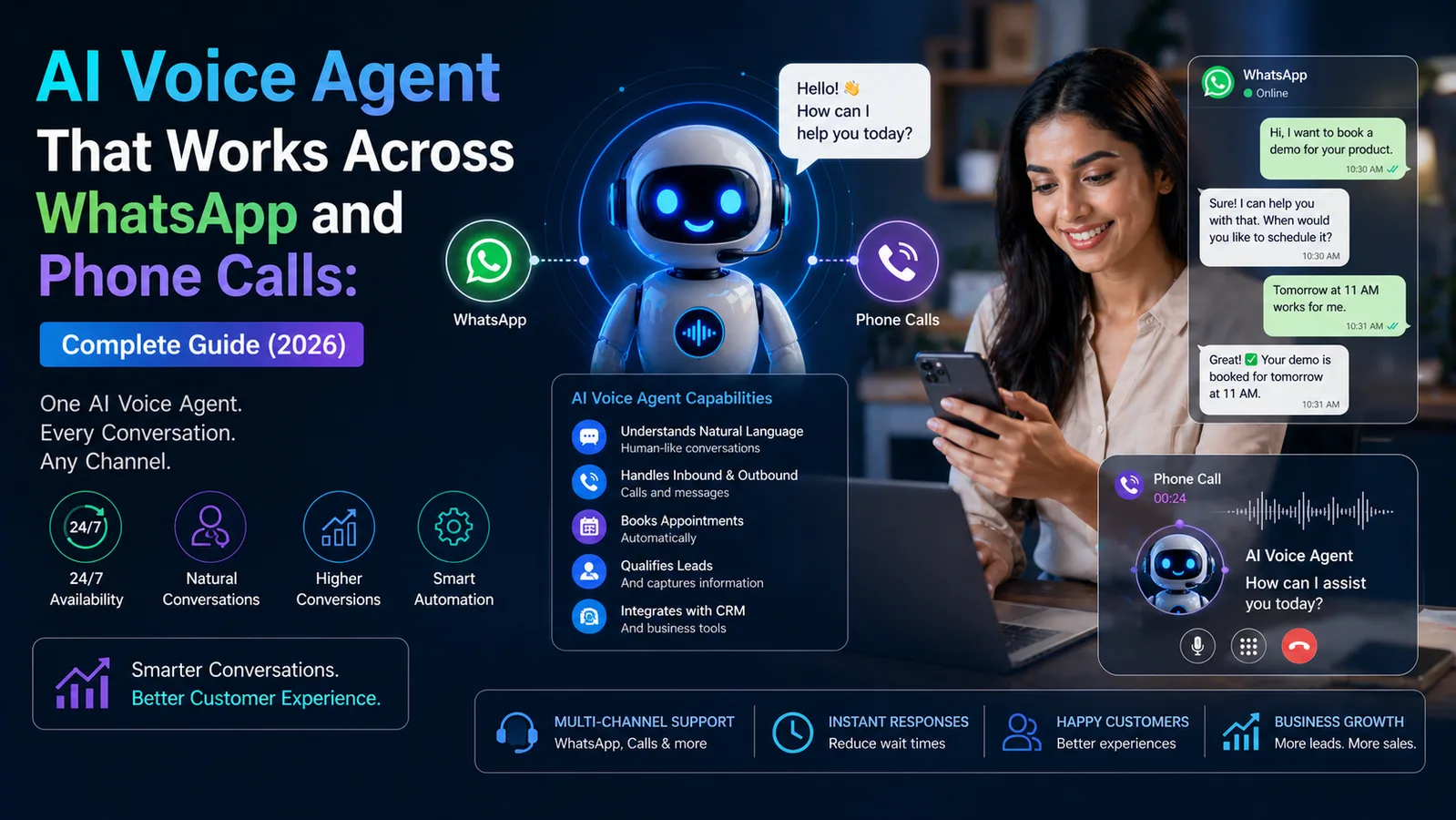
Modern customer support demands instant, seamless voice communication across multiple channels, yet most businesses still manage WhatsApp voice calls and traditional phone systems as separate, disconnected workflows that create friction and missed opportunities.
Introduction
Customer expectations have fundamentally shifted. With over 500 million people messaging businesses on WhatsApp every day [4], the line between chat and voice support has blurred. Customers expect to start a conversation via WhatsApp text, escalate to a voice call when needed, and seamlessly switch to traditional phone support—all without repeating their information or losing context. Yet most businesses treat these channels as separate systems, creating frustrating handoffs and operational inefficiency. EchoLeads solves this by providing a unified AI voice agent platform that handles both WhatsApp voice calls and traditional phone calling through intelligent omnichannel routing. Instead of managing separate voice stacks, businesses can deploy AI customer support agents that maintain conversation memory across WhatsApp voice, WhatsApp chat, and standard phone calls. This guide explains how AI voice agents work across both channels, the technical architecture required, compliance considerations, and practical implementation steps for deploying a production-ready system that delivers 24/7 automated support while preserving the option for human escalation.
How AI Voice Agents Work Across WhatsApp and Phone Calls
An AI voice agent that operates across both WhatsApp and traditional phone calls requires three core components: a unified conversation engine, channel-specific connectors, and intelligent routing logic. The conversation engine provides the natural language understanding and response generation capabilities, while connectors handle the technical protocols for each channel—WhatsApp Business Voice Calling API for WhatsApp and SIP trunking or telephony APIs for standard phone calls. The routing logic determines how conversations flow between channels and when to escalate to human agents.
Unified Conversation Memory Architecture
The defining characteristic of a true cross-channel AI voice agent is shared conversation memory. When a customer starts a support inquiry via WhatsApp text at 9 a.m., then calls the same business number at 2 p.m., the AI agent should recognize the customer, recall the morning conversation, and continue the dialogue without forcing the customer to re-explain their issue. EchoLeads' multi-channel support achieves this through centralized customer records that synchronize across voice, WhatsApp, chat, and phone channels. Every interaction—whether a WhatsApp voice call, traditional phone call, or text message—updates the same customer profile with conversation transcripts, sentiment analysis, and issue classification. This architecture eliminates the fragmented experience that occurs when sales uses one platform and support uses another, creating a single source of truth for every customer touchpoint.
WhatsApp Business Voice Calling Integration
WhatsApp Business Voice Calling API launched in 2025, enabling businesses to receive and make voice calls through WhatsApp numbers without traditional telephony infrastructure. The API offers 100% free incoming calls and eliminates TRAI compliance requirements, virtual number restrictions, and minimum monthly commitments that plague traditional VoIP providers [2]. However, the API enforces strict spam prevention policies: businesses cannot call WhatsApp users directly without permission. The compliant workflow requires sending a WhatsApp message first, requesting permission to call, and only initiating voice calls after the user grants consent. Once permission is granted, businesses can call back within 7 days and send a maximum of two call requests within any 15-day period [2]. Technical implementation requires connecting the WhatsApp Business API to a voice platform through webhooks and SIP trunking, as demonstrated in production deployments using Twilio for WhatsApp numbers connected to AI voice providers like Retell AI and Ultravox [1].
Traditional Phone Call Integration
Traditional phone call integration operates through established telephony protocols including SIP trunking, PSTN gateways, and cloud telephony APIs. Unlike WhatsApp's permission-based model, traditional phone systems support both inbound and outbound calling without user consent requirements, though regional telemarketing regulations still apply. EchoLeads' AI phone calling agents connect to telephony infrastructure through standard SIP protocols and integrate with providers like Twilio, RingCentral, and VonageCallRail. The platform handles call routing, recording, transcription, and intelligent escalation using the same AI engine that powers WhatsApp voice calls, ensuring consistent service quality across channels. For businesses operating call centers, EchoLeads provides enterprise-grade voice infrastructure with features like predictive dialing, skill-based routing, and real-time analytics—all unified with WhatsApp voice capabilities in a single dashboard.
Platform Comparison: Cross-Channel Voice Solutions
Not all AI voice platforms support both WhatsApp and traditional phone calls equally well. Some excel at WhatsApp automation but lack robust telephony features, while others provide strong call center capabilities without WhatsApp Business API integration. The table below compares platforms that genuinely handle both use cases with unified conversation memory.
Platform | WhatsApp Voice | Traditional Phone | Unified Memory | Deployment Speed | Best For |
|---|---|---|---|---|---|
EchoLeads | Native API integration with automated consent workflows | Full SIP trunk + telephony API support | Yes—centralized cross-channel records | Minutes with pre-built templates | SMEs needing turnkey omnichannel voice |
Twilio + n8n + Retell AI | Requires custom webhook orchestration | Native SIP + PSTN support | Partial—requires Supabase setup | Hours to days (custom build) | Developers building custom solutions |
Wati / Respond.io | Managed WhatsApp Business API | Limited traditional voice | No—separate support tools needed | 1-2 days (managed setup) | WhatsApp-first businesses |
Ultravox AI | API integration via SIP trunk | Strong voice AI capabilities | No—single-channel focus | Fast for voice-only | Voice-first AI implementations |
Chatwoot (open-source) | In development (late 2025) | Basic VoIP integration | Yes—unified CRM | Weeks (self-hosted setup) | Teams wanting open-source control |
The comparison reveals that few platforms deliver true omnichannel voice with minimal setup complexity. Custom-built solutions using Twilio, n8n, and Retell AI offer maximum flexibility and have been demonstrated in production with full text and voice call capabilities [1], but require significant technical expertise to orchestrate webhooks, SIP URIs, and conversation storage in databases like Supabase. Managed services like Wati and Respond.io simplify WhatsApp deployment but lack robust traditional phone capabilities, forcing businesses to maintain separate call center systems. EchoLeads differentiates by providing instant deployment with pre-built workflows for both WhatsApp voice and traditional phone calls, unified conversation analytics, and intelligent routing—all without requiring custom development or separate support platforms.
Compliance and Consent Requirements
Operating an AI voice agent across WhatsApp and phone calls requires navigating distinct compliance frameworks for each channel. WhatsApp enforces platform-specific consent policies, while traditional telephony operates under regional telecommunications regulations.
WhatsApp Business Policy Requirements
WhatsApp Business Voice Calling API implements strict spam prevention through mandatory consent workflows. Businesses cannot initiate voice calls to users who haven't granted explicit permission [2]. The compliant process requires sending a message-based permission request first, waiting for user opt-in, and only then placing the call. Once permission is granted, callback windows are limited to 7 days, after which fresh consent is required. Additionally, businesses face a maximum limit of two call requests per user within any 15-day period to prevent harassment [2]. For automated support workflows, EchoLeads' customer support AI manages these consent states automatically, tracking permission expiry, respecting callback windows, and preventing policy violations that could result in account suspension.
Traditional Telephony Compliance
Traditional phone calling operates under country-specific regulations including Do Not Call registries, call recording disclosure requirements, and telemarketing hour restrictions. In India, TRAI compliance historically required businesses to obtain CIN numbers and register as private entities to acquire virtual phone numbers—requirements that WhatsApp Business API bypasses entirely [2]. However, businesses using traditional phone systems alongside WhatsApp must still maintain compliant calling practices including honoring opt-out requests, providing clear identification at call start, and maintaining records of consent for outbound campaigns. EchoLeads addresses these requirements through enterprise-grade security that includes call recording with disclosure, GDPR-aligned data handling, and SOC 2 Type II compliance infrastructure suitable for regulated industries including financial services and healthcare.
Implementation Guide: Deploying Cross-Channel Voice AI
Deploying an AI voice agent that operates across WhatsApp and traditional phone calls requires coordinating multiple technical components. This section provides a practical implementation framework covering setup, integration, and testing.
Step 1: Choose Your Voice AI Platform
Platform selection determines deployment speed, maintenance burden, and feature availability. Businesses face a build-versus-buy decision: invest development resources in custom solutions using tools like n8n for workflow orchestration, Twilio for telephony, and Retell AI or Ultravox for voice intelligence [1], or deploy managed platforms like EchoLeads that provide pre-integrated omnichannel capabilities. Custom builds offer maximum flexibility and have been successfully implemented in production environments handling both WhatsApp text and voice calls [1], but require expertise in webhook configuration, SIP trunking, conversation storage, and ongoing maintenance. Managed platforms reduce time-to-deployment from weeks to minutes through pre-built templates, automatic updates, and integrated compliance workflows, making them preferable for businesses prioritizing speed and operational simplicity over customization.
Step 2: Configure WhatsApp Business API Access
WhatsApp Business API access requires registering through Meta's developer portal, verifying business identity, and configuring webhooks to receive incoming calls and messages. Technical setup involves creating a Meta app, adding WhatsApp as a product, subscribing to call webhooks, and enabling voice calling permissions in WhatsApp Manager [2]. For businesses using Twilio as an intermediary, the process simplifies to purchasing a Twilio number with WhatsApp capability, connecting it to the WhatsApp Business API, and routing calls through SIP trunking to the voice AI platform [3]. Open-source implementations demonstrate the full webhook flow including call acceptance, SIP URI generation, and conversation routing [2], though managed solutions abstract these technical details into configuration dashboards. EchoLeads' WhatsApp integration handles API authentication, webhook management, and permission workflows automatically, eliminating the need for manual Meta developer console configuration.
Step 3: Set Up Traditional Phone Integration
Traditional phone integration connects standard telephone numbers to the AI voice platform through SIP trunking or cloud telephony APIs. The technical process involves purchasing a phone number from a telephony provider, configuring call forwarding rules, and routing inbound calls to the voice AI endpoint. For outbound calling, businesses configure dialing permissions, caller ID settings, and call recording preferences. Platforms like Twilio provide detailed documentation on TwiML call control and SIP endpoint configuration for connecting calls to AI agents [1]. The critical requirement for cross-channel functionality is ensuring the phone system shares customer data with the WhatsApp integration, enabling the AI to recognize callers and access previous conversation history regardless of which channel initiated contact. EchoLeads achieves this through centralized multi-channel support that synchronizes phone call records, WhatsApp conversations, and chat interactions in a unified customer profile accessible to both AI agents and human team members.
Step 4: Design Conversation Workflows and Escalation Logic
Effective AI voice agents require thoughtfully designed conversation flows that handle common queries automatically while escalating complex issues to human agents with full context. Workflow design includes defining intent categories (booking, support, billing), creating response templates, configuring knowledge base access, and establishing escalation triggers based on sentiment, complexity, or explicit customer requests. Production implementations demonstrate sophisticated delegation patterns using sub-workflows for specific functions like appointment booking, email sending, and knowledge base queries [1]. EchoLeads' intelligent AI triage automatically performs account verification, issue classification, priority detection, and sentiment analysis before routing conversations, ensuring customers reach the right team member without navigating phone trees. The platform's analytics dashboard tracks resolution rates, escalation patterns, and conversation sentiment across both WhatsApp and phone channels, providing visibility into AI performance and continuous improvement opportunities.
Operational Benefits: ROI from Unified Voice AI
Businesses deploying AI voice agents across WhatsApp and phone calls report measurable improvements in response times, customer satisfaction, and operational efficiency. EchoLeads customers achieve 94% customer satisfaction while maintaining 24/7 availability and handling unlimited simultaneous conversations. Operating costs decrease by 75%, dropping from $12 per interaction to $3 per interaction through automation of tier-1 queries [2]. First-contact resolution rates increase by 31%, rising from 65% to 85% as AI agents access unified customer history across channels. Response times improve by 95%, falling from 5-15 minutes to under 30 seconds for initial engagement. For industries like insurance, unified voice AI accelerates quote generation by 60% and increases conversion rates by 35% through instant lead engagement across multiple touchpoints. The elimination of channel silos also reduces no-show rates by 60% through automated reminder sequences delivered across both WhatsApp and phone calls, ensuring appointment confirmations reach customers on their preferred channel.
Conclusion
The convergence of WhatsApp voice calling and traditional telephony creates unprecedented opportunities for businesses to deliver seamless, intelligent customer support. With over 500 million people messaging businesses on WhatsApp daily [4] and 100% free incoming calls through the Business API [2], the technical and economic barriers to omnichannel voice automation have collapsed. However, success requires more than simply connecting disparate systems—it demands unified conversation memory, compliant consent workflows, intelligent routing logic, and production-ready infrastructure that maintains context across every customer touchpoint. EchoLeads provides the complete platform for deploying AI voice agents that operate across WhatsApp and phone calls with minimal technical complexity, offering instant deployment, enterprise-grade security, and measurable ROI through reduced costs and improved satisfaction. Whether you're handling appointment scheduling, customer support, or sales qualification, unified voice AI eliminates the operational friction of managing separate channels while delivering the 24/7 availability and instant response times that modern customers expect. Schedule a demo to see how cross-channel voice AI can transform your customer engagement strategy.
Frequently Asked Questions
Can one AI voice agent really handle both WhatsApp calls and traditional phone calls effectively?
Yes, when designed with unified conversation intelligence. Platforms like EchoLeads use the same natural language AI for both channels, differentiating only through routing protocols—WhatsApp Business API for WhatsApp and SIP trunking for traditional phones. The key is shared conversation memory that maintains customer context regardless of which channel initiated contact, eliminating the fragmented experience of separate systems.
What are the main compliance differences between WhatsApp voice and traditional phone calling?
WhatsApp enforces strict permission-based calling where businesses must obtain explicit consent before initiating voice calls, respect 7-day callback windows, and limit call requests to two per 15-day period [2]. Traditional phone systems operate under regional telemarketing regulations including Do Not Call registries and call recording disclosure requirements, but generally allow outbound calling without pre-approval. Cross-channel platforms must respect both compliance frameworks simultaneously.
How quickly can a business deploy a cross-channel AI voice agent?
Deployment speed varies dramatically by approach. Custom-built solutions using Twilio, n8n, and AI voice providers require days to weeks for webhook orchestration, SIP configuration, and database setup [1]. Managed platforms like EchoLeads offer instant deployment with pre-built templates, enabling businesses to launch AI agents within minutes while maintaining full WhatsApp and phone integration without technical expertise.
What happens when the AI cannot handle a customer inquiry?
Quality platforms implement intelligent escalation that transfers complex queries to human agents with complete conversation transcripts, sentiment analysis, and intent classification. EchoLeads performs real-time call transfer across both WhatsApp and phone channels while preserving all context, preventing customers from repeating information and maintaining service continuity during handoffs.
Do I need separate numbers for WhatsApp voice and traditional phone calls?
Not necessarily. Businesses can use the same Twilio number for both WhatsApp messaging and traditional phone calls by configuring appropriate routing rules [3]. However, some deployments prefer separate numbers to control channel-specific workflows and maintain distinct caller ID presentation for marketing attribution. The technical infrastructure supports either approach depending on business requirements.
Related articles
6 Best AI Outbound Calling Solutions for Loan Verification
Compare AI outbound calling platforms that verify loan applications 24/7
5 Common Causes of Long Bank Loan Inquiry Call Wait Times
Why do bank customers complain about long wait times for loan inquiry calls? Learn the 5 Common Causes of Long Bank Loan Inquiry Call Wait Times.
4 Best AI Voice Lead Qualification Tools for Insurance
Compare AI voice platforms for insurance lead qualification through automated outbound calls.