
5 Common Causes of Long Bank Loan Inquiry Call Wait Times
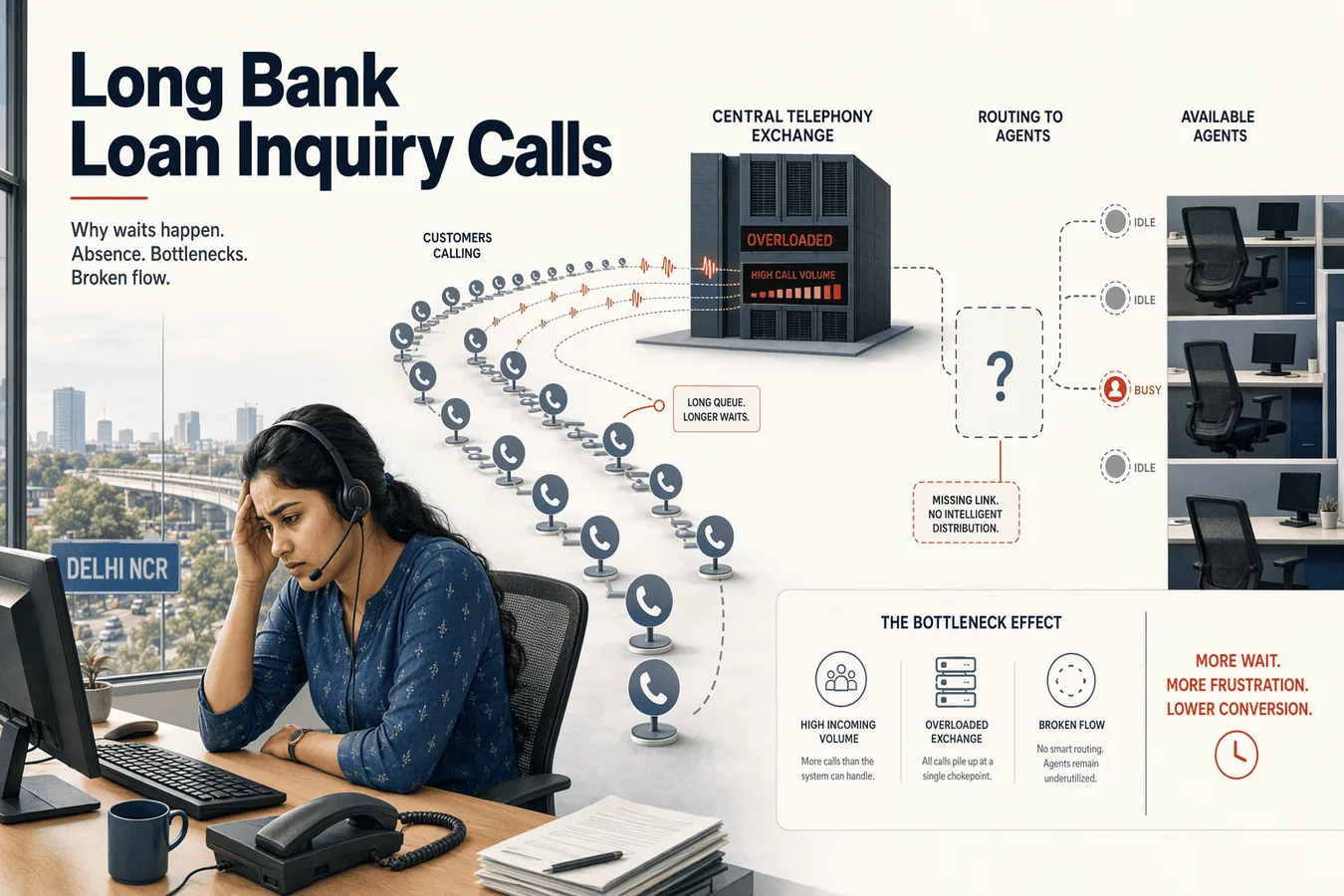
Bank customers across Delhi NCR and India frequently complain about extended wait times when calling for loan inquiries. These delays stem from predictable operational bottlenecks that converge during peak demand periods.
Key Takeaways
High call volumes during peak loan application seasons (Diwali, fiscal-year-end) create sustained volume spikes that overwhelm queue capacity designed for average daily demand.
Manual IVR routing forces customers through multi-layer menu trees, consuming 1–3 minutes before reaching loan-specialist queues that require dedicated expertise.
Understaffing during peak hours extends both average handle time and queue length as banks control labor costs.
Limited 24/7 coverage leaves customers without support during non-business hours when loan research and application planning typically occur.
AI voice agents answer calls within 3 seconds, operate around the clock, and qualify leads autonomously before escalating complex cases to human staff.
Why Bank Customers Complain About Long Wait Times for Loan Inquiry Calls
Bank customers complain about long wait times for loan inquiry calls because four operational bottlenecks converge during peak demand: high call volumes during loan application periods, manual IVR routing that fails to prioritize urgent inquiries, understaffing during peak hours, and a 24/7 customer expectation that exceeds traditional call-center coverage.

High Call Volumes During Loan Application Periods
Loan and mortgage inquiries rank among the top three call drivers in BFSI contact centers, creating sustained volume spikes when application seasons (home-buying cycles, end-of-quarter promotions) overlap with general account-servicing demand. Queue capacity designed for average daily volumes buckles under these seasonal surges, extending median wait times beyond the 60-second benchmark.
Manual Routing and IVR Limitations
Legacy IVR systems route calls through multi-layer menu trees that force customers to navigate options, explain their problem to a human agent, and endure hold periods while the agent locates information. These manual handoffs slow resolution and fail to prioritize time-sensitive loan inquiries over routine balance checks.
Understaffing and Agent Availability Constraints
Many banks operate contact centers overwhelmed by high call volumes, leading to long wait times and frustrated customers. Insufficient agent coverage during peak hours—when loan applicants expect instant answers—extends average handling time and worsens queue backlogs.
24/7 Customer Expectations vs Limited Call-Center Hours
Customers' financial lives never sleep—shopping online at midnight, making international transfers in the wee hours, yet most bank call centers operate 9-to-6 schedules. This coverage gap leaves after-hours loan inquiries unanswered until the next business day. Automation solutions like EchoLeads voice agents operate 24/7 for loan inquiries, addressing the hours-coverage gap that legacy call centers cannot close with human staff alone.
To understand why wait times spike, we must examine the structural forces that drive call volume in BFSI contact centers.
Primary Causes of High Call Volumes in BFSI Call Centers
Banks and NBFCs in Delhi NCR, and across India, experience persistent call-volume spikes driven by three structural factors. Understanding these drivers is key for deploying effective AI call-handling strategies that address the root causes of customer wait times.
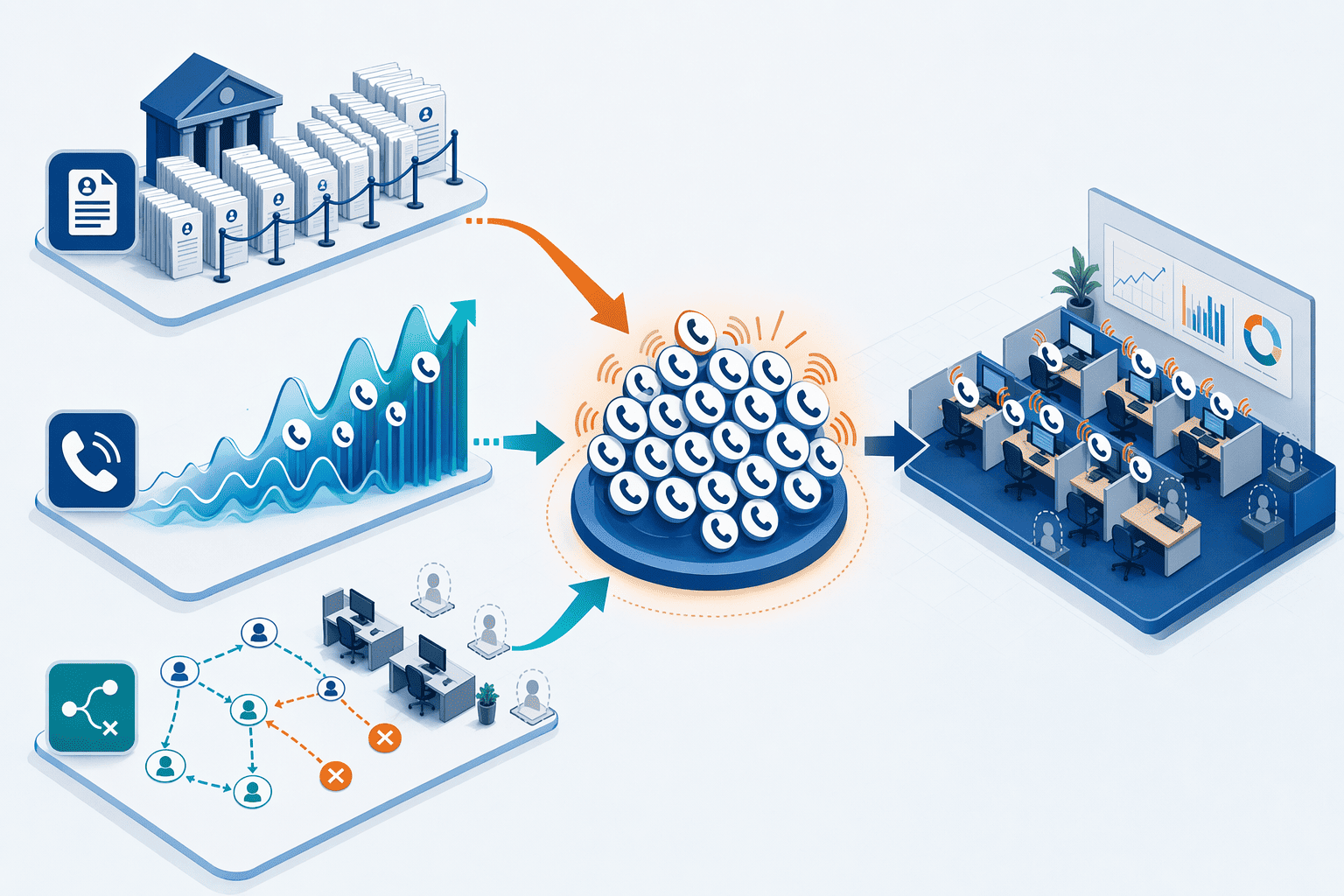
Seasonal Loan Application Surges, Home-loan and personal-loan inquiries spike during festival seasons (Diwali, regional harvest festivals) and fiscal-year-end periods (March). Indian banks' loan growth moderated for a sixth straight month in December, but lenders still report double-digit loan growth for years as retail credit demand remains high. These seasonal peaks create predictable call-center bottlenecks that overwhelm manual-only teams.
Multi-Product Comparison Requests, Customers call to compare loan products (home vs. Personal vs. Gold loan) rather than using digital calculators or chatbots. Research on customer-call motivators in the financial domain shows that customers tend to get unsatisfied if they have to call, yet they still prefer voice for complex product comparisons because incoming calls are a high-cost component for any business and signal serious buying intent. Even when banks offer strong online tools, customers call to ask nuanced questions about eligibility, interest rates, and processing fees.
Repeat Calls for Status Updates, Lack of proactive status communication forces customers to call multiple times for the same loan inquiry. A report found that Singaporeans spent more than 30 million hours on hold with customer service last year, an estimated S$1.24 billion in wages lost due to slow service. When banks don't send proactive SMS or email updates, customers initiate calls to ask 'Did my documents reach the underwriter?' or 'When will I hear back?', driving repeat-call volume that reactive support models cannot absorb.
Even when call volumes are predictable, operational inefficiencies in routing and staffing amplify the problem.
How Manual Routing and Understaffing Extend Wait Times
Multi-Layer IVR Navigation
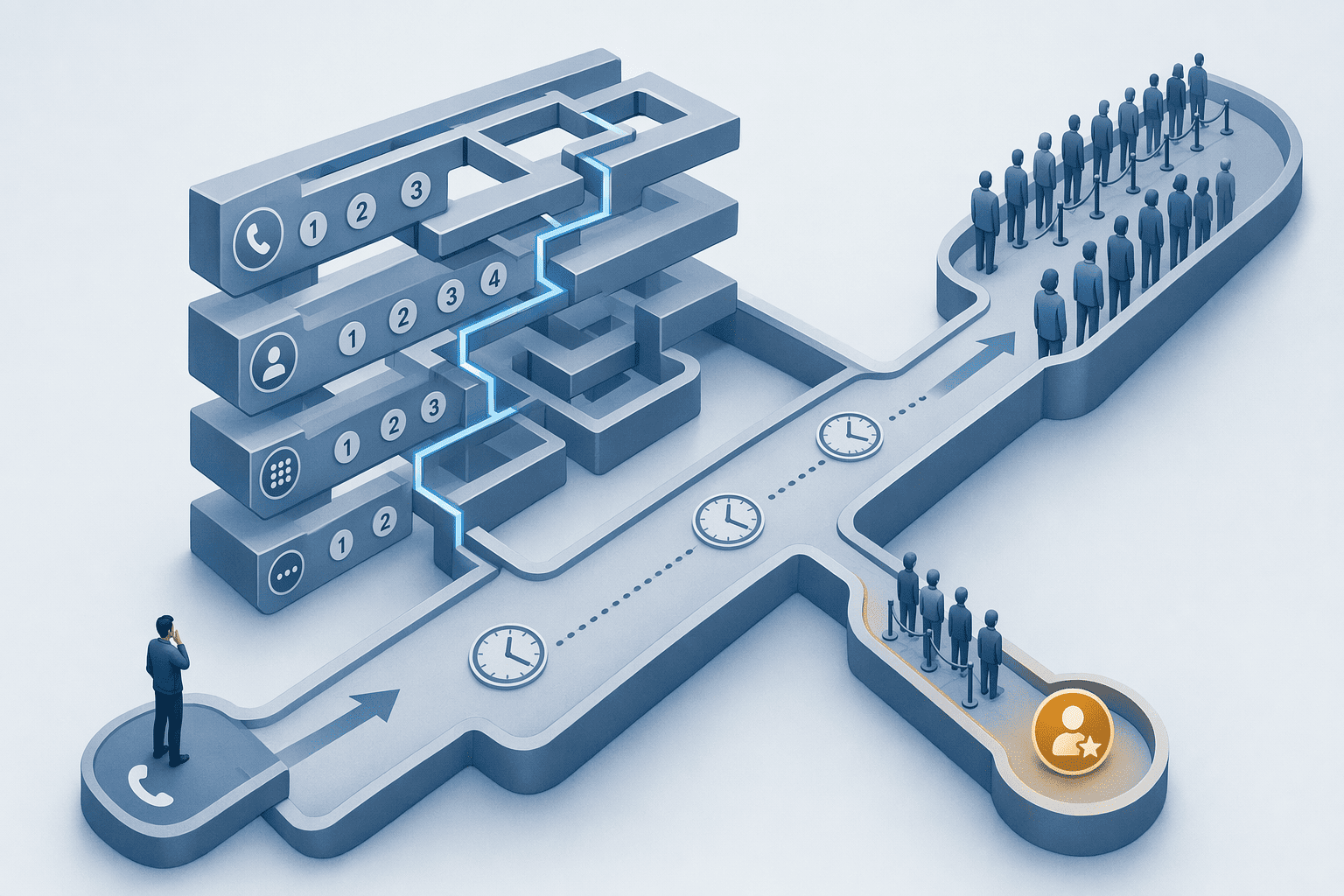
Before a customer even enters the agent queue, they navigate multi-layer IVR menus that consume 1 to 3 minutes of pre-queue time. The two-way hazards model demonstrates that customer waiting behavior depends on two timescales: waiting duration and time of day. This pre-queue navigation adds to perceived wait time without serving as a productive holding period, compounding frustration before the customer reaches the specialist they need.
Skills-Based Routing Bottlenecks
Loan-specialist queues are separate from general-inquiry queues because regulatory training and product complexity require dedicated expertise. When the loan queue saturates while general-inquiry agents sit idle, customers face uneven wait times that reflect skill-set segregation rather than total capacity. This architectural bottleneck means one queue can hold eight-minute waits while another remains empty.
Peak-Hour Staffing Shortfalls
Banks understaff call centers during peak hours to control labor costs, extending both average handle time and queue length. The Microsoft study found UK customers wait eight minutes and 27 seconds, 25.35 times higher than the optimal standard. This structural constraint reflects intentional cost-management decisions that degrade customer experience during high-demand windows.
AI voice agents address these structural constraints by answering calls within 3 seconds and operating 24/7, eliminating pre-queue navigation delays, skill-set bottlenecks, and peak-hour capacity shortfalls in one deployment.
Modern AI voice agents offer a fundamentally different approach to handling loan inquiries at scale.
The Role of AI Voice Agents in Reducing Loan Inquiry Wait Times
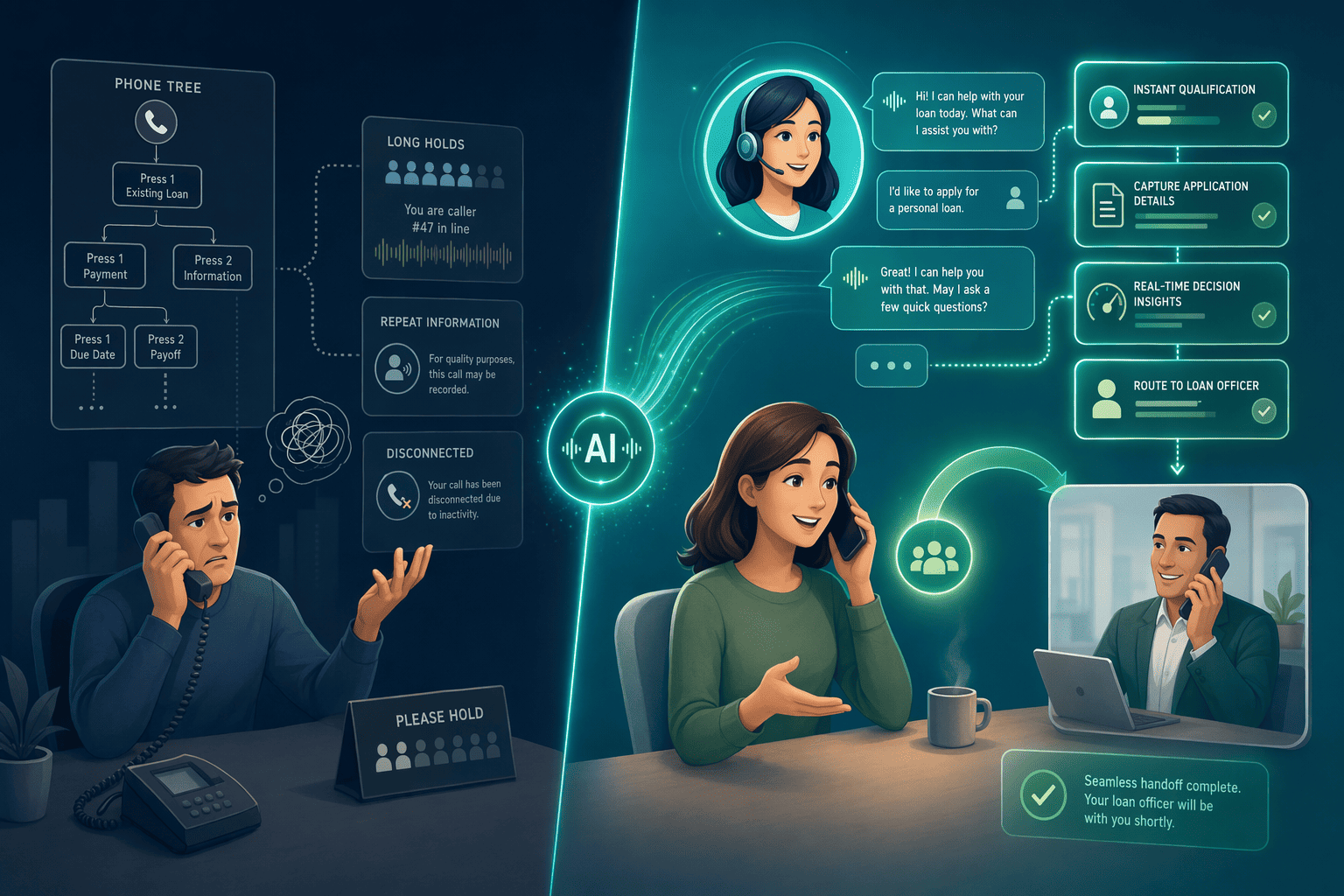
AI voice agents are automated phone-based systems that use conversational AI to qualify borrowers, collect application details, and route inquiries to loan officers. Unlike legacy IVR systems that force callers through rigid phone-tree menus, AI voice agents understand natural language, hold two-way conversations in the caller's language, and execute workflows in real time, eliminating the hold queues and after-hours gaps that drive long wait times in BFSI call centers.
3-Second Answer Times and 24/7 Availability
AI voice agents answer inbound calls within 3 seconds and operate around the clock. This contrasts sharply with the average 2-5 minute wait times cited in the Financial Brand study from section 1, where callers abandon the queue before reaching a human agent. Because voice agents handle hundreds of simultaneous calls without queue capacity constraints, every loan inquiry receives an immediate response, 24/7, including after banking hours and during lunch-rush peaks when manual staffing gaps are widest.
Autonomous Lead Qualification and Loan-Inquiry Handling
Voice agents qualify leads by capturing loan amount, tenure, income, and property location through conversational prompts, then route high-intent inquiries to human agents for document collection and underwriting. The AurionX lead-qualification workflow illustrates this pattern: the voice agent handles the initial intake autonomously, scores the inquiry based on predefined ICP logic, and escalates only when complexity or sentiment exceeds safe autonomy thresholds. Fraud accusations, identity verification failures, disputes, emotionally charged conversations, and multi-product comparisons trigger immediate escalation to human staff, ensuring compliance risk is never handled by AI alone.
Regional-Language Support for Delhi NCR BFSI Customers
Multilingual voice agents handle loan inquiries in Hindi, Punjabi, and English, addressing Delhi NCR's language diversity. The Caller Digital platform supports Hindi plus 13 regional Indian languages at 92 to 96% accuracy on real mobile audio, and the Delhi NCR deployment guide notes that customers predominantly speak Hindi with Punjabi, Haryanvi, and Hinglish code-switching. Voice agents that support these variants natively eliminate the language-barrier friction that forces Hindi-first callers into English-only IVR systems, reducing abandonment and improving qualification rates for banks serving the Delhi NCR market.
Platform Comparison: EchoLeads, Genesys, NICE, Talkdesk, Exotel
The table below contrasts five platforms offering voice automation for BFSI call handling, comparing pricing, deployment model, voice automation capabilities, agent assist/call routing, supported channels, integration support, customer rating, and BFSI/compliance certifications.
Platform | Pricing | Deployment | Voice Automation/IVR | Agent Assist/Call Routing | Supported Channels | Integration Support | Customer Rating | BFSI/Compliance Certifications |
|---|---|---|---|---|---|---|---|---|
EchoLeads | Custom pricing | Cloud SaaS | AI voice agents, 3-second answer times, 70+ languages | Autonomous lead qualification, CRM updates, escalation logic | Phone, WhatsApp, Instagram, SMS | Salesforce, HubSpot, Zoho, telephony operators | Not publicly disclosed | GDPR, CCPA compliant; RBI/DPDP alignment per regional use-case |
Genesys | Contact for pricing | Cloud or on-premise | Legacy IVR, conversational AI add-ons available | Agent assist, routing, workforce management | Phone, email, chat, social | Extensive CRM, ERP, telephony integrations | 4.2/5 (G2) | ISO 27001, SOC 2, PCI DSS, GDPR |
NICE | Contact for pricing | Cloud or on-premise | IVR, conversational AI modules | Real-time agent guidance, routing, analytics | Phone, email, chat, social | CRM, workforce optimization, telephony | 4.1/5 (G2) | ISO 27001, SOC 2, PCI DSS, GDPR |
Talkdesk | Starting $75/user/month | Cloud SaaS | AI-powered IVR, virtual agent | Agent assist, omnichannel routing | Phone, email, chat, SMS, social | Salesforce, Zendesk, Microsoft Dynamics, telephony | 4.4/5 (G2) | ISO 27001, SOC 2, PCI DSS, GDPR, HIPAA |
Exotel | Starting ₹999/month + usage | Cloud SaaS | IVR, call routing, voice API | Agent assist, call recording, routing | Phone, SMS | CRM integrations, telephony APIs | 4.3/5 (G2) | ISO 27001, GDPR; India-specific compliance focus |
EchoLeads offers 24/7 AI voice agents that answer loan inquiries within 3 seconds, qualify leads autonomously, and escalate complex cases to human staff, best for banks in Delhi NCR evaluating regional-language support and BFSI-compliant call-handling workflows. Trade-off: voice agents do not approve loans or make underwriting decisions; final underwriting requires human oversight or integrated automated underwriting systems. Genesys, NICE, and Talkdesk are enterprise contact-center suites with broad channel coverage and established BFSI certifications, but pricing and deployment timelines typically require a sales conversation. Exotel is an India-focused telephony and IVR platform with transparent starting pricing, suitable for teams prioritizing cost predictability and local compliance over advanced conversational AI.
For a deeper look at how AI voice agents work in finance and Hindi-language voice calling, see the linked guides.
While AI voice agents handle most inquiries autonomously, certain scenarios require human expertise and judgment.
When Voice Agents Escalate to Human Staff
Complexity and Multi-Product Comparison Triggers
Voice agents escalate when customers request side-by-side comparisons of three or more loan products, or when non-standard income verification scenarios arise. Platform providers like Talkrix report that approximately 20% of loan inquiries exceed safe autonomy thresholds and require human judgment, the industry baseline for complex cases that AI cannot resolve independently.

Fraud, Disputes, and Emotionally Charged Conversations
Any mention of fraud, identity theft, or account disputes triggers immediate escalation. Sentiment analysis detects frustration or anger thresholds; when conversation tone shifts beyond safe parameters, the voice agent hands off to human staff with full conversation context.
Identity Verification Failures
When customers cannot verify identity via OTP, Aadhaar, or PAN, voice agents escalate compliance requirements. Insurance telemarketing platforms in adjacent BFSI verticals illustrate the same pattern: AI handles intake and qualification, but identity-verification failures and underwriting decisions escalate to human staff. EchoLeads voice agents operate 24/7 for loan inquiries but escalate when complexity exceeds safe autonomy thresholds, they handle intake and qualification only, not final loan approval or underwriting decisions.
Conclusion
Traditional call-center operations offer human empathy and regulatory expertise but struggle with peak-season scalability and 24/7 coverage. EchoLeads voice agents operate around the clock and answer calls within 3 seconds, yet do not approve loans or make underwriting decisions, final credit decisioning requires human oversight or integrated automated underwriting systems. Voice agents handle 80% of loan-inquiry calls autonomously but escalate fraud, disputes, multi-product comparisons, and identity verification failures to human staff.
As BFSI call centers in Delhi NCR face rising customer expectations for instant answers and 24/7 availability, AI voice agents will become the operational baseline for loan-inquiry handling, with human agents reserved for complex cases that require judgment, empathy, or regulatory oversight.
Explore EchoLeads's AI voice agent platform for BFSI in Delhi NCR to see how 3-second answer times and autonomous lead qualification reduce wait-time complaints for loan inquiries.
Frequently Asked Questions
Why do bank customers complain about long wait times for loan inquiry calls?
Bank customers complain because four operational bottlenecks converge: high call volumes during peak loan application periods, manual IVR routing that fails to prioritize urgent inquiries, understaffing during peak hours, and limited 24/7 coverage. Loan and mortgage inquiries rank among the top three call drivers in BFSI contact centers.
What are the primary causes of high call volumes in BFSI call centers?
Seasonal loan application surges during Diwali and fiscal-year-end cycles, multi-product comparison requests, and repeat calls for status updates drive persistent volume spikes. Queue capacity designed for average daily volumes buckles when application seasons overlap with general account-servicing demand, creating sustained peaks.
How do AI voice agents reduce wait times for loan inquiries?
AI voice agents answer inbound calls within 3 seconds and operate 24/7. They qualify leads autonomously by capturing loan amount, tenure, income, and property details, then route high-intent inquiries to human agents. This contrasts with average 2-5 minute wait times in traditional systems.
When do AI voice agents escalate loan inquiries to human staff?
Voice agents escalate when complexity exceeds safe autonomy thresholds: fraud accusations, identity verification failures, disputes, emotionally charged conversations, and multi-product comparisons. The 80% automation rate leaves 20% of inquiries requiring human judgment, empathy, or regulatory oversight for document collection and underwriting.
Do AI voice agents approve loans or make underwriting decisions?
No, voice agents do not approve loans or make underwriting decisions. They handle intake and qualification only, capturing application details and customer information. Final credit decisioning always escalates to human underwriters or integrated automated underwriting systems that apply regulatory compliance and risk assessment protocols.
Can AI voice agents handle loan inquiries in Hindi and other regional languages for Delhi NCR customers?
Yes, multilingual voice agents handle loan inquiries in Hindi, Punjabi, and English, addressing Delhi NCR's language diversity. Platforms support Hindi plus 13 regional Indian languages at 92 to 96% accuracy, ensuring customers can discuss loan terms, eligibility, and documentation requirements in their preferred language.
What are the best times to call a bank for loan inquiries to avoid long wait times?
Early morning (9-10 AM) or late afternoon (4-5 PM) typically have shorter queues. However, AI voice agents eliminate wait-time variability by answering calls within 3 seconds 24/7, removing the need to time calls strategically or rely on callback requests during peak hours.
Related articles
6 Best AI Outbound Calling Solutions for Loan Verification
Compare AI outbound calling platforms that verify loan applications 24/7
4 Best AI Voice Lead Qualification Tools for Insurance
Compare AI voice platforms for insurance lead qualification through automated outbound calls.
How Banks in Delhi Can Handle Loan Season Calls with AI
Learn how AI voice agents can be used for loan callbacks for banks in Delhi NCR.