
How Banks in Delhi Can Handle Loan Season Calls with AI
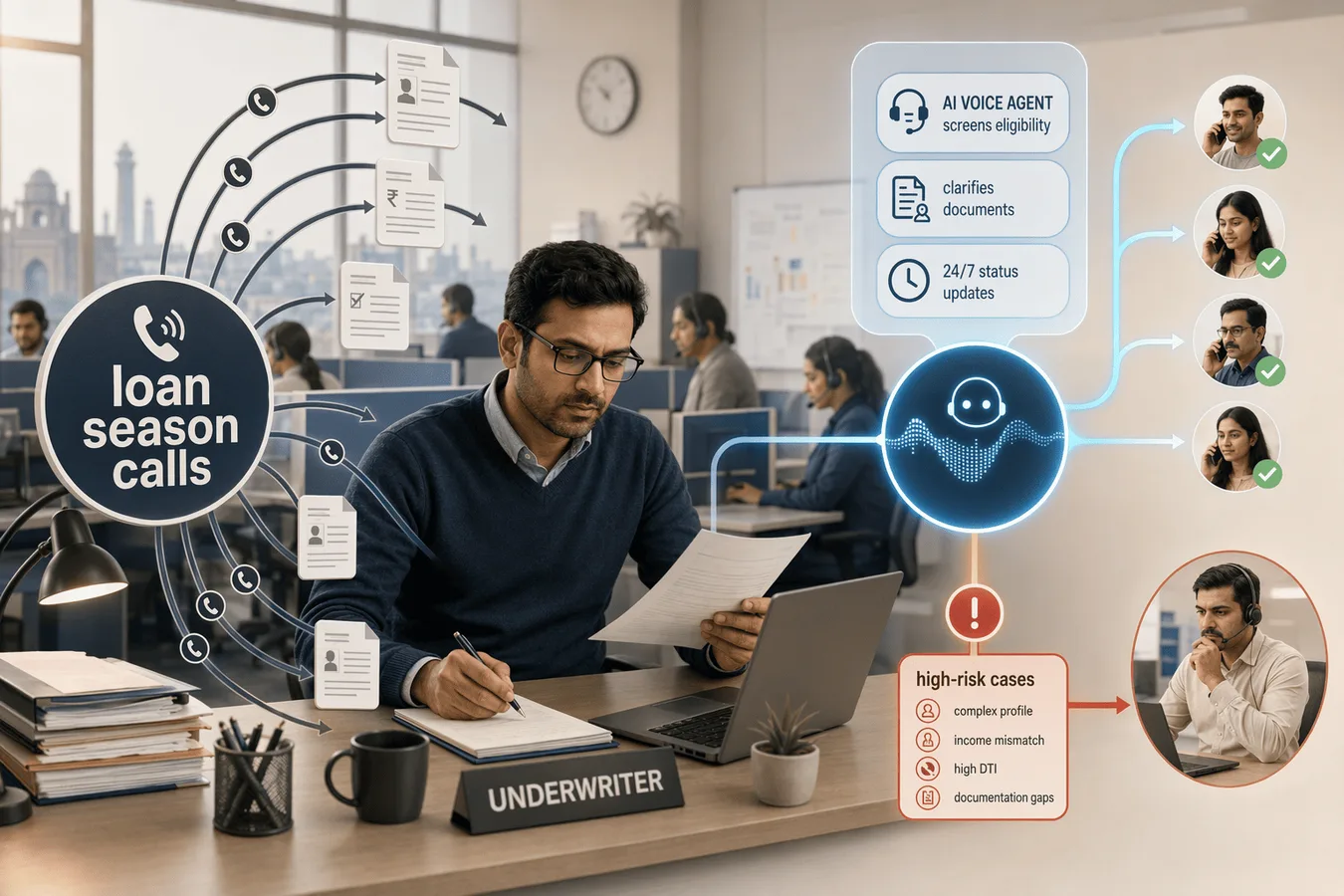
Delhi NCR banks face massive call volume spikes during loan application season, overwhelming traditional IVR systems and creating long hold times that drive borrower abandonment.
AI voice agents automate eligibility screening, document clarification, and 24/7 status updates—scaling capacity autonomously while maintaining RBI Digital Lending Directions compliance and escalating high-risk cases to human underwriters.
Key Takeaways
Traditional IVR systems cannot absorb loan-season call surges without degrading service quality and driving abandonment rates above 30%
AI voice agents automate intake workflows—eligibility screening, document collection, real-time status updates—without adding headcount
RBI Digital Lending Directions 2025 mandate audit trails, Fair Practices Code disclosure, and data localization on Indian servers for all voice agents
Voice agents escalate fraud accusations, identity verification failures, emotionally charged conversations, and complex multi-product inquiries to human underwriters
Core KPIs—containment rate, escalation accuracy, compliance adherence—measure autonomous resolution success and handoff precision during high-volume periods
Why Traditional Call Routing Fails During Loan Application Season
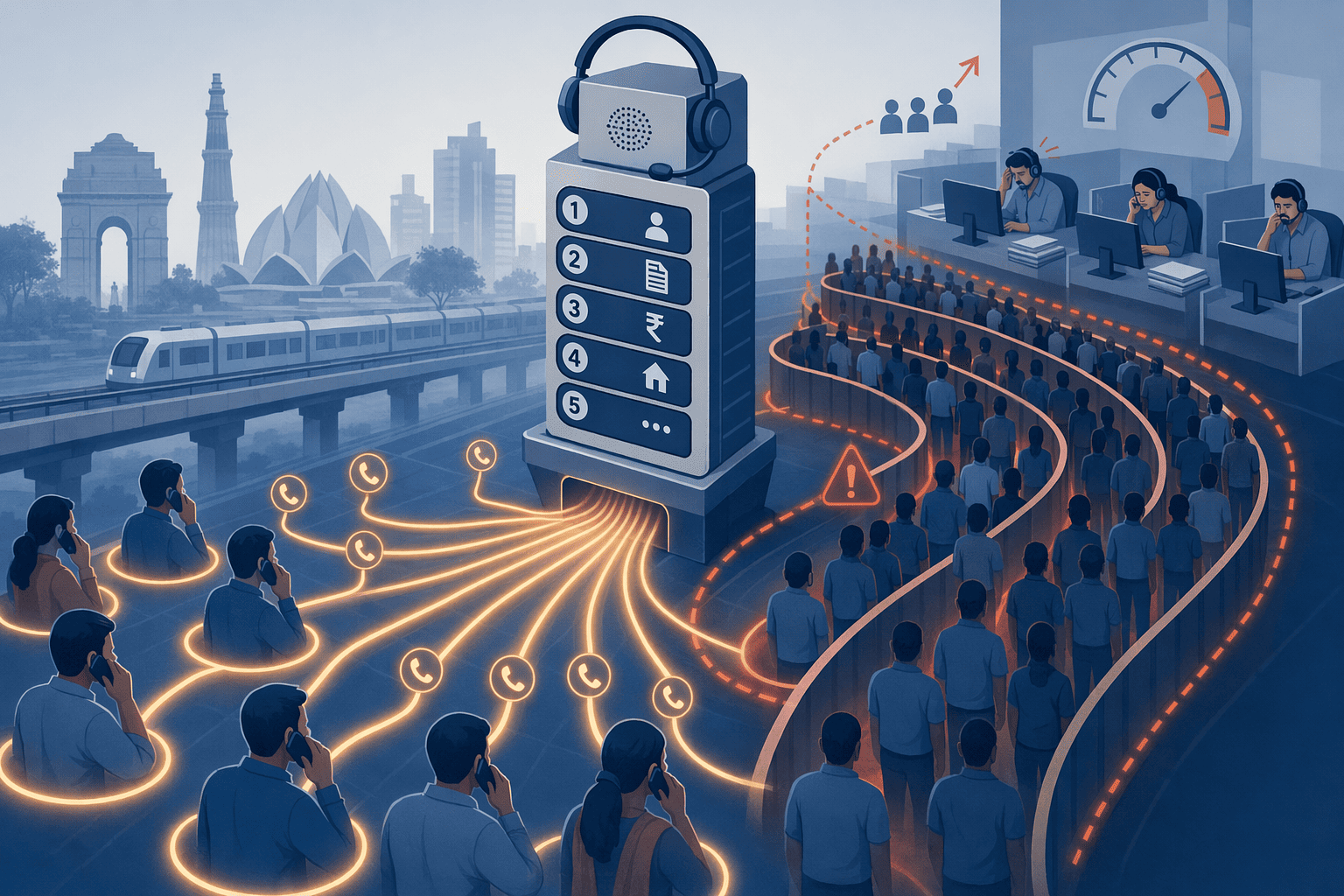
Traditional IVR and queue-based routing cannot absorb the call volume spikes that arrive during loan application season in Delhi NCR without degrading service quality. A single personal loan application can trigger four to six outbound calls before activation, verification, document follow-ups, consent capture, welcome walkthroughs. Multiply that across thousands of daily applications, and the staffing math stops working. AI voice agents designed for loan applications are now actively deployed across lending institutions to handle what menu-driven systems and seasonal hiring cannot scale to meet.
Queue Congestion Creates a Downward Spiral in Service Quality
High call volume during loan season overwhelms traditional IVR and agent pools, creating a downward spiral: longer hold times push abandonment rates up, frustrated callers retry multiple times (amplifying inbound volume), and the agents who remain online face back-to-back calls without recovery time. Traditional call-center tactics, callback queues, self-service portals, overflow routing, address symptoms but cannot autonomously triage eligibility questions, document requirements, or status update requests the way conversational AI can.
IVR Friction Increases Handle Time When Speed Matters Most
Menu-driven IVR adds friction, longer handle times, higher abandonment rates, during peak loan inquiry periods when borrowers expect immediate answers. Each layer of "press 1 for personal loans, press 2 for home loans" extends the path to a human agent or self-service outcome. Voice agents support mortgage and home-loan servicing and regional-language markets requiring multilingual loan inquiries, handling conversational intake without forcing callers through rigid menu trees.
Seasonal Hiring Lags Behind Demand Spikes
Hiring and training seasonal call-center staff takes weeks; loan application season demand spikes within days. By the time new agents are onboarded and productive, the peak has passed or service-level agreements have already been breached. Voice agents designed for BFSI workflows deploy faster and scale instantly, handling the surge without the lag traditional staffing models introduce.
Understanding why traditional systems fail clarifies the operational requirements AI voice agents must meet to autonomously absorb loan-season surges.
How AI Voice Agents Handle High-Volume Loan Inquiries Without Adding Staff
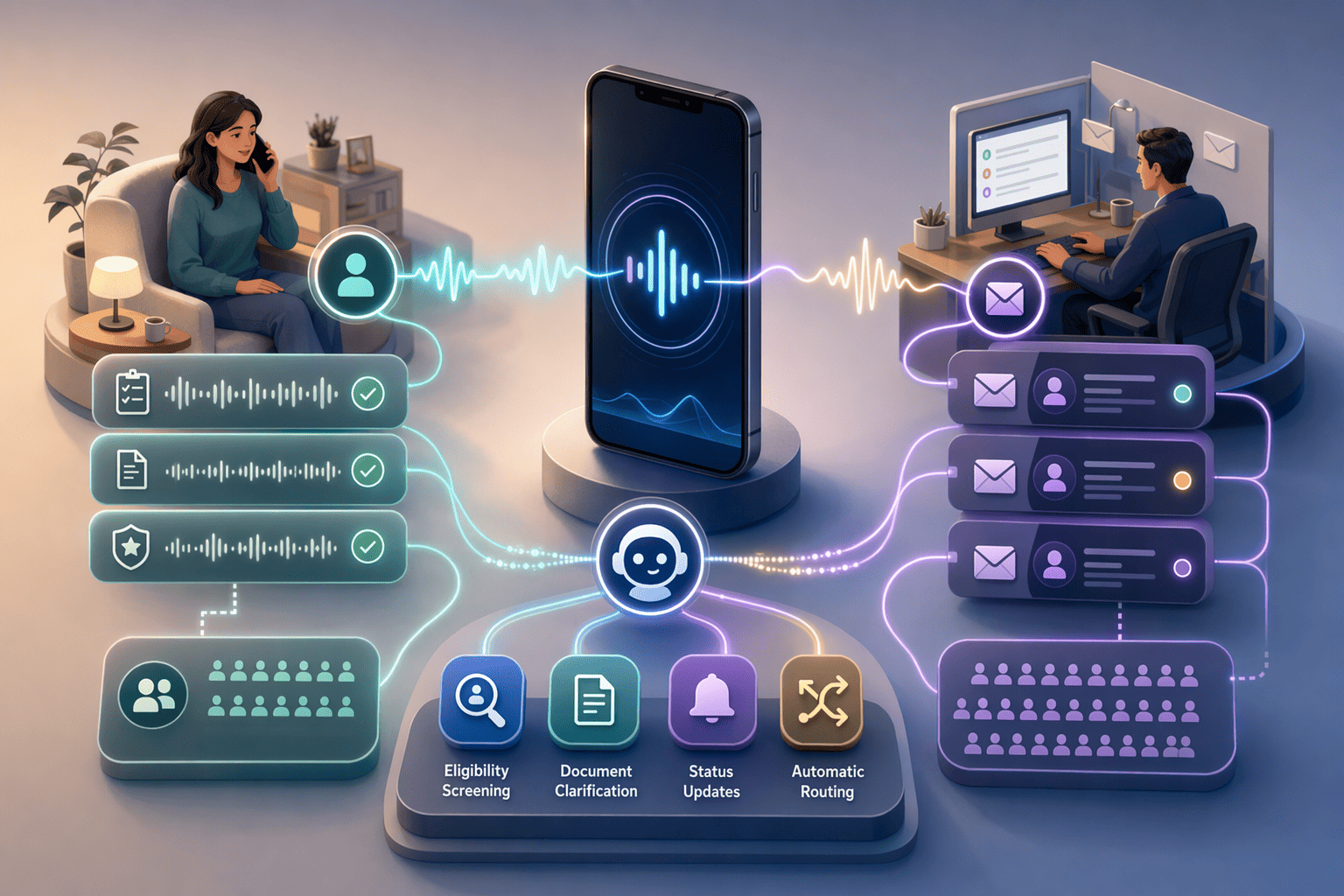
AI voice agents use conversational AI to automate intake workflows, performing eligibility screening, document clarification, and real-time status updates without requiring additional headcount. Unlike traditional IVR systems, these agents conduct natural-language phone conversations to qualify borrowers, collect application details, and route inquiries to loan officers, all while operating 24/7. Indian NBFCs like Bajaj Finance are deploying AI to handle 100 million customer calls annually, demonstrating the scalability banks in Delhi NCR need during loan application season.
Eligibility and Pre-Approval Conversation Automation
Voice agents pre-qualify applicants in real time by gathering income, employment, and credit-history data through conversational prompts, determining whether borrowers meet basic eligibility before advancing to document collection. The agent autonomously screens for loan amount fit, debt-to-income ratios, and employment stability, then routes qualified leads to human loan officers for final underwriting. This intake automation removes the repetitive qualification calls that overwhelm branch teams during peak season, letting voice agents handle hundreds of simultaneous inquiries without queue delays.
Real-Time Application Status Updates via Voice
Voice agents query core banking systems to provide instant status updates 24/7, confirming when applications move to underwriting review, when additional documentation is needed, and when final decisions are rendered. Borrowers call a dedicated number, authenticate via mobile OTP or account details, and receive live updates read directly from the loan management system. This eliminates hold queues for status inquiries and reduces call-center volume by offloading routine "where is my application?" calls to the voice agent, which operates after hours and across time zones.
Document Requirements Clarification Workflows
Voice agents enumerate required documents, PAN, Aadhaar, salary slips, bank statements, and guide borrowers through submission options including SMS links, email attachments, or secure portal uploads. The agent tracks document submissions, flags missing items, and proactively notifies borrowers of gaps, answering clarification questions about format, file size, and acceptable proof types. This workflow automation closes the documentation loop faster than email threads or branch visits, accelerating the move from inquiry to underwriting review without manual checklist management.
Scaling call capacity through automation demands strict adherence to Reserve Bank of India regulatory frameworks governing digital lending workflows.
RBI Digital Lending Compliance Requirements for Voice Agent Deployment
The Reserve Bank of India's Digital Lending Directions 2025 apply to all banks, NBFCs, and digital lending platforms operating in India, establishing a mandatory compliance baseline for any voice agent handling loan inquiries, applications, or follow-ups. These mandates are not optional add-ons, they define the foundation upon which automated calling workflows must be built. Organizations should consult legal counsel before deployment, as non-compliance carries reputational and regulatory risk.
Fair Practices Code Enforcement Through Audit Trails and Transparent Disclosures
Voice agents must maintain audit trails of all loan conversations and provide transparent terms disclosure. Key mandates include transparent terms, no hidden charges, and clear communication. The Reserve Bank of India requires continuous monitoring and regular stress testing, with human oversight to be maintained. This parallels the U.S. Consumer Financial Protection Bureau's findings that financial institutions risk violating legal obligations when deploying chatbot technology, a global regulatory convergence on transparent AI disclosures. EchoLeads voice agents log every exchange, capturing qualification questions, applicant responses, and booking confirmations in CRM-synchronized records, enabling post-call audits without manual transcription.
Data Localization Requirements for Borrower Information Storage
All borrower data, voice recordings, transcripts, personally identifiable information, must be stored on Indian servers under RBI data localization mandates. Voice agent platforms must route call data through India-domiciled infrastructure to comply. The Reserve Bank of India guidance requires lenders to put in place a risk management framework for all models, including AI and machine learning, with accountability extending to the board level. Platforms that default to offshore storage or multi-region replication without India-first routing fail this requirement by design.
Applicant Information Security and Consent Management
Voice agents must obtain explicit consent before collecting sensitive borrower data and secure it directives. This includes verbal consent capture during the call, documented in the audit trail, and encrypted storage of voice recordings. Banks are moving toward large language models and technologies marketed as artificial intelligence; each of the top 10 largest commercial banks have deployed chatbots, amplifying the compliance surface. Consent workflows must align with platform guidelines and include safeguards against unauthorized disclosure.
Meeting compliance mandates requires methodical integration planning, mapping voice agent workflows to core banking APIs, CRM systems, and escalation protocols before deployment.
Step-by-Step: Implementing Voice Agents for Loan Application Workflows
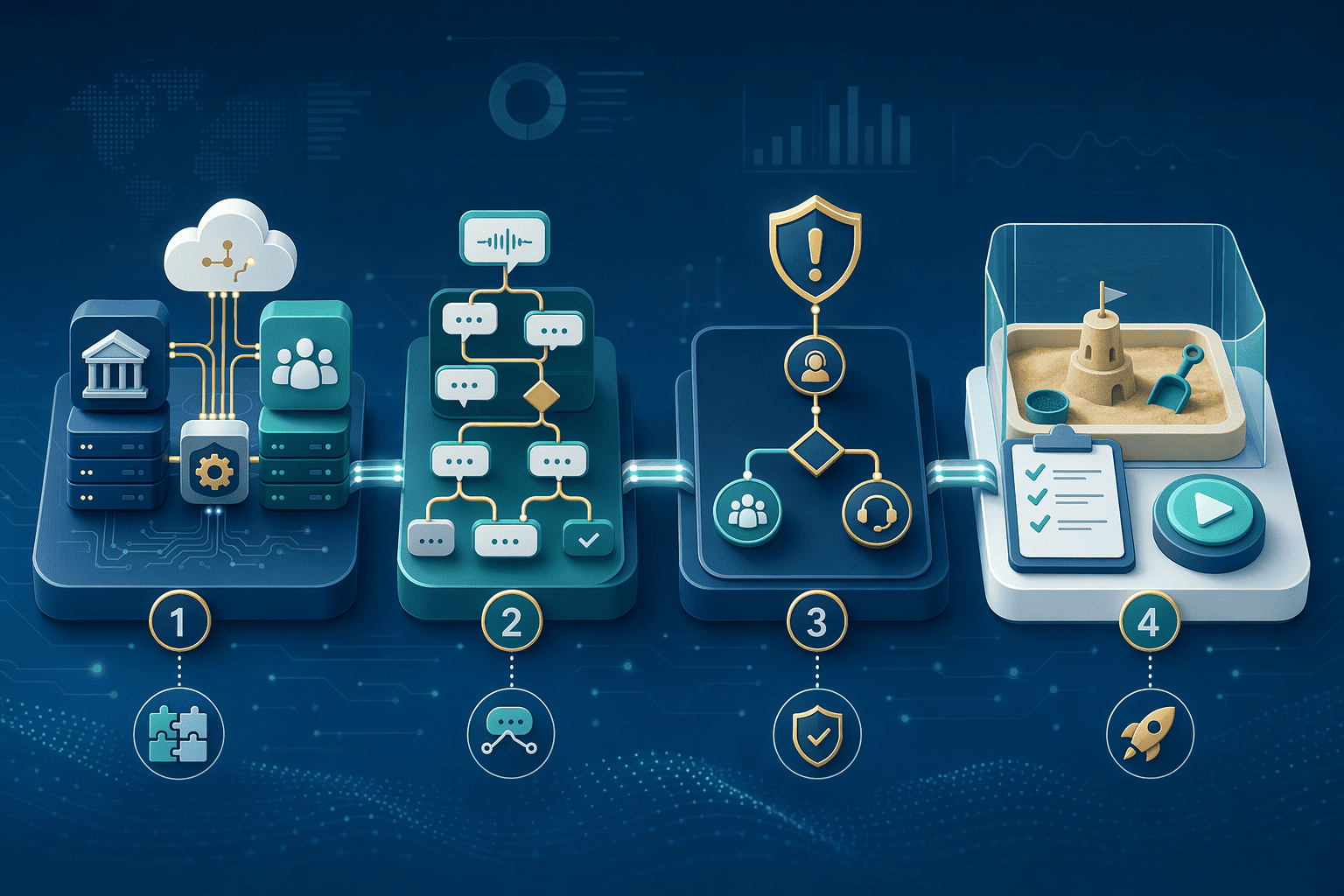
Deploying voice agents during loan season requires methodical integration with your existing core banking and CRM infrastructure. The numbered implementation roadmap below addresses API readiness, conversation flow design, escalation triggers, and pilot testing protocols that Delhi NCR banks must complete before full-scale deployment.
Core Banking System Integration for Bi-Directional Data Sync
Assess core banking API readiness, verify that your loan origination system exposes REST or SOAP endpoints for application status retrieval, document checklist queries, and lead record updates. Platforms like Caller Digital, AurionX, and EchoLeads require bi-directional CRM sync to write back qualification scores and conversation transcripts without manual data entry.
Configure loan-product-specific conversation flows, define eligibility criteria (minimum income, CIBIL threshold, employment type), required documents (salary slips, PAN, Aadhaar), and standard questions (loan amount, tenure preference, existing EMI obligations) for each product line. EchoLeads' workflow automation supports dynamic branching based on borrower responses.
Set escalation triggers for 24/7 autonomous operation, configure handoff rules for scenarios outside safe autonomy thresholds: fraud accusations, identity verification failures, co-borrower scenarios, or emotional distress. Voice agents escalate when complexity or compliance risk demands human judgment; they do not approve loans.
Integrate with CRM for lead synchronization, connect voice agent output to Salesforce, Zoho, or LeadSquared so that qualification scores, next-step recommendations, and call recordings flow into sales queues automatically. EchoLeads integrates directly with major CRM platforms.
Pilot test during off-peak periods, launch a 2-week pilot in January or mid-February before loan season peaks in March, April. Measure containment rate (percentage of inquiries resolved without human handoff) and escalation accuracy to calibrate thresholds.
Measure KPIs and scale, track average handle time, qualification-to-booking conversion, and borrower sentiment scores. If containment exceeds 70% and escalation precision is high, scale to full loan-season volume with regional language support for Hindi, Punjabi, and Urdu-speaking borrowers in Delhi NCR.
Autonomous resolution depends on precise escalation logic, voice agents must recognize when complexity, sentiment, or compliance risk exceeds safe autonomy thresholds.
When Voice Agents Escalate to Human Staff, Triggers and Handoff Protocols
Voice agents handle the majority of loan inquiries autonomously, but certain scenarios exceed safe autonomy thresholds and require immediate human intervention. Talkrix reports that AI handles 80% of outbound telemarketing calls, implying a 20% escalation rate for complex or high-risk conversations. For Delhi NCR banks navigating loan application season, defining explicit handoff triggers ensures compliance, borrower trust, and operational clarity.

Compliance-Risk Escalation: Fraud Accusations and Identity Verification Failures
When a borrower disputes their identity, alleges fraud, or fails multi-factor authentication, voice agents must escalate immediately. These scenarios carry regulatory and reputational risk under the RBI Fair Practices Code, which mandates transparent complaint handling and identity verification safeguards. Insurance telemarketing AI in India faces similar IRDAI compliance requirements for fraud detection and policy disputes, non-compliance can cost insurers up to ₹1 crore per violation. For banks, handoff protocols include flagging the account for manual review, logging the conversation transcript, and routing the call to a trained compliance officer within seconds.
Complexity-Threshold Escalation: Non-Standard Income Verification and Co-Borrower Scenarios
Loan inquiries that exceed voice agent autonomy, self-employed borrowers with variable income, co-borrower applications requiring joint verification, or multi-product comparisons (home loan + top-up + insurance bundling), must transfer to human underwriters. Voice agents can collect initial documentation (salary slips, bank statements) and pre-qualify standard salaried applicants, but non-standard cases require judgment calls about income stability, co-applicant creditworthiness, and product suitability. EchoLeads's handoff triggers can be configured by keyword ("co-applicant", "business income", "compare products") or by detecting multiple loan types in one conversation. Human agents receive full conversation context, eliminating the need for borrowers to repeat information.
Sentiment-Driven Escalation: Emotionally Charged Conversations
Voice agents monitor tone, pacing, and keyword sentiment to detect frustration, anger, or distress, signals that a borrower needs empathy and conflict resolution skills beyond AI capability. When sentiment scores exceed safe thresholds (e.g., repeated use of phrases like "this is unacceptable" or "I want to speak to a manager"), the system escalates to human agents trained in de-escalation techniques. This protocol prevents minor frustrations from escalating into formal complaints or social media criticism, protecting both borrower experience and bank reputation during high-volume loan seasons.
Measuring Success: KPIs for Voice Agent Performance in BFSI
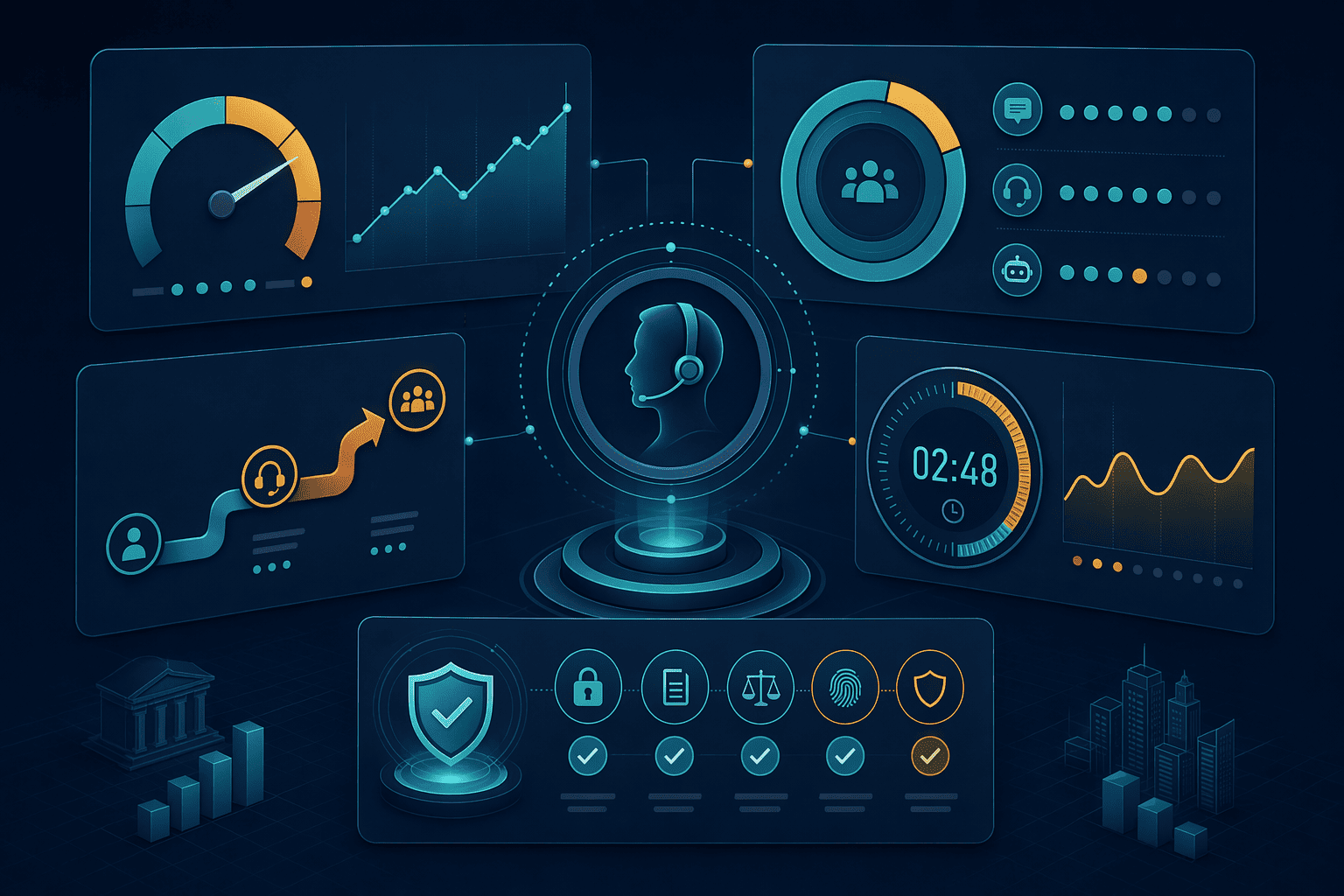
When banks tap AI for bigger tasks under RBI's regulatory guidelines, tracking the right key performance indicators becomes key to validate return on investment during loan-application peaks. The metrics below provide an actionable framework for Delhi NCR banks to measure voice agent impact without relying on anecdotal evidence.
Containment Rate: Percentage of Inquiries Resolved Without Human Escalation
Containment rate quantifies how often the voice agent completes an interaction autonomously, calculated as (autonomous resolutions ÷ total incoming calls) × 100. Insurance-focused AI platforms report under 60 seconds speed to first call and 1,000+ concurrent AI calls, illustrating the throughput required to maintain containment during peak volumes. For routine loan inquiries (balance checks, document status, eligibility FAQs), industry benchmarks suggest 70-85% containment; rates below 60% typically indicate under-trained intent models or overly conservative escalation triggers.
Escalation Accuracy: Are Voice Agents Escalating the Right Cases?
Escalation accuracy measures precision, the ratio of true-positive escalations (high-complexity or compliance-sensitive cases correctly routed) to false positives (routine cases unnecessarily handed off). Simultaneously track false negatives: high-risk conversations the agent resolved autonomously when it should have escalated. Weekly audit samples of 50-100 escalated and non-escalated transcripts reveal whether your ruleset is too permissive or too rigid; adjust confidence thresholds in the escalation logic accordingly.
Compliance Adherence: Audit Trail Completeness and Disclosure Transparency
Every loan-season conversation must satisfy RBI Fair Practices Code disclosure requirements, transparent terms, consent capture, and audit trail logging. Run monthly transcript audits filtering for keywords like "interest rate," "repayment schedule," and "consent"; flag calls missing mandatory disclosures or incomplete audit trails. Automated compliance scoring (percentage of transcripts with all required elements) should exceed 98%; anything below 95% signals the need for immediate script review or stricter guardrails.
Borrower Satisfaction: Post-Call Sentiment and Resolution Confirmation
Deploy post-call SMS surveys asking borrowers to confirm query resolution (yes/no) and rate satisfaction (1-5). Aggregate weekly Net Promoter Score (NPS) or Customer Satisfaction Score (CSAT) specifically for voice-agent interactions; compare against human-agent baselines to identify friction points. If satisfaction falls below human parity, review escalation timing and script empathy, borrowers often perceive premature automation as dismissive, especially in high-stakes loan contexts.
Conclusion
Custom API-driven voice platforms suit banks with engineering resources to build proprietary workflows; pre-configured BFSI platforms like EchoLeads suit mid-sized banks and NBFCs needing faster deployment without in-house AI teams. Single-language English-only voice agents suffice for metro Tier-1 branches; Delhi NCR banks serving mixed-language borrower bases require Hindi, Punjabi, and Urdu support, a capability gap that narrows platform options to regional-language specialists.
As RBI refines AI governance frameworks through 2026, expect stricter audit trail and explainability mandates for voice agents in lending, pushing banks toward platforms with built-in compliance dashboards and human-escalation transparency, rather than black-box conversational AI.
Audit your current loan-season call-handling workflows and identify which inquiries, eligibility, status updates, document requirements, voice agents can autonomously resolve, then explore EchoLeads's BFSI voice automation platform to pilot a compliance-ready deployment before the next high-volume season.
Frequently Asked Questions
Do AI voice agents approve loan applications autonomously?
No. Voice agents perform intake automation, eligibility screening, document collection, status updates, but do not make underwriting or loan approval decisions. Final credit decisions require human underwriters or integrated automated underwriting systems. Voice agents pre-qualify applicants by gathering income and employment data, then escalate to human staff for approval.
What RBI compliance requirements apply to AI voice agents in lending?
RBI Digital Lending Directions 2025 apply to all banks, NBFCs, and digital lending platforms in India. Voice agents must maintain audit trails of all loan conversations, provide transparent terms disclosure and store all borrower data, voice recordings, transcripts, PII, on Indian servers under data localization mandates.
When should a voice agent escalate a loan inquiry to a human agent?
Voice agents must escalate fraud accusations, identity verification failures, emotionally charged conversations, multi-product comparisons, and non-standard income verification scenarios. Self-employed borrowers with variable income, co-borrower applications requiring joint verification, and cases exceeding safe autonomy thresholds require immediate human intervention to ensure compliance and service quality.
Can AI voice agents operate in Hindi and regional languages for Delhi NCR borrowers?
Yes. Leading platforms support Hindi, Punjabi, Urdu, and other regional languages. Caller Digital's platform explicitly offers Hindi plus 14 additional Indian languages, enabling Delhi NCR banks to serve mixed-language borrower bases without forcing English-only interactions, which improves accessibility and containment rates across diverse customer segments.
How do banks measure voice agent performance during loan season?
Banks track three core KPIs: containment rate (percentage of inquiries resolved autonomously), escalation accuracy (precision of handoff decisions), and compliance adherence (audit trail completeness). Containment rate calculates autonomous resolutions divided by total incoming calls. Escalation accuracy measures true-positive escalations versus false positives, while compliance adherence confirms regulatory documentation.
Where is borrower data stored when using AI voice agents in India?
All borrower data, voice recordings, transcripts, personally identifiable information, must be stored on Indian servers under RBI data localization mandates. Voice agent platforms must route call data through India-domiciled infrastructure to comply with RBI Digital Lending Directions. Cross-border data transfers violate regulatory requirements and expose banks to enforcement action.
How quickly can banks deploy AI voice agents for loan application season?
Pilot deployment typically takes 4 to 8 weeks, including core banking integration, workflow configuration, and testing. Banks should start during off-peak periods to tune escalation triggers and test compliance adherence before loan-season surges. Methodical integration with existing CRM and core banking systems ensures API readiness and minimizes production failures.
Related articles
6 Best AI Outbound Calling Solutions for Loan Verification
Compare AI outbound calling platforms that verify loan applications 24/7
5 Common Causes of Long Bank Loan Inquiry Call Wait Times
Why do bank customers complain about long wait times for loan inquiry calls? Learn the 5 Common Causes of Long Bank Loan Inquiry Call Wait Times.
4 Best AI Voice Lead Qualification Tools for Insurance
Compare AI voice platforms for insurance lead qualification through automated outbound calls.