
6 Best AI Outbound Calling Solutions for Loan Verification
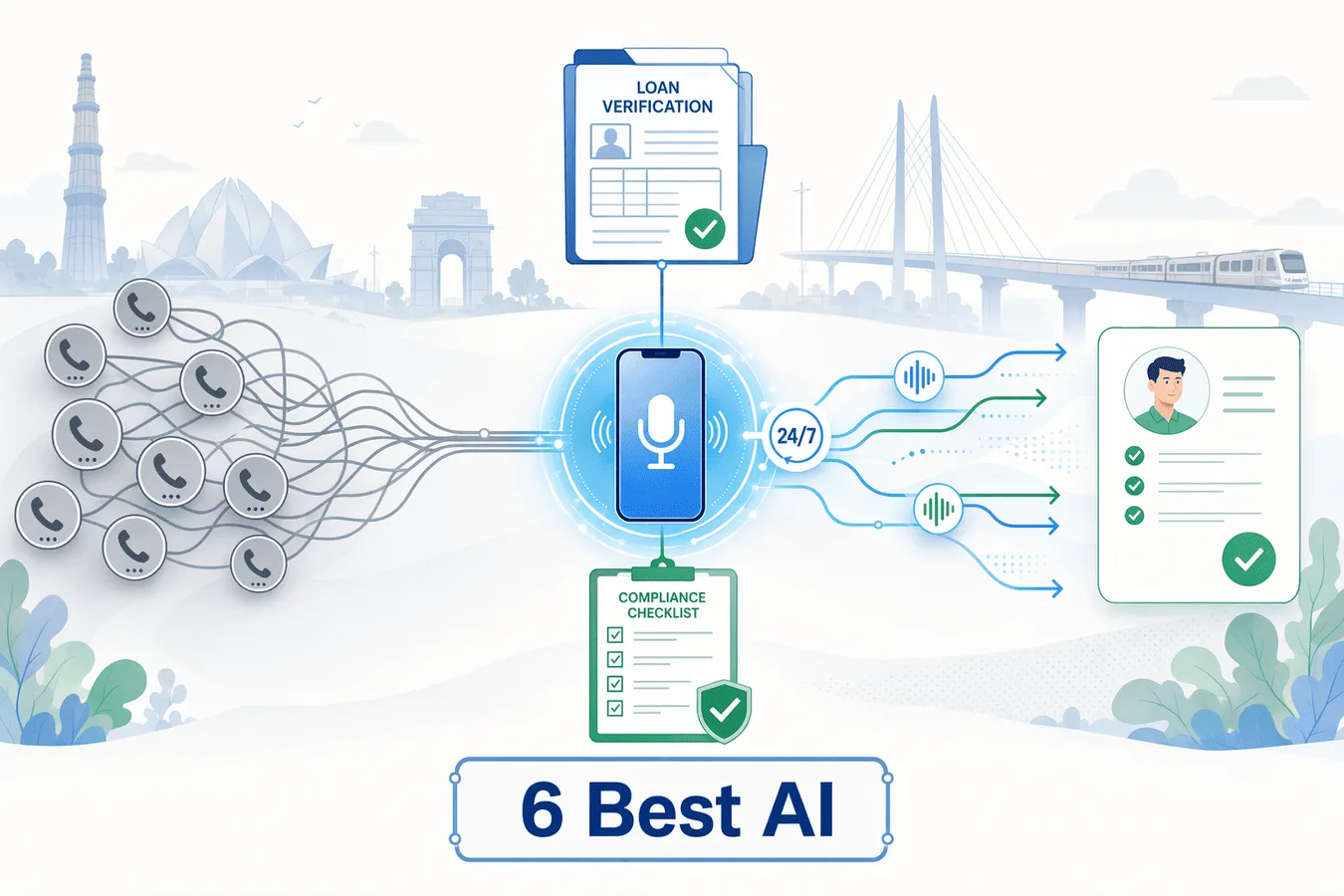
BFSI teams in Delhi NCR face mounting pressure to verify loan applications faster while maintaining compliance with RBI digital lending guidelines. Manual verification calls create bottlenecks, limit operating hours, and strain underwriting teams during seasonal lending surges.
AI voice platforms now automate outbound verification calls 24/7, confirming applicant details, capturing consent, and syncing outcomes to loan management systems in real time.
Key Takeaways
AI voice agents execute four-step outbound verification workflows—data retrieval, dialing, conversation, and CRM sync—autonomously
Platforms must support Hindi, Punjabi, and Hinglish code-switching for Delhi NCR markets, handle RBI consent disclosure requirements, and escalate disputes to human underwriters
API-first solutions offer deep customization but require developer resources; no-code platforms deploy faster with limited workflow flexibility
Usage-based pricing (per-minute or per-call) suits seasonal volume spikes; flat-rate monthly fees work better for predictable daily call counts
Voice agents verify application details but do not approve loans—final underwriting decisions remain with human teams or automated underwriting systems
Yes — platforms like EchoLeads, Finn, and Qualify.bot make outbound calls to verify loan applications automatically, 24/7. These AI voice agents dial applicants within minutes of form submission, confirm identity and application details, and sync outcomes to loan management systems without human intervention. Organizations should consult legal counsel before deployment, as vendors often reference compliance without operational detail.
The Outbound Verification Workflow
AI platforms execute loan verification in four steps:
CRM trigger — When a borrower submits an application form or abandons it mid-flow, the platform receives a webhook or API event from the CRM or lead-generation system.
Automated dial, The voice agent initiates an outbound call within minutes, while the applicant is still at their computer and motivated.
Identity and application confirmation, The agent verifies the caller's identity (name, date of birth, phone number match) and confirms application details such as loan amount, property address, or intended use. Finn's KYC verification workflow illustrates how platforms handle identity checks in regulated financial contexts.
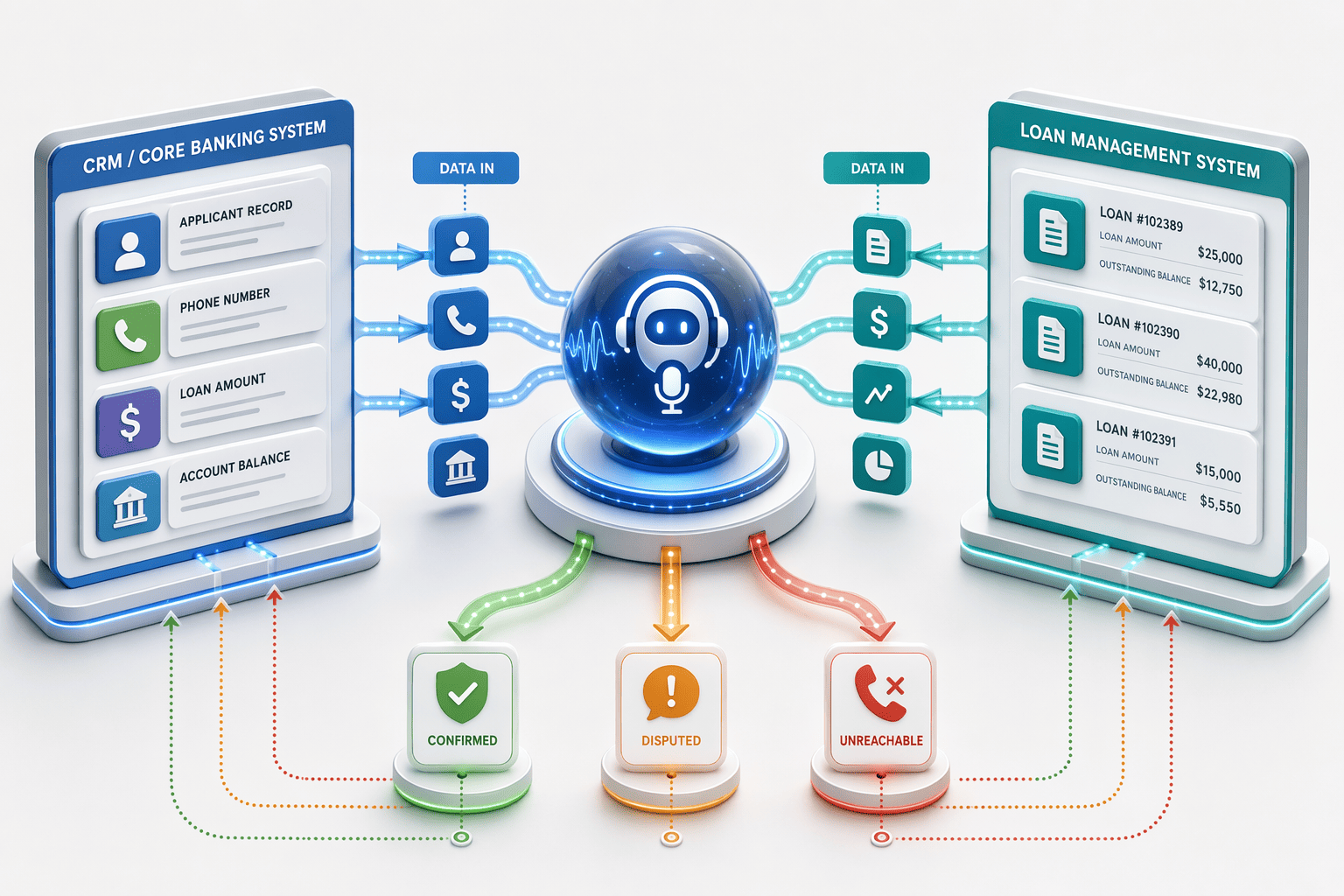
Outcome sync, The platform logs the call result (confirmed, unreachable, disputed, escalated) and updates the borrower's record in the loan origination or CRM system in real time.
EchoLeads automates this sequence for loan inquiries and mortgage callbacks, routing qualified leads to licensed loan officers when verification passes.
What Voice Agents Verify and What They Don't
Voice agents confirm application details and identity but do not approve loans or make underwriting decisions. They handle intake and qualification workflows that precede human decision-making, collecting proof of income, identification documents, and property details for secured loans, then guiding borrowers through submission options such as SMS links, email attachments, or secure portal uploads. Final underwriting decisions require human oversight or integrated automated underwriting systems.
Platforms escalate calls when complexity, sentiment, or compliance risk exceeds safe autonomy thresholds, including fraud accusations, identity verification failures, disputes, emotionally charged conversations, multi-product comparisons, non-standard income verification, and co-borrower scenarios.
Real-Time Data Sync with Loan Management Systems
After each verification call, AI platforms write structured outcomes, confirmed, unreachable, disputed, or escalated, into the lender's CRM or loan origination system via API. EchoLeads tracks document submissions, flags missing items, and proactively notifies borrowers of gaps, ensuring loan officers see real-time applicant status without manual data entry. Finn's platform demonstrates bi-directional sync for loan application follow-ups and payment reminders, logging every interaction for audit and compliance review.
Automating verification workflows requires more than just placing calls, platforms must integrate with existing loan management systems, handle regional dialects, and operate within strict compliance boundaries.
Key Capabilities Required for 24/7 Automated Verification
CRM and LMS Integration for Bi-Directional Sync
Platforms pull application data, name, loan amount, phone number, from CRM systems and push verification outcomes (confirmed, disputed, unreachable) back to loan management systems in real time. EchoLeads supports smooth CRM integration with bi-directional sync across major platforms, ensuring qualification scores and call transcripts flow automatically into Salesforce, HubSpot, Zoho, LeadSquared, and Kylas. Kallix reads live data from core banking systems via API, so balance inquiries reflect real-time state identical to branch teller screens. Bi-directional workflows eliminate manual data entry, reduce compliance risk, and let underwriting teams act on verified data within seconds of call completion.
Regional Language Support for Delhi NCR
Delhi NCR customers predominantly speak Hindi, with Punjabi, Haryanvi, and Hinglish code-switching common. Platforms supporting 13+ regional Indian languages, Hindi, Tamil, Telugu, Marathi, Bengali, Kannada, Punjabi, and more, handle this diversity natively. However, no platforms publish dialect-specific accuracy benchmarks for Hindi or Kannada in loan verification contexts. Teams should request live demos in their target dialect and test real mobile audio before committing to ensure the AI handles Hinglish switches, rural accents, and fast speech without escalation loops.
Platform Comparison: EchoLeads, Convin AI, Rootle AI, Kallix, Talkrix, VoAgents
Platform | Outbound Automation | Language Support | CRM Integrations | Compliance Features | Pricing Model |
|---|---|---|---|---|---|
EchoLeads | 24/7 autonomous calling | 70+ languages, multilingual loan workflows | Salesforce, HubSpot, Zoho, LeadSquared, Kylas | DPDP Act 2023, RBI FPC, IRDAI | Usage-based (not flat-rate) [content_directives] |
Convin AI | Call analytics + live coaching | Hindi + 10 Indian languages | Salesforce, Zoho, Freshworks | Conversation intelligence, audit trails | Custom enterprise pricing |
Rootle AI | Post-call analysis focus | Hindi, English, regional support | Salesforce, HubSpot | Call recording, transcript storage | Seat-based annual contracts |
Kallix | 24/7 inbound + outbound | 2 languages (EN, HI ) | Core banking API integration | RBI compliance, fraud triage | Not publicly disclosed |
Talkrix | 48hr go-live, 30s lead response | 50+ languages, Hindi/English native | Salesforce, LeadSquared, Zoho native | TRAI DND, RBI-regulated workflows | Per-call outcome-based |
VoAgents | Outbound campaigns + inbound IVR | Hindi + 8 regional languages | Zoho, custom API | Call recording, TCPA-aligned | Monthly flat-rate per agent |
All six platforms handle outbound verification calls autonomously, but differ in integration depth, language breadth, and pricing transparency. Comparative evaluation of Indian voice AI platforms shows deployment timelines range from 48 hours (Talkrix) to 2 to 3 weeks (EchoLeads, others), with enterprise-grade compliance (RBI FPC, DPDP Act, TRAI DLT) built into EchoLeads, Kallix, and Talkrix by default. Teams requiring bi-directional CRM sync without manual logging should prioritize platforms with native core-banking or LMS connectors; those needing regional-language accuracy beyond generic Hindi should test live audio samples in their target dialect before signing contracts.
24/7 automation delivers speed and scale, but BFSI organizations cannot deploy voice agents without addressing regulatory requirements that govern every outbound loan verification call in India.
Compliance and Consent Requirements for Outbound BFSI Calling
RBI Digital Lending Guidelines and Call Recording
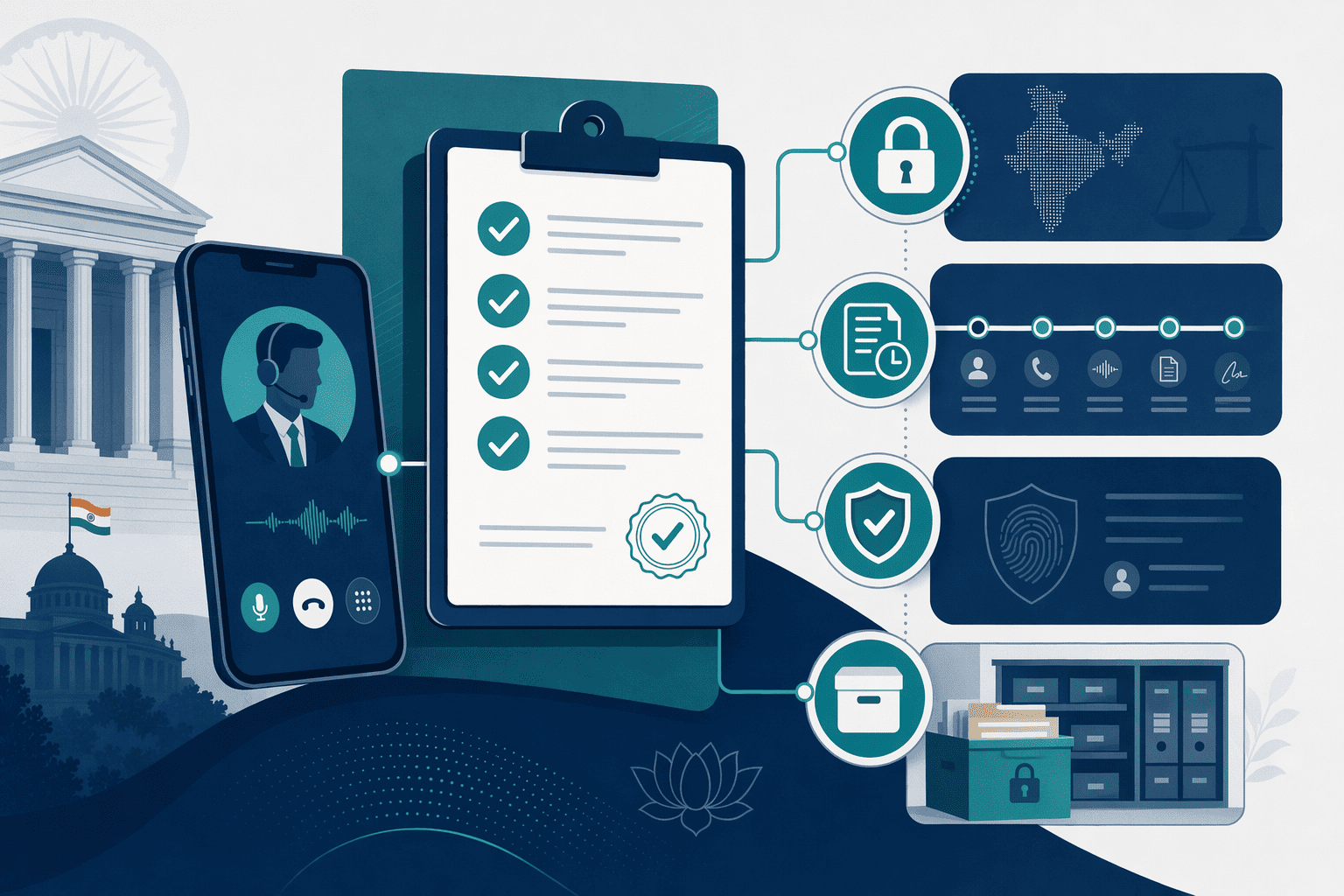
In Delhi NCR and across India, outbound loan verification calls fall under the Reserve Bank of India's regulatory framework for digital lending. The RBI's Digital Lending Directions, effective from 8th May 2025, mandate that all lenders, commercial banks, non-banking financial companies, and lending service providers, maintain audit trails, transparent disclosures, and secure handling of applicant information during automated outbound interactions. Call recording is not explicitly prescribed in every scenario, but operational norms require that lenders document customer interactions to support grievance redressal and regulatory audits. Unlike the U.S. Telephone Consumer Protection Act (TCPA), India does not enforce a blanket prior-consent rule for automated calls; however, the principle of affirmative consent before proceeding with sensitive data exchange is embedded in RBI's Fair Practices Code.
Consent Capture Workflows During Outbound Calls
At call start, the voice agent must disclose the lender's identity, the purpose of the call (loan application verification), and whether the conversation is being recorded. The agent then seeks affirmative consent, typically a verbal "yes" captured by the system, before collecting personally identifiable information such as income, employment, or Aadhaar details. If the applicant declines consent, the agent must disconnect and log the refusal in the lender's CRM. Few platforms publish end-to-end consent scripts; organizations should request detailed workflow documentation during vendor evaluation to verify that opt-in, opt-out, and call-termination logic align with RBI transparency requirements.
GDPR and CCPA Compliance Claims vs Operational Reality
GDPR and CCPA compliance features appear in many tools' marketing materials but implementation depth varies widely, organizations should consult legal counsel before deployment. Vendors often cite "GDPR-ready" data handling or "CCPA-aligned opt-out mechanisms" without detailing how consent is captured during live outbound calls, how data deletion requests are processed mid-verification, or whether cross-border data transfers comply with adequacy decisions. For India-based lenders, the Digital Personal Data Protection Act (DPDPA) will impose its own consent and data localization mandates; until final DPDPA rules are published, lenders should request compliance attestations, third-party audit reports, and explicit confirmation that the platform supports on-call consent revocation and immediate data purge workflows.
Even the most sophisticated voice agents encounter scenarios that require human judgment, understanding when and how platforms escalate calls separates reliable automation from liability risks.
When Voice Agents Escalate to Human Underwriters
Escalation Trigger Framework
Voice agents escalate loan conversations when complexity, sentiment, or compliance risk exceeds safe autonomy thresholds. Triggers include:
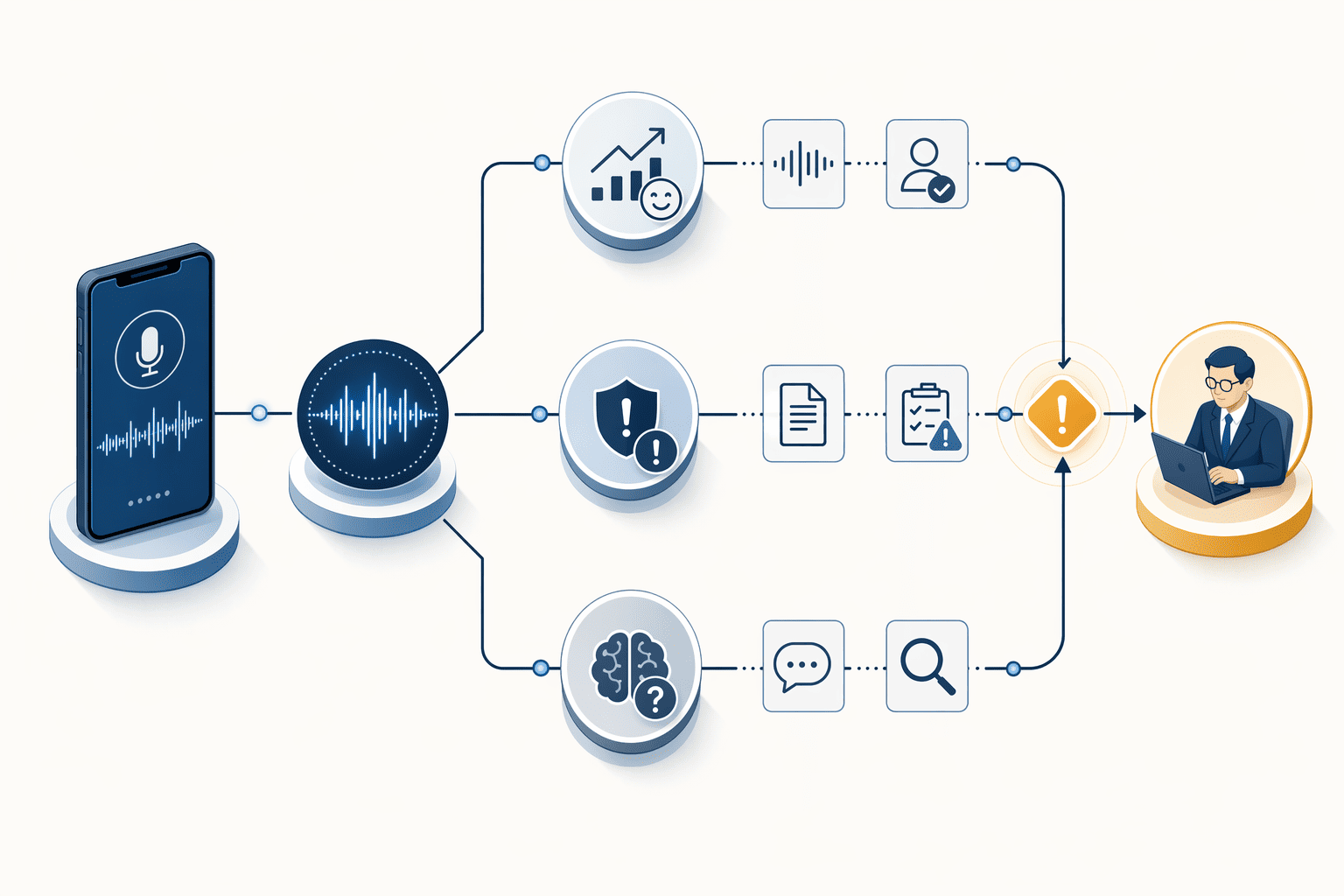
Fraud accusations, any mention of fraud, identity theft, or account disputes triggers immediate escalation
Identity verification failures, mismatched documents or caller authentication issues
Disputes, contested charges, loan terms, or payment histories
Emotionally charged conversations, sentiment scores indicating frustration, anger, or distress
Multi-product comparisons, scenarios requiring nuanced trade-off explanations across loan types
Non-standard income verification, self-employed applicants, gig workers, or complex income structures
Co-borrower scenarios, conversations involving multiple decision-makers or joint applications
EchoLeads allows businesses to configure these handoff triggers based on conversation keywords, sentiment scores, or explicit prospect requests. Similar insurance telemarketing workflows escalate complex policy scenarios that exceed AI autonomy thresholds.
How Platforms Measure Confidence and Intent
Answers aren't just blindly collected, confidence, uncertainty, satisfaction, and intent are also measured throughout the conversation. AI lead qualification platforms track not only what the caller says but how they say it: pauses, hesitation, sentiment shifts from neutral to frustrated or confused. Low-confidence responses, where the voice agent detects uncertainty or incomplete information, get flagged for human review rather than blindly logged as complete data points.
Real-Time Handoff Mechanics
Three common handoff patterns handle escalation:
Warm transfer, the agent stays on the line, introduces the human underwriter, and passes full conversation context
Callback queue, the agent schedules a human follow-up within a defined SLA (e.g., 2 hours), logs the conversation, and disconnects
Flagged outcome, the agent marks the record 'requires human review', syncs the transcript to CRM, and ends the call
EchoLeads supports all three handoff modes and retains conversation history for escalation to human sales representatives. This positions escalation not as a limitation but as a compliance feature, protecting lenders from fraud risk and regulatory exposure while maintaining the 24/7 verification capacity for routine cases.
Pricing models, deployment timelines, and regional support infrastructure vary widely across platforms, evaluating these factors against your operational context determines long-term ROI.
Platform Considerations for Delhi NCR BFSI Teams
Usage-Based vs Flat-Rate Pricing Models
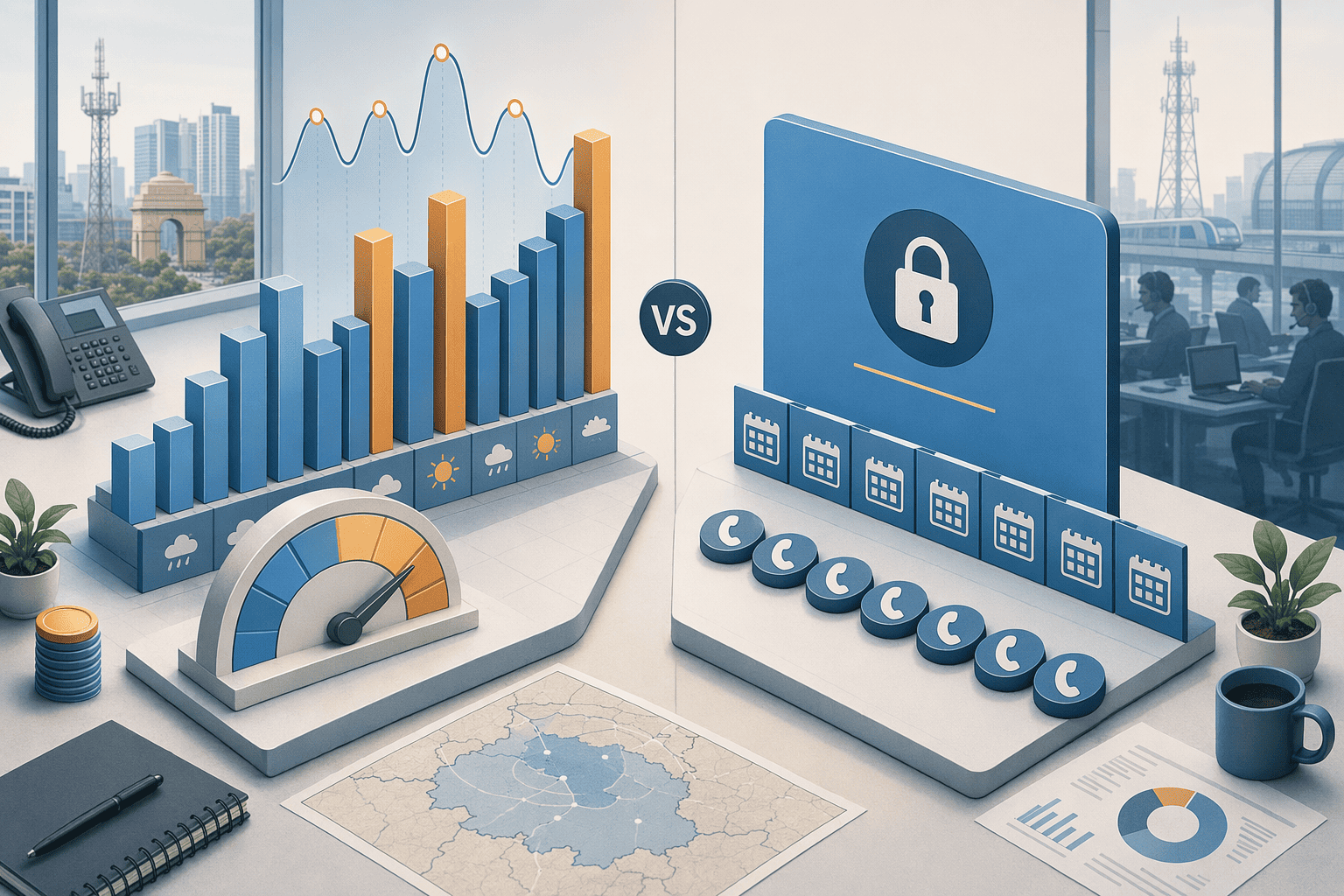
Pricing models split into two categories: usage-based (per-minute or per-call) and flat-rate monthly fees. EchoLeads offers a $25/month flat rate for predictable workloads and custom pricing for high-volume sales teams. Usage-based models suit seasonal verification surges, a mid-size MFI with 200,000 active borrowers placing roughly 200,000 reminder calls per month benefits from pay-per-outcome flexibility. Flat-rate pricing suits predictable daily call volumes, eliminating per-minute cost anxiety during peak periods. Caller Digital's outcome-based pricing ranges from ₹8 to 25 per resolved call, while competitors like Bolna charge approximately ₹5.52/min. The decision framework: if your verification volume fluctuates monthly (loan application surges during festival seasons), usage-based pricing prevents paying for unused capacity; if call counts remain stable year-round, flat-rate models simplify budgeting.
Integration Complexity and Deployment Timelines
API-first platforms like EchoLeads require developer effort but offer deep customization, the platform deploys in 72 hours using industry-specific templates for insurance and BFSI. No-code connectors (Zapier, Make) speed deployment to 1 week but limit workflow flexibility, you cannot encode complex multi-step qualification logic without API access. Typical deployment timelines: Caller Digital ships in 7 to 14 days, Gnani takes 8 to 16 weeks for enterprise BFSI, Bolna requires 2 to 6 weeks with a dev team. Integration with your LMS triggers outbound calls automatically based on loan lifecycle events, repayment due dates, KYC expiry, renewal windows, without manual dialling lists. Evaluate whether your verification workflows need real-time CRM updates or can tolerate batch sync; real-time bi-directional sync demands API integration, while daily batch updates often work via pre-built connectors.
Regional Support and Local Partnerships in Delhi NCR
Verify whether platforms maintain Delhi NCR implementation teams and Hindi-speaking support before committing. Caller Digital includes built-in TRAI and DPDP compliance for Indian sub-enterprise buyers, while global platforms like ElevenLabs operate under global-only compliance frameworks with no DPDP documentation. Request customer references from Delhi NCR BFSI clients, ask peers how the vendor handled RBI-regulated workflows, consent management, and call recording requirements. Platforms with India-sovereign infrastructure (like Sarvam ) offer data residency guarantees; US-hosted platforms may require additional data transfer agreements. During vendor evaluation, request transparent pricing documentation, no single source provides authoritative cost floors across all platforms, so direct vendor disclosure is key. Local partnerships matter for on-ground training and troubleshooting; ask whether the vendor's team can conduct on-site setup at your Delhi NCR branch or relies solely on remote support.
Making the Right Platform Choice for Your Verification Workflow
API-first platforms like EchoLeads offer deep CRM customization but require developer resources; no-code connector platforms speed deployment but limit workflow flexibility. Usage-based pricing suits seasonal loan volume surges, festival lending, housing loan peaks, while flat-rate monthly fees suit predictable daily verification call counts.
As RBI digital lending guidelines evolve and regional language models improve, expect voice AI verification accuracy to approach human parity for routine loan confirmation calls, but regulatory scrutiny around consent and recording will intensify, making compliance-first platform selection critical.
Document your current manual verification workflow, average handle time, call volumes, escalation rate, this week, then request live Hindi and English demos from EchoLeads and two competitors to compare dialect accuracy and CRM integration depth before committing.
Frequently Asked Questions
Can AI voice agents approve loan applications automatically?
No. Voice agents confirm application details and verify identity but do not approve loans or make underwriting decisions. They execute intake and qualification workflows, collecting proof of income and identification documents, that precede human decision-making or integrated automated underwriting systems.
What happens if a caller disputes information during a verification call?
Disputes trigger escalation protocols. AI platforms measure confidence, uncertainty, and intent throughout the conversation. When a caller disputes recorded information, the voice agent flags the call for human underwriter review and may offer a warm transfer or schedule a callback with a licensed officer.
Do I need to get consent before making outbound verification calls in India?
Yes. Outbound loan verification calls fall under RBI's digital lending framework, effective May 8, 2025. Platforms must disclose the lender's identity, call purpose, and recording status at call start, then capture affirmative consent before proceeding with verification questions.
How accurate are voice agents at understanding Hindi during loan verification calls?
No platforms publish dialect-specific accuracy benchmarks for Hindi and Kannada in loan verification contexts. Delhi NCR customers speak Hindi with Punjabi, Haryanvi, and Hinglish code-switching. Request live demos in your target dialect and review call transcripts before deployment to verify accuracy.
What is the typical cost per outbound verification call?
Pricing models split into usage-based (per-minute or per-call) and flat-rate monthly fees. No single source provides authoritative cost floors across all platforms. Verify current pricing directly with vendors, rates depend on call volume, CRM integration complexity, and compliance feature requirements for Indian markets.
Can voice agents handle co-borrower verification scenarios?
Voice agents collect basic information from both parties but typically escalate to human underwriters for joint verification. Co-borrower scenarios exceed safe autonomy thresholds because they require coordinated consent capture, cross-referenced income verification, and joint liability confirmation that demands human oversight.
How long does it take to deploy an AI outbound calling platform for loan verification?
API-first platforms like EchoLeads deploy in 72 hours using industry-specific BFSI templates. Full API integrations, CRM sync, call script configuration, compliance review, take 2 to 4 weeks. No-code connectors speed deployment to 1 week but limit workflow customization and escalation logic flexibility.
Related articles
5 Common Causes of Long Bank Loan Inquiry Call Wait Times
Why do bank customers complain about long wait times for loan inquiry calls? Learn the 5 Common Causes of Long Bank Loan Inquiry Call Wait Times.
4 Best AI Voice Lead Qualification Tools for Insurance
Compare AI voice platforms for insurance lead qualification through automated outbound calls.
How Banks in Delhi Can Handle Loan Season Calls with AI
Learn how AI voice agents can be used for loan callbacks for banks in Delhi NCR.