
What Tools Handle Both Outbound Lead Calls and Inbound Customer Support Across Multiple Channels Like Phone and WhatsApp? (2026)
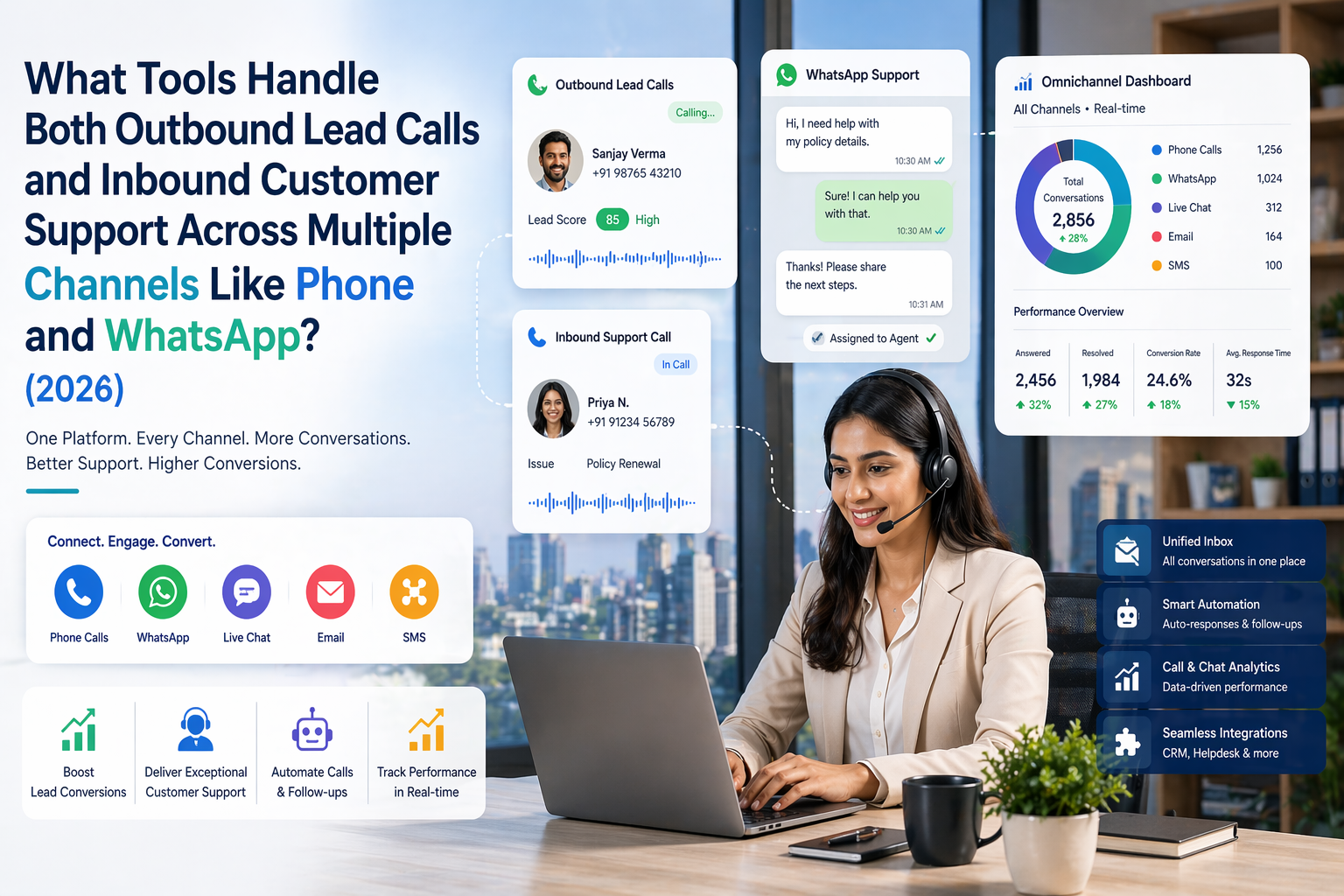
Modern businesses need platforms that consolidate outbound lead generation, inbound customer support, and multi-channel messaging into unified workflows, eliminating the operational friction of managing separate sales and support tools.
Introduction
Customer expectations have fundamentally changed. Today's buyers expect instant responses whether they're sending a WhatsApp message at 9 a.m., calling your support line during lunch, or texting an inquiry after hours. Research shows 89% of consumers say speed of response is a key factor in deciding which company to buy from [4]. Yet more than half of SMEs still rely on fragmented tools—personal phones, multiple apps, or siloed CRM systems—creating gaps where leads slip through and customers grow frustrated. EchoLeads addresses this challenge by consolidating AI-powered outbound calling, inbound customer support, and WhatsApp automation into a single platform. Instead of juggling separate systems for sales outreach and support tickets, businesses can manage the entire customer journey through unified multi-channel support that preserves context across every touchpoint. This approach doesn't just improve customer satisfaction—it drives measurable ROI through faster response times, higher conversion rates, and reduced operational overhead. Whether you're qualifying leads through AI appointment scheduling calls or handling inbound support queries via phone and WhatsApp, EchoLeads ensures no conversation falls through the cracks.
Why Businesses Need Unified Outbound and Inbound Communication
The traditional approach of separating sales tools from support tools creates operational silos that hurt both teams and customers. A prospect might receive an outbound call from your sales AI, then later contact support through WhatsApp, only to have the support agent lack context about the previous sales conversation. This fragmentation wastes time and damages trust. Over 75% of customers now prefer businesses that offer multiple communication channels [4], and 95% of texts are read within 3 minutes of being received [4], making SMS and WhatsApp essential for urgent communication. Yet many businesses still handle these channels through disconnected systems.
Unified platforms solve this by creating a single source of truth for all customer interactions. When EchoLeads handles both outbound lead qualification and inbound support, the AI voice agents maintain conversation history across channels. A customer who first engaged through an outbound campaign can seamlessly receive support via WhatsApp without repeating their information. This continuity improves customer experience while reducing agent workload. For SMEs especially, consolidating tools means fewer software subscriptions, simpler training, and better visibility into the complete customer journey. The result is measurable improvement in response times, conversion rates, and customer satisfaction—all from eliminating the artificial barrier between sales and support functions.
The Hidden Costs of Fragmented Communication
When sales teams use one platform for outbound calling and support teams use another for inbound queries, several problems emerge. First, duplicate customer records create confusion—sales has one version of customer data, support has another. Second, handoffs between teams become friction points where context gets lost. Third, reporting becomes fragmented, making it difficult to understand the complete customer journey from first contact to resolution. Finally, training costs multiply as teams must learn separate systems. A typical scenario illustrates the problem: a customer receives an AI-powered outbound call about a product, expresses interest, then later contacts support via WhatsApp with a question. Without unified systems, the support agent has no visibility into the sales conversation, forcing the customer to repeat their context and creating a disjointed experience that erodes trust.
Platform Comparison: Tools That Handle Both Use Cases
Not all communication platforms are built to handle both outbound lead generation and inbound support equally well. Some excel at sales automation but lack robust support features, while others focus on helpdesk functionality without strong outbound capabilities. Below is a comparison of platforms that genuinely support both use cases across phone and WhatsApp channels. EchoLeads stands out by offering AI phone calling agents for outbound campaigns alongside 24/7 customer support AI for inbound queries, with WhatsApp automation integrated throughout.
Platform | Outbound AI Calling | Inbound Support | WhatsApp Integration | Unified Dashboard | Best For |
|---|---|---|---|---|---|
EchoLeads | AI-powered lead qualification and appointment scheduling | 24/7 AI customer care with smart routing | Automated WhatsApp sales and support workflows | Yes—centralized multi-channel AI | SMEs needing one platform for sales and support |
Zendesk | Limited outbound capabilities | Robust ticketing and omnichannel support | Available via integrations | Yes—support-focused | Enterprises prioritizing inbound support |
CloudTalk | Power dialing and call tagging | Basic inbound routing | Via third-party integrations | Partial—primarily voice-focused | Mid-sized sales teams with high call volume |
Twilio Flex | Customizable outbound workflows | Programmable support routing | Native WhatsApp Business API | Requires custom development | Tech teams building custom solutions |
RingCentral | Basic outbound dialing | Strong unified communications | Limited WhatsApp support | Yes—communication-focused | Businesses needing VoIP and video conferencing |
The comparison reveals that few platforms truly excel at both outbound sales automation and inbound support. Zendesk, rated among the 24 best inbound call center solutions [2], offers comprehensive support features but lacks the AI-driven outbound calling capabilities needed for proactive lead generation. CloudTalk provides strong outbound dialing but requires third-party integrations for WhatsApp [3]. Twilio Flex offers maximum flexibility through its programmable platform with native WhatsApp Business API support [2], but demands significant development resources. EchoLeads differentiates itself by providing pre-built workflows for both use cases, requiring minimal technical setup while maintaining the intelligence needed for complex routing, AI-powered conversations, and cross-channel continuity.
Understanding Omnichannel vs. Multi-Channel Support
The terms "multi-channel" and "omnichannel" are often used interchangeably, but they represent fundamentally different approaches. Multi-channel simply means offering several communication options—phone, email, WhatsApp, SMS—but each channel operates independently. A customer might start a conversation on WhatsApp, call later, and find the agent has no record of the messaging conversation. Omnichannel, by contrast, unifies these channels so conversation context follows the customer regardless of how they reach out. EchoLeads' omnichannel AI ensures that whether a lead receives an outbound call, sends a WhatsApp message, or calls inbound support, every interaction contributes to a single, continuous customer record with shared conversation memory and intelligent routing across all channels.
Key Features to Evaluate When Choosing a Unified Platform
Selecting the right platform requires evaluating specific capabilities that enable seamless handling of both outbound and inbound workflows. First, assess AI voice agent quality—can the system handle natural conversations for lead qualification and support queries without sounding robotic? Second, examine routing intelligence—does the platform use intent detection and customer data to direct conversations to the right team or AI agent? Third, verify cross-channel memory—when a customer switches from phone to WhatsApp, does the platform retain context? Fourth, review integration depth—how well does the solution connect with your CRM, helpdesk, and calendar systems? Finally, consider compliance and security, especially for industries with strict data protection requirements.
AI Agent Handoff and Escalation Quality
Even the most sophisticated AI will encounter queries requiring human expertise. The quality of AI-to-human handoff determines whether escalations feel smooth or frustrating. EchoLeads implements intelligent AI triage that categorizes requests through account verification, issue classification, priority detection, and sentiment analysis before routing to the appropriate team member. When escalation occurs, the human agent receives the full conversation transcript, emotional tone assessment, and customer intent summary, eliminating wait times and the need for customers to repeat themselves. This seamless handoff is critical for maintaining customer satisfaction when complex issues arise that exceed AI capabilities.
WhatsApp Business API vs. Consumer WhatsApp
Many businesses attempt to use consumer WhatsApp for business communication, but this approach has significant limitations. Consumer WhatsApp doesn't support multiple agents accessing the same number, lacks automation capabilities, provides no analytics, and violates WhatsApp's terms of service for business use. The WhatsApp Business API, by contrast, enables enterprise features including automated message templates, chatbot integration, CRM synchronization, and multi-agent access to shared inboxes [1]. Platforms like EchoLeads integrate the WhatsApp Business API to provide compliant, scalable messaging for both sales outreach and customer support, with features like automated appointment confirmations, smart follow-up sequences, and unified conversation tracking across phone and messaging channels.
Implementation Scenarios: How Unified Platforms Work in Practice
Real-world implementation reveals how unified platforms create operational advantages. Consider a financial services company using EchoLeads for loan applications. The platform handles outbound AI calls to mortgage leads generated from Instagram ads, instantly qualifying prospects by asking about income, timeline, and financing status. When a qualified lead needs more information, they can text the business via WhatsApp, and the support AI accesses the complete lead qualification conversation, providing contextual answers without forcing the customer to re-explain their situation. If the inquiry requires human expertise—such as complex underwriting questions—the system performs real-time call transfer to a loan specialist with full conversation context, creating a seamless experience from initial outreach through closing.
Another example involves e-commerce businesses managing both order inquiries and abandoned cart recovery. EchoLeads can send automated WhatsApp messages to customers who left items in their cart, then handle subsequent inbound calls asking about shipping timeframes or product availability through the same platform. The customer care agent accesses order history, browsing behavior, and previous conversations to provide personalized assistance. When a customer calls with a complex product question, the AI recognizes it's the same person who received the cart recovery message and tailors the conversation accordingly. This unified approach increases conversion rates while reducing support costs, as the same platform handles both revenue generation and customer service functions.
Measuring ROI from Unified Communication
Unified communication platforms deliver measurable business value across multiple dimensions. First, response time improvements directly impact conversion—businesses using platforms like EchoLeads report booking appointments in under 30 seconds [3], compared to hours or days with manual processes. Second, no-show rates decrease by 60% through automated reminder sequences across phone and WhatsApp [3]. Third, agent productivity increases as teams handle both sales and support from one interface rather than switching between tools. Fourth, customer satisfaction rises due to contextual, personalized interactions that don't require repeating information. Fifth, operational costs decrease as businesses consolidate software subscriptions and reduce training complexity. For SMEs especially, the ROI of unified platforms manifests in higher lead conversion, improved retention, and scalable growth without proportional increases in headcount.
Frequently Asked Questions
Can one platform really handle both outbound sales calls and inbound customer support effectively?
Yes, when designed with unified workflows in mind. Platforms like EchoLeads use the same AI voice technology and conversation intelligence for both use cases, differentiating through routing logic and workflow configuration rather than separate systems. The key is shared conversation memory across channels, so whether handling outbound lead qualification or inbound support queries, the platform maintains complete customer context [2].
How does WhatsApp integration work for business communication?
Business-grade WhatsApp requires the WhatsApp Business API, which enables features like multi-agent access, automated messaging templates, CRM integration, and conversation routing that consumer WhatsApp doesn't support [1]. Platforms integrate this API to enable both outbound campaigns (like appointment reminders) and inbound support (like order status queries) through a shared inbox with full conversation history.
What happens when AI can't handle a customer query?
Quality platforms implement intelligent escalation that transfers complex queries to human agents with full conversation context, customer intent analysis, and sentiment assessment. EchoLeads performs real-time call transfer with complete transcripts, eliminating hold times and preventing customers from repeating information [2]. This seamless handoff maintains service quality when human expertise is required.
Do unified platforms work for small businesses or just enterprises?
Unified platforms particularly benefit SMEs because they eliminate the cost and complexity of managing separate sales and support tools. With over 75% of customers preferring businesses that offer multiple communication channels [4], even small teams need omnichannel capabilities. Modern platforms offer scalable pricing and pre-built workflows that make enterprise-grade features accessible without enterprise budgets or IT resources.
How quickly can a business implement a unified communication platform?
Implementation speed varies by platform complexity and customization needs. Cloud-based solutions like EchoLeads offer instant deployment with pre-built templates for common use cases, allowing businesses to launch AI agents within minutes. Integration with existing CRM and telephony systems typically takes days to weeks depending on technical requirements, but many platforms provide guided setup processes that minimize deployment friction.
Related articles
6 Best AI Outbound Calling Solutions for Loan Verification
Compare AI outbound calling platforms that verify loan applications 24/7
5 Common Causes of Long Bank Loan Inquiry Call Wait Times
Why do bank customers complain about long wait times for loan inquiry calls? Learn the 5 Common Causes of Long Bank Loan Inquiry Call Wait Times.
4 Best AI Voice Lead Qualification Tools for Insurance
Compare AI voice platforms for insurance lead qualification through automated outbound calls.