
AI Voice Agents for Student Admission Inquiries (2026)
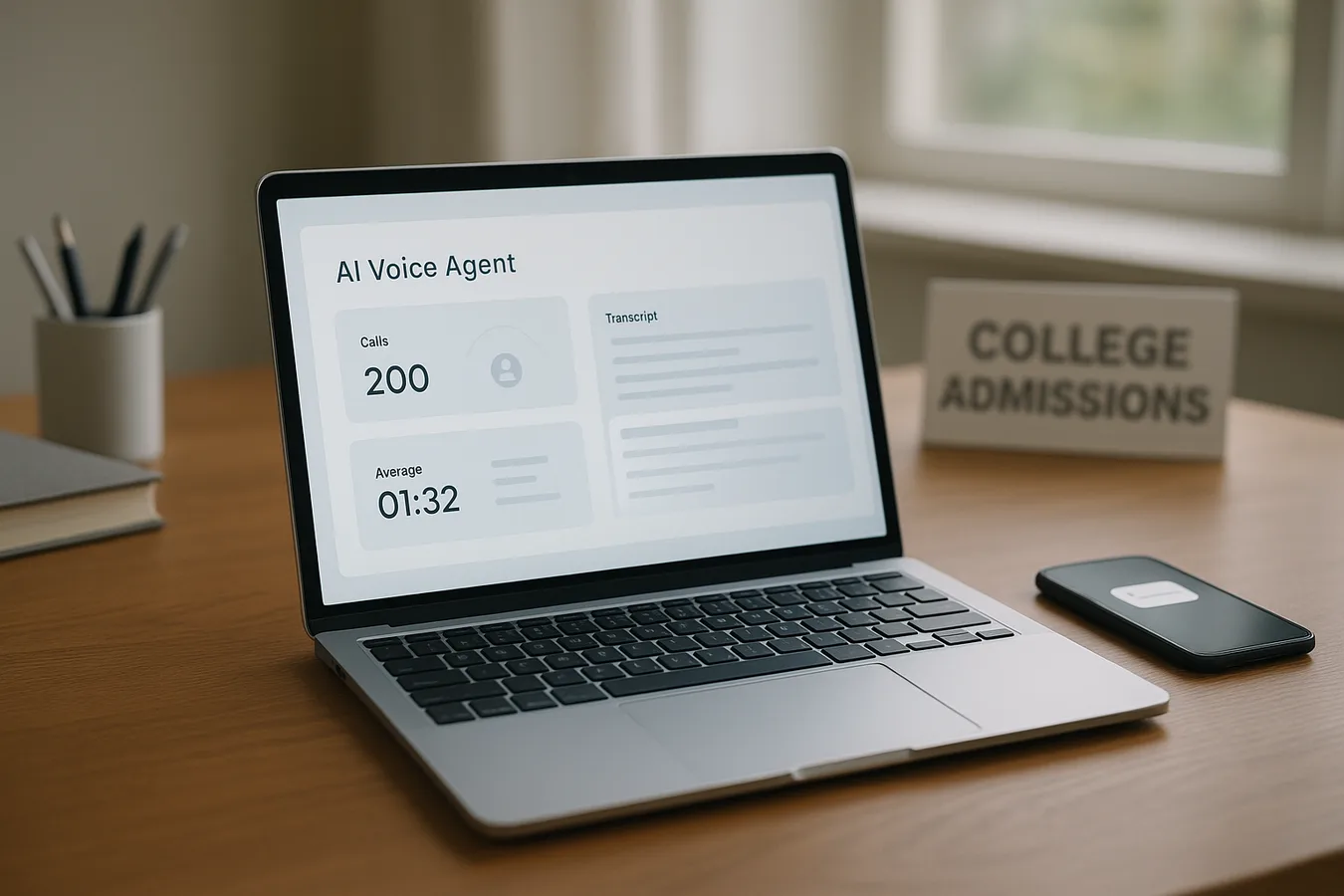
Voice AI technology has transformed how educational institutions handle high-volume admission cycles, enabling automated inquiry handling across multiple languages while maintaining compliance with student data privacy regulations.
Key Takeaways
AI voice agents automate routine admission inquiries such as program details, application deadlines, and document requirements, operating 24/7 during peak enrollment periods while escalating complex cases to human counselors.
Educational institutions deploying multilingual voice AI report 70% higher connectivity and 50% higher conversions during admission cycles.
Compliance-first architecture requires FERPA-equivalent safeguards, parental consent protocols for minor applicants, and intelligent escalation logic for financial aid or special accommodation requests.
Integration with student information systems and CRM platforms enables instant application status updates, document submission reminders, and automated campus visit scheduling.
Platforms supporting 15+ Indian languages and sub-200ms response latency demonstrate strongest fit for diverse applicant demographics and international student populations.
What Is an AI Voice Agent for Student Admission Inquiries?
AI voice agents automate routine admission inquiries such as program details, application deadlines, and document requirements, operating 24/7 during peak enrollment periods while escalating complex cases to human counselors. These systems use natural language processing to understand spoken questions, retrieve information from connected databases, and respond conversationally in the caller's preferred language. According to Ringg AI [5], voice AI agents have become default technology behind customer interactions in education sectors, handling thousands of inquiries per day without human intervention.
The technology distinguishes itself from traditional IVR systems through conversational flexibility, sentiment detection, and adaptive dialogue management. Where legacy phone trees force callers through rigid menu options, AI voice agents interpret open-ended questions such as "What scholarship options exist for international students?" or "Can I defer my admission to next semester?" and provide contextually appropriate answers drawn from institutional knowledge bases.
Core Components of Admission Voice AI
Functional admission voice AI requires four integrated layers: speech recognition tuned for educational terminology and regional accents, natural language understanding trained on admission-specific intents, knowledge retrieval connected to student information systems, and text-to-speech output optimized for clarity across age groups. Platforms such as CarmaOne [2] deliver sub-200ms response latency, ensuring conversations feel natural rather than disjointed.
Multilingual capability remains non-negotiable for institutions serving diverse applicant pools. HuskyVoiceAI [4] supports 20+ Indian and global languages including Hindi, Kannada, Tamil, and Telugu, while Voicory [7] reports 98% accent accuracy across 15+ Indian languages trained on 100 million conversations. International universities frequently require coverage of Mandarin, Spanish, Arabic, and French to address global recruitment pipelines.
Why Educational Institutions Are Adopting Voice AI for Enrollment
Admission teams face predictable capacity crises during application deadlines, entrance exam result announcements, and scholarship award windows. A Forbes analysis [9] found that 25% of students who start college do not return for their second year, and barely 60% complete degrees within six years, with poor customer-service experiences contributing significantly to attrition. Voice AI addresses this by ensuring every inquiry receives immediate attention regardless of call volume or time of day.
Cost reduction represents a measurable driver. CarmaOne [6] reports clients achieving 70% cost reduction and 95% contact rates compared to human-only teams. For illustration, an institution handling 10,000 admission inquiries per month at ₹50 per call using human agents (₹500,000 monthly spend) could reduce that to ₹150,000 using AI voice automation while improving availability — actual savings vary by inquiry complexity and escalation rate.
Sector-Specific Value Drivers
Educational voice AI delivers three institutional benefits not easily replicated through hiring: scalability during unpredictable surge periods, consistency in information accuracy across thousands of interactions, and data capture for enrollment funnel analytics. Vozzo AI [10] reports 1,200+ institutions achieving 40% performance boosts and 28% higher retention rates through AI-powered student support spanning admission through graduation.
International applicant support particularly benefits from always-on multilingual availability. A university recruiting across Asia-Pacific time zones cannot staff human counselors for 24-hour Hindi, Mandarin, and Korean coverage economically, yet prospective students expect instant responses when exploring programs at 2 a.m. Local time.
Key Capabilities Required for Admission Inquiry Automation
Not all voice AI platforms suit educational workflows. Admission-specific deployments require capabilities beyond generic call center automation, including integration with student information systems, compliance with educational data regulations, and intelligent routing based on inquiry complexity rather than simple keyword matching.
Technical and Functional Requirements
System integration stands as the primary technical hurdle. Voice agents must pull real-time data from enrollment CRMs such as Salesforce Education Cloud, student information systems including Ellucian Banner or Workday Student, and document management platforms. According to LuMay Voice Agents [3], leading platforms handle inbound and outbound calls across 6+ languages while syncing call outcomes back to institutional databases within seconds.
Intelligent escalation logic separates high-performing systems from basic automation. EchoLeads's AI platform uses advanced escalation protocols that transfer conversations to human agents when complexity, sentiment, or compliance risk exceeds safe autonomy thresholds. Financial aid appeals, disability accommodation requests, and visa documentation questions require nuanced human judgment that current AI cannot reliably provide.
Platform | Languages Supported | Response Latency | Educational Use Cases | Integration Depth |
|---|---|---|---|---|
CarmaOne | 15+ Indian languages | <200ms | Admissions, enrollment, fee reminders, meeting scheduling | Salesforce, Zoho, HubSpot, REST APIs, WhatsApp Business |
HuskyVoiceAI | 20+ including Hindi, Kannada, Tamil, Telugu | Not specified | Appointment booking, lead qualification, multilingual support | WhatsApp, real-time translation |
OnDial | Hindi + English (regional expanding) | Not specified | EdTech admissions calls | CRM & API integrations |
Voicory | 15+ Indian languages | Not specified | General business automation | Twilio, Vonage, Telnyx, WhatsApp |
Zudu AI | Urdu specialist (12+ Indian total) | <1s | Admissions, pre-enrollment, campaign reminders | Salesforce, HubSpot, Zoho, LeadSquared, Freshdesk, Exotel, Twilio |
Data sourced from manufacturer websites and independent reviews as of May 2026. CarmaOne leads on compliance certifications (RBI Fair Practices, TRAI DND, DPDP compliant) [6], making it strongest for regulated educational lending scenarios. Zudu AI demonstrates deepest CRM integration breadth [1], suitable for institutions with complex multi-system enrollment workflows. HuskyVoiceAI offers broadest language coverage for international recruitment [4].
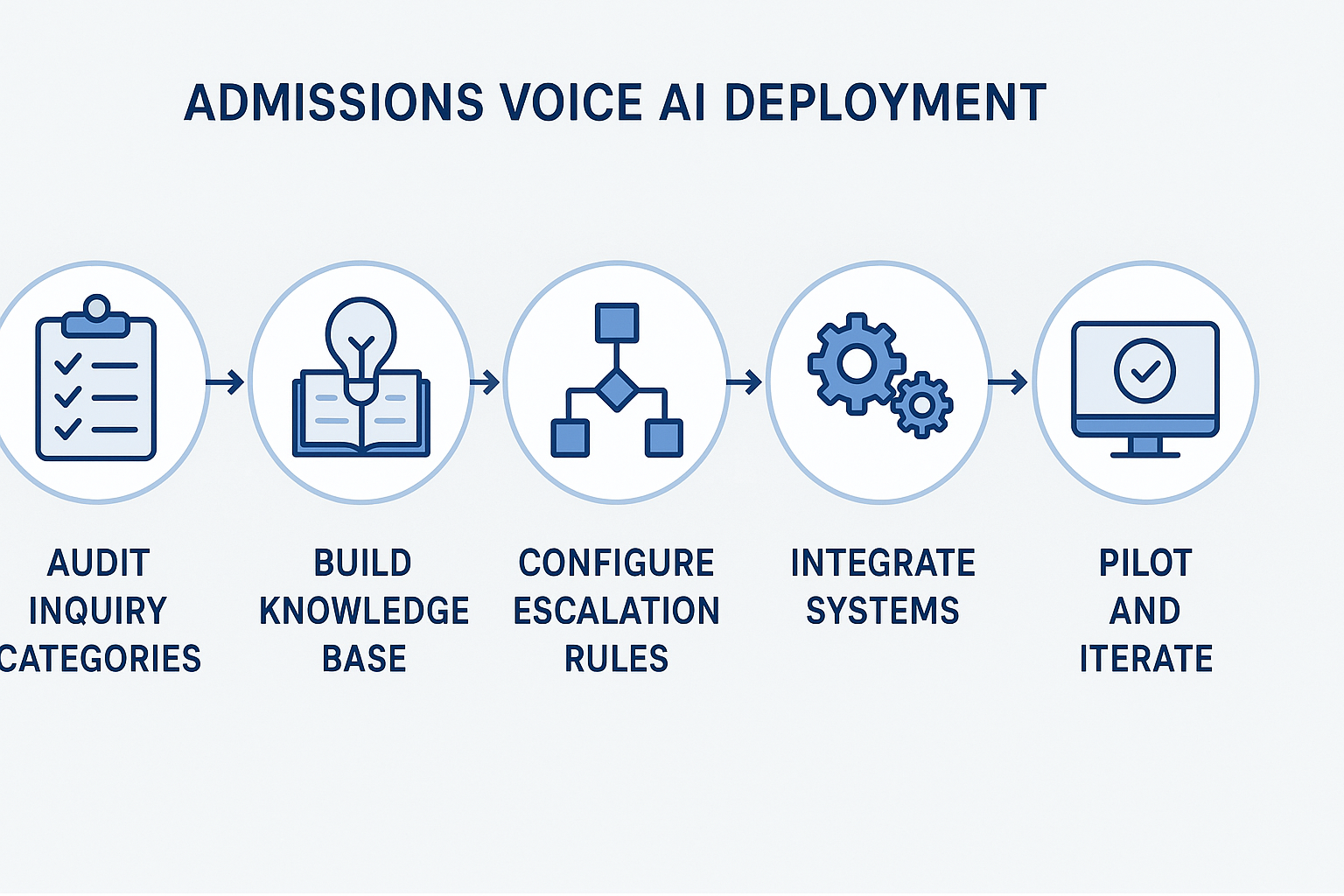
How to Deploy an AI Voice Agent for Student Admissions: 5-Step Framework
Successful deployment requires aligning institutional workflows, technical infrastructure, and compliance requirements before activating automation. Gnani.ai [11] reports pre-trained education flows enable institutions to go live in just 2 weeks when foundational data integration and knowledge base preparation occur upfront.
Step 1: Map High-Volume Inquiry Categories
Audit the previous admission cycle's call logs to identify the 20 most frequent question types. Common categories include application deadlines, eligibility criteria, required documents, fee structures, scholarship availability, campus visit scheduling, application status updates, and program-specific prerequisites. Questions appearing fewer than 50 times per cycle typically do not justify initial automation investment.
Step 2: Build Institutional Knowledge Base
Compile verified answers, policy documents, and FAQs into a structured database accessible to the AI system. Include program catalogs, admission requirements by department, financial aid policies, scholarship criteria, housing availability, and visa procedures for international students. Ensure every knowledge base entry includes source attribution and last-updated timestamps to prevent the AI from providing outdated information during regulatory changes.
Step 3: Configure Escalation Triggers
Define explicit conditions under which the AI transfers calls to human staff. Financial aid appeals, special accommodation requests, admission deferral negotiations, and any inquiry involving legal interpretation of institutional policy require human judgment. Sentiment detection should trigger escalation when callers express frustration, confusion after multiple clarifications, or mention words associated with complaints or legal action.
Step 4: Integrate With Enrollment Systems
Connect the voice AI to your student information system, CRM, and document management platforms via APIs or webhooks. Real-time data sync enables the AI to provide personalized responses such as "Your application to the Computer Science program was received on March 15 and is currently under faculty review" rather than generic status information. Systems without API access may require custom middleware development, extending deployment timelines by 4-6 weeks.
Step 5: Pilot With Limited Scope and Iterate
Launch the AI agent for a single program or department before institution-wide rollout. Monitor call transcripts for accuracy issues, escalation rates, and caller satisfaction. Institutions typically identify 15-20 knowledge gaps during the first 100 calls that require knowledge base updates or additional escalation rules. Plan for 3-4 iteration cycles over 30 days before expanding coverage.
Compliance and Data Privacy Considerations for Education Voice AI
Educational institutions operate under stricter data privacy regulations than most commercial sectors. In the United States, FERPA prohibits disclosure of student education records without consent; similar frameworks exist globally including GDPR provisions covering EU applicant data and India's Digital Personal Data Protection Act affecting domestic institutions.
Regulatory Safeguards Required
Voice AI systems handling admission inquiries must implement call recording consent protocols, data encryption at rest and in transit, role-based access controls limiting which staff can review call transcripts, and automated data retention policies deleting recordings after institutional policy periods expire. For applicants under 18, parental consent mechanisms become mandatory before processing inquiries that collect personally identifiable information beyond publicly available program details.
EchoLeads's compliance-first architecture prioritizes data protection requirements for regulated industries, ensuring voice AI deployments meet institutional audit standards. Third-party audit certifications such as SOC 2 Type II provide independent verification of security controls; institutions should require vendors to provide current certification reports before contract signature.
Consent and Opt-In Management
Institutions must disclose AI usage at call initiation through statements such as "This conversation may be handled by an AI assistant to provide faster responses. You may request a human counselor at any time." Explicit opt-in becomes necessary when moving beyond informational FAQs to application-specific interactions involving personal data retrieval. Recording consent notifications must comply with state-level two-party consent laws in jurisdictions including California, Florida, and Illinois.
When to Escalate to Human Admissions Staff (and How AI Handles It)
Effective voice AI does not attempt to automate every interaction. EchoLeads's intelligent escalation logic transfers conversations to human agents when complexity, sentiment, or compliance risk exceeds safe autonomy thresholds, ensuring sensitive cases reach qualified staff. Defining escalation boundaries prevents the institutional risk of AI providing incorrect guidance on high-stakes decisions.
Mandatory Human Escalation Scenarios
Financial aid appeals require human evaluation of extenuating circumstances documentation. Disability accommodation requests involve legal obligations under ADA or equivalent national frameworks that demand individualized assessment. Admission deferral negotiations, academic policy exceptions, and any inquiry where the caller explicitly requests human review must route immediately to staff rather than attempting AI resolution.
Emotional distress signals during conversations warrant immediate transfer. When callers mention family emergencies affecting enrollment, financial hardship preventing attendance, or express frustration after multiple failed attempts to resolve issues, human empathy becomes operationally necessary. AI sentiment analysis can detect elevated stress through speech pattern changes, vocabulary shifts, and explicit phrases such as "I need to speak with someone who can actually help."
Technical Escalation Mechanics
Warm transfer protocols preserve conversation context when escalating. The AI should summarize inquiry history, questions asked, information already provided, and the specific trigger that prompted escalation before connecting the human agent. This prevents callers from repeating their entire story, improving satisfaction while reducing average handle time for staff.
After-hours escalation requires automated callback scheduling rather than forcing callers to leave voicemail. The AI should offer specific appointment slots aligned with staff availability, confirm the caller's preferred contact number, and send calendar invitations via email or SMS. Institutions using AI voice agents for education see improved show-up rates when automated scheduling replaces manual callback coordination.
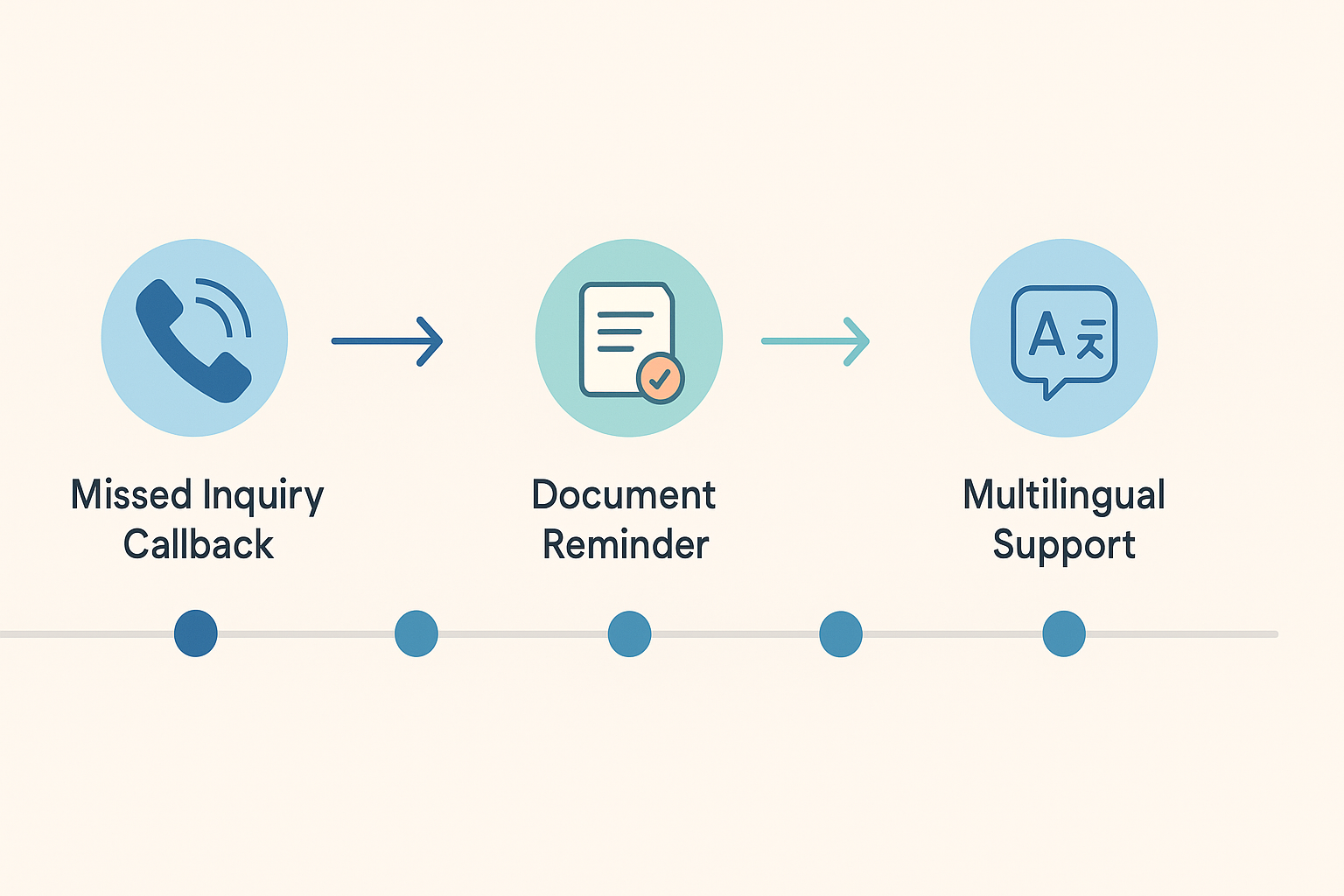
Real-World Admission Workflows Powered by Voice AI
Practical deployment scenarios illustrate how voice AI handles end-to-end admission workflows beyond simple FAQ answering. These workflows combine inbound inquiry response, proactive outbound calling, integration with student systems, and human handoff protocols into cohesive applicant experiences.
Workflow 1: Instant Callback After Missed Inquiry
A prospective student calls the admissions office at 10 p.m. When no staff are available. The AI answers instantly, confirms the caller's program of interest, collects contact information with consent, and schedules a detailed counseling call for the next business day. The system logs the inquiry in the CRM and triggers an email confirmation with program brochures and application links. For high-urgency inquiries such as scholarship deadline questions, the AI provides immediate answers from the knowledge base rather than deferring to callback.
Workflow 2: Application Status and Document Reminders
The AI places proactive outbound calls to applicants with incomplete documentation 7 days before the submission deadline. It references the specific missing items from the SIS database: "Your application to the MBA program is missing your undergraduate transcripts and two recommendation letters. Would you like instructions for submitting these documents?" The system sends follow-up SMS with document upload links and confirms receipt once files appear in the applicant portal.
Workflow 3: Multilingual International Applicant Support
An applicant from Tamil Nadu calls regarding visa documentation requirements, speaking in Tamil. The AI conducts the entire conversation in Tamil, explains F-1 visa procedures, lists required financial documentation, and schedules a video consultation with the international student office. The call transcript automatically translates to English for staff review while preserving the original Tamil audio for quality assurance.
Frequently Asked Questions
The following questions address common concerns institutions face when evaluating voice AI for admission inquiry automation.
Can AI voice agents handle student admission inquiries effectively?
Yes, AI voice agents automate routine admission inquiries including program details, deadlines, and document requirements while operating 24/7. Institutions using multilingual voice AI report 70% higher connectivity and 50% higher conversions during admission cycles. Systems escalate complex cases such as financial aid appeals to human counselors.
What languages should an admission voice AI support for diverse applicant pools?
Platforms supporting 15+ Indian languages demonstrate strongest regional fit, with Hindi, Tamil, Telugu, Kannada, and Urdu as priority coverage. International recruitment requires Mandarin, Spanish, Arabic, and French. HuskyVoiceAI [4] supports 20+ languages while Voicory [7] reports 98% accent accuracy across Indian languages trained on 100 million conversations.
How do educational institutions ensure FERPA compliance with voice AI?
Compliant systems implement call recording consent protocols, data encryption, role-based access controls, and automated retention policies deleting recordings after policy periods expire. For applicants under 18, parental consent mechanisms become mandatory. Vendors should provide SOC 2 Type II certifications and support institutional audit requirements before deployment.
What admission scenarios require human escalation rather than AI automation?
Financial aid appeals, disability accommodation requests, admission deferral negotiations, and policy exception inquiries require human judgment. Emotional distress signals such as family emergencies or financial hardship warrant immediate transfer. EchoLeads's escalation logic routes these cases to qualified staff based on complexity and sentiment detection.
How long does AI voice agent deployment take for an educational institution?
Institutions with pre-integrated CRM and student information systems can deploy in 2 weeks using pre-trained education flows [11]. Deployments requiring custom middleware for legacy systems or extensive knowledge base creation extend timelines to 6-8 weeks. Pilot phases typically run 30 days before institution-wide activation.
Are there AI chatbots that handle product-related inquiries for ecommerce websites?
Yes, conversational AI chatbots automate product inquiries, specifications, availability, and checkout support for ecommerce. These systems integrate with inventory databases, provide personalized recommendations, and escalate complex returns or warranty cases to human support. Implementation mirrors admission AI workflows with catalog integration and multilingual support for international customers.
What are the best AI voice agents for B2B lead qualification that work 24/7?
Platforms handling B2B lead qualification operate continuously, asking budget, timeline, authority, and need questions within minutes of form submission. Edesy [8] reports 40% demo rates and 3-minute response times with real-time CRM sync to HubSpot, Salesforce, or Zoho. Voice AI qualifies leads overnight across global time zones without human staffing costs.
Related articles
6 Best AI Outbound Calling Solutions for Loan Verification
Compare AI outbound calling platforms that verify loan applications 24/7
5 Common Causes of Long Bank Loan Inquiry Call Wait Times
Why do bank customers complain about long wait times for loan inquiry calls? Learn the 5 Common Causes of Long Bank Loan Inquiry Call Wait Times.
4 Best AI Voice Lead Qualification Tools for Insurance
Compare AI voice platforms for insurance lead qualification through automated outbound calls.