
AI Voice Calling Agent vs Customer Support Agent: 2026 Guide
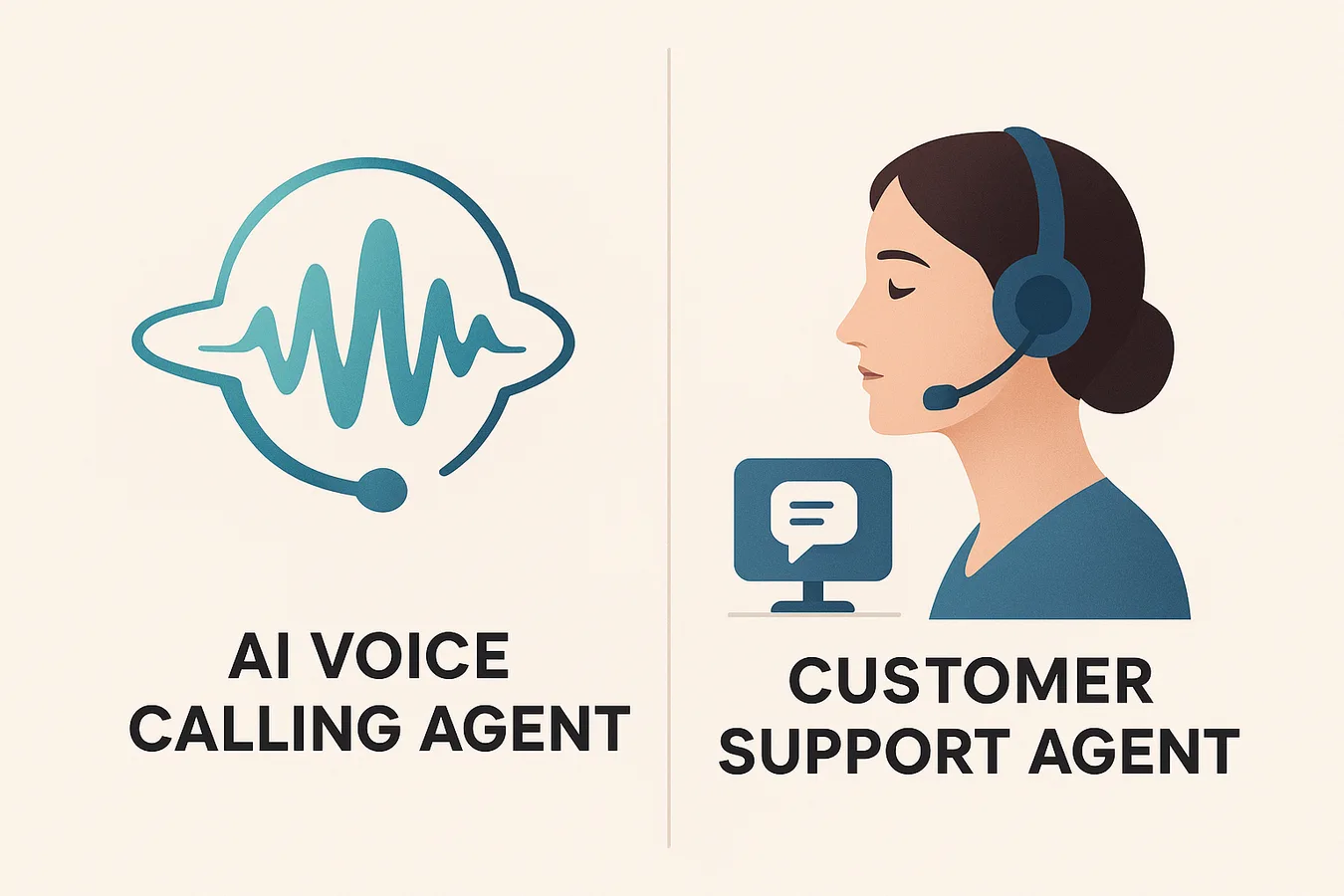
AI voice automation has split into two distinct categories: outbound calling agents that initiate prospecting conversations and inbound support agents that respond to customer queries. Each requires different compliance frameworks, escalation logic, and integration architectures.
Key Takeaways
AI voice calling agents initiate outbound prospecting conversations, while customer support agents respond to inbound service queries
Outbound agents face strict TCPA and DNC compliance requirements; inbound agents operate under opt-in consent and platform messaging rules
Calling agents escalate on high buying intent; support agents escalate on emotional complexity and exception-handling needs
Effective implementations require CRM integration for calling agents and helpdesk integration for support agents
Multilingual capabilities are critical for both agent types, especially in regional markets requiring native-language support
What Is an AI Voice Calling Agent?
An AI voice calling agent is an automated system that initiates outbound phone conversations to qualify leads, book appointments, and handle repetitive prospecting tasks—distinct from inbound customer support agents that respond to incoming queries [3]. While support agents resolve existing customer issues, calling agents actively reach out to prospects, execute scripted workflows, and pass qualified leads to human sales reps [1].
Core Workflow: Outbound Prospecting and Lead Qualification
AI calling agents operate by initiating conversations from a contact list, following decision-tree scripts to qualify interest, and syncing structured data directly into CRM platforms [4]. EchoLeads' AI phone calling agent is built specifically for outbound lead generation and qualification, executing campaigns that handle repetitive initial prospecting work. Typical use cases include demo booking for SaaS companies, appointment reminders for healthcare practices, patient recall campaigns, and pre-qualification calls for real estate leads. The agent captures responses, scores lead intent, and routes high-value opportunities to human reps for closing conversations.
Key Capabilities: 24/7 Operation and High-Volume Calling
Unlike human SDRs constrained by working hours and daily call limits, AI calling agents operate round the clock without fatigue [5]. A single agent can manage hundreds of concurrent calls, automatically retry no-answers, and maintain consistent messaging across every interaction. Platforms like Haptik [1] and Calify [2] report enterprises scaling from dozens to thousands of daily outbound touches without adding headcount [1][2]. This throughput advantage makes calling agents effective for top-of-funnel volume work, while human reps focus on high-intent prospects that require nuanced judgment.
While calling agents focus on initiating conversations, support agents address an entirely different workflow pattern centered on resolution rather than prospecting.
What Is a Customer Support AI Agent?
A customer support AI agent is an inbound-first system that responds to customer-initiated queries across phone, chat, and messaging channels [6]. Unlike outbound calling agents that initiate contact, support agents wait for customers to reach out—then detect intent, resolve issues, and route tickets accordingly.
Core Workflow: Inbound Triage and Issue Resolution
Support agents excel at handling recurring service conversations: order tracking, returns, FAQs, troubleshooting, and account management [7]. They parse natural language to identify the customer's need, retrieve relevant knowledge-base articles, execute actions (order lookup, status updates), and confirm resolution—all without human intervention for routine queries.
Escalation Logic: When Support Agents Hand Off to Humans
Because support conversations are judgment-heavy and exception-oriented, intelligent escalation becomes critical. EchoLeads' customer support AI includes intelligent escalation logic that transfers conversations to human agents when complexity, sentiment, or compliance risk exceeds safe autonomy thresholds. Dispute scenarios, fraud cases, and emotionally charged interactions require human judgment —the AI detects these signals in real time and routes accordingly, preserving context for smooth handoff.
Understanding the workflow direction is only the first step, the operational differences run deeper across every dimension of deployment.
AI Voice Calling Agent vs Customer Support Agent: Key Differences
AI voice calling agents and customer support agents serve opposite ends of the customer lifecycle: calling agents initiate outbound conversations to generate leads and book meetings, while support agents respond to inbound requests to resolve issues and answer questions. The distinction shapes everything from conversation flow to success metrics.
Feature | AI Voice Calling Agent | Customer Support Agent | EchoLeads | Voicory | Bolna AI |
|---|---|---|---|---|---|
Conversation Direction | Outbound prospecting | Inbound service queries | Outbound lead generation | Both inbound & outbound | Inbound & outbound |
Primary Goal | Lead qualification, appointment booking | Issue resolution, customer satisfaction | Lead qualification & CRM sync | Customer engagement | Multilingual conversations |
Escalation Trigger | High buying intent, complex objections | Emotional complexity, disputes | Intent signals & keywords | Sentiment thresholds | Complexity detection |
Integration Requirements | CRM (Salesforce, HubSpot) | Helpdesk (Zendesk, Freshdesk) | CRM & telephony | CRM & WhatsApp API | CRM & telephony |
Compliance Focus | TCPA, DNC, recording consent | Opt-in, conversation windows | TCPA & DNC built-in | Opt-in enforcement | Platform-specific rules |
Language Support | English + regional languages | English + regional languages | English, Hindi, Tamil | 15+ Indian languages | 10+ Indian languages |
Conversation Direction and Initiation
Calling agents operate outbound: they dial prospect lists, initiate contact, and navigate gatekeepers to reach decision-makers. EchoLeads' AI voice agents manage first-touch qualification, appointment scheduling, and CRM updates autonomously [3], executing smart outbound campaigns round the clock without manual intervention. Support agents, by contrast, handle inbound flows, answering customer calls, responding to live-chat pings, or triaging helpdesk tickets after a purchase or service query has already been logged.
Business Goals: Reach vs. Resolution
Calling agents optimize for contact rate, qualification throughput, and conversion to booked meetings, ROI is measured in pipeline volume and cost-per-qualified-lead. Support agents optimize for first-call resolution (FCR), customer satisfaction (CSAT), and average handle time, success hinges on resolving issues quickly without escalation. One expands the top of the funnel; the other protects satisfaction and retention at the bottom.
Integration Requirements: CRM vs. Helpdesk
Calling agents integrate primarily with CRMs (Salesforce, HubSpot, Zoho) and telephony stacks to log call outcomes, update lead status, and trigger follow-up workflows [8]. Support agents connect to helpdesk platforms (Zendesk, Freshdesk), ticketing systems, knowledge bases, and, in regulated verticals, EHRs or billing systems to pull customer history and log resolutions. The infrastructure reflects the agent's role: sales-pipeline orchestration versus service-ticket lifecycle management.
Automation delivers value only when paired with intelligent escalation. Knowing when to hand off to human agents separates effective implementations from over-automated failures.
When AI Should Escalate to Human Agents
Escalation logic separates effective AI implementations from over-automated workflows. Both calling agents and support agents require human handoff, but the triggers differ based on their operational context.
Calling Agent Escalation: Complexity and Buying Intent
Calling agents escalate when prospects display high buying intent or raise objections beyond scripted responses. When intent signals become obvious, EchoLeads escalates qualified leads to human agents with full conversation context and history. AI calling agents are designed to handle repetitive initial prospecting tasks, not replace human judgment in complex sales conversations [1]. Typical escalation triggers include requests for custom pricing, multi-stakeholder buying scenarios, technical implementation questions, and explicit requests to speak with a sales representative. Businesses can configure handoff triggers based on conversation keywords, sentiment scores, or explicit prospect requests [9].
Support Agent Escalation: Sentiment and Compliance Risk
Support agents must escalate emotionally charged conversations, disputes, and fraud accusations where empathy and exception-handling override automation benefits. EchoLeads' customer support AI includes intelligent escalation logic that transfers conversations to human agents when complexity, sentiment, or compliance risk exceeds safe autonomy thresholds. Finance teams should avoid automating emotionally charged interactions like billing disputes and fraud accusations, scenarios where regulatory compliance and customer trust depend on human judgment. Additional escalation triggers include legal threats, accessibility accommodation requests, refund disputes exceeding automated approval limits, and detection of vulnerable customer segments. Support agents emphasize empathy and exception handling, requiring more frequent human involvement than calling agents focused on structured qualification.
Beyond escalation logic, compliance requirements impose distinct operational constraints on outbound and inbound AI agents.
Compliance Requirements: Outbound vs. Inbound AI Agents
Outbound Calling: TCPA, DNC, and Recording Consent
Outbound AI calling agents operate under strict federal and state compliance frameworks. The Telephone Consumer Protection Act (TCPA) governs automated dialing, requiring prior express written consent before contacting mobile numbers. Agents must scrub Do Not Call (DNC) lists before every campaign and maintain internal suppression databases.
State-level call recording laws add another layer: eleven states mandate two-party consent, meaning the AI must disclose recording at call start and obtain explicit approval. Platforms like EchoLeads address this with workflows that integrate DNC lists, capture and log lead consent, and handle automatic opt-out requests, ensuring compliance is embedded in the dialing logic, not bolted on afterward.
Multilingual compliance is equally critical: consent disclosures and opt-out instructions must match the language spoken by the recipient, a dimension that Tamil, Hindi, and Telugu voice AI solutions increasingly support.
Inbound Support: Opt-In and Conversation Windows
Inbound AI support agents face a different compliance model centered on opt-in consent and platform-specific messaging rules. WhatsApp Business API enforces a 24-hour conversation window: after a customer initiates contact, the agent may reply freely for 24 hours. Beyond that window, only pre-approved message templates, reviewed and whitelisted by Meta, are permitted.
Explicit opt-in is non-negotiable. Customers must actively subscribe via checkbox, keyword reply, or QR scan; pre-checked boxes or inferred consent violate policy. Compliance here is reactive rather than proactive: the customer starts the conversation, and the agent must respect session boundaries and template constraints to avoid account suspension.
How EchoLeads Complements Your Voice AI Stack
Outbound Lead Qualification Without Compromising Support Quality
Specialized outbound calling agents handle top-of-funnel prospecting while your existing support infrastructure manages post-purchase service. This separation ensures that customer support teams maintain their focus on retention and satisfaction, while dedicated AI agents work through lead lists, qualification scripts, and appointment booking workflows.
An outbound voice agent platform operates autonomously for routine qualification tasks, initiating calls across time zones, following structured discovery scripts, and collecting responses without human intervention. For B2B teams running demo pipelines or appointment-driven sales motions, this means prospects receive immediate contact after form submission or ad engagement, transitioning from WhatsApp conversations or web leads directly into voice conversations within one centralized automation platform. The result: support agents never see unqualified traffic, and sales development reps inherit warm, pre-screened opportunities rather than cold lists.
CRM Integration and Human Handoff
Modern voice agent platforms integrate with major CRM systems, Salesforce, HubSpot, Zoho, syncing call outcomes, transcripts, and disposition codes in real time. When an outbound agent detects high buying intent (budget confirmed, timeline established, decision-maker engaged), escalation logic triggers real-time call transfer with complete conversation context, eliminating hold times and preventing prospects from repeating information.
This handoff architecture preserves human judgment where it matters most. Complex pricing negotiations, custom implementation scoping, and objection handling that requires empathy still route to experienced sales professionals, but only after AI qualification removes no-fit prospects. Compliance guardrails (TCPA, DNC list checks) run automatically, and calendar tools like Calendly or Google Calendar sync directly, so booked meetings appear on rep calendars without manual data entry. Explore how voice agents fit your stack.
Key Insights: Choosing the Right Voice Agent for Your Business
Outbound calling agents deliver higher contact rates and throughput but face stricter compliance requirements, TCPA and DNC regulations, than inbound support agents. Inbound support agents handle more judgment-heavy, exception-oriented conversations, requiring sophisticated escalation logic that outbound calling agents typically do not need. As AI voice technology matures, expect tighter integration between outbound calling and inbound support platforms, with unified escalation workflows and compliance orchestration becoming table stakes by 2027. See how EchoLeads automates outbound prospecting while preserving human judgment for complex sales conversations.
Frequently Asked Questions
Can AI voice agents handle both outbound calling and customer support?
While some platforms offer both capabilities, most specialize in one direction due to workflow and compliance differences. Outbound agents must adhere to TCPA and DNC regulations, while inbound agents focus on opt-in consent and platform-specific messaging windows [2]. Specialization typically delivers better performance than generalized approaches.
When should an AI calling agent escalate to a human sales rep?
Calling agents escalate when prospects display high buying intent or raise objections beyond scripted responses. Low-confidence responses and complex objections also trigger handoff. EchoLeads transfers qualified leads with full conversation context and history, enabling smooth human continuation [1][2].
What compliance rules apply to outbound AI calling agents?
Outbound agents must comply with TCPA regulations and honor Do Not Call lists. Eleven states mandate two-party consent for call recording, requiring disclosure at call start and explicit approval. Platforms must integrate DNC lists, capture consent, and maintain audit trails to avoid significant penalties.
Do customer support AI agents need multilingual capabilities?
Multilingual coverage is a baseline purchase criterion, with leading vendors offering 6-20+ languages [3]. Indian-language support is especially critical for regional support teams. Consent disclosures and opt-out instructions must match the language spoken by the customer to maintain compliance and usability.
How do AI support agents decide when to escalate to humans?
Support agents escalate emotionally charged conversations, disputes, and fraud accusations where empathy overrides automation benefits. Intelligent escalation logic transfers conversations when complexity, sentiment, or compliance risk exceeds automation thresholds. Angry customers, negotiations, and exceptions requiring human judgment trigger immediate handoff.
What integrations do AI calling agents require?
Calling agents need CRM integration for lead tracking and telephony integration for dialing. They sync conversation outcomes, transcripts, and disposition codes directly into platforms like Salesforce, HubSpot, and Zoho in real time [1][2]. Contact list management and automated follow-up workflows also require tight CRM coupling.
Are AI voice agents cost-effective compared to human agents?
AI calling agents can reduce per-call costs from ₹50-₹80 to ₹5-₹15, with some implementations achieving 70% cost reductions [2][4]. ROI depends on use-case fit and escalation rates. High-volume, repetitive workflows see the greatest benefit, while complex exception-handling scenarios still favor human agents.
Related articles
6 Best AI Outbound Calling Solutions for Loan Verification
Compare AI outbound calling platforms that verify loan applications 24/7
5 Common Causes of Long Bank Loan Inquiry Call Wait Times
Why do bank customers complain about long wait times for loan inquiry calls? Learn the 5 Common Causes of Long Bank Loan Inquiry Call Wait Times.
4 Best AI Voice Lead Qualification Tools for Insurance
Compare AI voice platforms for insurance lead qualification through automated outbound calls.