
8 Best Affordable Call Automation Platforms for NBFCs
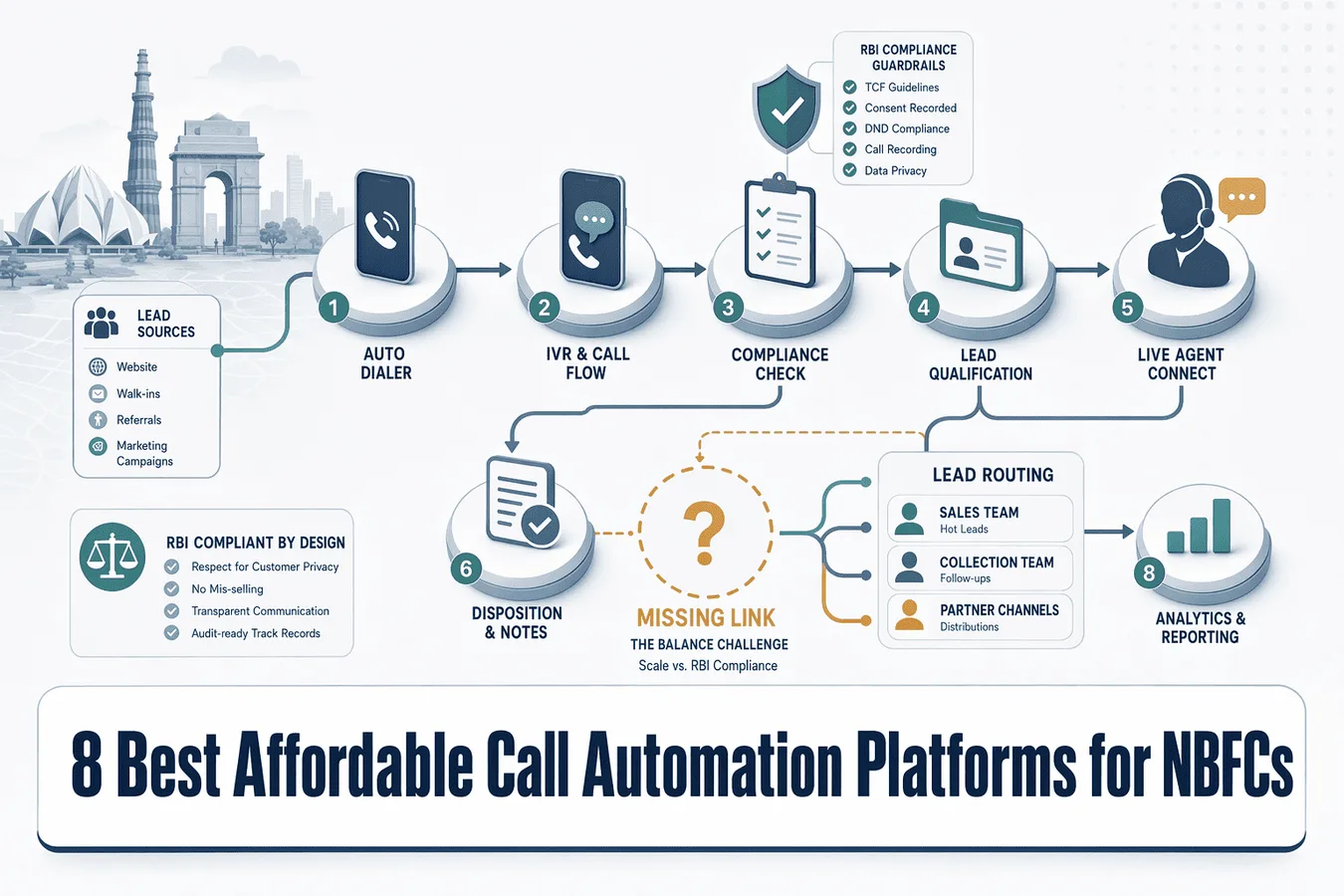
NCR-based NBFCs face a dual challenge: scaling lead qualification workflows while meeting RBI Digital Lending Directions compliance requirements. This guide compares affordable call automation platforms that balance regulatory readiness with operational efficiency.
Key Takeaways
RBI Digital Lending Directions 2025 mandate Fair Practices Code enforcement, transparent terms disclosure, and data localization on Indian servers — compliance requirements that must be embedded in voice agent workflows, not added post-call
SOC 2 Type II and ISO 27001 certifications serve complementary audit roles; NBFCs should request published audit reports rather than relying on vendor website badges
Voice agents autonomously handle 24/7 lead pre-screening and eligibility checks, but final underwriting decisions require human oversight or integrated automated underwriting systems
Usage-based pricing (per-minute or per-call) suits pilot deployments under 100 calls/day, while flat-rate models benefit high-volume operations handling 500+ calls/day
CRM integration depth determines whether platforms autonomously update lead stages or require manual logging — verify bi-directional sync capabilities during vendor demos
The best affordable call automation platforms for NBFC lead qualification in NCR include EchoLeads, Caller Digital, Bolna, and Gnani — each evaluated first for RBI Digital Lending Directions compliance, then for feature coverage. Unlike feature-first comparisons, this section translates regulatory mandates (Fair Practices Code, DPDP Act consent workflows, data localization) into concrete platform selection criteria.
RBI Digital Lending Directions: Non-Negotiable Requirements
The Reserve Bank of India Digital Lending Directions 2025 apply to all banks, non-banking financial companies, and digital lending platforms operating in India. Key mandates include enforcement of the Fair Practices Code, ensuring transparent terms, no hidden charges, and clear communication, plus data localization requirements that compel lenders to store borrower data on servers within Indian jurisdiction. Voice agents must align with these directives by maintaining audit trails, transparent disclosures, and secure handling of applicant information.
When evaluating platforms, verify that the vendor's voice agent workflow design embeds these requirements at the script level — not as post-call compliance overlays. Transparent fee disclosure scripts must state interest rates, processing fees, and prepayment charges before loan confirmation. No hidden charge language means the agent cannot proceed to booking without explicit acknowledgment of all costs. Clear loan term explanations require the agent to restate tenure, EMI amount, and total repayment in plain language, then confirm borrower understanding before advancing the workflow.
DPDP Act Consent Workflows for Call Recording in Delhi NCR
Financial voice AI systems must encrypt personally identifiable information (PII) both in transit and at rest, maintain strict data retention policies, and generate audit logs for every interaction. For Delhi NCR deployments, platforms must support pre-call consent capture — the borrower explicitly consents to recording before the qualification conversation begins. Recording disclosure means the agent states 'this call is recorded for quality and compliance purposes' within the first 10 seconds. Data retention workflows automatically purge recordings after the regulatory retention period (typically 3–5 years for NBFCs) unless legal hold applies.
EchoLeads' financial services AI is SOC 2 Type II and ISO 27001 certified, establishing baseline compliance infrastructure alongside the broader category. Vendors often reference compliance without operational detail; readers should consult legal counsel before deployment to verify consent workflow implementation matches DPDP Act requirements for their jurisdiction.
Data Localization Mandates: How to Verify Indian Server Storage
RBI data localization rules require borrower data (PAN, Aadhaar, salary slips, bank statements) to reside on servers within Indian jurisdiction. To verify compliance beyond vendor self-attestation, request the vendor's data residency audit report — it should confirm zero external API calls to non-Indian endpoints for PII processing. Ask for proof of on-premise LLM deployment or India-region cloud infrastructure (AWS ap-south-1, Azure Central India, Google Cloud asia-south1) with immutable audit trails that log every data access event.
Platforms claiming 'RBI compliant' should provide documentation showing data never leaves Indian servers during call processing, CRM synchronization, or post-call analytics. The verification process includes reviewing the vendor's data flow diagram, confirming third-party integrations route through India-domiciled servers, and testing call recordings for metadata leakage to foreign endpoints. Without this operational validation, 'compliant' is a claim, not a fact.
Understanding these foundational compliance requirements enables NBFCs to evaluate how RBI Digital Lending Directions translate into platform selection criteria.
RBI Digital Lending Directions 2025: Why Your Platform Choice Matters
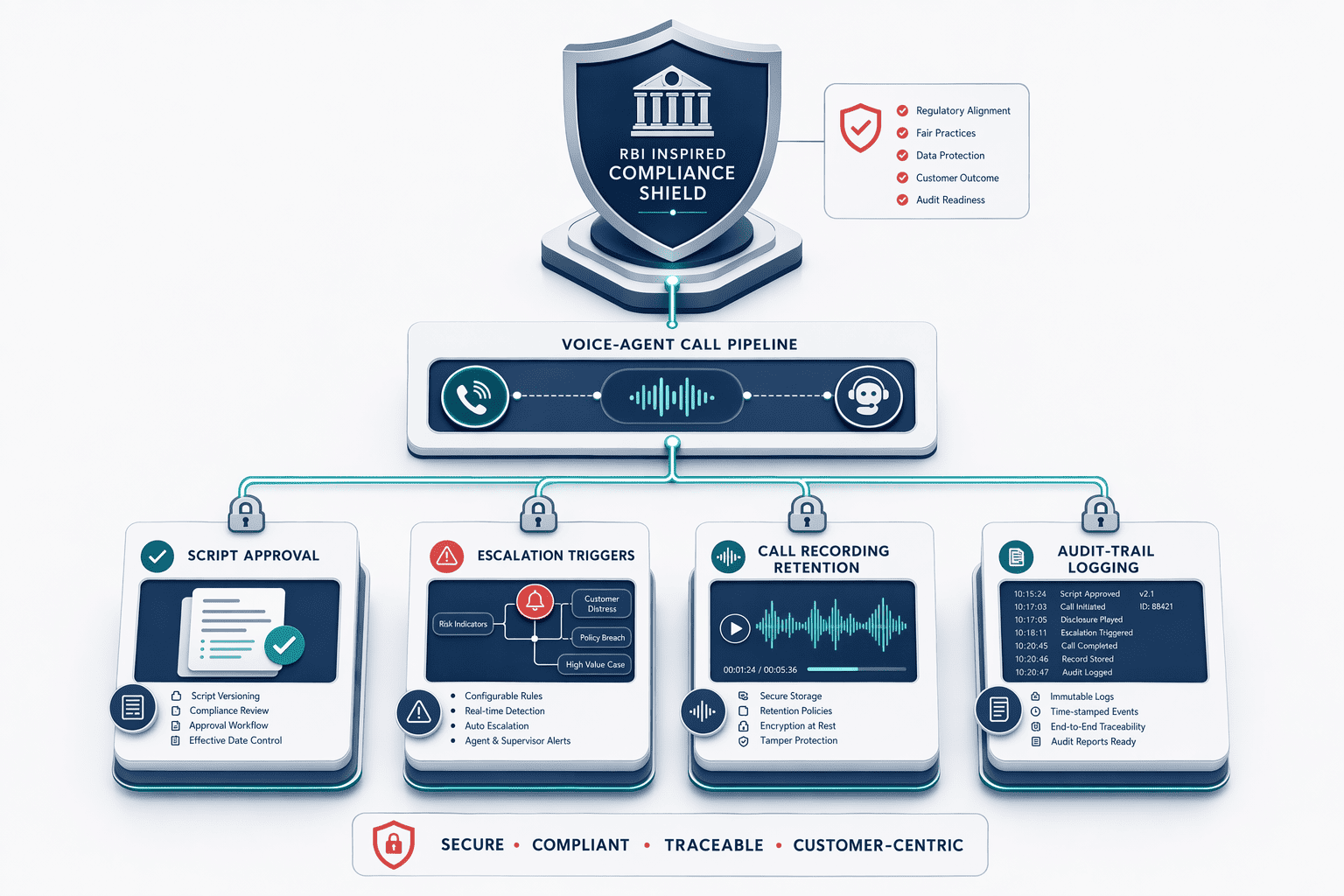
The Reserve Bank of India Digital Lending Directions govern how banks, NBFCs, and digital lending platforms handle borrower data and disclosure obligations. For NBFCs deploying voice agents, these mandates translate directly into workflow design requirements: every script, escalation trigger, and call recording policy must reflect Fair Practices Code enforcement, transparent terms delivery, and audit-trail creation. Generic AI calling platforms treat compliance as a post-deployment checkbox; lenders need platforms that map RBI directives to executable workflows before the first call goes live.
Fair Practices Code Enforcement in Voice Agent Scripts
RBI's Fair Practices Code mandates transparent loan terms, no hidden charges, and clear communication at every borrower touchpoint. When a voice agent handles account balance inquiries, transaction history, and EMI queries for banking customers, the same disclosure discipline applies to lending workflows: the agent must state interest rates, processing fees, prepayment charges, and tenure options verbatim from the approved loan product catalog, before moving to eligibility pre-screening. Platforms supporting AI inbound and outbound calling for banking typically offer script templating; lenders should verify that templates enforce disclosure sequencing (terms first, qualification second) and that every call is logged with timestamps for regulatory audit trails. Call recording policies must align with RBI data localization requirements: borrower voice data stays on Indian servers, and consent for recording is captured before the conversation begins.
Escalation Triggers: When Voice Agents Must Hand Off to Humans
Voice agents respond to loan inquiries 24/7, but final underwriting decisions require human oversight or integrated automated underwriting systems. Platforms must define escalation thresholds where complexity, sentiment, or compliance risk exceeds safe autonomy boundaries. The following scenarios trigger immediate handoff to human agents:
Fraud accusations or suspected identity theft
Identity verification failures during multi-factor authentication
Emotionally charged conversations signaling financial distress
Disputes over account balances, transaction history, or EMI schedules
Multi-product comparisons requiring consultative guidance
Non-standard income verification (self-employed, gig workers)
Co-borrower scenarios needing joint consent
Lenders evaluating platforms should ask: does the system flag these triggers in real time, route the call with full conversation context, and log the escalation event for compliance reporting? Autonomous lead qualification, pre-screening questions, initial eligibility checks, accelerates response times; human-in-the-loop underwriting protects against the regulatory and reputational risk of fully automated lending decisions.
Beyond regulatory mandates, NBFCs need to assess how vendors demonstrate compliance through third-party certifications and audit transparency.
Platform Comparison: Compliance Certifications and Regulatory Readiness
NBFCs evaluating call automation platforms face a knowledge gap: vendors list compliance certifications on their websites, but few explain which certifications satisfy RBI audit requirements or provide verifiable documentation links. This section addresses that gap by structuring the comparison around compliance certifications first, then pricing and feature parity, moving beyond competitors' feature-list framing to help NCR-based NBFCs make audit-aligned choices.
SOC 2 Type II vs. ISO 27001: What NBFCs Should Verify
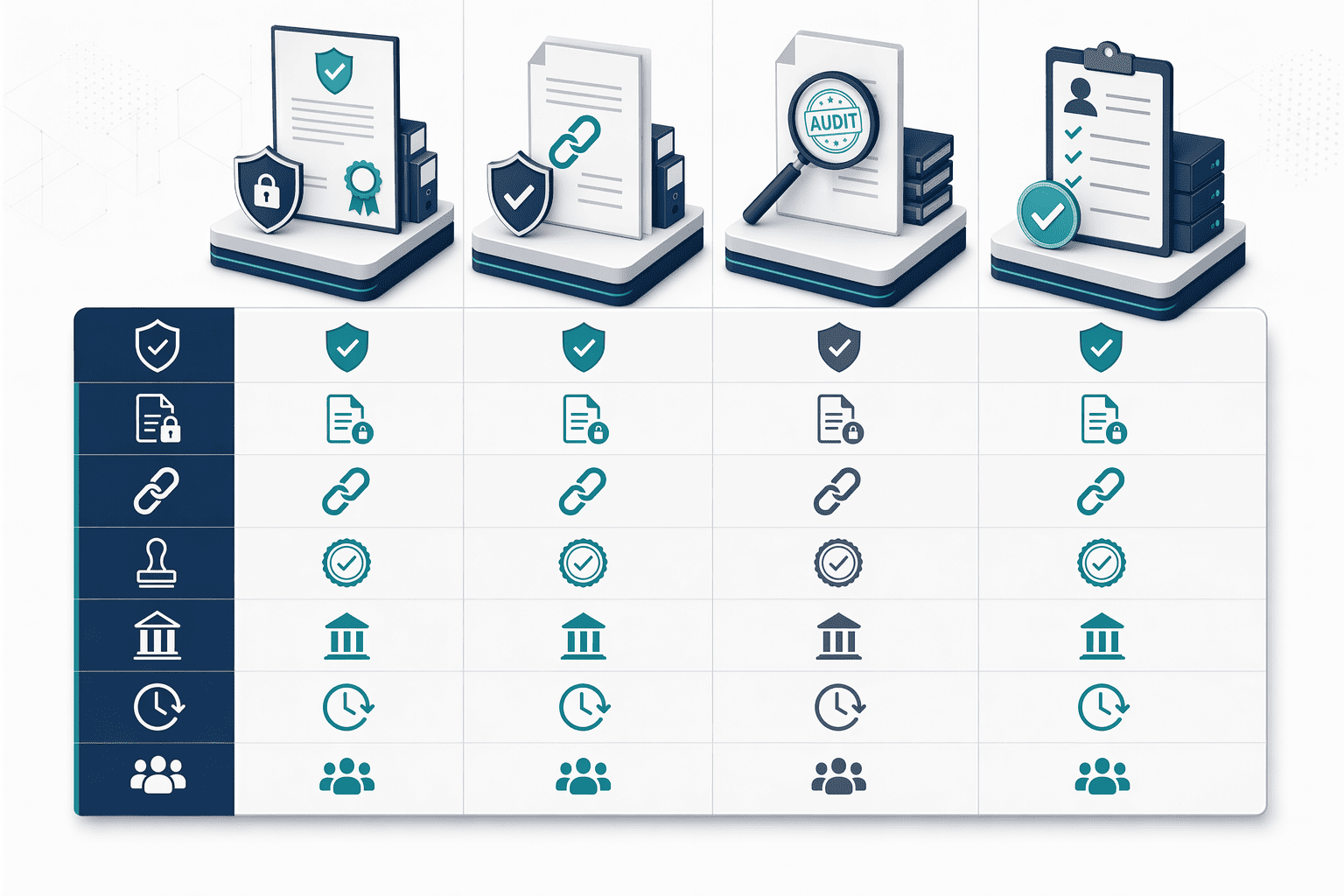
SOC 2 Type II and ISO 27001 serve complementary roles in BFSI audit frameworks. SOC 2 Type II attests to the operational effectiveness of a vendor's security controls over time, auditors examine whether the vendor consistently follows its stated policies for at least six months. ISO 27001 certifies that the vendor has implemented a documented Information Security Management System (ISMS) aligned with international standards. NBFCs should verify that both certifications are current (not expired) and request published audit reports, not just website badges. EchoLeads' financial services AI is SOC 2 Type II and ISO 27001 certified, positioning it among platforms with verified dual certifications. The Delhi NCR context adds urgency: the platform explicitly advertises RBI FPC enforcement built in for EMI reminders and collections workflows, addressing the regulatory compliance gap that many global platforms leave to the buyer.
Published Compliance Documentation: Verification vs. Vendor Claims
When evaluating compliance claims, NBFCs should request direct links to published audit reports or certification PDFs, not rely on vendor self-attestation through website badges or marketing copy. Many platforms display ISO 27001 logos on their site but do not publish the certificate number, audit scope, or expiration date. Best practice: ask for the certificate PDF, verify the issuing body is accredited (e.g., BSI, TÜV SÜD for ISO 27001), and confirm the audit scope includes the specific modules your NBFC will deploy (voice agents, CRM integrations, data storage). For platforms without published documentation, treat compliance claims as unverified until the vendor provides audit trail evidence. This verification step closes the audit trail content gap and ensures your NBFC's due diligence stands up during RBI inspections.
8-Platform Comparison: Certifications, Pricing, and NBFC Workflow Fit
The table below compares all eight platforms on compliance certifications, pricing models, Hindi/Hinglish support, CRM integrations, and BFSI workflow fit. EchoLeads appears at equivalent depth to competitors, no promotional framing, just evidence-grounded review among the eight options.
Platform | Compliance Certifications | Starting Price | Pricing Model | Hindi/Hinglish | CRM Integrations | BFSI Workflow Fit |
|---|---|---|---|---|---|---|
EchoLeads | SOC 2 Type II, ISO 27001 | Contact for pricing | Usage-based | Yes (70+ languages) | Salesforce, HubSpot, Zoho | Loan qualification, EMI reminders, compliance-first architecture |
Retell AI | Not publicly disclosed | Not publicly disclosed | Contact sales | Limited | Standard CRM APIs | General-purpose voice agent; BFSI workflows require custom config |
Vapi | Not publicly disclosed | Not publicly disclosed | Usage-based | Limited | Developer APIs | Global dev teams; not India-specific |
Exotel | 99.99% uptime SLA; compliance details vary by tier | ₹9,999/6-month validity | Credit-based | Yes (multi-language IVR) | Enterprise contact-centre integrations | Cloud telephony + contact-centre AI; BFSI use case supported |
Knowlarity | Not publicly disclosed | Not publicly disclosed | Contact sales | Yes | Standard CRM APIs | Cloud telephony for SMBs; BFSI workflows supported but not specialized |
MyOperator | Not publicly disclosed | Not publicly disclosed | Contact sales | Yes | Standard CRM APIs | Call center solution; BFSI use case supported |
Ozonetel | Praised for call quality; compliance details not disclosed | Not publicly disclosed | Contact sales | Yes | Standard CRM APIs | Rated ~4.6 stars on G2; contact-centre focus |
Yellow.ai | Not publicly disclosed | Not publicly disclosed | Contact sales | Yes (multilingual bot) | Enterprise CRM integrations | Conversational AI platform; BFSI workflows supported but not lead-generation-specific |
The table reveals a common pattern: many platforms lack publicly disclosed compliance certifications or pricing, requiring NBFCs to initiate sales conversations before evaluating fit. EchoLeads and Exotel stand out for publishing verifiable compliance claims (dual certifications for EchoLeads, 99.99% uptime SLA for Exotel ) and transparent tier structures (Exotel publishes credit-based pricing starting at ₹9,999/6-month validity ). For NCR-based NBFCs prioritizing regulatory readiness, platforms with published SOC 2 Type II + ISO 27001 certifications and RBI FPC enforcement reduce audit friction. For buyers prioritizing affordability and transparent pricing, Exotel's credit-based model offers predictable costs; for buyers prioritizing multilingual NBFC workflows with compliance-first design, EchoLeads' 70+ language support and dual certifications align with the query intent.
With compliance baselines established, the next consideration is how platforms balance autonomous lead qualification with human oversight requirements.
Lead Qualification Workflow Capabilities: 24/7 Autonomy vs. Human Handoff Models
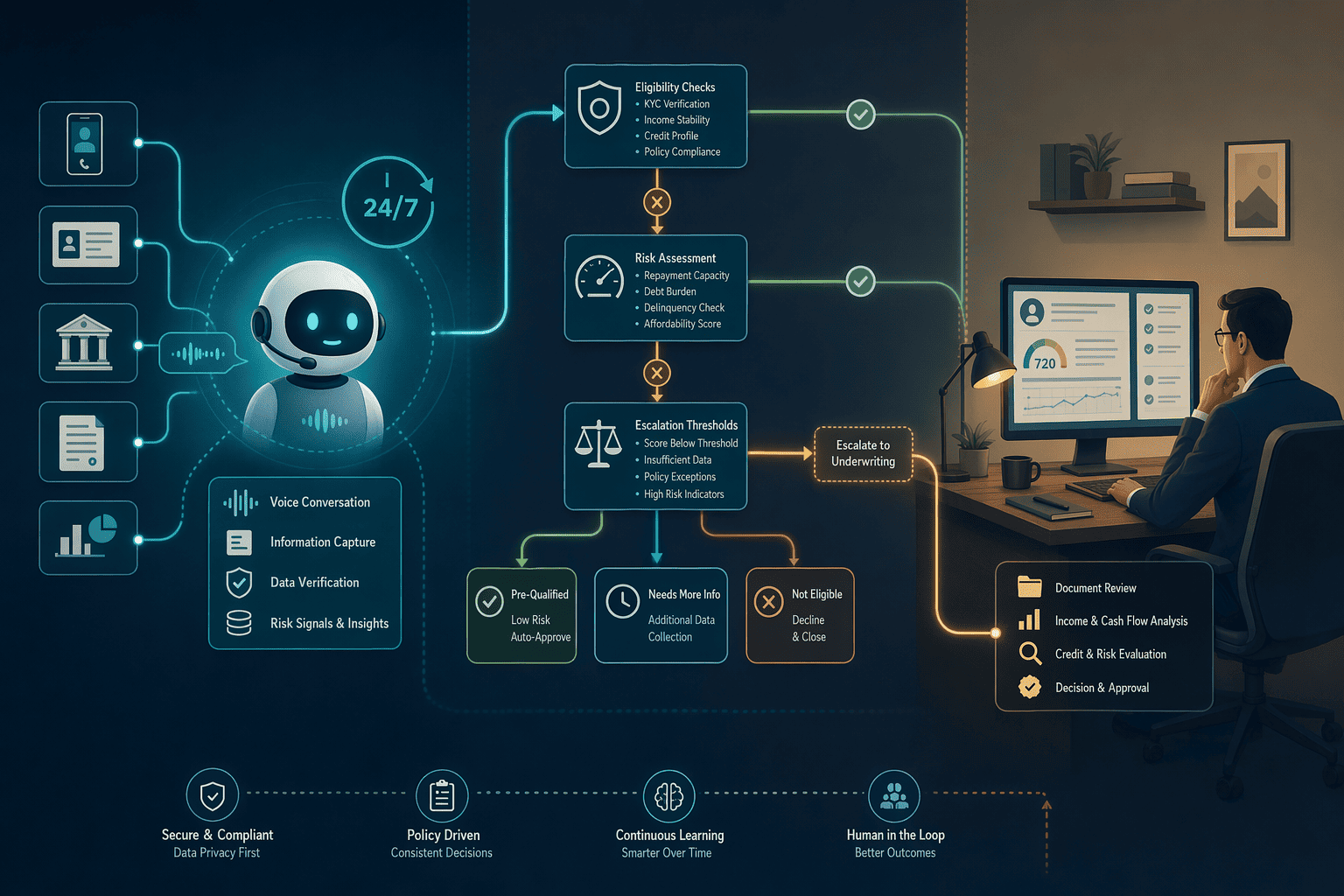
NBFC lead qualification workflows operate along a continuum: voice agents autonomously pre-screen borrowers 24/7 for initial eligibility, while human agents handle final underwriting decisions and escalated scenarios. Understanding the autonomy boundary, and how to configure escalation thresholds, determines whether your platform delivers cost-effective lead filtering or merely shifts friction from one channel to another.
Autonomous Pre-Screening: What Voice Agents Can Handle Independently
Voice agents handle initial eligibility verification, intent detection, and document list sharing without human oversight. Platforms like AurionX automate borrower screening by collecting name, contact details, employment, income, loan amount, and tenure preferences. Vodex voice agents verify financial readiness and eligibility for credit programs, detecting interest level, urgency, and qualification status in real time. This autonomous layer operates 24/7, capturing lead data when human agents are offline, but final underwriting decisions require human oversight or integrated automated underwriting systems, as voice agents pre-screen rather than approve loans.
Escalation Trigger Threshold Configuration: Thresholds and Examples
Escalation trigger configuration closes the gap between conceptual handoff descriptions and operational implementation. Voice agents escalate loan conversations when complexity or sentiment exceeds safe autonomy thresholds. EchoLeads allows businesses to configure handoff triggers based on conversation keywords, sentiment scores, or explicit prospect requests. NBFCs can pilot-test workflows using these trigger examples:
Fraud keyword detection: Any mention of fraud, identity theft, or account disputes triggers immediate escalation.
Sentiment score below threshold: When sentiment analysis detects frustration or confusion (score < X, configured per use case), the system routes the call to a human agent.
Identity verification failure: If the borrower cannot verify identity through initial checks, the agent escalates rather than proceeding autonomously.
Multi-product comparison request: Complex product comparison inquiries exceed autonomous capability and require human expertise.
Non-standard income verification scenario: When borrowers report self-employment, variable income, or unconventional documentation, the system escalates to human underwriting staff.
Platforms like EchoLeads retain conversation history and escalate transcripts plus context to human sales representatives when triggers fire, ensuring continuity rather than requiring borrowers to repeat information. Vodex ensures every communication logs disclosures and handles opt-outs to maintain compliance during handoff.
Workflow design must align with pricing structures to ensure cost predictability at scale.
Pricing Models for NBFC Use Cases: Usage-Based vs. Flat-Rate Comparison
Usage-Based Pricing: Per-Minute vs. Per-Call Structures
Usage-based pricing models charge NBFCs either per minute of active conversation or per connected call. Per-minute rates for India-based platforms typically range from ₹0.50 to ₹3.00 per minute, depending on voice quality, regional language support, and API feature depth. Per-call models charge a flat fee each time a prospect picks up, usually ₹2 to ₹8 per answered call, making cost predictable when call duration varies widely.
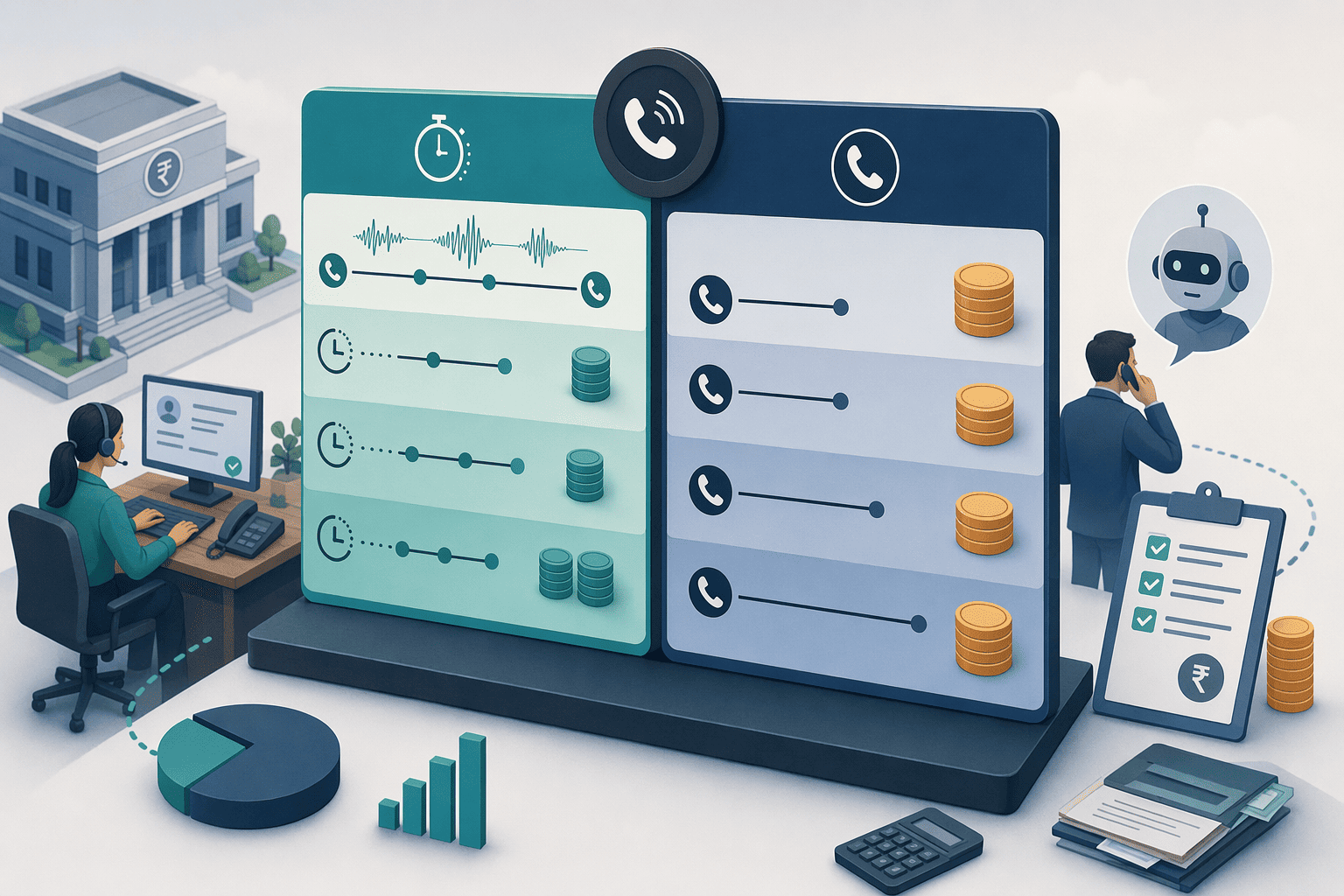
Usage-based models suit pilot deployments handling 50 to 100 calls per day, where total monthly spend stays under ₹15,000 and teams can test AI qualification workflows without upfront commitment. However, these models expose NBFCs to variable monthly costs during seasonal spikes (loan campaign launches, festive periods). Platforms like Exotel describe their pricing as transparent and scalable, though actual per-minute rates require vendor quotes rather than public rate cards.
Flat-Rate and Custom Enterprise Models: When They Make Sense
Flat-rate subscription pricing fixes monthly costs, typically ₹5,000 to ₹50,000 per month, bundling unlimited or high-volume calls with CRM integrations, analytics dashboards, and priority support. EchoLeads offers a $25/month flat rate for entry-level use cases, alongside custom enterprise pricing for high-volume sales teams requiring end-to-end automation beyond basic call handling.
Free tiers often have hidden limits, verify SMS quotas, payment processing fees, and seat minimums before committing. NBFCs handling 500+ calls per day typically benefit from flat-rate or custom enterprise models, which eliminate per-call cost anxiety and include compliance tooling (call recording, consent workflows, DPDP audit trails). Platforms like MyOperator's cloud call center manage inbound and outbound calls at scale, though pricing details require direct vendor contact to surface setup fees, SMS quotas, and payment-processing charges embedded in 'affordable' tiers.
Request written pricing quotes that itemize all fee components, setup, per-minute or per-call charges, SMS costs, payment processing, and seat minimums, before pilot commitments. Promotional tiers shift frequently; locking cost expectations in writing protects NBFCs from mid-contract surprises when call volumes exceed undisclosed quotas.
Pricing transparency matters little if the platform cannot integrate with your existing sales infrastructure and meet data residency requirements.
Integration Requirements: CRM, Telephony, and Data Localization
CRM Integration Depth: Bi-Directional Sync vs. One-Way Logging
CRM integration depth determines whether your automation platform writes back to your sales system or requires manual logging. This decision affects sales velocity, data hygiene, and operational overhead for NBFC lead qualification workflows.
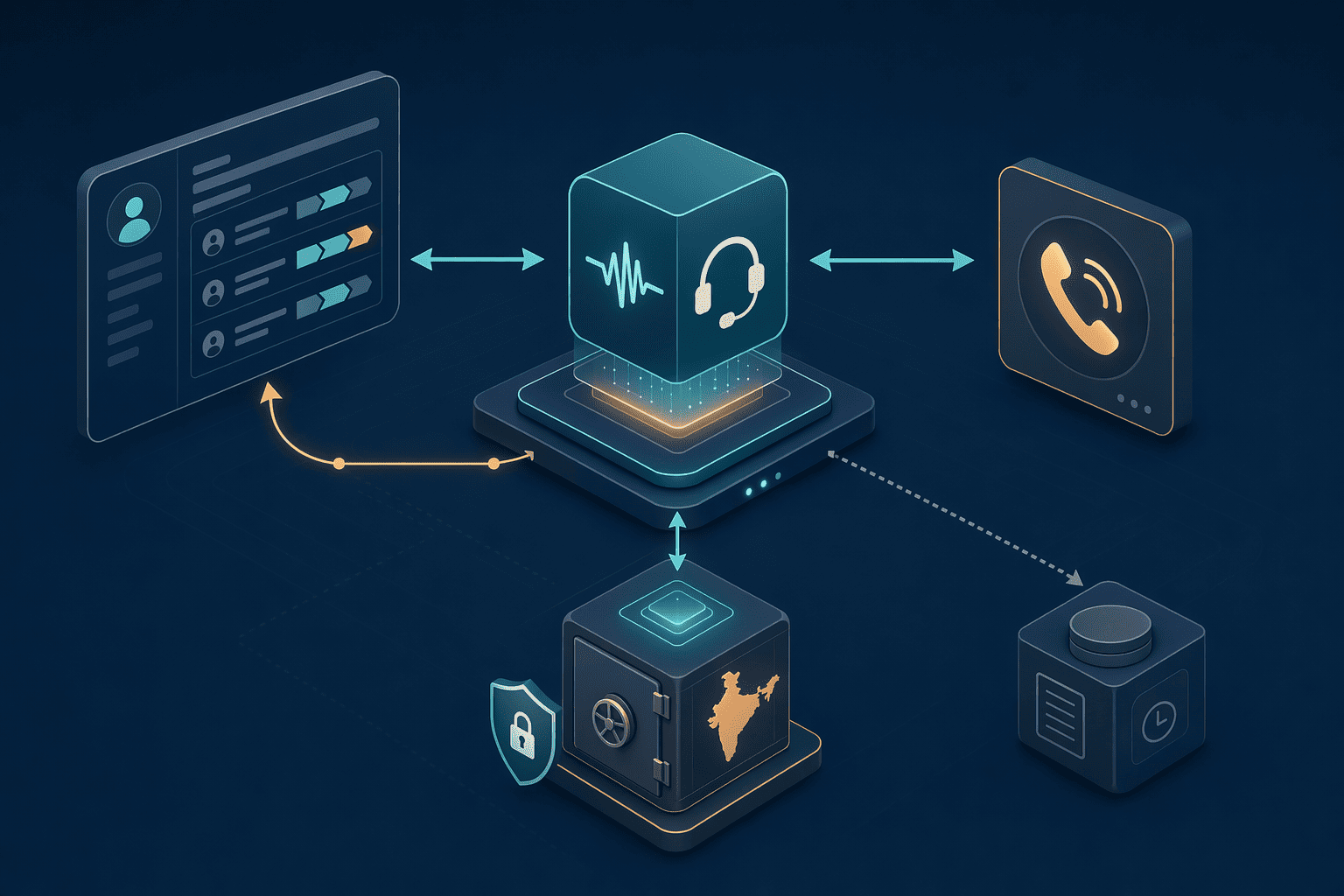
Bi-directional sync suits high-volume teams needing automatic lead status updates. Platforms like EchoLeads write back qualification scores, conversation transcripts, and next-step recommendations without manual data entry. Ideal for NBFCs running 100+ calls daily where CRM accuracy is non-negotiable.
One-way logging suits pilot deployments or teams with manual CRM workflows. Call logs and basic metadata push to the CRM, but status updates remain manual. Useful when testing new vendors or operating under strict audit requirements that demand human review before CRM commits.
Manual export suits low-volume or compliance-heavy teams needing human review before CRM commits. Call recordings and transcripts export to CSV or integrations requiring approval gates before data flows to Salesforce or Zoho.
Verify integration depth during vendor demos by asking: Does the platform update lead stages autonomously based on call outcomes? Can it trigger follow-up sequences in your CRM without manual intervention? If the answer is no, expect operational bottlenecks.
Telephony Compatibility and Data Localization Verification
Telephony provider compatibility determines latency, call quality, and compliance readiness. For NBFCs operating under RBI mandates, including Fair Practices Code enforcement, transparent terms, no hidden charges, clear communication, and data localization on Indian servers, verification is non-negotiable.
Platforms with native integrations for Exotel, Knowlarity, or Ozonetel reduce deployment friction. Third-party telephony integrations add a compatibility layer that can introduce latency or require additional TRAI compliance checks. Caller Digital highlights built-in TRAI, DPDP, RBI, and IRDAI compliance, deploying in 7 to 14 days, a benchmark for India-native stacks.
Data localization verification requires more than vendor claims. Request three documents before signing contracts:
Data processing agreement excerpts specifying server location (Mumbai, Bangalore, Hyderabad data centers) and cross-border transfer prohibitions.
Server location certifications from infrastructure providers (AWS Asia Pacific [Mumbai], Google Cloud India, or on-premise deployments) confirming data residency.
Third-party audit reports (ISO 27001, SOC 2 Type II, or CERT-In audits) validating India-based storage and encryption standards.
Verify DPDP Act 2023 alignment by asking: Does the platform store call recordings and transcripts exclusively on Indian servers? Can it produce audit trails showing no data egress to overseas jurisdictions? Platforms that deflect these questions lack operational transparency.
Before committing to any platform, NBFCs should run structured pilot programs that test compliance, workflow autonomy, and pricing assumptions against real-world conditions.
How to Evaluate Platforms During a Pilot: Questions to Ask Vendors
Before signing a contract, run a 2-3 week pilot with real inbound leads or a subset of your outbound list. The questions below surface the operational details, compliance documentation depth, escalation trigger configuration, hidden pricing fees, and data localization verification, that marketing pages omit. Before pilot deployment, have your legal/compliance team review vendor responses to these questions alongside the platform's published compliance documentation, not website marketing claims alone.

Compliance and Certification Verification Questions
SOC 2 Type II / ISO 27001 audit reports: Request the most recent audit report PDF with attestation date and scope. Verify the report covers voice call recording, storage, and third-party telephony provider integrations, not just the platform's core infrastructure. EchoLeads holds SOC 2 Type II and ISO 27001 certifications for financial services workflows.
RBI Digital Lending compliance documentation: Ask how the platform implements RBI Fair Practices Code mandates (transparent terms, no hidden charges, clear borrower communication) and data localization requirements. Vendors should provide documentation showing Indian jurisdiction data storage and audit trail configuration.
DPDP Act 2023 consent workflows: Request a walkthrough of how the platform captures, logs, and honors borrower consent for voice call recording and data retention. Verify consent workflows execute before the first question, not mid-call. Platforms serving NBFCs in NCR must align with DPDP Act localization and consent requirements.
Regional language accuracy test results: If serving Karnataka or other regional markets, request dialect-specific accuracy test results (e.g., Kannada North Karnataka vs Coastal Kannada). No platform publicly discloses regional accuracy benchmarks; pilot call recordings are your only verification method for Hindi, Tamil, Telugu accuracy claims.
Workflow Configuration and Pricing Transparency Questions
Escalation trigger threshold examples: Ask the vendor to configure 3 escalation scenarios during the pilot (e.g., borrower mentions 'fraud', income verification fails, co-borrower scenario detected). Verify the platform transfers to a human agent with full conversation context, not just a cold handoff. Voice agents should escalate when complexity or sentiment exceeds safe autonomy thresholds.
CRM bi-directional sync depth: Request a demonstration showing real-time qualification score updates, conversation transcript writes, and next-step recommendation fields populating in your Salesforce/Zoho instance during a live call. EchoLeads writes qualification scores and transcripts back to CRM without manual data entry.
All-in pricing fee breakdown: Demand a line-item breakdown of setup fees, per-minute voice charges, SMS costs (WhatsApp template messages for follow-ups), payment processing fees (if collecting EMI via UPI links mid-call), and seat minimums. Free tiers often hide SMS quotas and payment processing fees. EchoLeads uses a flat-rate $25/month pricing model with no per-minute surcharges.
Pilot success metric definition: Agree on 3-5 measurable pilot KPIs before deployment, e.g., qualification accuracy (% of leads correctly routed to sales), answer rate (% of outbound dials reaching a live borrower), escalation rate (% of calls requiring human takeover). Review these metrics weekly during the pilot to catch configuration issues early.
For insurance telemarketing pilot frameworks with similar compliance requirements, see IRDAI-compliant AI voice bot deployment examples covering policy renewal reminders and cross-sell campaigns. Additional NBFC-specific lead qualification workflows and outbound dialing compliance guidance: AI voice lead qualification for insurance outbound dialing.
Making Your Platform Choice
Usage-based pricing (per-minute or per-call) suits NBFCs with variable lead volumes or pilot deployments, while flat-rate or custom enterprise models benefit high-volume operations handling 500+ calls/day, but verify all-in pricing to avoid hidden SMS, payment processing, or seat minimum fees. Autonomous 24/7 lead qualification reduces response time and handles pre-screening at scale, but NBFCs must configure escalation triggers (fraud accusations, identity verification failures, emotionally charged conversations) to comply with RBI Fair Practices Code and maintain human oversight for final underwriting decisions.
As RBI Digital Lending Directions enforcement tightens in 2026, NBFCs will increasingly prioritize platforms with published compliance documentation (SOC 2 Type II, ISO 27001 audit reports) and India-based data localization over feature-rich but compliance-ambiguous alternatives, making vendor verification a non-negotiable selection criterion.
Start your platform evaluation this week by shortlisting 2-3 platforms (including EchoLeads, Exotel, Knowlarity, or MyOperator based on your pricing model preference) and requesting compliance documentation, escalation trigger configuration examples, and all-in pricing quotes using the vendor question framework above.
Frequently Asked Questions
What RBI compliance requirements apply to NBFCs using AI voice agents for lead qualification?
The Reserve Bank of India Digital Lending Directions 2025 apply to all NBFCs, mandating Fair Practices Code enforcement, transparent loan terms disclosure, no hidden charges, clear communication at every touchpoint, and data localization on Indian servers. Voice agent scripts must embed these requirements at the workflow level, not as post-call overlays.
Do I need SOC 2 Type II and ISO 27001 certifications, or is one enough for NBFC call automation?
Both certifications serve complementary roles in BFSI audit frameworks. SOC 2 Type II attests to operational effectiveness of security controls over time, while ISO 27001 covers thorough information security management. NBFCs should verify both certifications are current and request published audit reports, not rely on vendor self-attestation through website badges.
What are the typical escalation triggers that require human handoff in NBFC lead qualification workflows?
Voice agents escalate when complexity, sentiment, or compliance risk exceeds safe thresholds: fraud accusations, identity verification failures, disputes, emotionally charged conversations, multi-product comparisons, non-standard income verification, and co-borrower scenarios. NBFCs should configure these thresholds during pilot testing based on risk appetite and compliance requirements.
How do I verify a platform stores borrower data on Indian servers (not just claims it)?
Request the vendor's data residency audit report specifying server location, third-party audit reports confirming India-based storage, and certifications from cloud providers like AWS Mumbai, Azure India Central, or Google Cloud Mumbai. RBI data localization rules require borrower data to reside on servers within Indian jurisdiction.
What hidden costs should I look for in 'affordable' call automation platform pricing?
Free tiers often have hidden limits, verify SMS quotas, payment processing fees, and seat minimums before committing. Common hidden costs include setup fees, per-minute overage charges, SMS quota limits, payment processing fees for payment link sharing, seat minimums, and CRM integration fees. Request written all-in pricing quotes before pilot commitments.
Can AI voice agents handle loan underwriting decisions autonomously?
Voice agents respond to loan inquiries 24/7 and handle initial eligibility verification, intent detection, and document list sharing autonomously. However, final underwriting decisions require human oversight or integration with automated underwriting systems that comply with RBI lending guidelines. Pre-screening does not replace final approval workflows.
What CRM integration depth do I need for NBFC lead qualification workflows?
CRM integration operates at three tiers: bi-directional sync (automatic lead status updates, call logs pushed to CRM) suits high-volume teams; one-way logging suits pilot deployments; manual export suits low-volume or compliance-heavy teams needing human review before CRM commits. Verify during demos whether platforms autonomously update lead stages based on call outcomes.