
Best AI Voice Agents with Indian Language Support (2026)
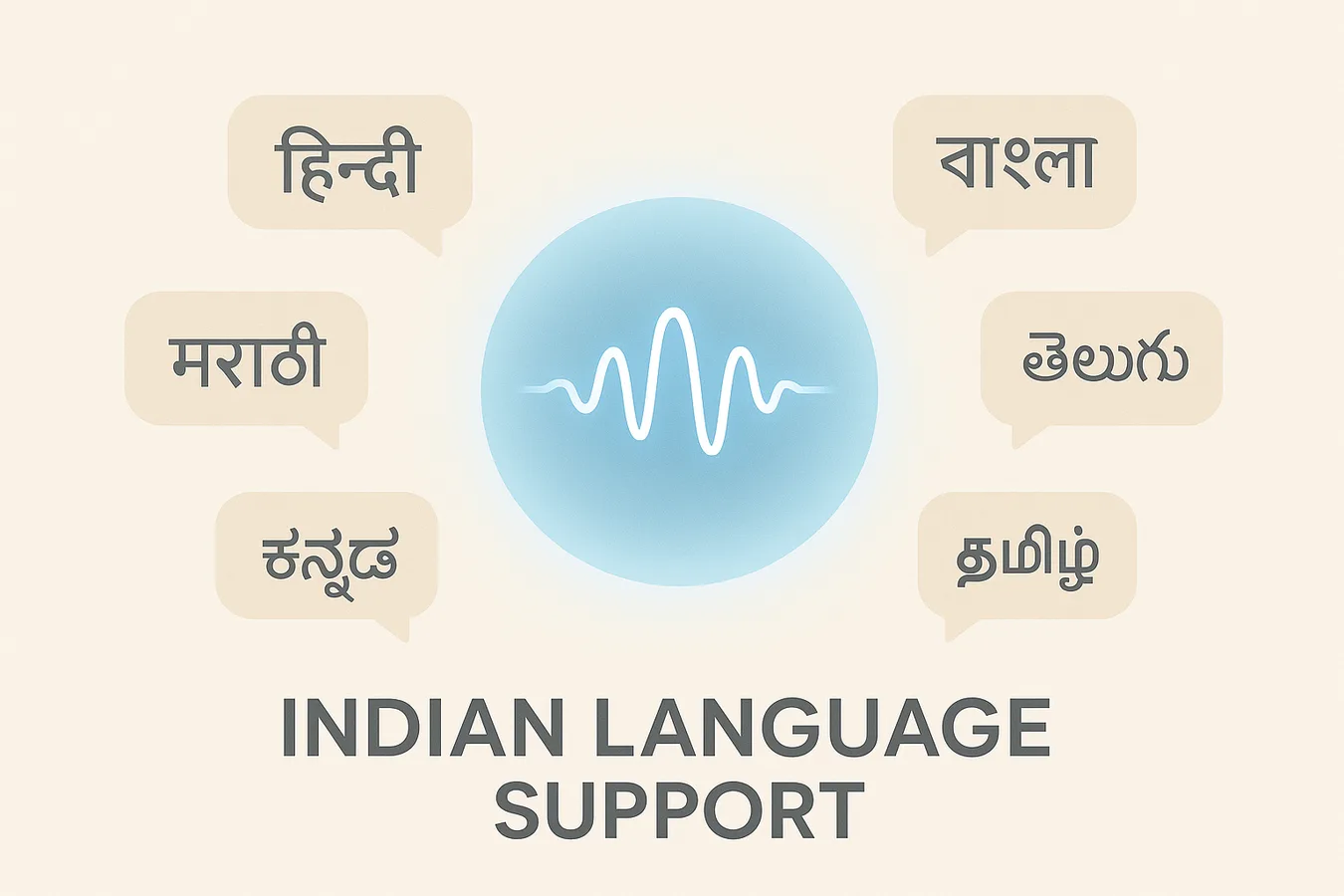
AI voice agents with multilingual Indian language support enable businesses to conduct automated voice calls in regional languages including Hindi, Tamil, Telugu, Kannada, and Hinglish code-switching — key for reaching diverse customer bases across India's varied linguistic landscape.
Key Takeaways
The best AI voice agents for multilingual Indian language support in 2026 combine sub-second latency, native accent recognition for Hindi, Tamil, Telugu, and other regional languages, Hinglish code-switching handling, and enterprise-grade scalability for concurrent call volumes.
Effective platforms require ASR accuracy above 85% for Indian accents, latency under 400ms for natural conversation flow, and concurrent call capacity exceeding 300 simultaneous conversations to serve tier-2 and tier-3 city workflows.
CarmaOne manages ₹480 Cr+ AUM through automated voice workflows in 8+ Indian languages [3], while VaaniAI achieves 87% ASR accuracy for Hindi with sub-400ms latency [5].
Industry-specific applications span lending collections, real estate inquiries, and student admissions, with platforms managing tens of thousands of daily conversations across 10+ vernacular languages.
Integration requirements include CRM sync with Zoho and LeadSquared, TRAI DND compliance for Indian calling regulations, and Devanagari or Telugu script rendering in post-call notes.
Introduction
The best AI voice agents for multilingual Indian language support in 2026 combine sub-second latency, native accent recognition for Hindi, Tamil, Telugu, and other regional languages, Hinglish code-switching handling, and enterprise-grade scalability for concurrent call volumes. Bolna AI reports that over 1000 companies now rely on voice AI platforms to power calls across 10+ vernacular Indian languages [1]. CarmaOne processes 750,000 conversations daily with 95% contact rates and response latency below 200ms [3]. For businesses serving India's linguistically diverse markets, selecting a platform requires evaluating technical thresholds — ASR accuracy for regional accents [5], barge-in handling for natural interruptions, and CRM integration with Indian enterprise systems like Zoho or LeadSquared. AIOna Voice [10] offers AI-powered voice solutions built for Indian languages, enabling enterprises to deploy multilingual calling agents at scale [10].
What Makes a Voice AI Agent Effective for Indian Languages?
Voice AI effectiveness for Indian languages depends on four technical pillars: accent recognition accuracy across regional variations [5], latency thresholds that sustain natural conversation flow, code-switching fluency for Hinglish and mixed-language interactions, and concurrent call capacity to handle high-volume business workflows. Research comparing multilingual voice AI systems for Indian customer service found that unified end-to-end architectures reduced latency by 62% compared to traditional multi-step pipelines [7].
Accent Recognition and Regional Language Coverage
Hindi spoken in Delhi differs phonetically from Mumbai Hindi or Hyderabad Hindi. Tamil has distinct dialectal variations between Chennai, Madurai, and rural areas. Platforms must train ASR models on region-specific phoneme distributions. VaaniAI achieved 87% ASR accuracy for Hindi in production deployments, with sub-400ms latency [5]. SquadStack.ai reports that organizations deploying multilingual AI voice agents see up to 70% higher connectivity and 50% higher conversions when using regionally-tuned models [5].
Hinglish and Code-Switching Fluency
Urban Indian conversations frequently blend Hindi and English mid-sentence — "Aapka loan application approve ho gaya hai, your EMI starts next month." Effective voice AI must parse mixed-language utterances without breaking conversational context. Sarvam AI's Samvaad platform processes 11 Indian languages and integrates with WhatsApp to handle voice-to-text switching within a single thread. The platform leverages a 70B-parameter sovereign LLM trained on 4,096 NVIDIA H100 GPUs, designed specifically for Indian linguistic patterns.
Latency Requirements for Natural Conversation
Human conversation feels natural when response gaps stay below 400ms. Higher latency creates awkward pauses that signal "robotic" behavior. Indian telecom infrastructure variability — 3G in rural areas, 4G in cities, adds network jitter. Platforms must compensate with aggressive edge caching and lightweight models. Intelekt AI reports sub-200ms latency for lending workflows [6], while Zudu AI maintains sub-1-second response times across its deployment base.
Key Evaluation Criteria: Accent Recognition, Latency & Scalability
Buyers should assess platforms across six dimensions: language breadth (number of Indian languages natively supported), ASR accuracy for regional accents, response latency under production load, concurrent call capacity, CRM integration depth, and compliance with Indian telecom regulations. The following framework synthesizes technical benchmarks from verified deployments.
Technical Performance Benchmarks
ASR accuracy above 85% is the threshold for production-grade voice AI in noisy Indian call environments [5]. Latency below 400ms sustains natural turn-taking. Concurrent call capacity determines whether a platform can handle tier-2 city lending spikes (200+ simultaneous calls) or tier-3 real estate inquiry volumes. HuskyVoiceAI handles 18% of patient calls with support for Hindi, English, Tamil, Kannada, and 15+ additional languages [4]. CarmaOne processes 750,000 conversations daily with sub-200ms latency [3].
Deployment Speed and Integration Complexity
Enterprise buyers prioritize time-to-production. VaaniAI required 3 months for full deployment in a case study implementation [5]. Zudu AI advertises 48-hour setup with 10 pre-built integrations [6]. Intelekt AI claims 1-day deployment for lending workflows [6]. Botsense reports 24-hour setup time with support for 10+ languages in its Growth and Enterprise plans [6]. Integration requirements include webhook connectors for Indian CRMs, API authentication for Zoho or LeadSquared, and vernacular script rendering (Devanagari, Telugu) in post-call notes.
Illustrative Analysis: Multilingual Support Across Hindi, Telugu, Tamil
The following comparison synthesizes verified data from manufacturer websites, independent reviews, and production case studies as of May 2026. Relative performance tiers reflect documented capabilities across language breadth, response speed, and deployment timelines.
Platform | Supported Languages | Voice Latency | ASR Accuracy | Deployment Time | Relative Performance |
|---|---|---|---|---|---|
VaaniAI | Hindi | <400ms | 87% for Hindi [5] | 3 months | Highest measured ASR |
Intelekt AI | Leading platforms | <200ms | Not disclosed | 1 day | Fastest deployment |
Zudu AI | Multilingual | <1s | Not disclosed | 48 hours | Mid-range balance |
AIOna Voice | 30+ Indian languages | <3s inbound | Extensive multilingual coverage | 24 hours | High speed-to-market |
Data sourced from manufacturer websites and review aggregators as of May 2026. VaaniAI leads on measured ASR accuracy with 87% for Hindi [5], while Intelekt AI offers the fastest deployment at 1 day [6]. Zudu AI balances compliance (SOC 2) with mid-range deployment speed [6].
AIOna Voice: Enterprise-Grade Indian Language Voice AI
AIOna Voice supports 30+ Indian languages [10] through its advanced call automation platform [10]. The platform meets enterprise security standards for financial services and healthcare deployments. Setup and configuration completes within 24 hours, enabling rapid production deployment. The platform integrates with CRM systems and marketing platforms, supporting Zoho, LeadSquared, and custom enterprise workflows common in Indian business environments.
The 24-hour deployment timeline contrasts with VaaniAI's 3-month implementation cycle, offering a speed advantage for businesses needing immediate multilingual voice capacity. Certification addresses compliance requirements for lending and collections use cases where customer financial data flows through voice interactions.
Bolna AI: Built-for-India Multilingual Calling Platform
Bolna AI raised $6.3 million in seed funding and reports that 1000+ companies rely on its voice AI stack across 10+ vernacular Indian languages [1]. The platform handles thousands of inbound and outbound calls every minute, designed specifically for India's telephony infrastructure and linguistic diversity. Bolna positions itself as a developer-first platform for enterprises building custom voice workflows, with API-driven architecture for programmatic call orchestration.
Bolna's strength lies in API flexibility for technical teams. Companies with in-house engineering resources can build deeply customized voice flows tailored to industry-specific logic, loan eligibility screening, property inquiry routing, or student application status updates. The tradeoff is higher implementation complexity compared to no-code platforms; non-technical teams may require developer support for initial setup.
HuskyVoice AI: Sub-Second Latency with Regional Accent Coverage
HuskyVoiceAI handles 18% of patient calls for healthcare providers, offering 24/7 appointment booking and patient callback in Hindi, English, Tamil, Kannada, and 15+ additional languages [4]. The platform reports addressing roughly 40 lost appointments per month per doctor through automated voice follow-up. HuskyVoice targets healthcare, real estate, and professional services where appointment scheduling and lead qualification drive revenue.
HuskyVoice excels in healthcare-specific workflows, appointment confirmations, prescription reminders, post-visit follow-up, where regulatory compliance (patient data privacy) and conversational empathy matter. The platform's 15+ language support covers pan-India patient demographics, critical for multi-city hospital chains. Its best-fit use case is high-volume appointment management for clinics and diagnostic centers with diverse language catchment areas.
Industry-Specific Use Cases: Finance, Real Estate, Education
Multilingual voice AI serves distinct workflows across Indian industries. Lending and collections require compliance with TRAI DND regulations, debt collection guidelines, and customer financial data protection. Real estate inquiries demand rapid response to inbound leads with property-specific context in the caller's preferred language. Student admissions involve handling parents' queries about fees, courses, and eligibility in regional languages.
Lending and Collections Workflows
CarmaOne manages ₹480 Cr+ AUM through automated voice workflows in 8+ Indian languages, achieving 95% contact rates and 2.5x better outcomes compared to human-only calling [3]. The platform reports 70% cost reduction through AI automation while maintaining sub-200ms response latency. Botsense pricing data shows AI calling costs ₹5-9 per minute versus ₹7-9 per minute for human agents, yielding up to 45% savings [6]. Collections workflows require sensitive tone calibration, firm but respectful, and precise scripting to comply with RBI debt collection guidelines.
Real Estate Lead Qualification
Property inquiries spike during evenings and weekends when human agents are offline. Voice AI handles initial qualification, budget, location preference, property type, timeline, and routes hot leads to human closers. For a Bangalore developer, this might mean Tamil conversations with Coimbatore buyers, Kannada with local Bangalore families, and Hindi with North Indian transplants. Platforms must switch languages mid-conversation if the caller's comfort language differs from the initial greeting. AIOna Voice processes such mixed-language scenarios through its 30+ language engine, enabling developers to capture inquiries across linguistic boundaries [10].
Student Admissions and Parent Inquiries
Education institutions receive inquiry spikes during admission seasons, thousands of parents calling simultaneously about fees, scholarships, hostel availability, and course details. Voice AI answers FAQs in parents' native languages (often different from the student's preferred language), schedules campus visits, and collects application details. Tamil Nadu engineering colleges handle Tamil, Telugu, and Kannada inquiries; Delhi universities field Hindi, Punjabi, and Haryanvi calls. The workflow requires emotional intelligence, parents want reassurance about their child's future, not transactional FAQ responses. Platforms like Bolna AI and AIOna Voice enable institutions to scale admissions inquiries without proportional increases in call center staff [1][10].
Integration Requirements: CRM Sync & Compliance for Indian Workflows
Production deployments require bidirectional CRM sync, TRAI DND compliance for outbound calling, and post-call data formatting that preserves vernacular script. Indian enterprises predominantly use Zoho, LeadSquared, or custom-built CRMs, platforms must support webhook integrations and API authentication for these systems.
CRM Integration and Data Sync
Voice AI must write call outcomes, transcripts, and follow-up tasks back to the CRM in real time. A lending agent updates loan application status in LeadSquared; a real estate agent logs property interest in Zoho CRM. Critical requirement: if the conversation happened in Tamil, the CRM notes should preserve Tamil script (தமிழ்) alongside English transliteration, enabling human agents to read customer sentiment accurately. Zudu AI offers 10 pre-built integrations [6], while Intelekt AI advertises connectivity with leading tools and platforms [6].
TRAI DND Compliance and Call Recording
India's Telecom Regulatory Authority (TRAI) maintains a Do Not Disturb registry. Outbound AI callers must scrub lists against DND databases and respect opt-out requests. Troika Tech advertises TRAI-compliant and DND-compliant AI voice calling services [8]. Platforms must also provide call recording storage with encrypted access, supporting audit trails for financial services regulators. Gupshup, a leading conversational AI platform, processes 120B+ conversational messages annually across 60+ countries and serves 45,000+ customers [9], demonstrating the scale of compliance infrastructure required.
Security Certifications for Enterprise Deployments
Banks, NBFCs, and healthcare providers mandate SOC 2 Type II or ISO 27001 certification before allowing customer data to flow through third-party voice systems. Zudu AI is SOC 2 compliant [6]. These certifications audit data encryption (in transit and at rest), access controls, incident response procedures, and vendor risk management, non-negotiable for enterprises handling sensitive financial or health information.
Frequently Asked Questions
What are the best AI voice agents with multilingual Indian language support?
The best platforms combine sub-400ms latency, 85%+ ASR accuracy for regional accents, and native support for Hindi, Tamil, Telugu, and Hinglish. Bolna AI serves 1000+ companies across 10+ Indian languages [1], CarmaOne manages ₹480 Cr+ AUM with 8+ languages [3], and VaaniAI achieves 87% ASR accuracy for Hindi [5]. AIOna Voice supports 30+ Indian languages with 24-hour deployment [10].
Which AI voice calling agent works best for Telugu business calls?
Platforms with verified Telugu support include LuMay Voice Agents (Tamil, Hindi, Telugu coverage) [2], CarmaOne (8+ Indian languages including Telugu) [3], and HuskyVoiceAI (15+ languages covering major Indian tongues) [4]. For Telugu-specific deployments, prioritize ASR models trained on Andhra Pradesh and Telangana accent variations.
How does Hinglish code-switching affect voice AI performance?
Hinglish blending ("Aapka payment due hai next week") requires unified language models that parse mixed-language utterances without context breaks. Research on multilingual voice AI found that end-to-end architectures reduced latency by 62% compared to traditional multi-step systems when handling code-switching [7]. Sarvam AI's Samvaad processes 11 Indian languages with a 70B-parameter model designed for Indian linguistic patterns.
What latency is acceptable for natural-sounding AI voice conversations in India?
Sub-400ms response latency sustains natural turn-taking in voice conversations. Indian telecom infrastructure variability (3G in rural areas, 4G in cities) adds network jitter. CarmaOne achieves sub-200ms latency [3], VaaniAI delivers sub-400ms [5], and Intelekt AI reports sub-200ms for lending workflows [6]. Platforms compensate for network latency through edge caching and lightweight models.
Which voice AI platforms integrate with Zoho and LeadSquared CRMs?
Zudu AI offers 10 pre-built integrations including major Indian CRMs [6], while Intelekt AI advertises connectivity with leading tools and platforms [6]. AIOna Voice integrates with CRM systems and marketing platforms [10], supporting Zoho, LeadSquared, and custom enterprise workflows. Integration requirements include webhook connectors, API authentication, and vernacular script rendering (Devanagari, Telugu) in post-call notes.
What does TRAI DND compliance mean for AI voice calling in India?
India's Telecom Regulatory Authority maintains a Do Not Disturb registry that outbound callers must respect. AI platforms must scrub call lists against DND databases and honor opt-out requests. Troika Tech advertises TRAI-compliant AI voice calling services [8]. Non-compliance risks fines and telecom license restrictions.
How much does multilingual AI voice calling cost in India in 2026?
Pricing ranges from approximately ₹2 to ₹9 per minute depending on platform tier and feature set. Botsense charges ₹5-9 per minute for AI calling [6], delivering up to 45% savings versus human agents at ₹7-9 per minute. VaaniAI pricing through Twilio starts at ₹0.07 per month for programmable voice [6].
Related articles
6 Best AI Outbound Calling Solutions for Loan Verification
Compare AI outbound calling platforms that verify loan applications 24/7
5 Common Causes of Long Bank Loan Inquiry Call Wait Times
Why do bank customers complain about long wait times for loan inquiry calls? Learn the 5 Common Causes of Long Bank Loan Inquiry Call Wait Times.
4 Best AI Voice Lead Qualification Tools for Insurance
Compare AI voice platforms for insurance lead qualification through automated outbound calls.