
How Can Sales Conversational AI Enhance Customer Interactions
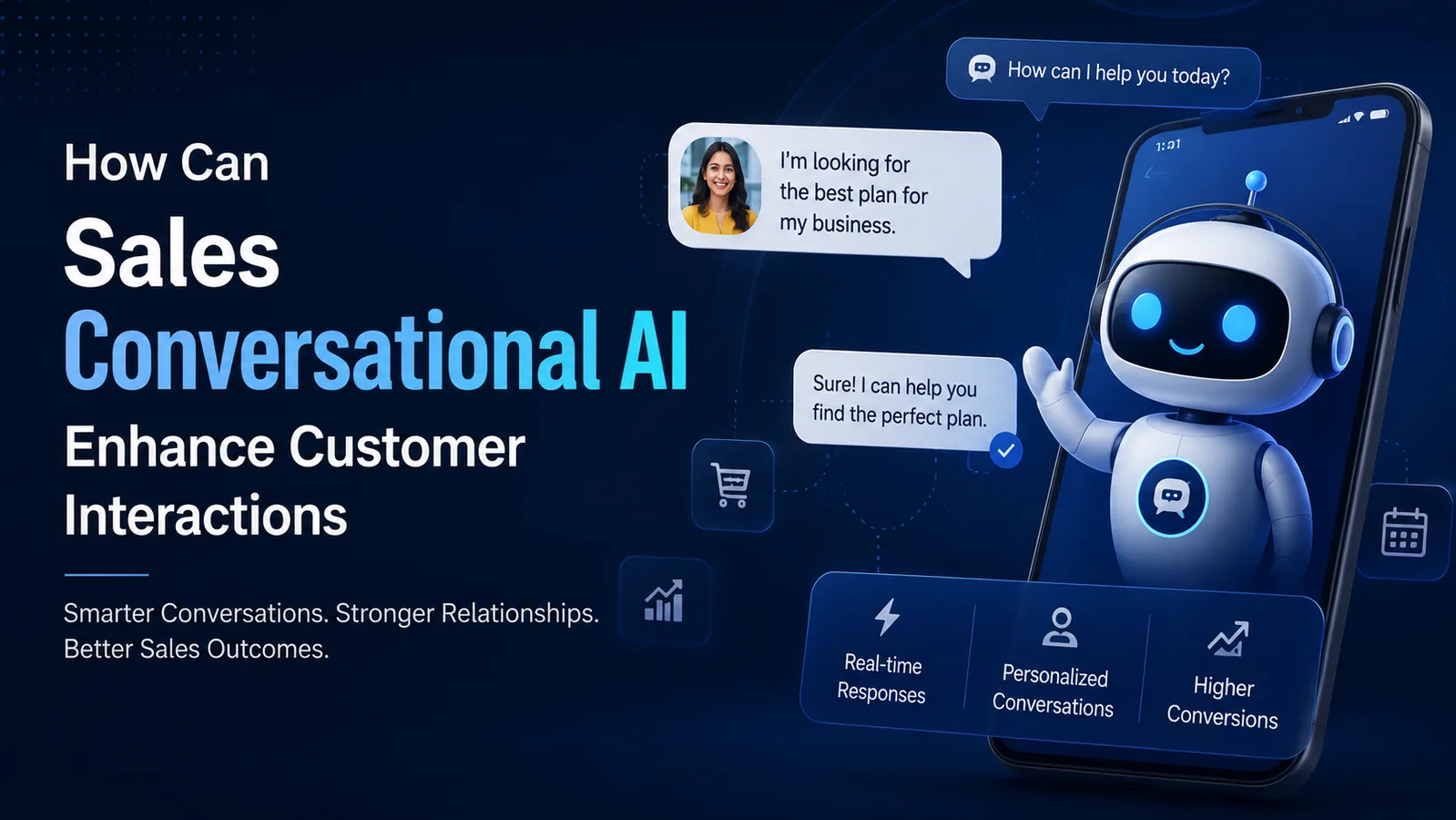
A mid-market B2B software company experienced steady growth in website traffic, but qualified pipeline remained flat. Prospects landed on pricing pages, scrolled through feature comparisons and disappeared. Sales development reps were not able to respond quickly enough outside of business hours, and the handful that did often lacked context from the visitor’s browsing behaviour. The game-changer came when the company deployed a conversational AI agent that began contextual conversations, asked qualifying questions in natural language, handled common objections, and booked meetings right onto sales calendars. Conversion rates from website visitor to sales-qualified lead skyrocketed in just one quarter, and human sellers had warmer, better-prepped conversations. That outcome illustrates precisely how can sales conversational ai enhance customer interactions.
Sales conversational AI has moved beyond simple FAQ answering. Modern systems are always on sales development capacity. They identify buying signals, personalise outreach, qualify against ideal customer profiles, nurture cold leads, recover abandoned carts or stalled deals, and deliver high-intent prospects to human closers with complete context. Therefore, you’ll see higher engagement, faster response, better lead quality, and measurable revenue contribution.
Quick Answer Box
How can sales conversational ai enhance customer interactions: by delivering instant, personalized, multi-turn conversations that qualify intent, address objections, and guide prospects toward the next step at any hour. It increases response rates, improves lead quality, shortens sales cycles, and frees human sellers for high-value relationship work.
How Can Conversational AI Improve Customer Engagement in Sales?
Customer involvement in sales is about speed, relevance and continuity. All three are enhanced by Conversational AI.
Speed is the first lever. Data indicates that the likelihood of qualifying a lead diminishes significantly after the first few minutes. Conversational AI provides lightning fast responses in seconds across website chat, WhatsApp, SMS or voice channel. The immediacy makes it stand out at its best and prevents any competitors from getting in.
Context is what gives relevance. Sophisticated systems leverage page views, past interactions, CRM data and behavioural signals to initiate conversations that reference the specific product page or pain point that the prospect has already explored. Instead of generic greetings, the artificial intelligence can ask targeted questions about budget, timeline, authority and use case generating richer qualification data than a static form.
Channels and time are flowing continuously. A person who starts on web chat can continue on SMS or get a voice follow-up without having to re-explain the message. We don’t put dormant leads through a generic drip sequence but rather give timely, personalised nudges based on previous signals. Recovery dialogues for abandoned carts or stalled opportunities refer to the specific items or concerns left unresolved.
Natural language also increases engagement. Prospects write or speak in their own voice. The artificial intelligence can understand intent, handle interruptions, change tone. This reduces the friction of rigid menus and makes it more likely that the conversation will continue rather than end in frustration.
Last but not least, conversational AI scales personalisation. “Human teams can’t maintain that one-to-one relevance for thousands of simultaneous prospects.” AI agents can do that. Faster, context, continuity, natural dialogue leads to: More response rate, longer conversation duration, more frequent movement to qualified meetings or purchase.
What Are the Best Sales Conversational AI Platforms for Enhancing Customer Interactions?
The 2026 landscape will be divided between a few pragmatic buckets: CRM-native agents, dedicated sales chat and SDR platforms, conversation intelligence tools, and voice-first or messaging-first systems.
The CRM-native approach includes Salesforce Agentforce and HubSpot Breeze. They operate within the seller’s current systems, access live account and opportunity data, and can assist human sellers in real-time or function as autonomous qualification or outreach agents. They’re platforms for organisations that want tight data governance and low context switching.
Both Drift (now part of broader revenue platforms) and Qualified are good for inbound conversational sales, particularly in Salesforce-heavy environments. They are good at engaging website visitors, sending high intent traffic to the right rep and running playbooks that combine chat with human take over.
Conversation intelligence platforms like Gong analyse live or recorded sales calls, surface coaching insights, and are increasingly used to provide real-time guidance during conversations. They enhance conversations to make every human conversation smarter instead of replacing the human.
Conversica, Artisan and other AI SDR agents are automating multi-channel sequences for outbound and persistent follow-up while maintaining two-way natural dialogue. They keep pipelines warm without reps having to manually put in constant effort.
Deepen channels with voice and messaging pros. Some are working on AI voice agents for qualification and appointment setting. Others focus on WhatsApp and SMS conversational flows that feel native to the customer’s preferred channel.
Selection criteria should include natural language quality, depth of CRM write-back, smoothness of hand-off to human sellers, analytics on conversion and lead quality, compliance posture, and total cost of ownership including conversation volume. There is not one platform that rules all use cases. The best fit is determined by the CRM, primary channels, priority (inbound conversion, outbound scale, or seller augmentation)
Where Can I Find Case Studies on Sales Conversational AI Improving Customer Service and Sales Outcomes?
Credible case evidence appears in vendor customer stories, independent analyst reports, and industry publications from 2025 and 2026.
Multiple B2B implementations report conversion rate increases in the 40 percent range when conversational agents move beyond simple support into active qualification and objection handling. One documented pattern shows traditional landing pages converting at roughly 2.4 percent while chatbot-augmented experiences reach 4.1 percent or higher, with simultaneous improvement in sales-qualified lead rates.
Ecommerce and retail deployments frequently cite higher average order values and cart recovery rates when AI initiates proactive conversations during browsing or after abandonment. Some brands attribute 20 percent or greater lifts in support-driven revenue to AI agents that both resolve questions and recommend relevant products.
In B2B sales, organizations embedding agentic AI into prospecting and relationship workflows have reported revenue per relationship manager increases of 3 to 15 percent alongside reductions in cost-to-serve. Seller productivity gains of 60 percent and win-rate improvements around 26 percent appear in aggregated customer data from engagement platforms.
Financial services and SaaS case studies highlight faster lead response, higher meeting-to-opportunity conversion, and better expansion identification inside existing accounts. These outcomes typically require integration with CRM data and clear rules for when the AI hands off to a human closer.
When evaluating case studies, look for named metrics (conversion lift, response time, lead quality, revenue impact), time frames, and whether the AI operated primarily in support mode or in active sales mode. The strongest results occur when conversational AI is treated as revenue infrastructure rather than pure cost reduction.
Which Companies Offer Sales Conversational AI Solutions Tailored for the Indian Market?
The Indian market needs multilingual capability (Hindi, Hinglish and major regional languages), strong WhatsApp integration, TRAI and DPDP compliance, outcome-oriented pricing and ability to execute across high-volume, price sensitive and relationship-driven sales motions.
Gnani.ai is frequently referenced for enterprise BFSI and multi-lingual voice AI at scale. It supports multiple Indian languages and is aimed at regulated, high-volume environments.
Platforms like Sahay specialise in serving Indian SMB and mid market sales teams and are optimised for WhatsApp-first conversational flows, natural hinglish, rapid lead callback, qualification and CRM updates. They are based on the way Indian buyers actually communicate, not on translated global templates.
Voice AI providers catering to India including those compared in local buyer guides, emphasise telephony-trained models, built-in compliance for DPDP and TRAI, and pricing models based on resolved outcomes or per-minute rates that fit D2C, BFSI, healthcare and logistics use cases. Typical distinguishing factors include deployment in days or weeks, not months.
Other India-focused solutions help field sales with voice-first capture of leads and orders in multiple languages, or provide conversation intelligence tailored for retail floor and dealership environments. Global platforms with a strong India presence (certain CCaaS and CRM-native agents) also serve large enterprises that demand both local language depth and international governance.
Buyers should test language accuracy against real customer accents, check WhatsApp Business API readiness, review audit and consent features, and test hand-off quality to human teams. The top India deployments leverage conversational AI within existing CRM and telephony stacks, not build out new siloed channels.
Technical & Performance Data Matrix
Capability Area | Traditional Approach | Conversational AI Enhancement | Typical Impact Range (2025–2026 Evidence) |
Speed to first response | Hours or next business day | Seconds, 24/7 | 70%+ faster lead response |
Lead qualification depth | Form fields or basic chat scripts | Multi-turn natural dialogue on pain, budget, timeline | Higher SQL rates, 35%+ quality lift |
Personalization | Generic templates | Context from behavior + CRM | Higher engagement and conversion |
Objection handling | Requires human availability | Real-time or scripted natural responses | Improved progression to next step |
Channel continuity | Siloed email, phone, chat | Unified context across chat, SMS, voice, WhatsApp | Reduced drop-off |
Seller productivity | Manual research and follow-up | Automated research, nudges, meeting booking | 26–60% productivity gains in cases |
After-hours coverage | Limited or none | Full autonomous engagement | Capture of otherwise lost intent |
This matrix does not only show that conversational AI is about speeding up existing processes. It changes the nature and timing of the customer’s interactions Speed alone has value but combined with deeper qualification and ongoing context it brings the bigger commercial rewards.
Organisations measure containment or cost per conversation and undervalue the worth. Other strategic metrics include sales qualified lead volume and quality, show rates, conversion from conversation to opportunity, and revenue influenced by AI handled interactions.
The quality of implementation determines whether the impact ranges are achieved at the upper or lower end. The platforms that write cleanly into a CRM, keep a history of conversations for human sellers, and allow for rapid iteration of dialogue flows continue to outperform the ones that work as stand-alone chat widgets.
Language and channel fit are more important in India. Even with a powerful large language model at the backend, training on real Indian conversational patterns and integration with WhatsApp gives higher engagement than generic English-first models.
Risk Analysis and Implementation Considerations
Typical risks include over-automation that frustrates complex buyers, poor hand-off that forces customers to repeat information, hallucinated product claims, and compliance gaps around consent or data residency. Mitigation requires clear rules of escalation, human-in-the-loop review of high-value or regulated conversations, grounding of responses in approved knowledge bases, and regular audit of conversation logs.
Change management is just as important. Sellers need to be confident that the AI will enhance their work, not undermine it. Transparent reporting of AI-sourced pipeline and joint coaching on how to use AI-prepared context facilitates adoption.
Macro Trend Analysis: From Chatbots to Agentic Sales Systems
The market has evolved beyond basic rule based chat bots. Today’s frontier is agentic systems that can plan multi-step outreach, update CRM records, schedule meetings, and adapt strategy based on real-time signals. According to observations from Gartner and McKinsey in 2026, the majority of the reported productivity and revenue gains are seen by organisations that embed AI into their core commercial workflows rather than treating it as a side experiment.
Advice vs Strategic Thinking Matrix
Decision Point | Generic Advice | Strategic Thinking |
Goal of deployment | Reduce support tickets | Increase qualified pipeline and conversion while improving experience |
Platform selection | Choose the cheapest or most hyped | Match to CRM, primary channels, language needs, and hand-off requirements |
Success metrics | Number of conversations handled | SQL volume and quality, conversion rates, revenue influenced, seller time freed |
Human role | Replace as many humans as possible | Free humans for complex judgment and relationship building |
India-specific readiness | Assume global platform works locally | Verify multilingual accuracy, WhatsApp depth, and TRAI/DPDP posture |
Rollout approach | Big-bang across all traffic | Start with high-intent pages or specific lead sources, measure, then expand |
Ongoing management | Set and forget | Continuously test dialogue variants and retrain on real conversation outcomes |
Generic advice optimizes for short-term cost or novelty. Strategic thinking treats conversational AI as a commercial system that must integrate with people, data, and process to deliver sustained improvement in customer interactions and revenue.
People Also Ask
Q: How can conversational AI improve customer engagement in sales?
It responds instantly, personalizes based on behavior and CRM data, conducts multi-turn qualification dialogues, handles common objections, maintains continuity across channels, and operates 24/7. These capabilities raise response rates, conversation quality, and progression to qualified opportunities compared with forms or delayed human follow-up.
Q: What are the best sales conversational AI platforms in 2026?
Strong candidates are Salesforce Agentforce and HubSpot Breeze for CRM-native use, Drift and Qualified for inbound conversational sales, Gong for conversation intelligence and real-time guidance, and specialised AI SDR or voice platforms for outbound scale. Best fit is determined by the current CRM, channel mix and whether the goal is inbound conversion or seller augmentation.
Q: Where can I find reliable case studies on sales conversational AI?
Look for vendor customer stories with named metrics, independent analyst summaries (McKinsey, Gartner-referenced findings), and 2025–2026 industry reports. Credible studies report conversion lifts, lead quality improvements, productivity gains, and revenue impact rather than only cost savings or containment rates.
Q: Which companies offer sales conversational AI tailored for India?
The providers, like Gnani.ai (enterprise multilingual voice), Sahay (WhatsApp-first SMB and mid-market), and other India-focused voice AI platforms, focus on local languages, Hinglish, WhatsApp integration, TRAI and DPDP compliance, and outcome-based or accessible pricing. Global platforms with huge India deployments are also used by larger enterprises.
Q: Does conversational AI replace salespeople?
No. It handles high-volume, repetitive, and after-hours engagement so that human sellers can focus on complex negotiations, relationship building, and high-stakes closings. The strongest results occur when AI and humans operate as a coordinated system.
Q: What metrics should I track after deploying sales conversational AI?
Track speed to first response, conversation-to-SQL conversion, lead quality scores, meeting show rates, opportunity creation from AI-sourced leads, revenue influenced, and seller time reallocated to higher-value activities. Cost per conversation alone is insufficient.
Q: How important is CRM integration?
Critical. Without clean write-back of conversation history, qualification data, and next steps, human sellers lose context and the AI cannot learn from outcomes. Native or deep CRM integration is a primary selection criterion.
Q: How can EchoLeads.ai help organizations using sales conversational AI?
EchoLeads.ai is an expert in high volume omnichannel and AI voice outreach to complement chat-based conversational AI. EchoLeads.ai may be an option for continuous, customised voice follow-up, appointment scheduling or smart outbound engagement in a complete conversational sales stack.
For sales and growth teams ready to make the leap from basic chatbots to intelligent, revenue-driven conversational systems, platforms that provide chat, messaging and voice at scale can be considered. Contact the EchoLeads.ai team to see how AI-powered outreach works with your current Conversational AI investments to accelerate customer interactions and pipeline velocity.