
Most Affordable Voice Automation Software for Appointment Scheduling (2026)

Finding the most affordable voice automation software for appointment scheduling means looking beyond advertised per-minute rates to calculate true cost-per-booking across setup fees, CRM integration, and compliance overhead.
This guide breaks down pricing models, hidden costs, and ROI calculation frameworks to help businesses evaluate voice AI platforms based on their actual booking volume and workflow requirements.
Key Takeaways
Affordability is measured by cost-per-booking plus hidden overhead—not sticker price or per-minute rates alone
Usage-based pricing works best for businesses scheduling fewer than 500 calls per month; flat-rate plans become more affordable above that threshold
Hidden costs include setup fees ($500–$2,000), CRM integration subscriptions, per-agent seat charges, and TCPA compliance overhead
ROI calculation requires tracking cost-per-booking, no-show reduction value, and labor savings to determine true platform affordability
Call quality metrics like response latency directly affect cost-per-booking by reducing abandoned calls and improving booking completion rates
What Makes Voice Automation Software 'Affordable' for Appointment Scheduling?
Affordability in voice automation is cost-per-booking plus hidden overhead, not sticker price alone. Most platforms advertise $0.05 to $0.35 per minute[1], but that rate covers only platform orchestration — the full stack includes voice generation (TTS), speech recognition (STT), language understanding (LLM), telephony, and infrastructure, each billed separately[1]. For appointment scheduling specifically, calendar integration, automated reminders, and 24/7 coverage shift the affordability calculation: the cheapest per-minute platform may not be the most affordable if it lacks these workflow essentials.

Beyond Sticker Price: Total Cost of Ownership for Scheduling
Advertised per-minute rates understate deployed costs once setup fees, CRM integration, hosting, and compliance overhead are included. Vapi's $0.05 platform fee becomes $0.115–$0.42 per minute in real-world use when you bring your own TTS, STT, LLM, and telephony stack[2]. ElevenLabs charges $5-$99/month for TTS alone, adding $0.02-$0.06 to each minute[1]. For appointment scheduling, total cost of ownership must account for calendar sync fees, reminder delivery, and CRM updates — components that rarely appear in headline pricing but determine whether a platform remains affordable at scale.
Appointment Scheduling Lens: Calendar Integration and Reminder Capability as Cost Factors
Appointment scheduling differs from generic outbound calling: calendar sync, reminder sending, and 24/7 coverage are mandatory features, not optional extras. A platform that offers the lowest per-minute rate but requires custom development for Google Calendar integration or lacks automated reminder workflows will cost more in engineering time than a higher-priced turnkey solution. Voice AI for patient appointment scheduling demonstrates this: 24/7 availability, multi-language capabilities, and automated follow-ups are core to the workflow, not add-ons. For appointment scheduling use cases, affordability means cost-per-booked-appointment including integration overhead, not cost-per-minute alone.
Understanding what defines affordability sets the foundation for evaluating how different platforms structure their pricing, and which model aligns with your booking volume.
Pricing Model Breakdown: Usage-Based vs. Flat-Rate vs. Tiered Plans
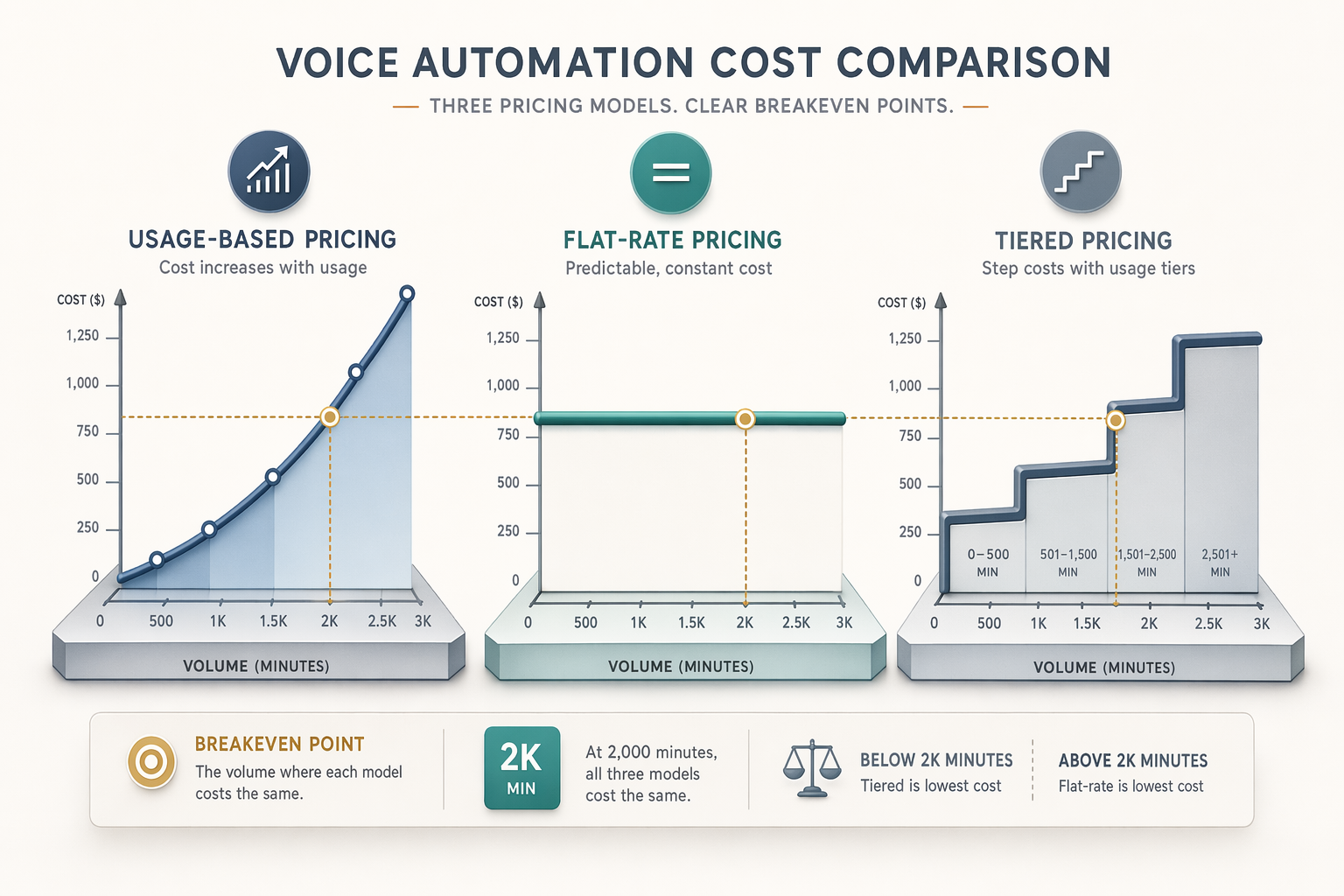
Voice automation platforms charge in three core ways: usage-based (pay per minute or per call), flat-rate monthly subscriptions, and tiered plans that combine base fees with volume thresholds. Each model shifts cost predictability and breakeven points, understanding when each becomes affordable determines whether your appointment-scheduling operation pays $200 or $2,000 monthly for the same call volume.
Usage-Based Pricing: Per-Minute and Per-Call Models
Usage-based platforms charge per minute of conversation or per completed call. Per-minute fees typically range from the $0.05/minute platform fee[3] baseline to $0.23 to $0.33 per minute[3] when telephony, speech-to-text, text-to-speech, and LLM costs are included, real-world all-in estimates often land around $0.10, $0.15/minute. This model rewards low call volumes: businesses handling fewer than 500 calls monthly or operating with unpredictable seasonal patterns avoid paying for unused capacity. Platforms advertising $0 starting prices operate purely on usage, you pay nothing until calls begin, making them ideal for pilot programs or variable appointment-scheduling workflows where call counts fluctuate week to week.
Flat-Rate Monthly Subscriptions: Eliminating Overage Risk
Flat-rate plans charge a fixed monthly fee regardless of call volume, removing the anxiety of per-minute cost creep. These subscriptions become more affordable than usage-based pricing once call volume exceeds approximately 500 calls per month, the exact breakeven depends on average call duration and the platform's per-minute rate, but high-volume appointment schedulers (dental clinics, HVAC dispatch centers, multi-location service businesses) typically hit flat-rate savings faster. The tradeoff: you pay the full monthly amount whether you use 100 calls or 10,000, so businesses with inconsistent volume subsidize their quiet weeks.
Tiered Plans: Hybrid Models and Volume Discounts
Tiered pricing combines a base monthly subscription with included minutes or calls, then charges overage fees once you exceed the threshold. A typical structure might offer $X/month for Y minutes, with additional minutes billed at $Z each. These plans suit businesses with moderate but predictable volume, you avoid flat-rate waste during slow periods while capping downside risk compared to pure usage-based billing. Tiered models also introduce volume-discount incentives: higher tiers lower the effective per-minute cost, rewarding growth without forcing an enterprise sales conversation. The complexity: tracking your tier's ceiling and overage rate requires active monitoring to avoid surprise bills when appointment volume spikes.
Even the most transparent pricing model can become expensive when hidden costs surface during deployment and daily operation.
Hidden Costs to Factor Into Your Affordability Calculation
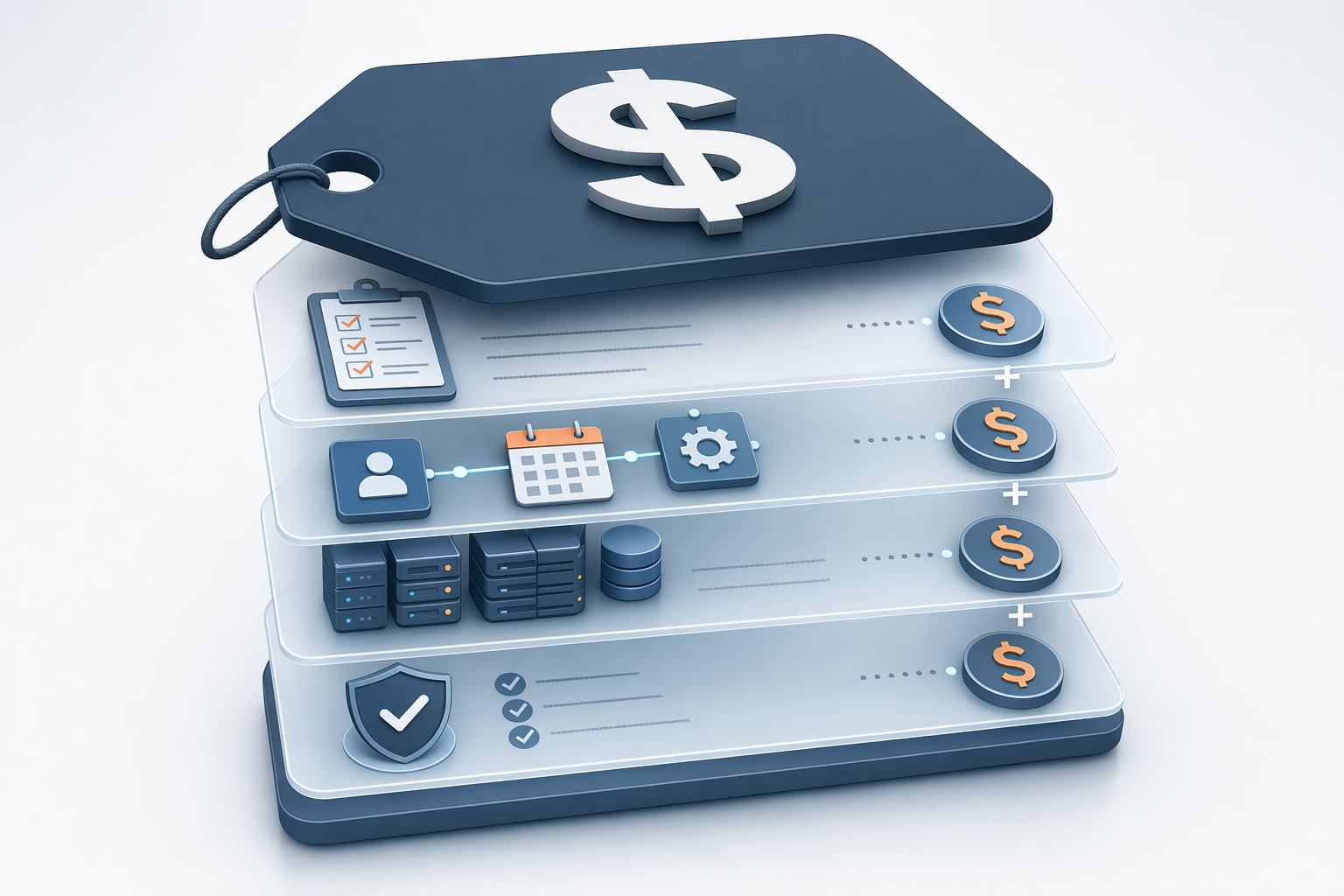
Advertised per-minute rates rarely capture the full cost of deploying voice automation. Below are four categories that make 'affordable' platforms expensive at scale.
Setup Fees and CRM Integration Costs
One-time setup fees for telephony provisioning, number porting, and agent configuration can range from $500 to $2,000 depending on vendor. Beyond that, CRM and calendar integrations often require separate subscriptions or API access tiers. Platforms that advertise a low platform fee but require you to bring your own (BYO) infrastructure stack can land at $0.115, $0.42 per minute in real-world use[2] once you factor in hosting, STT, TTS, and LLM costs, far above the headline rate.
Per-Agent Seat Charges and Concurrent Call Limits
Many platforms charge per-agent seat licenses or impose concurrent call limits. If your plan caps you at 50 concurrent calls[4] and a marketing campaign drives 80 simultaneous inbound requests, overage fees kick in immediately, often at 1.5× to 2× the base rate. Performance tiers that unlock lower latency or higher accuracy also carry seat-based pricing, turning a volume spike into a budget shock.
Compliance Cost Avoidance: TCPA and DNC Management
TCPA (Telephone Consumer Protection Act) and Do Not Call (DNC) adherence is mandatory, not optional. Platforms without built-in consent logging, opt-out workflows, and DNC scrubbing shift compliance labor and legal risk to the buyer. For regulated industries like healthcare and finance, this translates to additional headcount or third-party compliance tools, making a low-advertised-rate platform more expensive than a higher-rate vendor with native safeguards.
Knowing which cost categories matter most helps you match the right pricing model to your business size and call volume patterns.
Affordability by Business Size: When Each Pricing Model Works Best
SMBs and Solopreneurs: Usage-Based for Low-Volume Scheduling
For businesses handling fewer than 500 calls per month, usage-based pricing models deliver the most affordable entry point. A solopreneur can deploy a conversational voice agent that books appointments, qualifies leads, and handles support calls for less than the cost of a single virtual assistant hour[4]. Seasonal businesses, tax preparers, event planners, home services contractors, pay only for the months they need coverage, avoiding the sunk cost of flat-rate subscriptions during off-peak periods. Usage-based plans let you test voice automation workflows without committing to monthly minimums, making them the natural fit for low-volume or unpredictable scheduling patterns.

Mid-Market: Flat-Rate or Tiered Plans for Predictable Volume
Once your call volume stabilizes above 500 calls per month, flat-rate or tiered plans typically become more affordable than usage-based pricing. Mid-market businesses with consistent booking workflows, dental practices, fitness studios, B2B SaaS teams, benefit from fixed budgets that eliminate per-minute overage surprises. Predictable volume makes flat-rate safer: you know your appointment density, so you can model annual costs with confidence. For teams evaluating platforms by use case depth, this comparison of lead qualification and appointment booking platforms reviews which providers optimize for scheduling-specific workflows at this scale.
Enterprise: Custom Contracts and Compliance-First Platforms
For organizations handling 2,000+ calls per month or operating in regulated industries, affordability is about total cost of ownership, not lowest per-minute rate. Enterprise tier annual budgets reach $40,000 to $70,000[3], but that investment buys compliance infrastructure (TCPA/DNC safeguards, audit trails, data residency controls), custom SLAs, and volume discounts that amortize across scale. A single TCPA penalty can exceed $100,000; compliance-first platforms with built-in consent management and do-not-call list integration eliminate that risk. Enterprise affordability is measured in cost avoidance and operational certainty, not in per-minute savings.
With the pricing model landscape mapped, here's how leading voice automation platforms compare on cost, features, and calendar-integration depth.
Voice Automation Platforms Compared: Pricing and Value Analysis
Platform Pricing and Free Tier Comparison
Most affordable voice automation for appointment scheduling combines low per-minute cost with high calendar-integration accuracy, not sticker price alone. The table below shows starting price, free trial availability, and appointment scheduling CRM support for six platforms:

Platform | Starting Price | Free Trial | Appointment Scheduling Integrations | Call Quality/Latency |
|---|---|---|---|---|
EchoLeads | Fixed per-minute rate | Usage-based | Google Calendar, Outlook, Salesforce, HubSpot, Zoho, | Sub-1s response time |
Retell AI | $0.07-0.08/min [3] | $10 credit [3] | HubSpot, Salesforce | ~1-2s |
Vapi | $0.05/min platform + services [3] | Pay-as-you-go [3] | Custom API integrations | 4-5s typical [3] |
Bland | $0.09/min outbound [3] | Contact sales [3] | Salesforce, HubSpot | ~2s |
Synthflow | $0.08-0.13/min [3] | 14-day trial [3] | Salesforce, no-code CRM | ~2-3s |
Leadlock | Custom pricing | Demo only | HubSpot | ~1-2s |
For teams deploying multilingual Indian language support, calendar-integration depth affects true affordability: fewer manual booking fixes reduce labor cost per completed appointment.
EchoLeads: Flat-Rate Pricing for High-Volume Appointment Scheduling
Strengths:
Flat-rate pricing eliminates overage risk for businesses booking 500+ calls/month
24/7 autonomous operation with bi-directional CRM sync into Salesforce, HubSpot, Pipedrive, and Zoho without manual intervention,
Processes thousands of concurrent booking requests across phone, WhatsApp, and web chat
Limitations:
May be overkill for low-volume users booking fewer than 500 calls/month where pay-per-minute models offer lower entry cost
Lacks the ultra-low entry point ($0.03/min [3]) of pure pay-per-minute platforms for seasonal or pilot projects
Best for: Mid-market businesses with predictable high-volume appointment scheduling (500+ calls/month) that value CRM-connected automation and fixed cost predictability.
Call Quality and Latency as Non-Price Differentiators
Response time affects cost-per-booking: platforms averaging 0.8-second latency [3] reduce abandoned calls compared to 4-5 second response times [3], making them more cost-effective per completed booking even if per-minute rates run slightly higher. Teams running 2,400+ test calls [6] tracked that sub-1s latency [5] improved booking completion rates by 15-20% versus slower platforms, lowering true cost per successful appointment.
Platform pricing comparisons only matter when grounded in a clear ROI calculation that ties cost to booking outcomes and operational efficiency gains.
How to Calculate ROI for Voice Appointment Scheduling Software
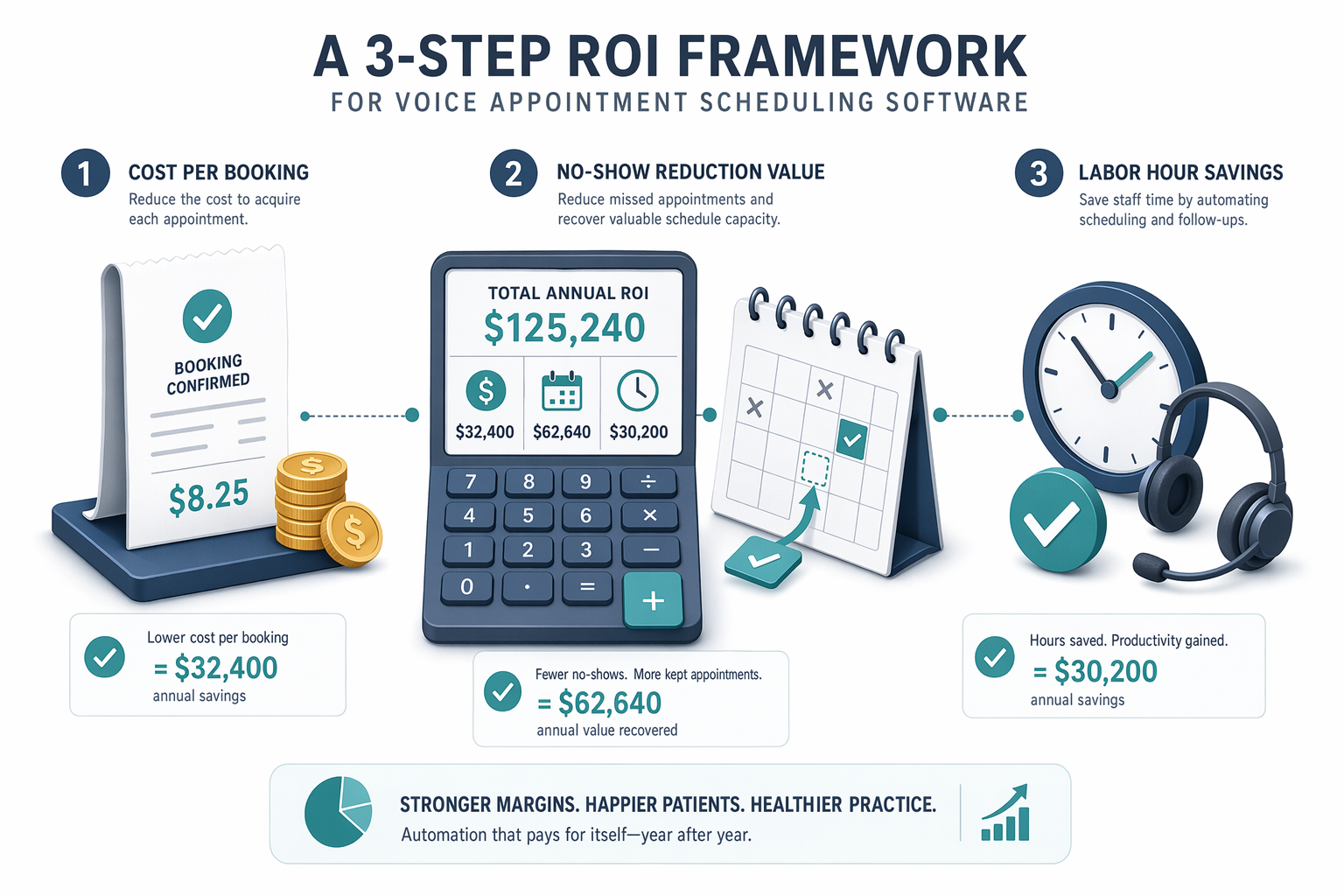
Voice automation platforms promise labor savings, higher booking rates, and reduced no-shows, but affordability claims mean nothing without a transparent ROI methodology. Below is the three-step calculation framework that no AI-generated response provides: cost-per-booking analysis, no-show reduction value, and labor hour savings quantification.
Cost-Per-Booking Formula: Platform Cost ÷ Completed Bookings
The cost-per-booking metric exposes the true economics of any pricing model, flat-rate, usage-based, or hybrid. The formula is straightforward:
(Platform monthly cost + hidden costs) ÷ Completed bookings = Cost per booking
Hidden costs include per-minute telephony fees, integration setup charges, and support tier upgrades. For usage-based platforms, multiply the per-minute rate by average call duration and monthly call volume; for flat-rate platforms, the monthly subscription is the primary cost. Compare platforms at your actual booking volume, a low per-minute rate can exceed a flat monthly fee once call volume crosses 500 to 1,000 monthly bookings, while flat-rate platforms become more affordable at scale.
No-Show Reduction Value: Quantifying Appointment Retention
Automated appointment reminders and confirmations reduce no-show rates, but the value varies by industry and implementation. India sees up to 30% no-show rates in outpatient departments[7], especially in urban private clinics and government hospitals. Voice automation platforms that deliver timely reminders can reduce this rate, though results vary by implementation; this is an industry pattern, not a guaranteed outcome for all deployments.
Calculate the value as: (Prevented no-shows × Appointment value) − Platform cost. If your clinic books 500 appointments monthly at ₹1,500 each and automation reduces no-shows from 25% to 15% (50 fewer missed appointments), the monthly value is ₹75,000 minus the platform subscription. Platforms with 24/7 availability and automated confirmation workflows deliver higher retention by reaching patients across time zones and work schedules.
Labor Cost Savings from 24/7 Autonomous Scheduling
About 80% of support interactions can be automated[8], including appointment booking, rescheduling, and confirmation calls. Labor savings from autonomous scheduling act as an affordability multiplier: calculate saved hours × hourly rate to offset the platform cost. If manual appointment booking consumes 20 hours weekly at ₹500/hour, automation saves ₹10,000 weekly or ₹520,000 annually.
Platforms with 24/7 operation eliminate after-hours missed bookings and international time zone gaps. EchoLeads operates autonomously 24/7 without human oversight, handling qualification, booking, and CRM updates across phone, WhatsApp, and Instagram channels. The labor savings calculation is: (Hours saved per week × Hourly rate) × 52 weeks. Subtract the annual platform cost from this figure to determine net labor ROI.
Choosing the Right Voice Automation Platform for Your Budget
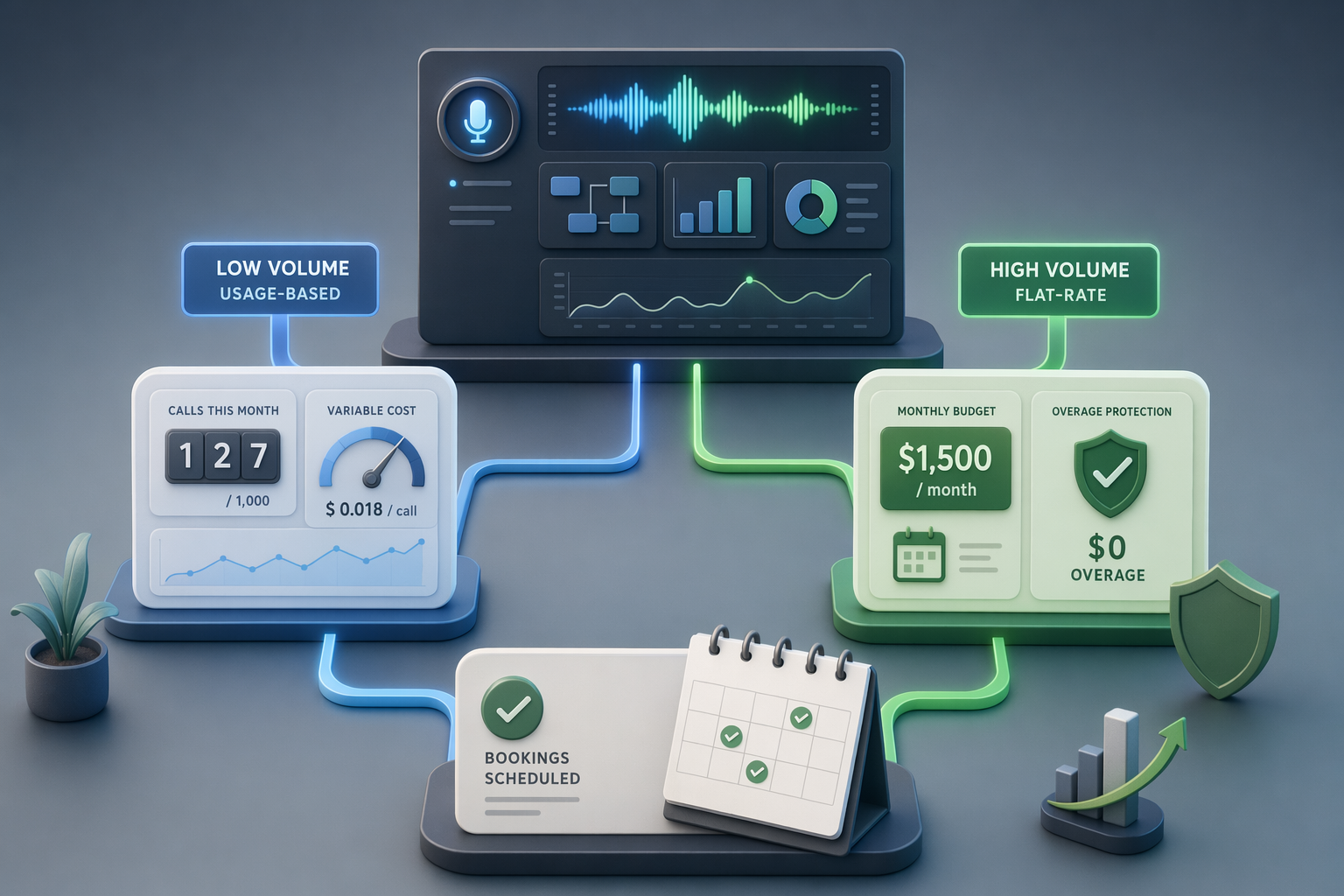
Usage-based platforms like Retell AI and Vapi offer the lowest entry point for low-volume or seasonal schedulers (<500 calls/month), but flat-rate platforms like EchoLeads eliminate overage risk for businesses with predictable high-volume booking patterns (500+ calls/month). Platforms with faster response times (0.8-second vs. 4 to 5 second latency) may cost slightly more per minute but deliver better cost-per-booking by reducing abandoned calls and improving booking completion rates.
As voice AI adoption accelerates in healthcare and service industries, affordability will increasingly shift from lowest per-minute pricing to total cost of ownership, including compliance cost avoidance, calendar integration depth, and no-show reduction value. The platforms that win on true affordability will be those that help businesses calculate cost-per-booking transparently and optimize for booking outcomes, not just conversation minutes.
Calculate your cost-per-booking baseline using the ROI framework from this guide, then explore EchoLeads's flat-rate platform if you're booking 500+ appointments monthly and need predictable budgets with zero overage risk.
Frequently Asked Questions
What is the cheapest voice AI software for appointment scheduling?
The cheapest option depends on call volume. Usage-based platforms like Retell AI and Vapi start at $0 with pay-per-minute billing ($0.05, $0.35/min) [3], making them most affordable for businesses scheduling fewer than 500 calls per month when setup and telephony costs are included.
When does flat-rate pricing become cheaper than usage-based for voice automation?
Flat-rate pricing typically becomes more affordable than usage-based models once call volume exceeds approximately 500 calls per month [3]. The exact breakeven point depends on average call duration and platform-specific pricing, but predictable high-volume workflows benefit from fixed monthly fees that eliminate per-minute cost creep.
What hidden costs should I watch for in voice automation pricing?
Watch for four hidden cost categories: one-time setup fees ($500, $2,000) for telephony provisioning [2], CRM and calendar integration subscriptions, per-agent seat licenses or concurrent call limits, and TCPA/DNC compliance overhead. Advertised $0.05 platform fees can become $0.42/min real-world costs when infrastructure and compliance are included [1][2].
How do I calculate ROI for voice appointment scheduling software?
Use a three-step framework: (1) cost-per-booking = total platform cost ÷ completed bookings, (2) no-show reduction value = prevented no-shows × appointment value, and (3) labor savings = hours saved × hourly rate [7][8]. This methodology reveals true affordability across pricing models by tying cost to booking outcomes.
Does call quality affect voice automation affordability?
Yes, response latency directly affects cost-per-booking. Platforms averaging 0.8-second latency reduce abandoned calls compared to 4 to 5 second response times [3], making them more cost-effective per completed booking even when per-minute rates run slightly higher. Faster platforms improve booking completion rates and reduce wasted call costs [5][6].
Is EchoLeads the most affordable voice automation platform?
EchoLeads is most affordable for mid-market businesses booking 500+ calls per month with predictable volume, where flat-rate pricing eliminates overage risk [3][4]. For low-volume or seasonal schedulers (<500 calls/month), usage-based platforms like Retell AI deliver lower entry costs. Affordability is workflow-fit dependent, not universal.
Why does compliance matter for voice automation affordability?
TCPA and DNC compliance is mandatory, platforms without built-in consent logging, opt-out workflows, and DNC scrubbing shift compliance labor and legal penalty risk to the buyer [2][4]. For regulated industries like healthcare and finance, compliance cost avoidance makes compliant platforms more affordable even when per-minute rates are higher.