
How to Scale Outbound Calling Without Hiring More Reps
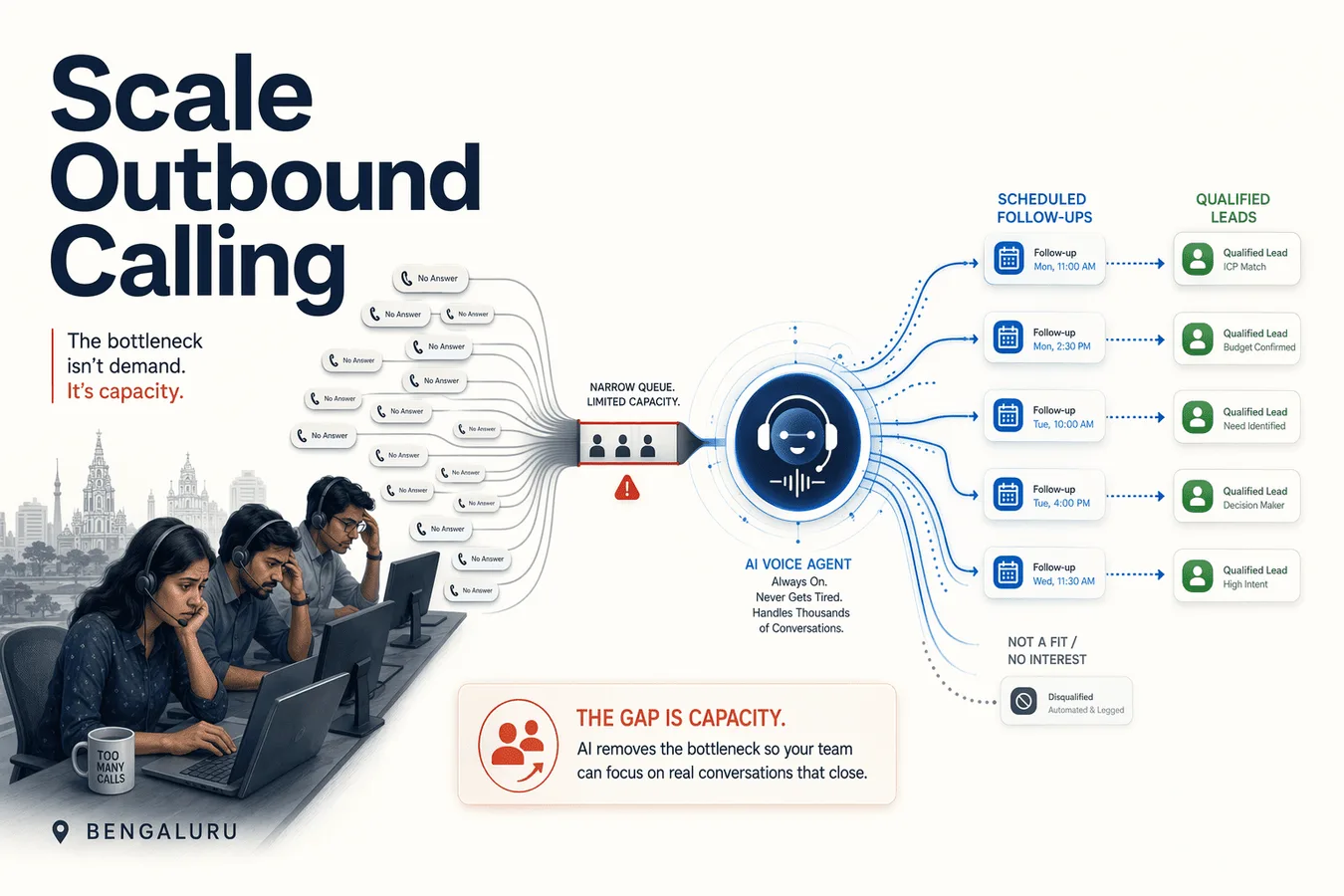
Bengaluru SaaS companies face a common bottleneck: outbound calling capacity caps revenue growth, but hiring more SDRs drains budgets and extends onboarding timelines. AI voice agents eliminate that constraint by automating qualification, scheduling, and follow-ups at scale.
Key Takeaways
AI voice agents handle 5,000-10,000 qualification calls per month—17× the volume of a single SDR—while writing BANT scores and transcripts back to your CRM
Deploy in 72 hours by connecting Zoho or Salesforce, designing BANT scripts, configuring Karnataka two-party consent prompts, and launching with 50-100 test calls
AI excels at transactional SaaS (<$10k ACV, <30-day cycles) but escalates to human SDRs for pricing negotiations, technical objections, or executive-level prospects
Monitor contact rate, qualification rate, and handoff triggers in real-time dashboards to refine scripts mid-campaign without waiting for end-of-day reports
Total cost: $500-1,500/month for AI subscription versus $625-940/month for one SDR who dials 200-300 contacts manually
How AI Voice Agents Scale Outbound Calling Without New Hires
AI voice agents automate high-volume qualification and appointment scheduling, letting human SDRs focus on closing deals instead of burning out on cold calls. Sales teams waste up to 50% of their time on unqualified prospects; AI agents remove that drain by running consistent BANT checks, scoring leads, and handing off hot prospects to humans within seconds. The division is clear: machines handle repetitive first-touch conversations; humans navigate complex objections and close revenue.
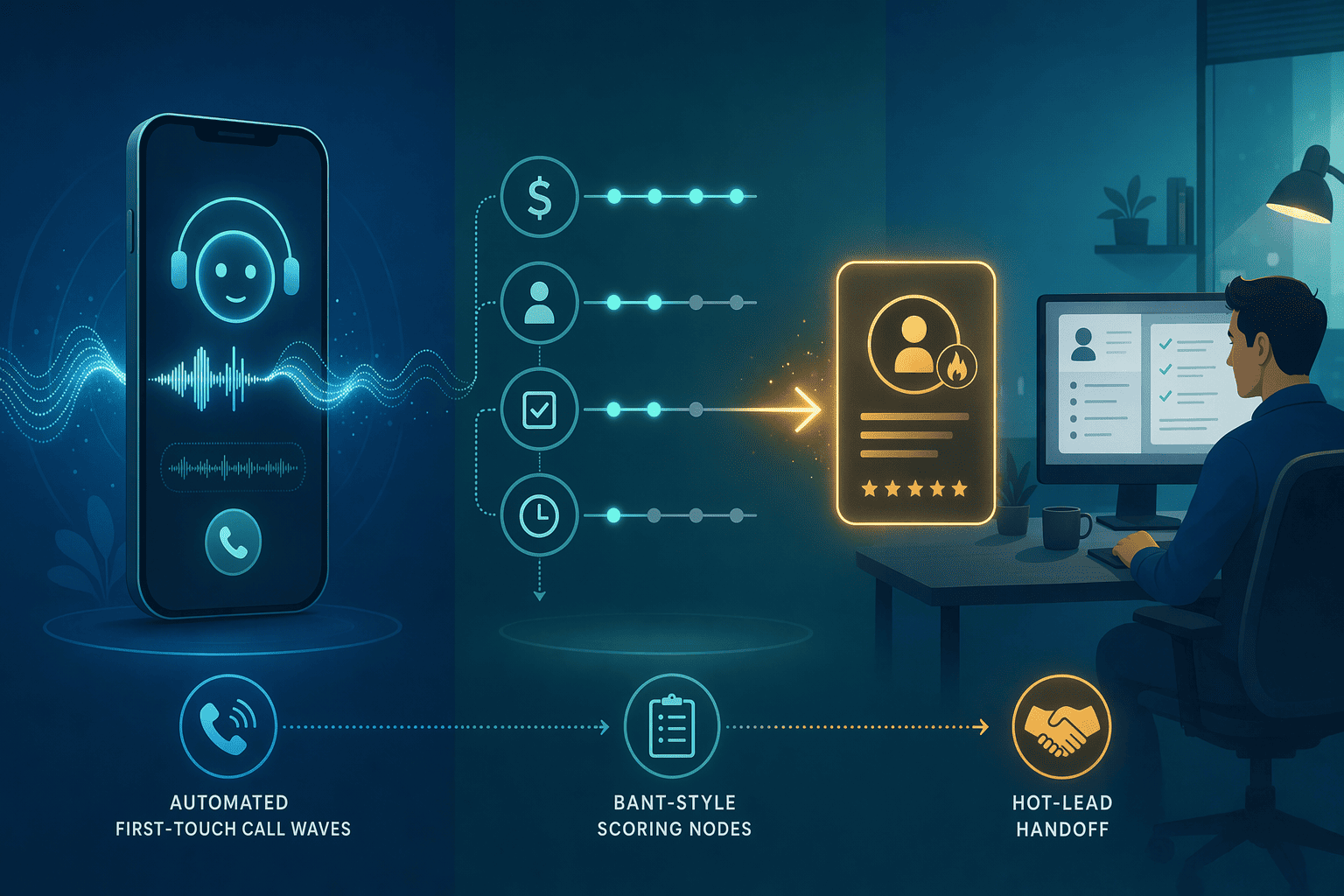
What AI Voice Agents Handle vs. What Stays Human
AI agents answer every inbound call immediately, run your qualification script, score each lead, and route high-intent prospects to a human rep in real time. Leads contacted within 5 minutes are 100 times more likely to qualify than those reached after 30 minutes. Human SDRs take over when a prospect meets budget, authority, need, and timeline criteria—closing deals that AI-qualified conversations teed up.
The Deployment Workflow: Five Steps from CRM to Launch
Teams configure an AI agent's voice and script, connect it to their CRM, upload lead lists, set call schedules, and launch campaigns—typically within 72 hours. Platforms like EchoLeads provide pre-built templates for B2B lead qualification and inbound call handling, reducing setup friction. The agent dials autonomously, logs outcomes, and escalates qualified leads without manual follow-up.
Bengaluru-Specific Context: Kannada Support and Karnataka Compliance
Bengaluru SaaS companies need Kannada language support to reach regional prospects; EchoLeads supports Kannada within a 70+ language portfolio. However, no platform publishes Kannada-specific accuracy benchmarks, and vendor documentation lacks Karnataka-specific consent workflows for call recording. Teams must confirm regulatory compliance independently before deploying at scale.
Once you understand the operational model, the first technical step is connecting your existing sales infrastructure to the AI platform.
Step 1: Connect Your CRM and Upload Lead Lists
Supported CRM Integrations: Zoho, Salesforce, HubSpot
Bengaluru SaaS companies typically run on Zoho or Salesforce—together they account for approximately 42% of the Indian startup CRM market. To connect your AI calling platform, follow this three-step integration flow:
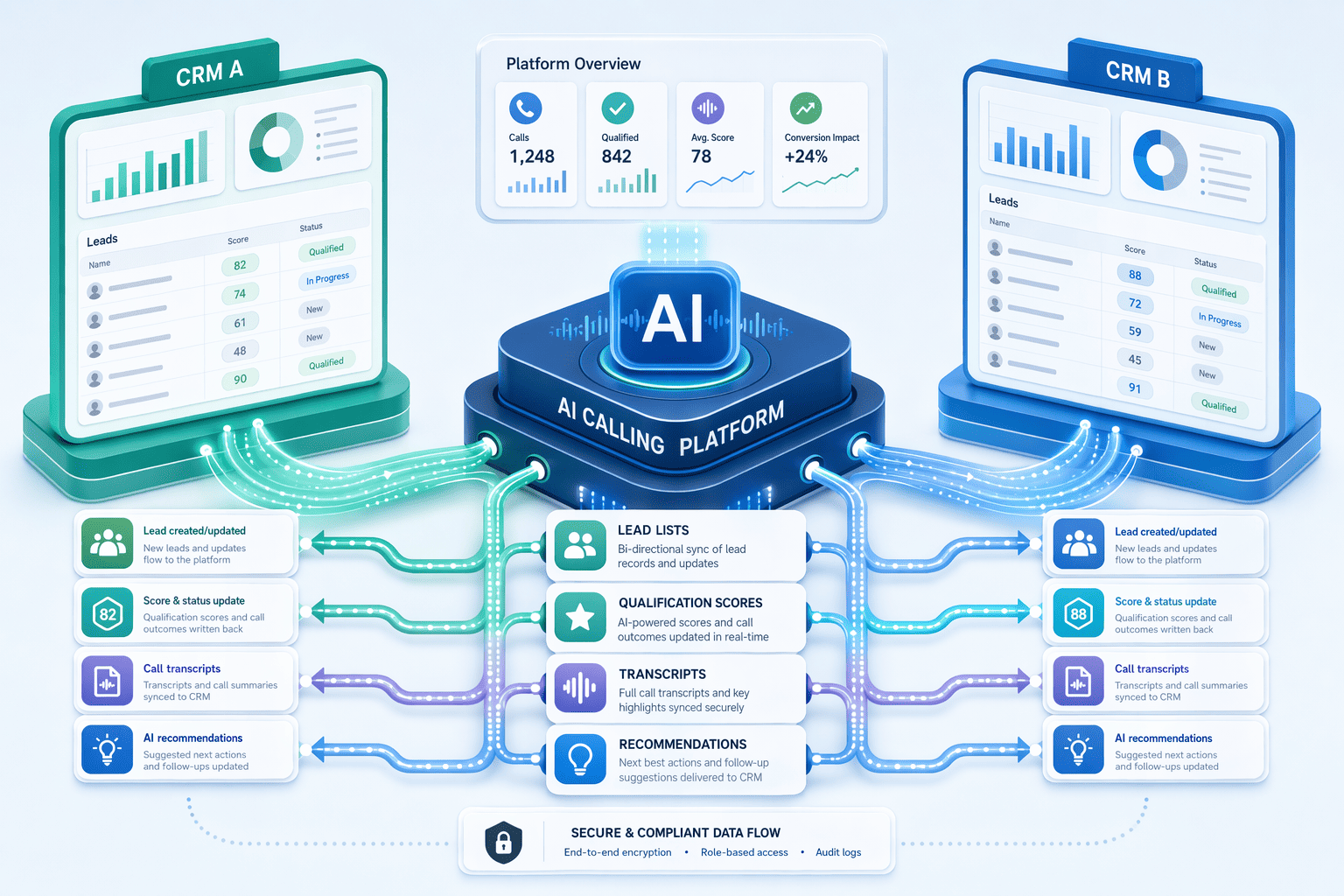
Authenticate via OAuth, Grant API access through your CRM's OAuth 2.0 flow. EchoLeads integrates bi-directionally with Salesforce, HubSpot, Pipedrive, and Zoho, completing authentication in under 90 seconds with one-click Zoho integration.
Map fields, Match your CRM's lead schema (phone, lead status, qualification score, owner, custom fields) to the calling agent's data model. Most platforms pre-map standard fields; custom fields require manual selection.
Enable bi-directional sync, Activate write-back permissions so call outcomes, appointment bookings, and qualification scores update CRM records in real time.
Bi-Directional Sync: Call Outcomes Write Back to CRM Records
EchoLeads provides bi-directional CRM sync with major platforms, writing back qualification scores, conversation transcripts, and next-step recommendations without manual data entry. When a prospect indicates budget authority and timeline during a call, the system immediately updates the lead's 'Qualification Score' field in Salesforce, triggering an automated handoff workflow to your SDR team.
Lead List Upload and Segmentation
Upload your outbound list via CSV (required columns: phone, first name, last name). The platform validates phone formatting, checks for duplicates against existing CRM records, and flags invalid entries before campaign launch. Segment lists by ICP tier, lead source, or engagement history to route qualified prospects to voice agents and colder leads to WhatsApp nurture sequences.
With your CRM connected and lead lists uploaded, the next step is teaching the AI what to say and when to escalate.
Step 2: Design Conversation Scripts for Lead Qualification
BANT Qualification Framework for B2B SaaS
A structured BANT (Budget, Authority, Need, Timeline) script ensures your AI agent extracts qualification signals without overwhelming the prospect. Rather than yes/no questions like *"Do you have budget?"*, use open-ended prompts that reveal intent depth. Here's a sample flow you can adapt for voice AI lead qualification workflows:
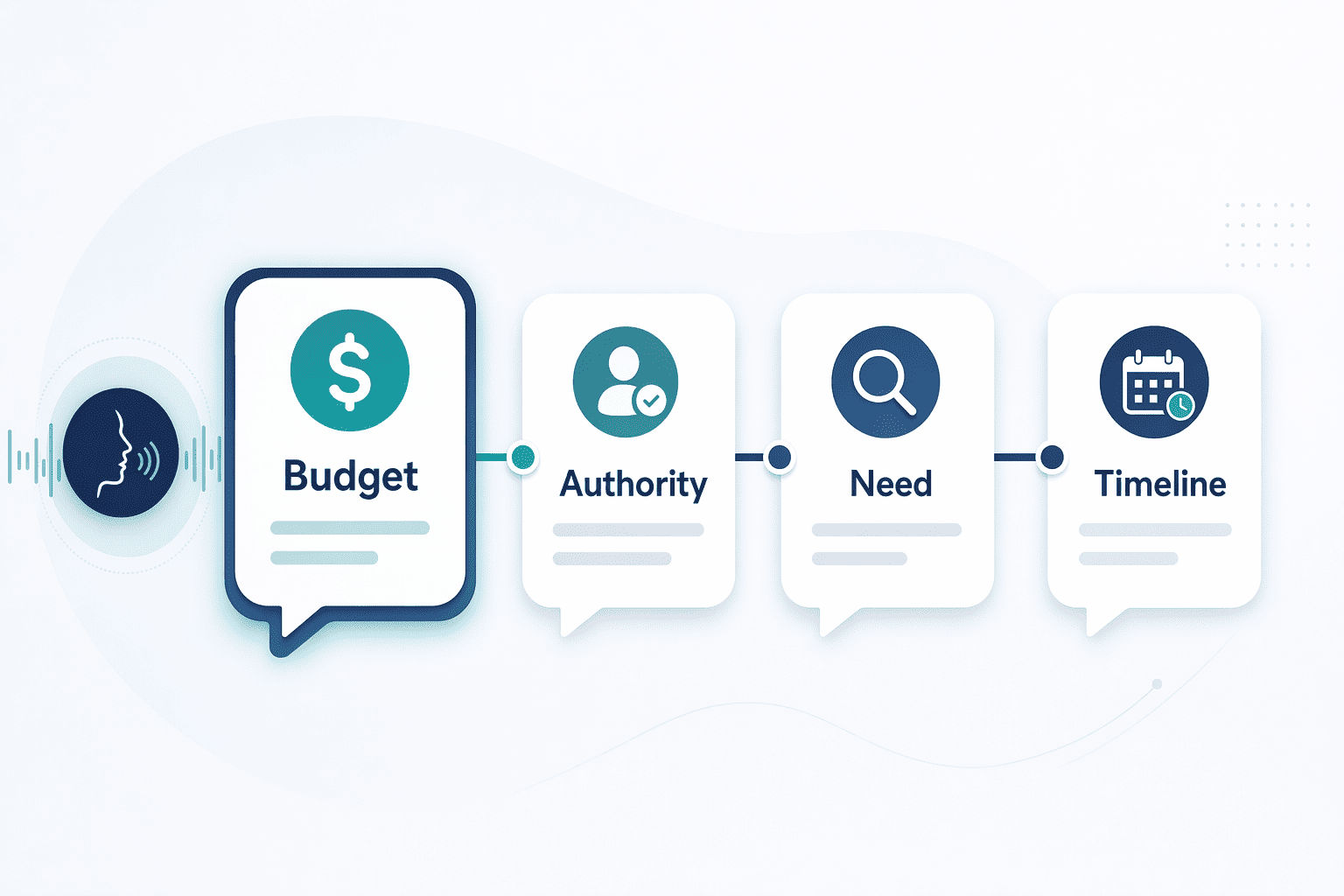
Budget exploration, *"What budget range are you working with for this quarter's sales-automation investments?"* (captures financial scope without forcing a binary answer)
Authority check, *"Who else on your team is involved in evaluating sales tools?"* (identifies decision-making structure)
Need discovery, *"What's the biggest bottleneck in your current outbound process?"* (reveals pain points)
Timeline confirmation, *"When are you planning to make a decision?"* (establishes urgency)
This conversational sequencing, budget first, then authority, need, and timeline, mirrors how SaaS buyers mentally organize purchase criteria. Your agent gathers actionable data while keeping the dialogue natural.
Objection Handling and Escalation Triggers
Common objections (pricing concerns, feature gaps, implementation timelines) require scripted deflections that either resolve the objection or escalate appropriately. For instance, if a prospect asks *"Does your platform integrate with our custom CRM?"*, the agent can respond with a pre-written feature confirmation or transfer to a technical specialist. EchoLeads supports configurable handoff triggers based on conversation keywords, sentiment scores, or explicit prospect requests, ensuring clarity-threshold breaches (e.g., custom-pricing questions outside the script's scope) route to human SDRs rather than producing shallow answers.
Appointment Scheduling Flow
Once qualified, the agent transitions to booking. A typical calendar-integration script follows three steps: (1) check real-time availability in Google Calendar or Outlook, (2) propose two time slots aligned with the prospect's timezone, (3) confirm the meeting and send an automated email. Voice-first appointment-booking agents handle this workflow end-to-end, detecting calendar conflicts, booking directly, and sending confirmations, without requiring the prospect to click a link or manually select a slot. This removes friction from the handoff between qualification and demo.
Script design determines what gets asked; compliance configuration determines whether you're legally permitted to record the answers.
Step 3: Configure Compliance Settings for Bengaluru Operations
Karnataka Call Recording Consent Workflows
Karnataka follows a two-party consent requirement for call recording, meaning both the caller and the recipient must agree before the conversation is recorded. Configure your voice agent to execute a pre-call consent workflow:
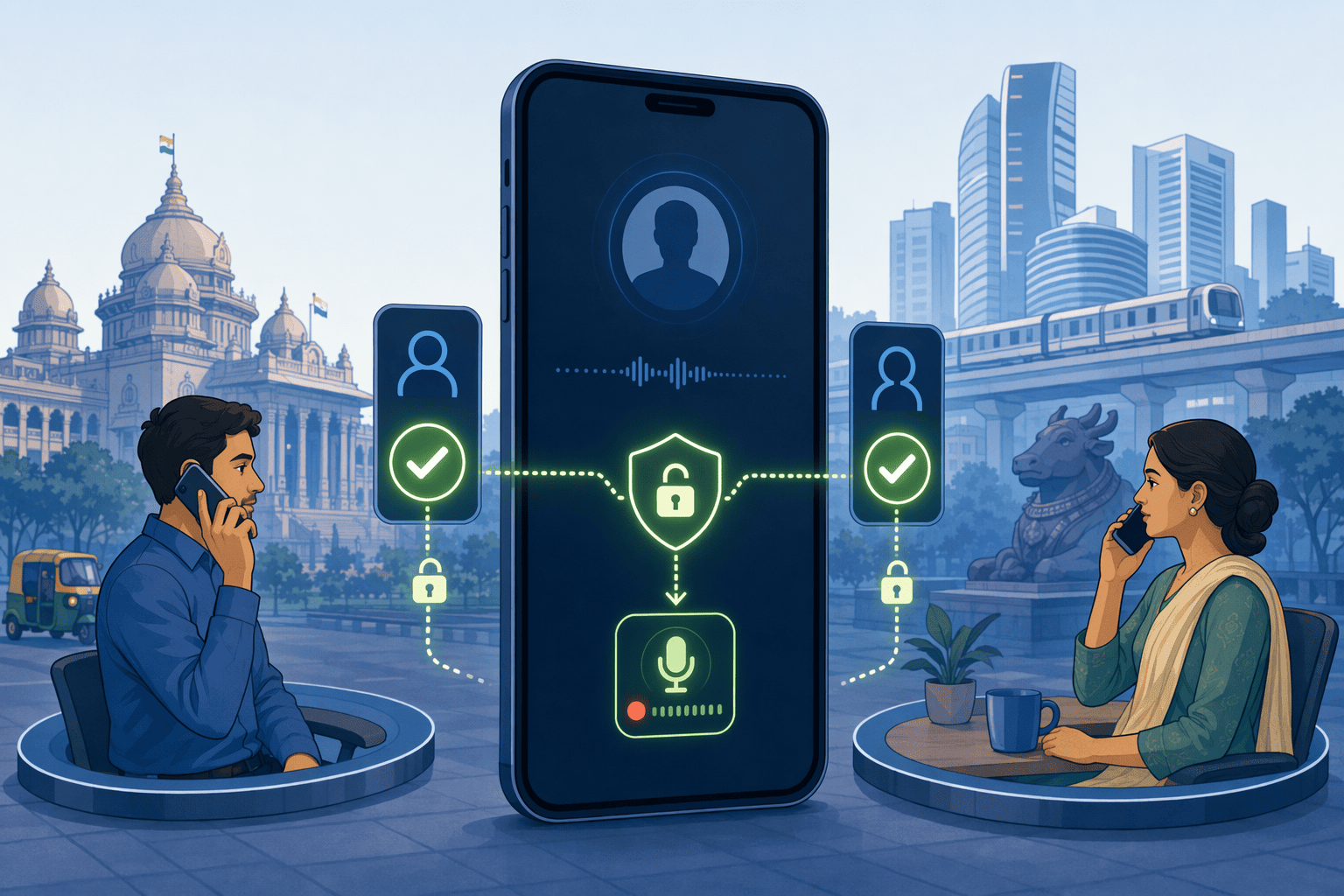
Enable a pre-call consent prompt: "This call will be recorded for quality purposes. Do you consent?"
Log the prospect's consent response in a dedicated CRM field (`recording_consent: yes|no|withdrawn`).
Terminate the call immediately if consent is refused, and flag the contact record accordingly.
Most vendor documentation, including EchoLeads, lacks Karnataka-specific consent workflows or call recording guidance. Oosai is one of the few India-focused platforms that mentions call recording consent in its compliance section, though even that coverage is not Karnataka-specific. Consult legal counsel for authoritative compliance guidance tailored to your jurisdiction and use case.
TCPA Considerations for Automated Calling in India
India's TRAI regulations require all outbound automated calling systems to honor the Do-Not-Call (DNC) registry, even for B2B outbound campaigns. Common mistake: assuming B2B outbound is exempt, it is not. Configure your system to:
Scrub lead lists against the latest TRAI DNC registry before launching a campaign.
Log opt-in consent in your CRM for every contact (required for defensibility during audits).
Set up automated DNC list synchronization weekly to catch new opt-outs.
Data Retention and Privacy Settings
Configure call recording retention periods to align with Indian data protection norms. EchoLeads offers configurable retention settings (30, 60, or 90 days), allowing teams to set retention policies based on legal requirements and internal governance. After the retention window expires, the system automatically purges recordings and transcripts to minimize PII exposure. Always verify that your retention policy satisfies both your industry regulator and any contractual commitments with customers.
Compliance gates protect you legally, but handoff workflows protect your conversion rates, qualified prospects need human attention at the right moment.
Step 4: Set Up Human Handoff and Meeting Scheduling
Escalation Triggers: When AI Hands Off to Humans
AI voice agents qualify prospects autonomously, but five specific conditions trigger human escalation:
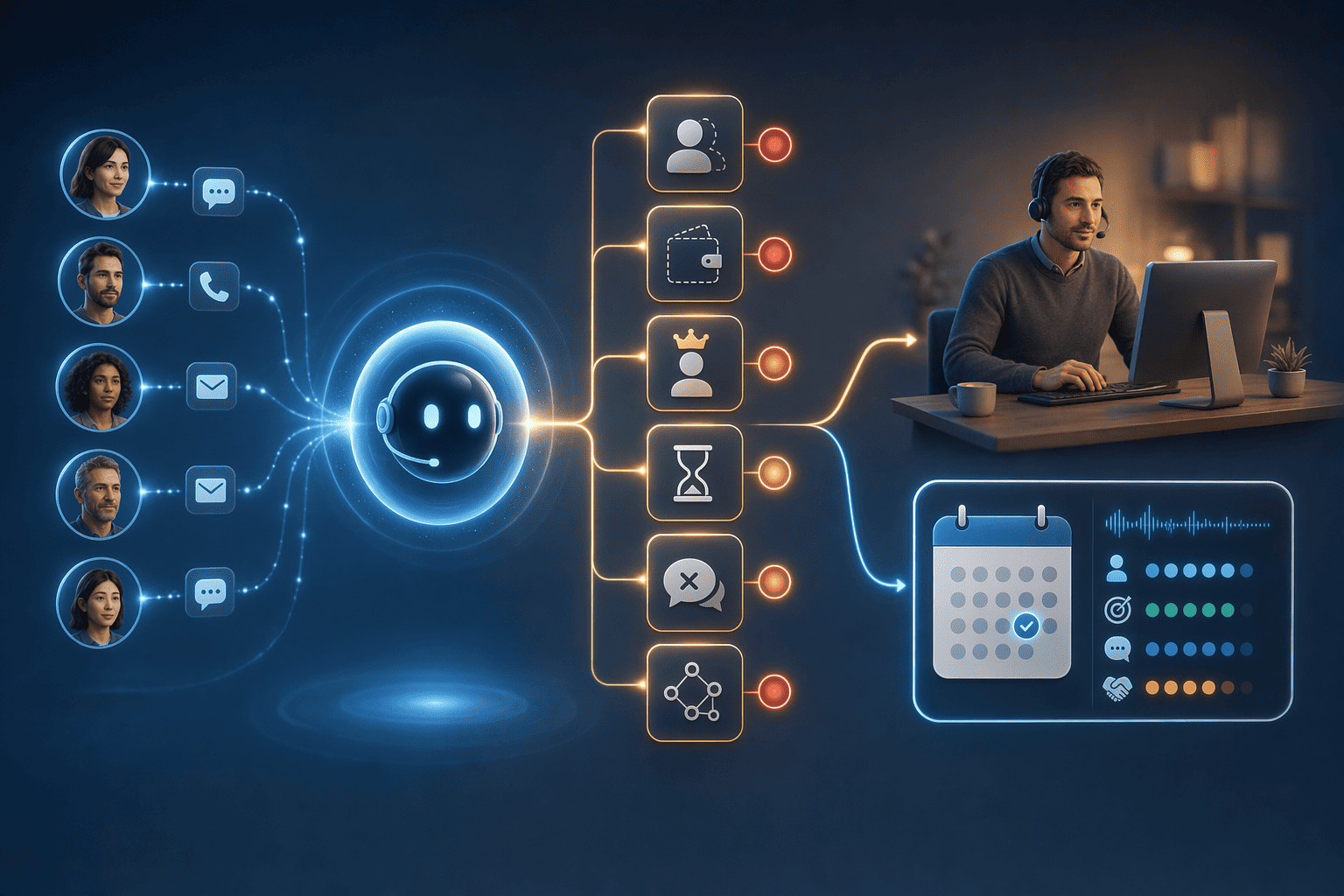
Pricing or negotiation questions, budget discussions that require flexible authority.
Technical objections, product-specific concerns needing domain expertise beyond the agent's knowledge base.
Executive-level prospects, CXO titles flagged by ICP rules for direct SDR engagement.
Clarity score below 70%, when speech recognition confidence or intent classification confidence falls below safe thresholds.
Explicit prospect request, "I'd like to speak with someone" triggers immediate handoff.
Sales teams ignore low-context leads; handoffs with BANT scores and objection notes convert 3-5× better than raw contact lists.
Live Transfer vs. Scheduled Callback Workflows
Configure handoff mode by time-of-day rules. Live transfer connects the prospect to an on-duty SDR immediately, the AI summarizes qualification context (budget, timeline, pain points) before the human joins. Use this workflow during business hours when SDR capacity allows.
Scheduled callback books a future slot when SDRs are off-duty or the queue is full. The agent confirms a time, logs the appointment, and routes the lead to the next available rep, no prospect waits on hold.
Meeting Scheduling and Calendar Integration
EchoLeads' two-way Google Calendar and Outlook sync prevents double-booking: the agent checks SDR availability in real time before confirming a slot. Once booked, the system writes the appointment directly to the calendar, appends qualification notes, and sends a confirmation SMS or email. This workflow removes the manual step competitors require, no rep logs into a CRM to manually add the meeting after the call.
With CRM, scripts, compliance, and handoffs configured, you're ready to launch, but smart teams start small and monitor obsessively.
Step 5: Launch Your First Campaign and Monitor Performance
Pre-Launch Checklist: Data Hygiene and Internal Testing
Before launching your first outbound campaign, validate the operational foundation:
Validate phone numbers, Remove disconnected lines, landlines that don't accept business calls, and numbers flagged by carriers as high-complaint risk.
Run internal test calls, Have your sales team receive live calls from the AI agent. Listen for script flow, qualification logic, and handoff triggers.
Confirm CRM bi-directional sync, Verify that contact records, qualification scores, and appointment bookings flow automatically into your CRM without manual entry.
Enable compliance consent prompts, Configure the agent to capture opt-in consent for call recording and follow-up communications telemarketing regulations.
Ramped Rollout: Start Small, Scale Gradually
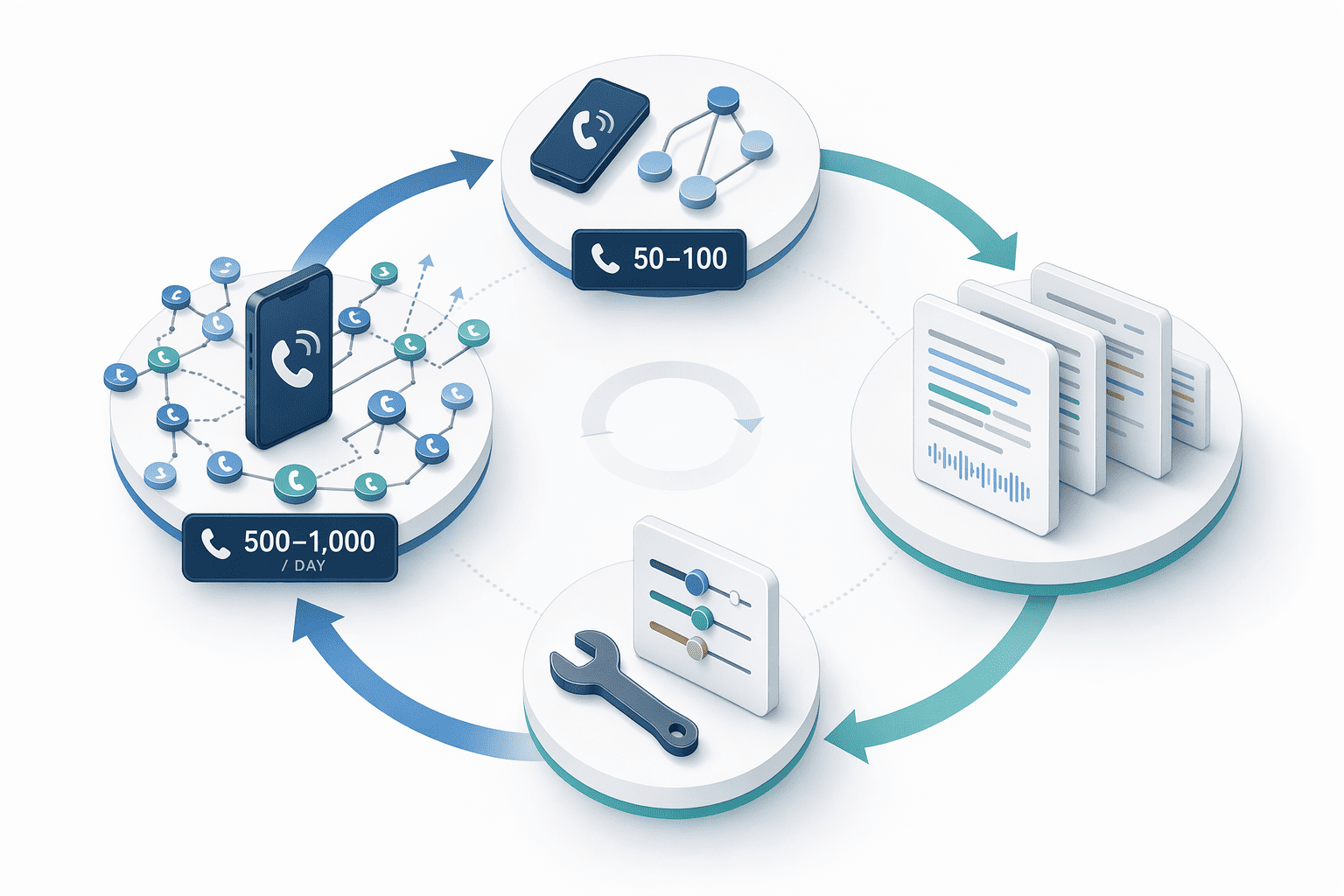
Launch with 50-100 calls per day for the first 3-5 days. Monitor call transcripts and identify common failure patterns: script sections where prospects disengage, qualification questions that confuse non-native English speakers, or handoff triggers that fire too early. Adjust scripts based on real conversation data, then scale to your target volume of 500-1,000 calls per day once quality metrics stabilize.
Performance Dashboards: Metrics to Track Daily
Monitor these metrics in your platform's real-time dashboard:
Contact rate, Percentage of calls answered by a live prospect (target: 25-35% for outbound cold calls).
Qualification rate, Percentage of answered calls that complete the qualification script and receive a lead score.
Appointment-booking rate, Percentage of qualified leads that accept a calendar invite during the call.
Handoff rate, Percentage of calls escalated to human reps, segmented by reason (high-intent, objection handling, technical issue).
Kannada-call accuracy, Manual review of Kannada-language call transcripts during the first week to catch language-handling issues.
EchoLeads' dashboard tracks contact rate, qualification rate, and handoff triggers in real time, letting you adjust scripts mid-campaign without waiting for end-of-day reports. However, no platform (including EchoLeads) publishes Kannada-specific accuracy benchmarks, you must monitor Kannada call transcripts manually during the first week to identify dialect-handling gaps before scaling to full volume.
Performance data reveals when to scale AI volume and when to route calls to humans instead, the decision hinges on deal complexity and unit economics.
When to Use AI Voice Agents vs. Human SDRs in Bengaluru
The choice between AI voice agents and human SDRs hinges on deal complexity, sales cycle length, and unit economics. Many Bengaluru SaaS teams assume AI eliminates the need for human SDRs entirely, it doesn't. AI shifts human effort from high-volume qualification to high-value closing.

Deal Complexity: Transactional vs. Enterprise Sales
For transactional SaaS with <$10k ACV, AI handles the full journey, qualification, nurture, booking, without human handoff. Enterprise deals (>$50k ACV) require human relationship-building from first contact; AI disqualifies faster but doesn't close. Mid-market ($10 to 50k ACV) benefits from AI qualification followed by human closing.
Sales Cycle Length: Short vs. Long Nurture
AI excels in <30-day cycles: it qualifies using Budget, Authority, Need, Timeline (BANT) criteria, books demos, and nurtures via automated follow-ups. Multi-quarter enterprise cycles (>90 days) demand human judgment for stakeholder politics and custom deal structures, AI assists but doesn't lead.
Cost Comparison: AI Voice Agent vs. SDR Salary in Bengaluru
A Bengaluru SDR costs ₹40 to 60k/month ($500 to 750) plus ₹10 to 15k benefits ($125 to 190), totaling $625 to 940/month for ~200 to 300 manual dials. EchoLeads's $799/month tier delivers 5,000 AI-driven calls, 17× the volume at comparable cost. The unit economics favor AI for top-of-funnel qualification; humans focus on the 10 to 15% of qualified leads AI surfaces.
Conclusion
AI voice agents handle high-volume transactional outbound (<$10k ACV, <30-day cycle) but require human escalation for enterprise deals (>$50k ACV) where relationship and customization matter from first contact. Platforms like EchoLeads and Waani support Kannada but don't publish language-specific accuracy benchmarks, monitor Kannada-call transcripts manually during the first week to catch language-handling issues.
As AI voice models improve multilingual accuracy and compliance frameworks mature in India, expect AI voice agents to handle increasingly complex objection types, but the hybrid model (AI openers, human closers) will remain the standard for B2B SaaS where relationship still closes deals.
Launch your first AI voice campaign this week, connect your CRM, design a BANT qualification script, configure Karnataka consent prompts, and run 50-100 test calls to validate the workflow before scaling to full volume. Try EchoLeads's free trial to deploy your first campaign in 72 hours.
Frequently Asked Questions
What CRM platforms integrate with AI voice agents for outbound calling?
Zoho, Salesforce, and HubSpot are the three most common integrations in Bengaluru SaaS stacks, together Zoho and Salesforce account for approximately 42% of the Indian startup CRM market. Bi-directional sync writes call outcomes, qualification scores, and conversation transcripts back to CRM lead records automatically, eliminating manual data entry.
Do AI voice agents support Kannada for Bengaluru outbound calling?
Most platforms, EchoLeads, Waani, MetroSales.AI, list Kannada support, but no platform publishes Kannada-specific accuracy benchmarks. Monitor Kannada-call transcripts manually during the first week to catch language-handling issues and adjust scripts as needed before scaling to full volume.
What are the Karnataka call recording consent requirements for AI calling?
Karnataka follows a two-party consent rule: the AI voice agent must prompt for consent ('This call will be recorded, do you consent?') and log the response in your CRM. Terminate the call if consent is refused. Most vendor documentation lacks Karnataka-specific workflows, consult legal counsel to ensure compliance.
When should AI voice agents escalate to human SDRs?
Five triggers require human escalation: pricing or negotiation questions, technical objections requiring product expertise, executive-level prospects (CXO title), conversation clarity score below 70%, or the prospect explicitly requests a human. Handoffs with BANT context convert 3-5× better than raw contact lists.
What does an AI voice agent subscription cost compared to hiring an SDR in Bengaluru?
AI subscriptions cost $500-1,500/month for 5,000-10,000 calls (EchoLeads $799-1,499; Waani ₹30-50k). A Bengaluru SDR costs ₹40-60k/month salary plus ₹10-15k benefits, totaling $625-940/month for 200-300 manual dials. AI handles 17× the volume at comparable cost, but humans still close complex deals.
How long does it take to launch an AI outbound calling campaign?
Day 1-2: CRM integration and field mapping. Day 3-4: script design and internal testing. Day 5: compliance configuration and consent prompts. Day 6-7: ramped rollout (50-100 calls/day). Week 2: scale to full volume after monitoring transcripts and refining scripts based on early failure patterns.
Can AI voice agents book meetings directly from qualification calls?
Yes, AI agents check Google Calendar or Outlook availability in real time, propose slots, book meetings, and send confirmation emails. Two-way sync prevents double-booking: the agent verifies SDR availability before confirming a slot, then writes the appointment and qualification notes directly to the calendar.