
What Is IVR in Banking: Complete Guide to Automated Voice Banking
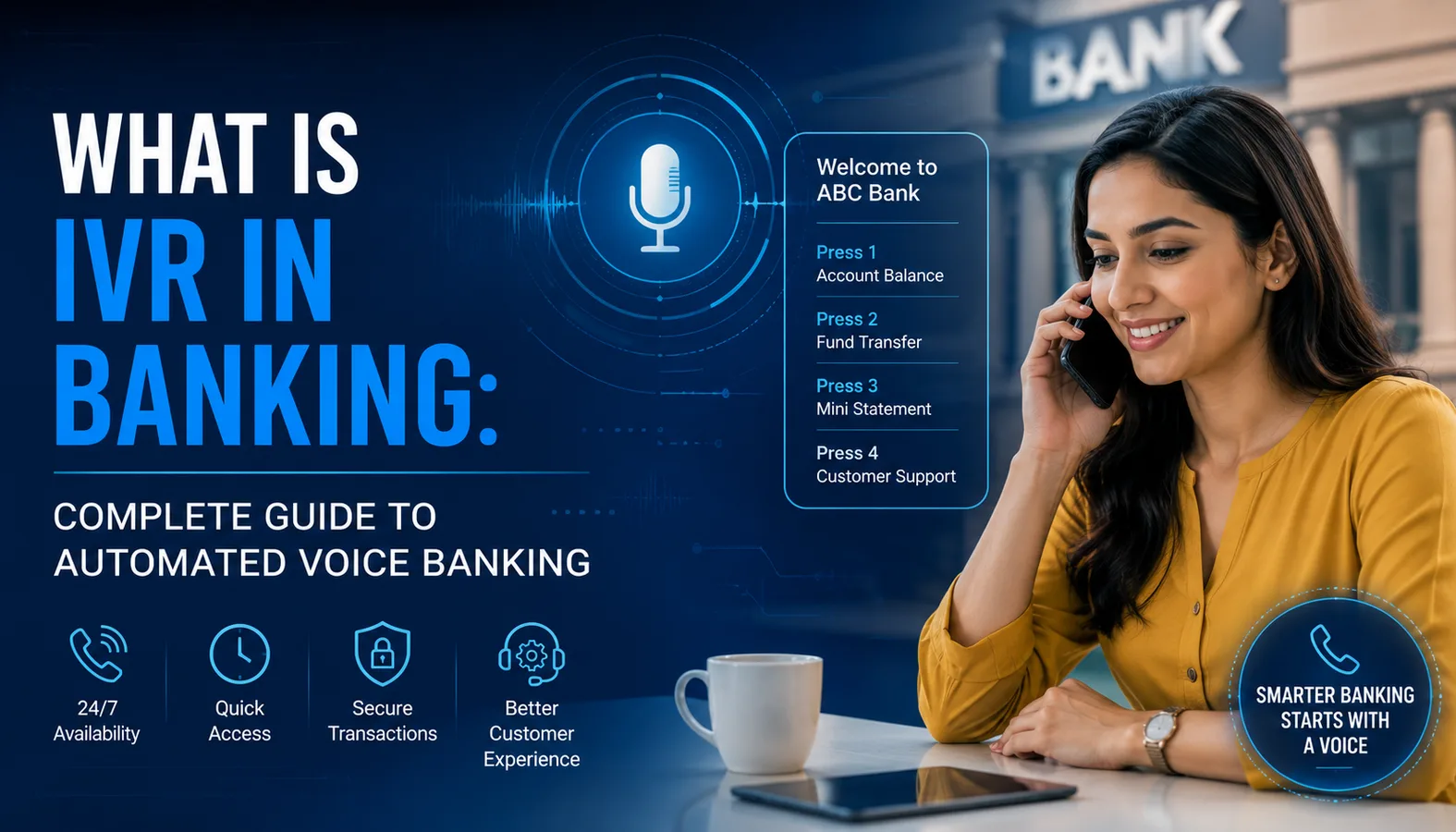
A customer in Hyderabad wanted to block a lost debit card at 11.40 pm. The branch was closed down. The mobile app needed a network connection, which was not available at this moment. The only reliable line left was the bank's toll-free number. It took two minutes from calling to the automated system confirming identity, hotlisting the card and giving a reference number to confirm the action. No human agent required. That silent, safe ending is the daily outcome when you look up: what is ivr in banking.
Interactive Voice Response technology has been a staple of banking customer service for over two decades. In newer systems, customers can use pre-recorded prompts and keypad entries or speak commands to perform routine and security-sensitive transactions. IVR is one of the most widely adopted self-service channels in an industry where trust, availability and regulatory compliance are not up for discussion.
Quick Answer Box
It is an automated telephone system that uses pre-recorded messages, menu options and authentication to allow customers to check balances, view recent transactions, block cards, generate PINs, transfer funds within limits and perform other banking tasks 24/7 without speaking to a live agent. It also provides a verification layer for high-value digital transactions.
What Is IVR in Banking Terms?
In banking, IVR means Interactive Voice Response. This is a telephony application sitting in front of the bank's contact center and its core banking systems. When a customer calls the official phone-banking or customer-care number, the IVR answers, offers a structured menu, authenticates the caller (typically through phone banking PIN, debit-card PIN, OTP or registered mobile number) and then performs the service requested by querying the bank’s secure databases.
The system can speak balances, list the last few transactions, accept stop-payment instructions, hotlist lost or stolen cards, seed Aadhaar numbers, and in many cases initiate limited fund transfers. If the customer asks outside the self-service rules or presses zero, the call is transferred to a live agent, with the context already collected, so the customer does not have to repeat information.
Modern banking IVR is increasingly employing speech recognition and natural-language understanding, reducing the need for pure dual-tone multi-frequency (DTMF) keypresses. The heart of the matter, however, is still the same: secure, scalable, always-on self-service that protects the customer and the bank.
How Do Banks in India Use IVR Systems to Improve Customer Service?
India’s banks have hundreds of millions of customer interactions each year. IVR systems handle a significant portion of routine volume, liberating human agents for complex advisory, complaint resolution and high-value conversations.
Union Bank of India has a multi-language IVR on toll-free numbers like 1800 22 2244 and related numbers. Once the customer registers the phone-banking PIN, the system provides account information, current balance, last five transactions, debit card hotlisting, stop payment of cheques, Aadhaar seeding without any intervention from an agent. Calls can be attended in Hindi, English and many regional languages.
Other public and private sector banks have also exhibited similar patterns. For instance, Karur Vysya Bank supports six languages and enables balance inquiry, last three transaction details and intra-bank fund transfer after TPIN authentication. The design goals are clear: reduce average handle time on simple queries, provide 24/7 access for customers in remote locations or outside of branch hours, and require strict authentication before disclosing any account data.
IVR is also a layer of fraud prevention and transaction verification. In case of high-value UPI transactions, most banks initiate an automated IVR call asking the customer to confirm the transaction either by pressing a key or by speaking a code. The real-time intent check helps to identify SIM-swap and social engineering attacks before the money actually leaves the account.
It allows banks to deflect routine volume, freeing up agents to service customers that need the human touch, increase first-contact resolution on simple tasks and decrease the cost per interaction, all while remaining compliant with RBI and data-protection expectations.
How Do Leading Banks Integrate IVR Technology into Their Customer Service Channels?
Integration is never a one-off exercise. Leading banks integrate their IVR platform with their core banking system (CBS), customer relationship management (CRM), card management systems and fraud engines through secure APIs and middleware.
Authentication is the first point of integration. The IVR verifies the caller using the registered mobile number, phone-banking PIN, debit-card information or one-time passwords generated by the bank’s systems. If successful, authentication creates a session to retrieve real-time balances and transaction history.
Menu design is data driven Banks can see your call logs and so put the most popular options (balance, recent transactions, card block) in the first menu. The choice of language is offered early on and many systems automatically detect the preferred language from the mobile network or from previous preferences.
When a call needs to be escalated, the IVR sends the authenticated customer identity, the selected menu path and any partial data collected up to that point to the agent desktop. This “screen pop” prevents the customer from having to repeat account numbers or reason for the call.
Equally important is Outbound IVR. Banks deploy automated voice campaigns for EMI reminders, KYC update requests and soft collections. These campaigns are built with the collections system so that responses (promise to pay, dispute, callback request) automatically update the account status.
Security and compliance layers include encryption of voice sessions, masking of sensitive data in recordings, audit logs of every menu selection, and compliance with TRAI and RBI guidelines for commercial communication and data localisation. The result is a channel which feels independent to the customer, but is closely coupled to the bank’s overall service architecture.
Which Technology Providers Offer Robust IVR Solutions Specifically for the Banking Sector?
There are several Indian as well as global vendors who have BFSI-grade IVR and contact-centre platforms.
Private banks and NBFCs use Exotel to power inbound IVR and outbound voice automation. Its platform supports multi-level menus, AI routing, CRM integration, voice bots and high concurrent capacity with strong uptime SLA’s. Collections and customer service case studies show measurable conversion and deflection gains.
Knowlarity (a part of Gupshup ecosystem) and Ozonetel have mature cloud telephony stacks with visual flow builders, analytics and compliance tooling for regulated industries. These platforms allow banks to build sophisticated authentication flows and multi-language prompts without writing a lot of custom code.
Other notable players include CallerDesk, MCUBE, and Servetel for mid-market deployments, whereas large banks may also adopt on-premise or hybrid solutions from global CCaaS vendors that adhere to Indian regulatory requirements. Common requirements for banking-grade IVR are PCI-DSS or equivalent security posture, detailed audit trails, seamless core-banking integration and the ability to scale during month-end or festive peaks.
Increasingly, these providers are layering generative AI and natural-language understanding on top of traditional IVR so that customers can speak requests rather than navigate deep menus, while falling back to structured DTMF when confidence in speech recognition is low.
How Can Customers Effectively Navigate Common Banking Services Using an Automated Voice System?
Good navigation starts before the call. Customers should have their account number, debit-card number or registered mobile number and the phone-banking PIN, if already generated. Calling from the registered mobile number usually makes authentication easier.
When hooked up, listen all the way through the first menu. Most of the banking IVRs put language selection and the most common services (balance, transactions, card services) early. If you press the keys too fast, the system may not register the input.
For balance inquiry and recent transactions Follow the prompts to enter the required identifiers and PIN. In most cases the system will read the information to you and may offer SMS confirmation. The flow usually asks for the card number and a confirmation keypress to block or hotlist a card, and then provides a reference number.
If the menu gets confusing, press zero (or the announced agent key) and get a live executive. Do not randomly hammer keys, this will lock the session or cause fraud alerts to be triggered.
Broadly, the IVR services provided for credit cards include options such as blocking/unblocking the card, requesting a statement, reporting a disputed transaction and generating a temporary PIN. Authentication is more stringent and usually requires the full card number and some additional verification.
Watch out for verification calls for high-value transactions. Answer the automated call and listen to the transaction details and only confirm or reject if the details match a genuine payment the customer made. Never share OTPs or PINs with any one calling from the bank on an unverified number.
The more you practise and the more familiar you get, the less frustrating you’ll feel. Most banks post simplified IVR menus on their websites; reviewing the menu before calling can save time.
What Is an IVR Transaction and What Is IVR in Credit Card Services?
An IVR transaction means any banking or payment transaction made solely over the automated voice system. These include checking account balances, making intra-bank fund transfers within the specified limits, bill payments through SADAD or similar systems, and confirmation of a high-value UPI payment. It is treated as a remote channel transaction and is governed by the bank’s risk rules and authentication standards as the transaction is done without physical presence of a card or a branch visit.
For credit-card uses, IVR lets cardholders immediately block a lost or stolen card, temporarily freeze the card, request a replacement, check available credit or dispute a transaction. These flows are short and highly authenticated, so a customer can lock the account within minutes of spotting a problem, even outside banking hours.
Both types of transaction work on the same principles: strong authentication, clear confirmation prompts and an audit trail that the bank can look at later.
Technical & Performance Data Matrix
Service | Typical IVR Path (Illustrative) | Authentication Required | Availability | Common Outcome |
Balance Enquiry | Language → Banking Services → Balance | Phone Banking PIN / Card + PIN | 24/7 | Spoken balance + optional SMS |
Last Transactions | Language → Banking Services → Transactions | Phone Banking PIN | 24/7 | Last 3–5 transactions spoken |
Debit / Credit Card Hotlist | Language → Card Services → Block Card | Card number + confirmation | 24/7 | Immediate block + reference number |
Phone Banking PIN Generation | Registration flow from registered mobile | Customer ID / Account + OTP | 24/7 | New PIN set for future calls |
Stop Cheque Payment | Language → Cheque Services → Stop Payment | Account + PIN | 24/7 | Instruction accepted + reference |
High-Value UPI Verification | Inbound automated call from bank | Keypress or voice confirmation | Real-time | Transaction approved or declined |
Agent Transfer | Press 0 at any time | Already authenticated session | Business hours / 24/7 | Live agent with screen-pop context |
The matrix shows that most of the high frequency banking needs can be fulfilled without any human intervention after the customer is authenticated. Immediate card blocking is particularly useful, as fraud windows are in minutes. IVR as a security control (and not a convenience feature) is underscored by high-value UPI verification.
There are three constraints banks use to build these paths: speed (customers will abandon long menus), security (no sensitive data spoken without authentication), and escalation (zero must always work). Providers with expertise in visual flow design and real-time analytics help banks to continue to shrink the most common journeys.
Language support is a game changer in India and other markets like Saudi Arabia. Systems with Hindi, regional Indian languages, Arabic, Urdu and English reduce cognitive load on customers and improve successful self-service rates.
The matrix finally indicates that IVR is not static. The same infrastructure that today supports balance inquiry is being extended with speech recognition and generative AI so that a customer can simply say “block my card” without navigating three menu levels. The backbone is the underlying authentication and core banking integration.
Regional Examples: Union Bank of India and Al Rajhi Bank
“What is ivr in union bank of india” It is a search term where there is a practical multi language self service layer on numbers like 1800 22 2244. After language selection and PIN authentication, customers can get balances, transaction lists and do card related actions. The system is explicitly designed to handoff to a human agent with context when required.
Interactive Voice Response service (often available via 920000084 or toll-free equivalents) in Saudi Arabia at Al Rajhi Bank in Arabic, Urdu and Hindi for balance inquiry, card blocking, bill payments, beneficiary management and remittance-related tasks. The service is available around the clock to customers inside and outside the Kingdom. These examples illustrate that the core IVR pattern is similar across geographies even with differences in language packs and regulatory rules.
Risk Analysis and Compliance Considerations
Poorly designed menus create abandonment and repeated calls. Weak authentication opens fraud vectors. Overly aggressive outbound IVR can generate customer complaints and regulatory scrutiny. Banks mitigate these risks through continuous menu optimisation, multi-factor authentication, clear opt-out mechanisms for marketing calls, and detailed logging. Customers mitigate personal risk by never sharing PINs or OTPs on unsolicited calls and by verifying that any verification call matches a genuine recent transaction.
Advice vs Strategic Thinking Matrix
Situation | Generic Advice | Strategic Thinking |
Need balance after hours | Wait until morning or visit branch | Dial the official IVR, authenticate, and obtain spoken balance plus SMS |
Lost debit card | Panic and search for branch number | Call IVR immediately, select card services, complete hotlisting for reference number |
Confusing menu | Keep pressing random keys | Press zero for agent transfer; note the reference for follow-up |
High-value UPI confirmation call | Ignore or reject automatically | Listen carefully; confirm only if details match a transaction you initiated |
First-time phone banking | Avoid IVR entirely | Complete PIN registration from registered mobile, then practice common paths |
Choosing a bank’s service channels | Rely only on app or branch | Treat IVR as the reliable 24/7 fallback for security-sensitive actions |
Evaluating IVR technology | Look only at cost | Prioritise security certifications, core-banking integration, and analytics |
Generic advice causes customers to turn to limited hours or slower channels. Strategic Thinking Treats the official IVR as a secure, always-on tool and installs the necessary credentials ahead of time. The same goes for banks: view IVR as a strategic self-service and security layer, rather than a cost-reduction afterthought, and you’ll get higher containment, less fraud and better customer trust.
People Also Ask
Q: What is IVR in banking in simple words?
IVR in banking is an automated phone system that allows you to check your balance, see recent transactions, block a lost card or do other simple tasks by pressing numbers or speaking, without having to wait for a human agent. It runs 24 hours a day on the bank’s official toll-free number after you authenticate with a PIN or card details.
Q: What is IVR in Union Bank of India?
IVR on toll-free numbers such as 1800 22 2244 is provided by Union Bank of India. Customers can choose a language and authenticate with a phone-banking PIN to hear account balances and last transactions, hotlist debit cards, stop cheques and avail other self-service options. The system supports multiple local languages and can transfer the call to an agent if necessary.
Q: What is an IVR transaction?
An IVR transaction is any banking activity performed through the automated voice system, like balance inquiry, limited fund transfer, bill payment or confirmation of a high value UPI payment. It’s done over the phone, without a physical card, so it’s covered by the bank’s remote-transaction security rules.
Q: What is IVR in credit card services?
IVR for credit card facilitates cardholders to block/unblock a card, request statements, report disputes, or generate temporary PINs by dialling the dedicated helpline of the card and following authenticated voice prompts. One of the most useful features when a card is lost or stolen is immediate card blocking.
Q: What is the Al Rajhi Bank IVR number?
Al Rajhi Bank customers can access Interactive Voice Response services via numbers such as 920000084 or the toll-free 800-1190-088 (and international equivalents). The service supports balance enquiry, card blocking, bill payments, and remittance functions in multiple languages and is available 24/7.
Q: How do I navigate a banking IVR successfully?
If you can, call on your registered mobile, have your account or card number and PIN handy, listen to the entire first menu, select the most relevant option, perform authentication carefully and hit zero if you need a human agent. Don't make rapid or random key presses.
Q: Why do banks use IVR for high-value UPI transactions?
Banks can trigger an automated IVR call for certain high-value UPI payments, so the customer can confirm the transaction in real-time. This added layer of authentication helps prevent fraud from phishing, SIM-swap or social engineering attacks before the money moves.
Q: How can EchoLeads.ai support banks and financial institutions improving voice customer service?
EchoLeads.ai offers AI-powered voice and omnichannel platforms that can work in conjunction with traditional banking IVR systems. Institutions looking for more containment, natural language understanding, or intelligent outbound engagement for collections and service can consider EchoLeads.ai solutions as part of a modern voice strategy.
Banks and financial institutions that are ready to evolve from traditional menu-based IVR to intelligent and secure voice experiences can look at production-ready AI calling platforms. Discuss with the EchoLeads.ai team how advanced voice automation can be integrated with your existing IVR and contact center infrastructure.