
Why WhatsApp Business Lead Responses Are Slow (2026 Fix)
When a potential customer messages your WhatsApp Business account, every minute of delay shrinks your conversion window. Most businesses lose nearly half their leads due to structural response bottlenecks, not laziness.
Key Takeaways
Responding within 5 minutes makes you 21x more likely to qualify a lead, yet most businesses average 2+ hours during business hours
Three core bottlenecks cause delays: manual handling limits (5-user cap on Business App), complex qualification workflows, and complete after-hours coverage gaps
Notification lag and device-bound architectures add hidden latency even when teams are standing by
AI-powered WhatsApp agents eliminate all three bottlenecks by providing instant engagement, smart qualification, and 24/7 availability
Businesses using API-based automation handle 70-85% of lead conversations end-to-end without human intervention [4]
Slow WhatsApp Business response times stem from three structural bottlenecks: manual handling capacity limits, 24/7 coverage gaps, and complex qualification workflows that create friction between first contact and sales handoff. A study by Clarivo found businesses that respond within 5 minutes are 21x more likely to qualify leads [1] than those who wait 30+ minutes—yet the average small business takes over 2 hours to reply, turning response delay into a direct revenue leak.[5]
The Conversion Cost of Slow Responses
Response speed directly determines qualification rates. Leads contacted within 5 minutes convert at 78%, dropping to 45% when replies arrive between 5–30 minutes.[1] The drop isn't about message tone or offer quality—it's pure timing. Prospects who reach out on WhatsApp expect immediacy; when they wait, they move to competitors, abandon the purchase decision, or lose context on why they inquired. Each hour of delay compounds the problem: leads forget their question, comparison-shop elsewhere, or simply lose interest. Businesses lose 40% of potential customers [1] before any conversation begins, making response lag the silent killer in lead funnels.[1]
Three Root Causes of Response Lag
Response delays trace back to three choke points. First, manual workflow constraints: human agents can only handle 3–5 conversations simultaneously, creating queues during peak hours. Second, coverage gaps: nights, weekends, and holidays leave leads unattended when buying intent peaks. Third, qualification friction: multi-step discovery scripts, CRM lookups, and manager approvals stretch what should be a 3-minute exchange into hours of back-and-forth. Research from Privyr reveals that message complexity and difficult questions cause leads to drop off during qualification conversations [6]. These aren't random failures, they're predictable structural limits that compound when inquiry volume spikes. Understanding which bottleneck dominates your funnel is the first step toward cutting response times from hours to seconds.
The first bottleneck becomes visible the moment your team exceeds five concurrent conversations.
Manual Handling Creates Unavoidable Response Delays
The Five-User Ceiling of WhatsApp Business App
The free WhatsApp Business App allows only five users [2] to manage conversations simultaneously, a hard architectural limit. When your daily inquiry volume exceeds what five people can handle during working hours, delays become mathematically unavoidable. The platform offers no queue management, no automatic routing, and no automation layer. Each incoming message sits in a shared inbox until a human reads and replies.

This constraint hits hardest during peak inquiry windows, product launches, promotional campaigns, or seasonal demand spikes. When fifteen leads message within the same hour, ten will wait. The Business App's broadcast limit of 256 contacts [2] per send further restricts proactive outreach, forcing teams into purely reactive mode. Volume that a sales team could theoretically handle becomes a bottleneck when funneled through a five-seat interface.
Human Bandwidth vs. Lead Volume Mismatch
The delay problem is not about typing speed, it's about simultaneous conversation capacity. A single team member can craft thoughtful replies quickly, but can only hold one conversation at a time. When twenty leads reach out in parallel, nineteen experience a queue they cannot see. Each person in your five-user setup might respond within two minutes per message, yet the average lead waits twenty minutes because they're fifteenth in an invisible line.
Even with full staffing during business hours, coverage gaps emerge. Leads who message at 7 PM or on weekends encounter zero active handlers, not slow ones. The manual model treats every inquiry as requiring human judgment, leaving no pathway for routine questions, qualification, pricing, availability, to resolve outside the 9-to-5 window when your five-person team is offline.
Even after your team opens a conversation, a second layer of friction slows the path to booking.
Slow responses are not only about inbox latency, complex qualification flows create an additional bottleneck after the first hello. Even when a team replies within minutes, the follow-up conversation can grind to a halt if the qualification process involves too many questions, confusing decision trees, or manual handoffs between chat and CRM systems.
When Qualification Creates Friction
Too many or difficult questions cause leads to drop off during the qualification conversation. When a prospect receives a simple greeting and then faces a barrage of budget ranges, timeline checkboxes, and open-ended fields, engagement plummets. Privyr data shows message complexity and question difficulty reduce engagement rates significantly, especially when each answer triggers another layer of manual triage [6]. Businesses that respond initially within five minutes see a 78% qualification rate, but that number falls to 45% when the same five-minute window is consumed by a multi-step form rather than a conversational exchange.
The Two-Step Lag Pattern
The pattern unfolds in two stages: an initial response delay while the message sits unread, followed by a qualification delay as the sales rep copies answers into a CRM, consults scoring rules, or waits for manager approval to route the lead. This second lag often exceeds the first. A prospect who replied at 10:03 AM may not hear back until 11:47 AM, not because the inbox was unwatched, but because the qualification workflow required three internal steps before the agent could send a meeting link. Notification delays and platform friction introduce a third delay type independent of human availability, compounding the lag even when teams are actively monitoring WhatsApp.
Beyond inbox capacity and qualification friction, technical architecture introduces latency you might not notice.
Notification Delays and Platform Friction Add Hidden Lag
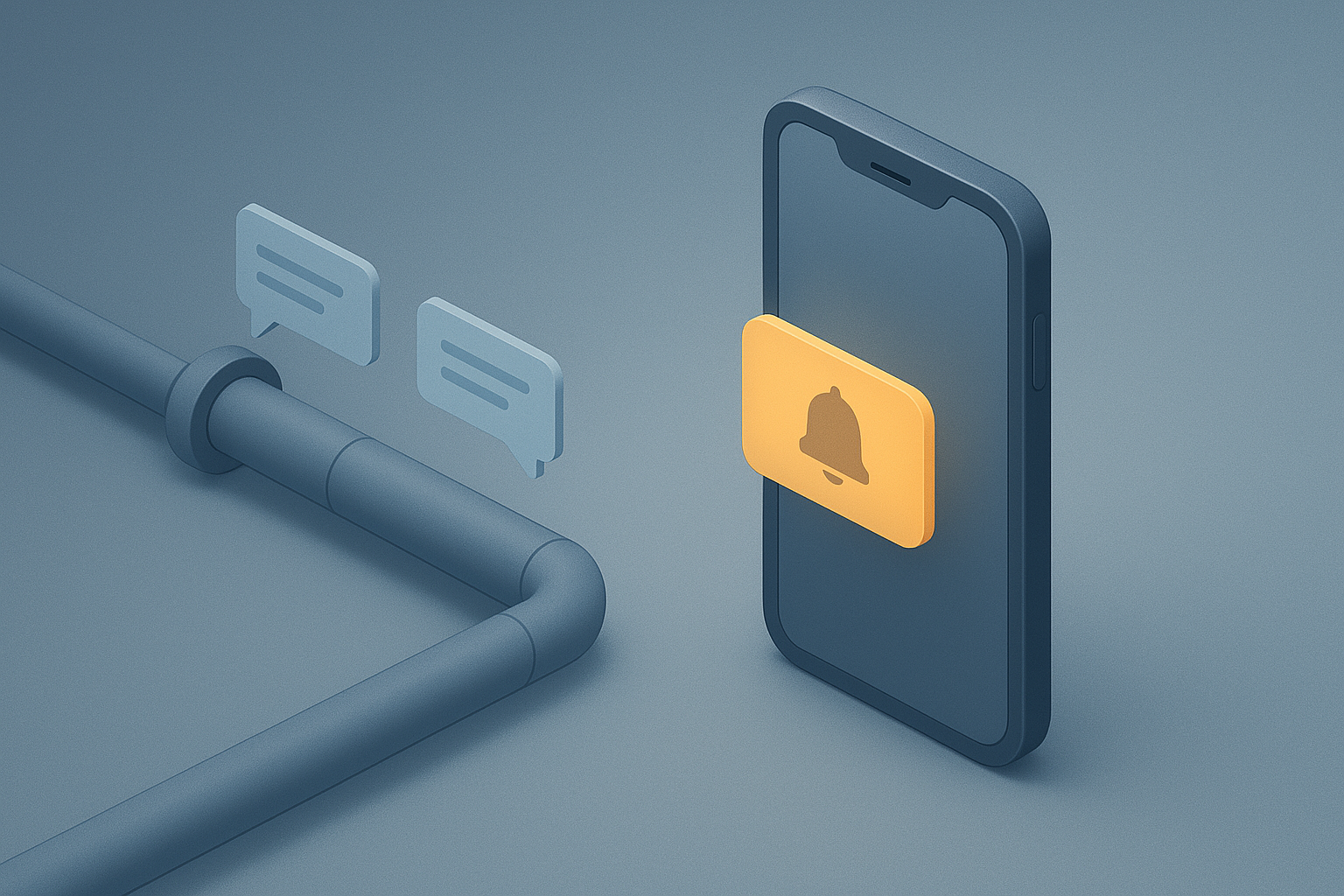
Even when your team is ready to reply, the message might not reach them in time. Notification lag is distinct from coverage gaps, it describes the technical delay between when a lead sends a message and when an alert lands on a human device.
Device-Bound Notifications and Missed Alerts
The WhatsApp Business App ties all notifications to a single device. If that phone is offline, in airplane mode, or silenced during a meeting, incoming leads queue silently. Sources do not isolate notification lag as a measured operational cause, but the architecture makes the inference straightforward: no device connection means no push alert. When multiple agents share login credentials, a pattern that violates WhatsApp's terms but remains common, handoff friction compounds the delay as messages bounce between personal devices.
API Architecture Eliminates Notification Dependency
Platforms built on the WhatsApp Cloud API route messages to centralized dashboards accessible from any browser or workstation. No single device holds the notification pipeline; alerts flow to web inboxes, CRM integrations, or AI agents in parallel. This architectural shift removes device dependency entirely, cutting the notification layer from the response chain. Yet even instant alerts cannot solve the next challenge: after-hours and weekend inquiries still face zero human presence, leaving leads unanswered until the next business day.
The coverage problem intensifies outside traditional working hours, when leads arrive but no one is available to respond.
After-Hours and Weekend Coverage Gaps Leave Leads Waiting
The Hidden Cost of 9-to-5 Availability
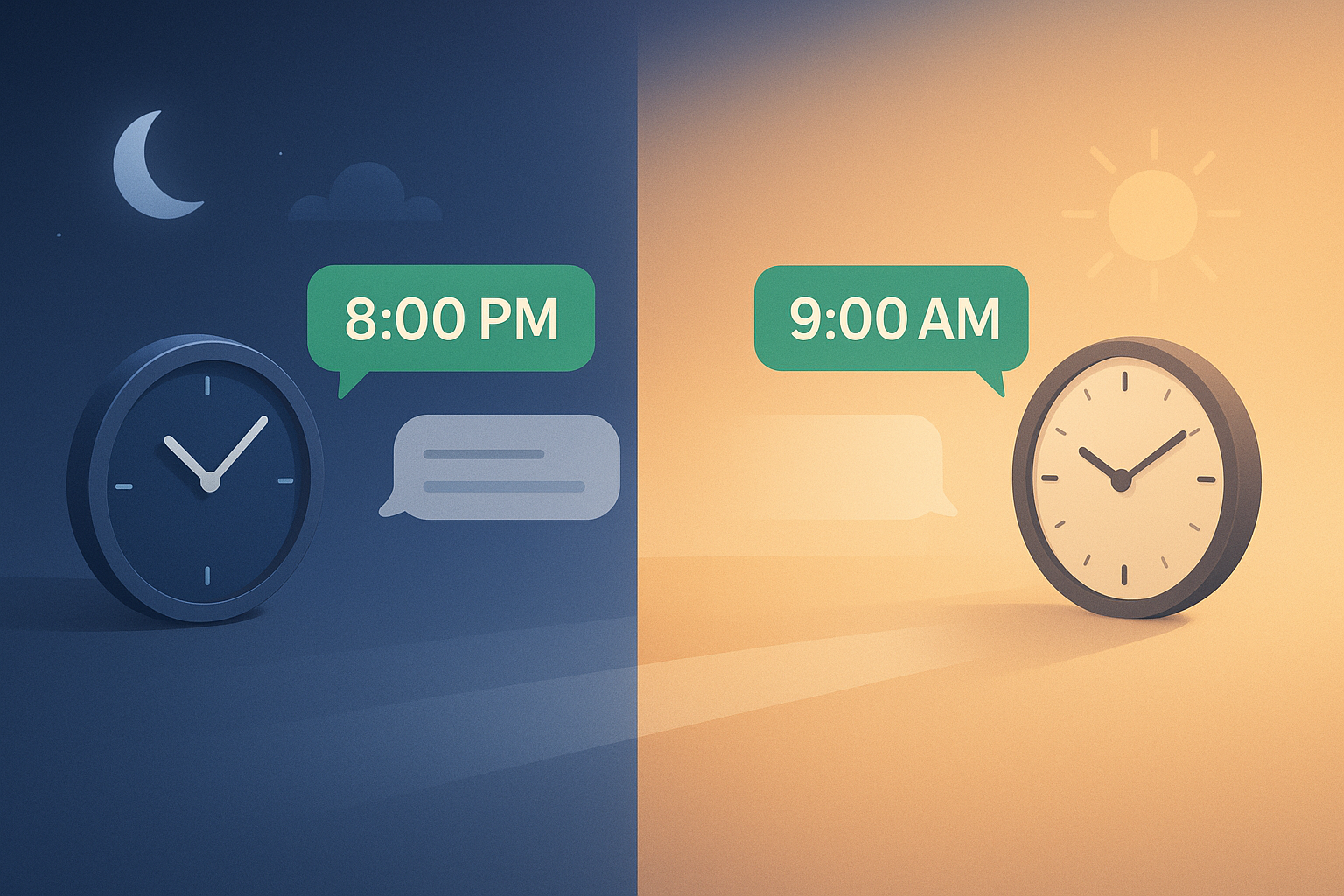
After-hours inquiries don't face slow responses, they face *zero* response until the next business day. While the average small business takes 2+ hours to respond during working hours[1], evening and night leads experience indefinite delays. A prospect messaging at 8 PM on Tuesday won't hear back until 9 AM Wednesday at the earliest, missing the critical 5-minute qualification window by more than twelve hours. The conversion math is brutal: businesses that respond within 5 minutes are 21x more likely to qualify leads than those responding after 30 minutes[1]. After-hours inquiries fall so far outside that window that most prospects have already contacted competitors or lost interest by the time your team clocks in.
Weekend and Holiday Lead Leakage
Weekend coverage gaps compound the problem. A Friday evening lead waits until Monday morning, a 60+ hour void during which competitors with 24/7 systems capture the conversion. Holiday periods extend these blackouts further, creating multi-day silent stretches that signal abandonment to prospects. Modern automation platforms eliminate these structural gaps entirely, operating round the clock to qualify leads the moment they arrive, whether that's 3 AM Sunday or Christmas Eve. The next section maps how AI automation systematically resolves each delay type explored above, transforming response mechanics from manual triage into continuous engagement.
Each of the bottlenecks outlined above has a corresponding automation solution that addresses the root cause.
Each delay type, manual handling, qualification friction, and coverage gaps, has a corresponding AI automation capability that eliminates the bottleneck at its source. Modern WhatsApp AI agents deploy instant response engines, conversational qualification logic, and round-the-clock availability to ensure every lead receives immediate, contextual replies. Wati research confirms that deploying WhatsApp AI agents in B2B contexts accelerates pipelines and reduces sales cycles by up to 30% [7].
Instant Engagement Removes Manual Handling Delays
AI agents respond the moment a lead message arrives, eliminating the workflow lag inherent in manual handling. While human teams require notification handoffs, queue management, and context switches, API-based platforms trigger automated replies within seconds. The table below compares five platforms that deliver instant engagement:
Platform | Response Speed | Automation Depth |
|---|---|---|
EchoLeads | Instant (API-triggered) | End-to-end qualification + follow-up |
IDB2B | Instant (API-triggered) | Lead capture + CRM sync |
Whappy | Instant (API-triggered) | Qualification + booking [3] |
ChatArchitect | Instant (API-triggered) | Conversational flows + handoff |
SalesHiker | Instant (API-triggered) | Auto-reply + basic routing |
AI automation uses human-voice responses for lead qualification, bookings, and demonstrations around the clock, removing the notification-to-reply cycle that adds 2+ hours of latency in manual workflows.
Smart Qualification Reduces Follow-Up Friction
AI agents use conversational qualification workflows to collect intent signals and budget data without forcing leads through rigid forms. Automation platforms automatically qualify users with high-buying intent and follow up through voice and messaging channels, reducing the back-and-forth that stalls manual processes. Strong lead qualification question workflows adapt to prospect behavior, capturing budget, timeline, and decision authority in natural exchanges rather than static surveys. This approach keeps leads engaged and accelerates pipeline velocity by routing high-intent prospects to human agents only when conversion signals are present. For teams comparing WhatsApp automation tool options [8], selecting platforms with native AI qualification capabilities ensures workflows scale without adding manual triage steps [8].
24/7 Availability Closes Coverage Gaps
Round-the-clock AI agents ensure every lead receives an immediate reply regardless of time zone, holiday schedule, or team capacity. Business hours are a structural bottleneck: leads who message at 11 PM or on weekends wait until the next business day, often abandoning the conversation before a human replies [4]. Automated systems handle 70 to 85% of incoming chats end-to-end, freeing human agents to focus on high-value conversations while the AI manages routine inquiries at any hour [4].
Slow WhatsApp Business response times are caused by three structural bottlenecks: manual handling limits, complex qualification workflows, and 24/7 coverage gaps. Traditional approaches improve one dimension while sacrificing another, adding team members increases coverage but not speed, and manual CRM workflows improve data capture but slow qualification. Modern automation prioritizes end-to-end lead qualification and booking automation over broad CRM feature parity, making it ideal for teams focused on WhatsApp-first sales workflows rather than enterprise-scale omnichannel orchestration.
By 2027, AI-powered instant engagement will become the baseline expectation for WhatsApp Business interactions, and businesses still relying on manual handling will face widening conversion gaps as lead patience continues to shrink.
See how 24/7 AI WhatsApp agents close coverage gaps and qualify leads instantly, explore modern automation platforms to eliminate response delays and recover lost leads.
Frequently Asked Questions
Why does it take so long for leads to respond to my WhatsApp Business messages?
Leads aren't slow, businesses are. When companies take 2+ hours to send the first reply [1], prospects move on or lose interest. Responding within 5 minutes boosts qualification rates 21x [1], but delayed business responses cause lead drop-off, not the other way around.
What is the ideal response time for WhatsApp Business leads?
The 5-minute window is critical: businesses that respond within five minutes are 21x more likely to qualify a lead [1]. Anything beyond that threshold significantly reduces conversion likelihood, as customer expectations for instant messaging platforms cluster around the 3 to 5 minute mark.
Can WhatsApp Business App handle high-volume lead conversations?
No. The Business App caps simultaneous users at five and broadcast lists at 256 contacts [2], making it unsuitable for scaling. High-volume operations require API-based platforms that support multi-agent access, centralized dashboards, and automation workflows without device constraints.
How do AI WhatsApp agents improve lead response times?
AI agents provide instant engagement the moment a message arrives, eliminating manual delay. They handle smart qualification without follow-up lag and operate 24/7, closing coverage gaps. Modern AI platforms manage 70 to 85% of conversations end-to-end [4], removing human bottlenecks entirely.
Do I need WhatsApp Business API to automate responses?
Yes. The Business App is device-bound with no automation capabilities. The API enables cloud-based automation, multi-agent access, centralized dashboards, and integration with AI platforms, none of which the App supports. Automation requires API architecture.
What percentage of leads arrive outside business hours on WhatsApp?
Industry-wide data on after-hours percentages is not publicly available. Businesses should audit their own lead timestamps to identify coverage gaps. AI automation platforms [3][4] solve the problem by offering 24/7 availability regardless of when inquiries arrive.
Can AI automation integrate with my existing CRM and WhatsApp setup?
Yes. Modern automation platforms use WhatsApp Business API and integrate with CRMs via API and webhook connections. Setup typically completes within 24 hours, and the platform routes messages to centralized dashboards accessible from any browser or workstation.
Related articles
6 Best AI Outbound Calling Solutions for Loan Verification
Compare AI outbound calling platforms that verify loan applications 24/7
5 Common Causes of Long Bank Loan Inquiry Call Wait Times
Why do bank customers complain about long wait times for loan inquiry calls? Learn the 5 Common Causes of Long Bank Loan Inquiry Call Wait Times.
4 Best AI Voice Lead Qualification Tools for Insurance
Compare AI voice platforms for insurance lead qualification through automated outbound calls.