
How to Make an AI Calling Agent: Platforms, APIs, n8n
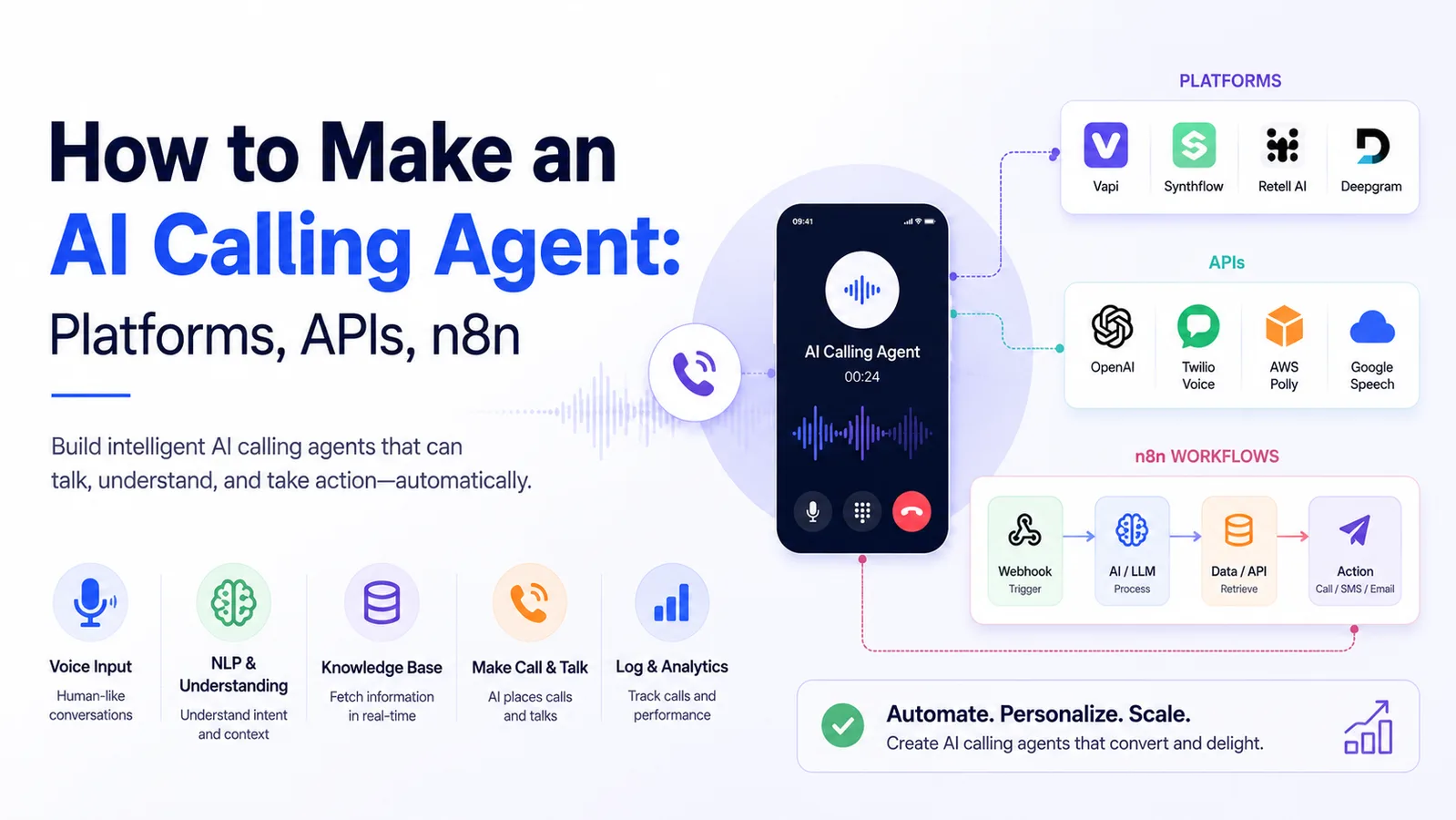
One founder recorded a “perfect” demo on speakerphone in a quiet room. The agent misheard Hinglish and spoke over the customer on a real +91 mobile, and never wrote the ticket. That is why the question of how to make ai calling agent is a systems question. You are wiring ears, a brain, a mouth, a phone line, a tool layer. If you miss one, the demo still sounds good.
Quick Answer Box
Don't begin by training a voice model. Start with a single job (reset password, book a slot, confirm delivery). Developers? Use Vapi or Retell. Need Hindi/TRAI routing this month? Use India-managed platform. Calendar/CRM actions mid-call? Use n8n. Speech recognition should be a streaming STT with interruption handling.
How to Create an AI Agent (The Voice Version)
How to create an ai agent on a phone is five contracts, written down before any API key.
Job: one goal, one success metric (ticket created, slot booked, human accepted the transfer)
Knowledge: what it can say, what it must deny.
Tools: order search, create tickets, get slots, transfer.
Policy: automated call disclosure, recording notice, opt-out, hours.
Handoff: number or queue, transcript
Then pick a build path:
No-code India platform: script, voice, +91 number, CRM field mapping
Orchestrator: Vapi, Retell, Bland. You give me LLM and sometimes STT/TTS keys.
Custom pipeline: SIP in, streaming STT, LLM with tools, streaming TTS, audio back out (LiveKit or Pipecat if you want open source)
Genesys Talkdesk Five9 style IVA CCaaS add-on If you already own the contact center.
Most teams should take path one or two. Path three is for latency or volume that a platform cannot meet.
How to Make an AI Voice
How to make an ai voice in this context is text-to-speech, not training Whisper from scratch.
Options:
Select a stock voice from ElevenLabs, Cartesia, Azure, Google, OpenAI TTS or Sarvam Bulbul for Indic languages.
Clone a brand voice only after getting documented consent & legal review.
Use a speech-to-speech model (OpenAI Realtime, Gemini Live) where voice is native to model, not a separate TTS step.
Quality that matters on a phone: turn taking under ~800 ms, barge-in (stop talking when the human starts), and stability on 8 kHz telephony audio. If STT can’t hear the customer on a noisy street, studio quality clones are useless. Test Indian languages on real call recordings, not on a headset in office. Indic stacks such as Sarvam, Reverie etc often beat global STT on Hindi, code switch. ElevenLabs wins English brand voice. Don’t assume a single vendor will win both.
How to Create a Voice Call AI Agent With n8n
How to create a voice call ai agent with n8n is the pattern most independent builders actually ship.
n8n is not the phone company. It is the tool bus.
Typical architecture:
Live call belongs to Vapi or Retell.
You define GetSlots, BookSlot, LookupTicket, CreateTicket tools The URL for each tool is a n8n webhook.
The model pauses mid-call, POSTs JSON to n8n, waits and speaks the returned fields.
An end of call webhook hits a second n8n flow that writes crm notes and slack .
The third flow can be outbound: new form row in sheets or hubspot trigger POST to Vapi or Retell to place the call.
Current public n8n templates integrate Vapi or Retell with GoHighLevel, Google Calendar and BANT scoring. If you already have the voice assistant and number, setup usually takes less than an hour. Keep business logic in n8n so you can change CRM rules without having to re-publish the prompt to the voice vendor each time.
The other popular tutorial stack is ElevenLabs plus n8n plus Twilio: ElevenLabs holds the conversational agent, Twilio holds the number, n8n fires outbound on a new lead. Same idea, different conductor.
Failure mode: n8n queries a slow CRM in 4 seconds The caller gets silence. Fix with a spoken filler (“let me check that”), cache and timeouts that pass instead of hang.
How Can I Build an AI Calling Agent for Customer Support?
Support is retrieval plus actions, not a friendly monologue.
Blueprint:
Intents: Order Status, Start Return, Reset Password, "Talk to a person.
Grounding: the same help articles that the chat agent uses.
Identity: Ticket or order ID collected by speech or DTMF
Actions : write Freshdesk or Zendesk, issue RMA within policy, escalate to skilled queue.
QA: ten calls a day scored for groundless answers and illegal promises
Latency budget on support: greet fast, look up in under a second if possible, never make up a refund window. Transfer if retrieval is empty. A queue is cheaper than a support agent who “helps” by guessing.
India support extras: Hindi/Hinglish first, 160-series for outbound service, recording consent, human queue, staffed when agent offers to transfer
What Platforms Offer Tools to Create AI-Powered Calling Agents?
Developer orchestrators: Vapi (byo stt/llm/tts max + cleanest n8n tool pattern) Retell AI (managed latency + visual builder + outbound + receptionist) Bland AI (high volume outbound apis) Published 2026 per-minute bands are often around $0.05-0.14 + pass-through model costs, with turn taking claims around 400-900 ms depending on stack.
Voice-native platforms: ElevenLabs Agents (voice quality), LiveKit Agents and Pipecat (open-source control).
Realtime model APIs: OpenAI Realtime and Gemini Live for speech-to-speech when you want fewer moving parts and will accept their telephony story.
CPaaS and CCaaS: Twilio ConversationRelay, Exotel AgentStream-class pipes, Ozonetel CXi, Knowlarity, classic IVA inside Five9 or Genesys.
No-code India builders: Vyora, Vomyra, Tabbly-class products, plus mid-market managed callers.
Pick Vapi if engineering owns the agent. Pick Retell if operations wants a builder. Pick an India platform if compliance and language are the product.
Which Companies Provide AI Calling Agent Software for Businesses in India?
Group them so you do not compare an API to a BPO.
India voice AI product companies: Caller Digital, Bolna, Gnani.ai, Skit.ai, SquadStack (AI plus human backup), Vyora and peers. They compete on Indic audio, INR pricing, and TRAI-aware routing.
Indian telephony rails: Exotel, Ozonetel, Knowlarity. Many “AI calling” stacks in India terminate here even when the brain is Vapi or Sarvam. Mint has described these firms as the pipes under a large share of domestic AI calls.
Indic model labs: Sarvam (STT/TTS/LLM for Indian languages).
Global platforms used from India: Vapi, Retell, Bland, ElevenLabs, Twilio. You still must attach a legal calling path for +91 promotional versus service traffic.
If the business is D2C support in Hindi, start India-native. If the business is a SaaS exporter calling US numbers, a global orchestrator is fine.
What Are the Best APIs for Developing an AI Calling Agent?
There is no single best API. There is a best API per layer.
Orchestration / agent runtime: Vapi, Retell, Bland, LiveKit, Pipecat.
Speech-to-text: Deepgram Nova for English and some Hindi; Sarvam Saaras, Reverie, Mihup for live Indian call audio; ElevenLabs Scribe for broader language lists.
LLM: GPT-4o or Claude for tool calling; Gemini Flash-class models often used for vernacular latency; Sarvam-M when you want Indic in one vendor.
Text-to-speech: ElevenLabs and Cartesia for quality and speed; Azure/Google for broad Indian language catalogs; Sarvam Bulbul / Smallest for Indic naturalness.
Speech-to-speech: OpenAI Realtime, Gemini Live, Deepgram Voice Agent, AWS Nova Sonic.
Telephony: Twilio, Telnyx, Exotel, Plivo, SIP trunks into any of the above.
A common India support build in 2026 implementation notes is Deepgram or Sarvam STT, GPT-4o or Gemini, ElevenLabs or Sarvam TTS, Exotel, calendar via n8n, all-in often discussed around ₹8–20 for a short call depending on TTS and minutes. Consider that planning maths, not a quote.
How to Integrate Speech Recognition in an AI Calling Agent
How to integrate speech recognition means streaming, not “transcribe the recording later.”
Steps:
Go with streaming STT with an endpointing setting you can tune (when has the human finished a sentence).
Inside the orchestrator connect it (Vapi provider key, Retell native ASR, or a custom WebSocket from SIP audio)
Enable barge-in: When STT detects new speech, stop TTS playback immediately.
Only send partial transcripts to the LLM when the utterance is complete, or use a realtime multimodal API that already does turn-taking.
Add DTMF fallback for account numbers. 16 digit IDs not good on speakerphone. Speech.
Measure your call word error rate: Hindi, Hinglish. Loud two-wheelers. IVR audio 8 kHz. WER Marketing Studio.
Log transcripts + consent + retention rules (DPDP if store Indian personal data)
If recognition is wrong, every later layer is theatre. Fix STT and audio gain before you rewrite the prompt.
Technical & Performance Data Matrix
Build path | Who should use it | Speech stack | n8n role | India caution |
India no-code caller | Ops teams, Hindi support | Vendor bundled | Optional CRM | Fastest TRAI path |
Vapi + n8n | Developers | BYO STT/LLM/TTS | Mid-call tools + EoC | You own +91 compliance |
Retell + n8n | Mid-market builders | Managed ASR + LLM options | Tools + outbound trigger | Test Hinglish before scale |
Bland outbound API | High-volume campaigns | Platform voice | Bulk trigger from CRM | Promo versus service series |
ElevenLabs + Twilio + n8n | Voice-quality first | ElevenLabs agent + Twilio SIP | Lead-to-dial | Indic STT may need a second vendor |
Custom LiveKit / Pipecat | Platform teams | Fully chosen | Whatever you code | Longest time to first call |
Exotel / Ozonetel + agent | Indian CX already on CPaaS | Attached AI layer | Ticket macros | Best existing number inventory |
Realtime S2S API | Low-tool conversations | Native speech-to-speech | After-call only | Tool calling and PSTN vary |
The matrix is the decision the tutorials leave out. n8n is good when the agent needs to do something in the middle of a sentence. It doesn’t replace STT. India no-code excels when the bottleneck is numbers and language, not webhook design.
Build support starting on inbound, one queue, one language pair, then add outbound reminders. Sales builds need to begin with a speed-to-lead, not cold blasting a DND heavy list.
A 14-Day Build Plan
Day 1–2: write the job, disclosure, and 20 test utterances.
Day 3–4: stand up number and orchestrator, greet plus transfer only.
Day 5–6: attach streaming STT and listen to errors.
Day 7–8: one n8n tool (lookup or calendar).
Day 9–10: knowledge snippets and refusal.
Day 11–12: 50 real calls, score barge-in and write-back.
Day 13–14: lock hours, DND or service classification, and a weekly review owner.
If day 6 audio is unusable, do not spend day 9 on prompt poetry.
Advice vs Strategic Thinking Matrix
Task | Generic advice | Strategic thinking |
Make an AI calling agent | Clone a celebrity voice | Job, tools, STT, then voice |
Create an AI agent | One giant prompt | Five contracts plus a metric |
Make an AI voice | Longest clone sample | Telephony latency and language |
n8n voice agent | Put the whole conversation in n8n | n8n for tools, orchestrator for audio |
Support build | Replace the contact center | Three intents and a staffed transfer |
India vendor | Cheapest USD per minute | Indic WER plus legal routing |
Speech recognition | Batch Whisper after the call | Streaming STT with barge-in |
Generic advice ships a demo. Strategic thinking ships a number customers will not hang up on.
People Also Ask
Q: How do I make an AI calling agent?
One job: number connection, streaming STT, LLM with tools, TTS, transfer. Combine those with Vapi or Retell, or an India platform if you need +91 and Hindi right away.
Q: How do I create an AI agent?
Write: goal, knowledge, tools, policy, handoff. Then select no code, orchestrator or custom SIP. An agent without tools is just a talking IVR.
Q: How do I make an AI voice?
Get consent and either clone or choose a TTS voice . Use a speech to speech API . Optimise for barge-in & 8k phone audio, not studio beauty.
Q: How do I create a voice call AI agent with n8n?
Let Vapi or Retell hold the call. Point tool URLs at n8n webhooks for CRM and calendar. Use a second workflow for end-of-call logging and a third to trigger outbound dials.
Q: How do I build one for customer support?
Ground on help articles, collect IDs with DTMF if needed, write the ticket, and transfer when unsure. Staff the queue you promise.
Q: What are the best APIs?
Vapi or Retell for runtime, Deepgram or Sarvam for STT, GPT-4o or Gemini for tools, ElevenLabs or Sarvam for TTS, Exotel or Twilio for the line.
Q: How do I integrate speech recognition?
Use streaming STT inside the orchestrator, enable interruption, tune endpointing, add DTMF for numbers, and measure WER on real calls.
Q: How can EchoLeads.ai help if I do not want to assemble APIs?
Teams can skip the Vapi-plus-n8n assembly line with support and outbound AI calling agents from EchoLeads.ai. Compare an in-house built stack still with an EchoLeads.ai pilot on the same intents.
You don’t have to build an AI agent calling. The conversation design is not owned by . Want a production voice agent without being a telephony integrator? Contact the EchoLeads.ai team to scope a support or outbound pilot on your real numbers.