
Why Do My Leads Keep Falling Through the Cracks After Hours When They Call to Book Appointments?
Your calendar shows open slots, your phone system records missed calls, and your CRM logs incomplete inquiries—yet prospects who reach out after 5 PM rarely convert into booked appointments.
The problem isn't lead quality or market demand; it's a structural workflow gap that abandons high-intent prospects exactly when they're ready to commit.
Key Takeaways
After-hours lead loss follows five systematic failure points: inquiry abandonment, qualification delays, handoff failures, nurturing breakdowns, and post-quote silence
Leads contacted within 5 minutes are 100x more likely to connect and 21x more likely to qualify than those reached later
Automation-first architecture captures intent instantly and escalates to humans when complexity or compliance risk exceeds safe autonomy thresholds
TCPA compliance is mandatory for automated outbound calls and SMS in appointment booking workflows, especially in regulated industries like healthcare
Sixty percent of appointment booking calls arrive after business hours, making 24/7 capture systems key for conversion continuity
Why After-Hours Leads Disappear: The Core Problem
Leads keep falling through the cracks after hours not because of lead quality, but because of a structural workflow mismatch: prospects are ready to book appointments 24/7, but most businesses operate on a 9-5 schedule. When 60% of calls arrive after-hours [1] and sit unread for 12+ hours [1], the disconnect between constant availability and limited human capacity creates five predictable leakage points — initial inquiry abandonment, qualification delays, handoff failures, nurturing breakdowns, and post-quote silence.
The 24/7 Availability Mismatch
The core problem is timing. Leads arrive at 7pm, 10pm, and 2am [1] — peak intent windows when most service businesses are completely unreachable. Voicemails wait until morning, Facebook messages accumulate overnight, and website chat inquiries sit idle. By the time the office opens, the prospect has already moved on or booked with a competitor.
This isn't a staffing problem you can solve by hiring more people. It's a structural capacity gap: human teams can't maintain instant response across every channel around the clock. The business closes at 5pm, but customer intent doesn't follow business hours. When after-hours represents the majority of inbound volume [1], leaving it unattended means abandoning your highest-intent leads during their decision window.
Why Speed of Response Determines Conversion
The research is clear: response speed determines conversion outcome. Businesses responding within 5 minutes are 100 times more likely to make contact [2] and 21 times more likely to qualify the lead [2] than those waiting 30 minutes. The window is even tighter than most teams realize — companies responding within one hour are almost 7 times more likely to qualify [3] than those waiting just one more hour, and 60 times more likely [3] than those waiting 24 hours.
When 78% of customers book with the first responder [1], delayed response doesn't just reduce conversion — it eliminates it. The lead who calls at 9pm and hears nothing until 9am has already compared three competitors, received two quotes, and scheduled an appointment. Your callback becomes irrelevant because the buying decision already happened while you were offline.
The five leakage points, initial inquiry abandonment, qualification delays, handoff failures, nurturing breakdowns, and post-quote silence, all trace back to this timing problem. Each represents a moment when speed determines whether the lead moves forward or disappears. Understanding where and why leads leak lets you automate appointment booking at the exact points where human capacity creates delays.
Understanding the problem is only half the battle, now let's map exactly where your after-hours leads vanish and what triggers each abandonment point.
The Five After-Hours Lead Leakage Points
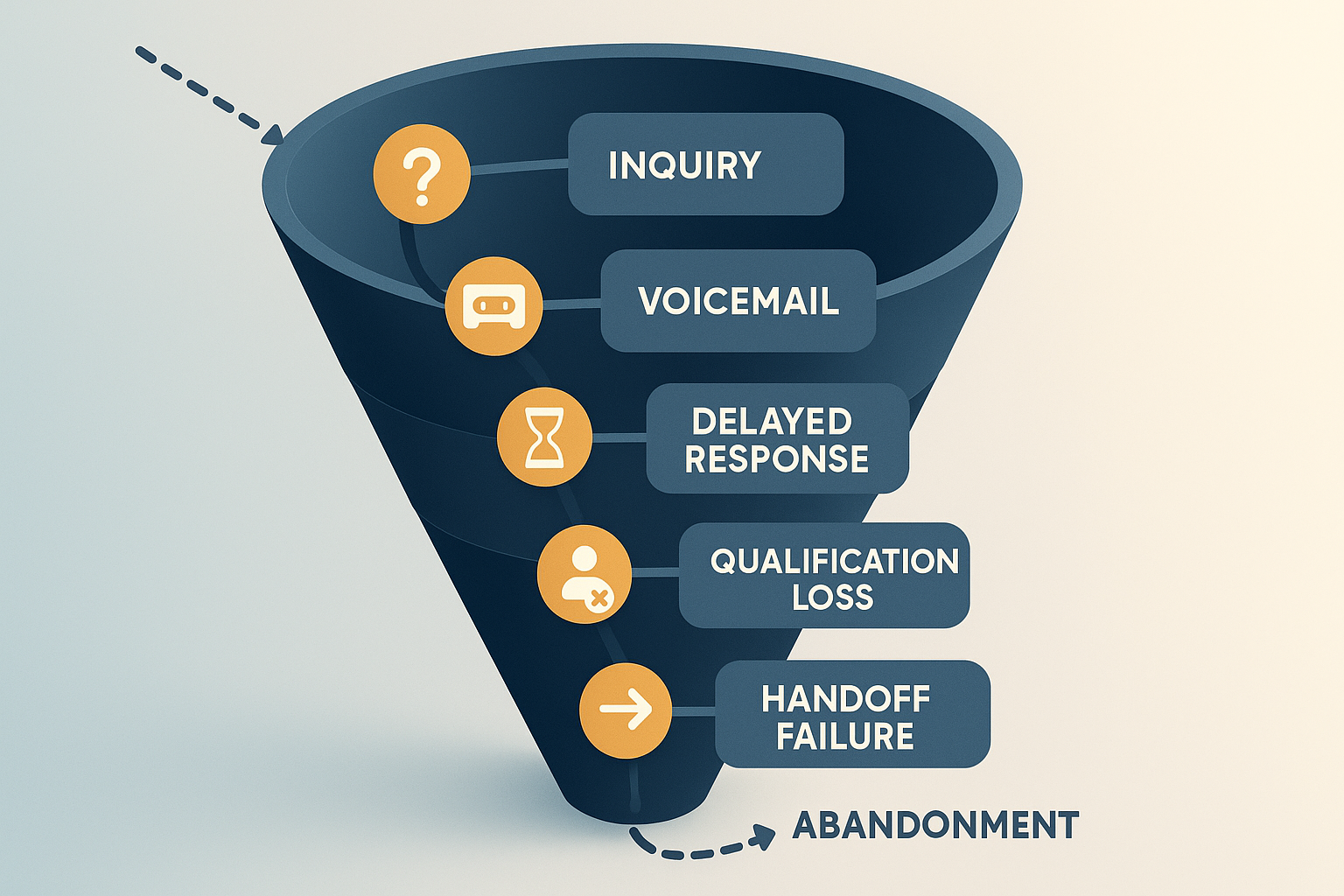
After-hours lead loss isn't random, it follows five systematic failure points where prospects move from inquiry to abandonment. Each point represents a specific workflow stage where lack of automation, context loss, or delayed response causes revenue to evaporate. Understanding these stages lets you remediate the actual breakdowns rather than treating symptoms.
Point 1: Initial Inquiry Abandonment (Voicemail Drop-Off)
When prospects call after 5 PM or on weekends and reach voicemail, conversion rates collapse. Voicemail creates a multi-hour response gap, the prospect leaves a message, moves on to the next provider's listing, and books elsewhere before your team returns the call the next morning. Self-serve booking pages don't solve this problem when the lead starts with a phone call; the prospect wanted to speak with someone, not fill out another form. Always-on call capture systems answer immediately, qualify intent while the prospect is still engaged, and route high-priority inquiries to on-call staff or book appointments directly into your calendar. The initial touch determines whether the lead enters your workflow or disappears into a competitor's schedule.
Point 2: Qualification Stage Delays
Even when you capture the inquiry, slow qualification timing causes prospects to self-disqualify. A lead who requests pricing at 7 PM expects acknowledgment within minutes, not a callback scheduled for 9 AM. During that 14-hour window, they research three more providers, receive instant quotes from competitors using automated qualification flows, and mentally close the decision. By the time your team calls, the prospect has already moved forward with another vendor. Qualification speed isn't about convenience, it's about staying in the active consideration set. Prospects interpret delayed response as a signal of how you'll handle future interactions, and they choose providers who demonstrate operational readiness during the evaluation phase.
Point 3: Handoff Failures Between Automated Capture and Human Follow-Up
Context loss during after-hours handoffs destroys conversion momentum. A prospect interacts with an automated capture system at 8 PM, answers budget and timeline questions, and receives a confirmation that someone will follow up. The next morning, a human team member calls, but the conversation context didn't transfer. The prospect has to re-explain their needs, repeat qualification answers, and justify their timeline again. This redundancy signals internal dysfunction and triggers prospect skepticism about whether your operation can handle complex projects. Systems that preserve conversation context across handoffs [4] prevent this breakdown: when the human rep calls, they reference the specific details the prospect already provided, pick up the conversation mid-thread, and move directly to scheduling or proposal discussion. EchoLeads' omnichannel booking architecture maintains full conversation history across voice, WhatsApp, and calendar interactions, ensuring handoffs carry forward the prospect's intent and prior answers without requiring repetition.
Point 4: Nurturing Process Breakdowns
Inconsistent touchpoint timing after hours causes prospects to disengage from nurturing sequences entirely. A prospect inquires Thursday evening, receives an automated acknowledgment, but the next scheduled touchpoint doesn't fire until Monday morning, 84 hours later. During that gap, competitive offers arrive, urgency fades, and the prospect mentally de-prioritizes the decision. Industry data suggests the average practice has 200-500 unconverted leads [5], and reactivating existing contacts costs 5-7x less than acquiring new patients [5]. Most of these unconverted leads are nurturing failures, not initial qualification failures: the prospect expressed interest, entered a sequence, then dropped off when touchpoint timing didn't match their decision velocity. Automated nurturing that operates 24/7 maintains engagement momentum regardless of when the prospect first inquired.
Point 5: Post-Quote Silence (Ready-to-Book Drop-Off)
The highest-value leakage point occurs when prospects receive pricing or a proposal and are ready to commit, but cannot reach anyone to finalize the booking. A lead gets your quote Friday afternoon, decides to move forward over the weekend, and calls Saturday to schedule, but reaches voicemail. By Monday, they've accepted a competitor's offer that allowed instant booking. This isn't a qualification problem or a nurturing problem; this is a transaction-completion failure. The prospect cleared every qualification gate, received your pricing, and chose to buy, but your workflow couldn't close the deal because no one was available to take the order. After-hours appointment booking systems that accept transactions 24/7 capture this ready-to-buy intent the moment it surfaces, converting post-quote momentum into scheduled revenue before competitors can intercept.
Identifying the leakage points reveals the scope of the problem; solving them requires a fundamentally different approach than traditional staffing models.
How Automation Bridges the 24/7 Gap (Without Replacing Humans)
Why Manual Teams Cannot Provide 24/7 Coverage
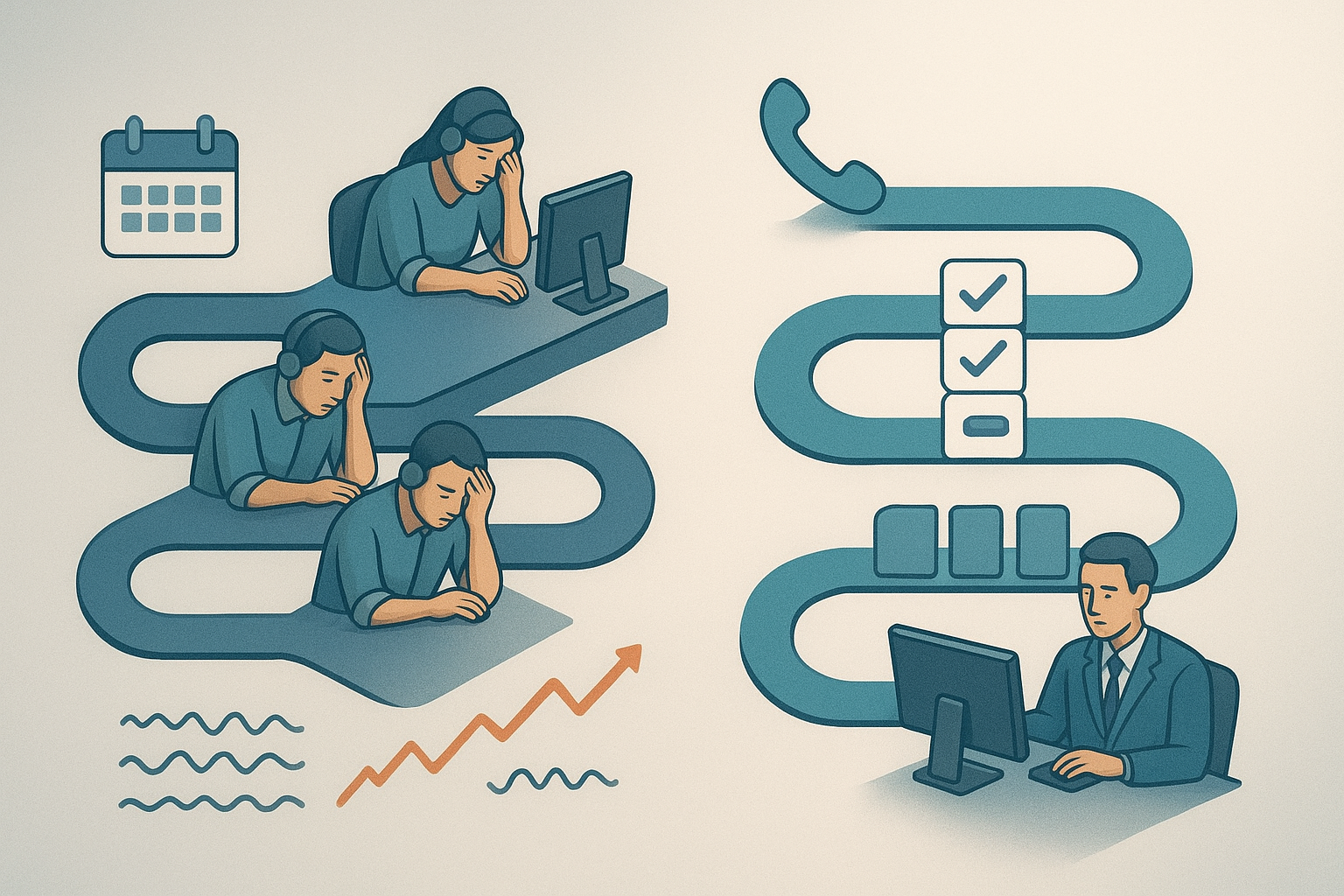
Staffing human teams around the clock requires three shifts of trained representatives, each capable of qualifying leads and booking appointments with the same consistency. For a five-person sales team, 24/7 coverage means hiring fifteen people, tripling payroll while distributing leads unevenly across time zones. Night-shift workers experience higher burnout and turnover, and most small teams cannot sustain the cost or recruitment pipeline required to maintain continuous human availability without exhaustion or quality erosion.
Automation as the After-Hours Bridge, Not the Replacement
AI calling agents handle the repetitive initial prospecting work, answering inbound calls within seconds, collecting budget and timeline details, and qualifying leads using predefined ICP logic. Once qualification is complete, the system escalates high-buying-intent prospects to human agents, preserving conversation context so sales representatives receive warm, ready-to-close leads rather than cold call lists. EchoLeads operates 24/7 across voice and messaging channels, capturing after-hours inquiries that would otherwise drop into voicemail and scheduling meetings directly into Google Calendar or CRM-based schedulers without human intervention.
When Automation Should NOT Be Used (Human Escalation Triggers)
Intelligent escalation logic transfers conversations to human agents when complexity, sentiment, or compliance risk exceeds safe autonomy thresholds. Emotionally charged conversations, disputes over billing, accusations of fraud, or urgent account issues, require human judgment and empathy that AI cannot replicate. Similarly, conversations involving regulatory compliance (financial disclosures, medical advice, legal obligations) must be routed to trained staff to avoid liability. The system detects these triggers through sentiment analysis and keyword patterns, escalating immediately with full conversation context so the human representative can pick up mid-conversation rather than restarting from the beginning.
Omnichannel Continuity: Unified Context vs Independent Channels
Traditional multi-channel systems let a prospect book via phone, reschedule via email, and ask questions via SMS, but each channel operates independently, forcing the prospect to repeat their budget, timeline, and preferences at every touchpoint. Omnichannel platforms unify conversation context across phone, WhatsApp, and Instagram DM, so when a lead qualifies via voice call and follows up via text two days later, the AI recalls their initial inquiry and continues the conversation without asking the same questions twice. This continuity prevents the handoff leakage that occurs when scheduling tools operate as isolated calendar links disconnected from the broader sales workflow.
Platform | After-Hours Call Capture | Omnichannel Context | Human Escalation Logic |
|---|---|---|---|
EchoLeads | Answers calls within 3 seconds | Unified across phone, WhatsApp, Instagram | Automatic (complexity, sentiment, compliance) |
Setmore | Self-serve booking only | Single-channel (calendar link) | Manual handoff required |
Self-serve booking only (no call answering) | Single-channel (calendar link) | Manual handoff required | |
Square Appointments | 24/7 booking site [6] | Single-channel (calendar link) | Manual handoff required |
Even the most sophisticated automation strategy operates within a regulated environment where legal compliance determines what you can deploy and how you deploy it.
Compliance Requirements for After-Hours Automation
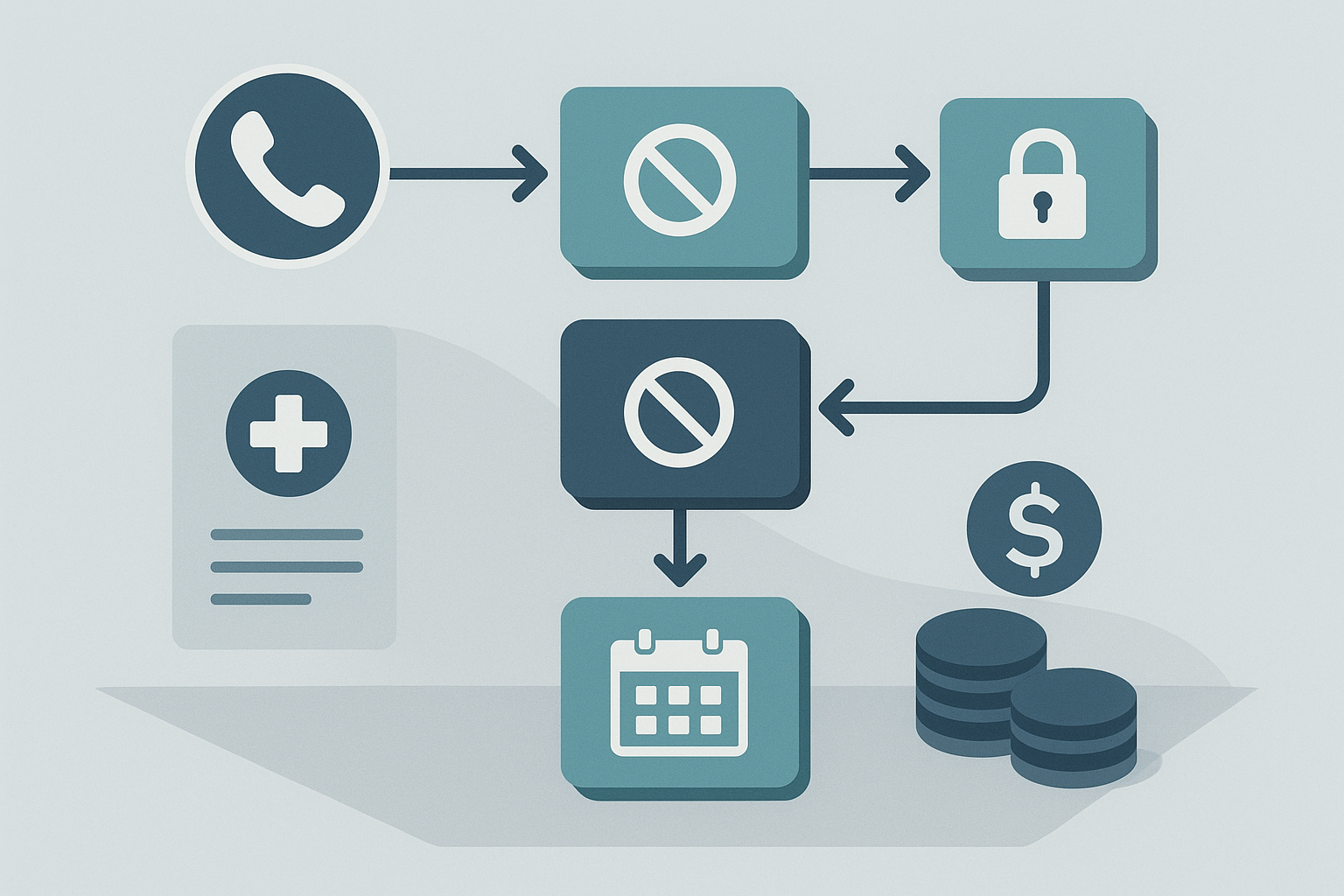
After-hours automation for appointment scheduling operates in a regulated environment where legal compliance is not optional. For healthcare and financial services organizations deploying AI-powered calling systems, Telephone Consumer Protection Act (TCPA) consent requirements and Do Not Call (DNC) list management are mandatory first-order design requirements, not features to be bolted on after deployment. The stakes are operational: practices handling tens of thousands of appointment bookings annually must enforce compliance protocols at scale, where manual oversight is infeasible.
TCPA and Do Not Call (DNC) Compliance for Automated Outbound
Automated outbound calling systems must operate within TCPA consent frameworks, which require prior express written consent for most automated calls to mobile numbers. Platforms designed for after-hours lead capture must integrate DNC list checks before dialing, maintain opt-out records, and log consent artifacts for each outbound contact. EchoLeads, for example, includes workflows with TCPA compliance, integration with DNC lists, and automatic opt-out handling as core platform capabilities, not add-ons. Organizations should validate that their chosen automation platform provides real-time DNC scrubbing, consent timestamp recording, and audit trails before deploying after-hours calling workflows. Generic automation tools often lack these controls, exposing practices to regulatory risk when operating outside business hours without live supervision.
Compliance-First Architecture for Healthcare and Financial Services
Regulated industries must design automation with compliance protocols embedded from the start. In healthcare, where a 20-month study documented 16,894 practice appointments and 81,173 hospital appointments [7], after-hours systems must enforce HIPAA-compliant call handling, patient identity verification, and secure scheduling workflows at volumes where manual review is impossible. Financial services face parallel requirements under PCI DSS and GDPR for payment-related calls and customer data protection. Platforms built for these verticals integrate compliance controls into the automation architecture, consent verification before every outbound call, encrypted voice channels for sensitive conversations, and role-based access controls for appointment data. The healthcare AI voice agent model demonstrates this approach: compliance checks run inline with call routing logic, blocking non-compliant calls before they initiate rather than flagging violations after the fact. Organizations deploying after-hours automation should verify that compliance enforcement occurs at the platform layer, not as a manual downstream review step, to avoid exposing patient or customer data during unmonitored hours.
Self-serve scheduling tools like Calendly and Zoho Bookings excel when prospects initiate via calendar link but fail when prospects call after hours, EchoLeads bridges the gap by answering the call first, then routing to booking. Manual 24/7 staffing delivers human judgment on every call but exhausts teams and escalates costs; automation handles repetitive capture and qualification tasks around the clock, escalating only high-intent or sensitive conversations to humans.
The appointment scheduling market is shifting from static calendar links to intelligent triage systems that decide what happens next based on intent signals, not just offer a time slot. Compliance-aware automation will become the baseline expectation for after-hours operation in regulated industries.
Map your current after-hours booking workflow against the five leakage points and implement 24/7 call capture with EchoLeads' AI appointment scheduling to close the gaps this week.
Frequently Asked Questions
How quickly should I respond to after-hours appointment booking inquiries?
Respond within 5 minutes. Leads contacted in the first few minutes are 100x more likely to connect and 21x more likely to qualify than delayed responses [2]. A lead requesting pricing at 7 PM expects acknowledgment within minutes, not a callback scheduled for 9 AM the next morning [4][5].
Can AI appointment scheduling systems handle all customer calls without human support?
No. AI handles repetitive initial tasks like capture, qualification, and triage, but must escalate high-intent, emotionally charged, disputed, or fraud-related calls to humans [4][5]. Automation is the bridge that maintains continuity, not a replacement for human judgment when complexity or risk thresholds are exceeded.
What is the difference between multi-channel and omnichannel scheduling systems?
Multi-channel systems operate phone, SMS, and email independently, causing context loss at handoffs. Omnichannel systems maintain unified context across all channels, preserving intent and conversation history when leads transition from after-hours capture to human follow-up [4][5], preventing the momentum collapse that destroys conversions.
Do I need TCPA compliance for after-hours automated appointment booking?
Yes. If your system makes automated outbound calls or sends automated SMS, you must comply with TCPA consent requirements and maintain DNC list management [7]. This is mandatory for regulated industries like healthcare and financial services, where compliance protocols must be embedded from the start, not bolted on later.
Why do self-serve scheduling tools like Calendly not prevent after-hours lead loss?
Self-serve tools require prospects to initiate booking via a calendar link. After-hours leakage happens when prospects call instead, traditional schedulers don't answer the call or capture intent before the prospect hangs up [4][5]. You need call-answering automation paired with scheduling integration to close this gap.
How much revenue am I losing from unconverted after-hours leads?
The average practice has 200-500 unconverted leads, each representing $300-2,000 in potential production [5]. Reactivating existing contacts costs 5-7x less than acquiring new patients. Inconsistent after-hours touchpoint timing causes prospects to disengage entirely, creating multi-hour response gaps that compound the revenue loss [4][5].
What percentage of appointment booking calls come after business hours?
Sixty percent of calls come after-hours [1]. This is not a trivial edge case, it represents the majority of inbound booking attempts for many businesses. In healthcare alone, a 20-month study documented over 98,000 appointments [7], underscoring the scale of after-hours demand across regulated industries.