
Why Customers Hang Up When They Can't Reach a Human Agent (And How AI Support Fixes It)
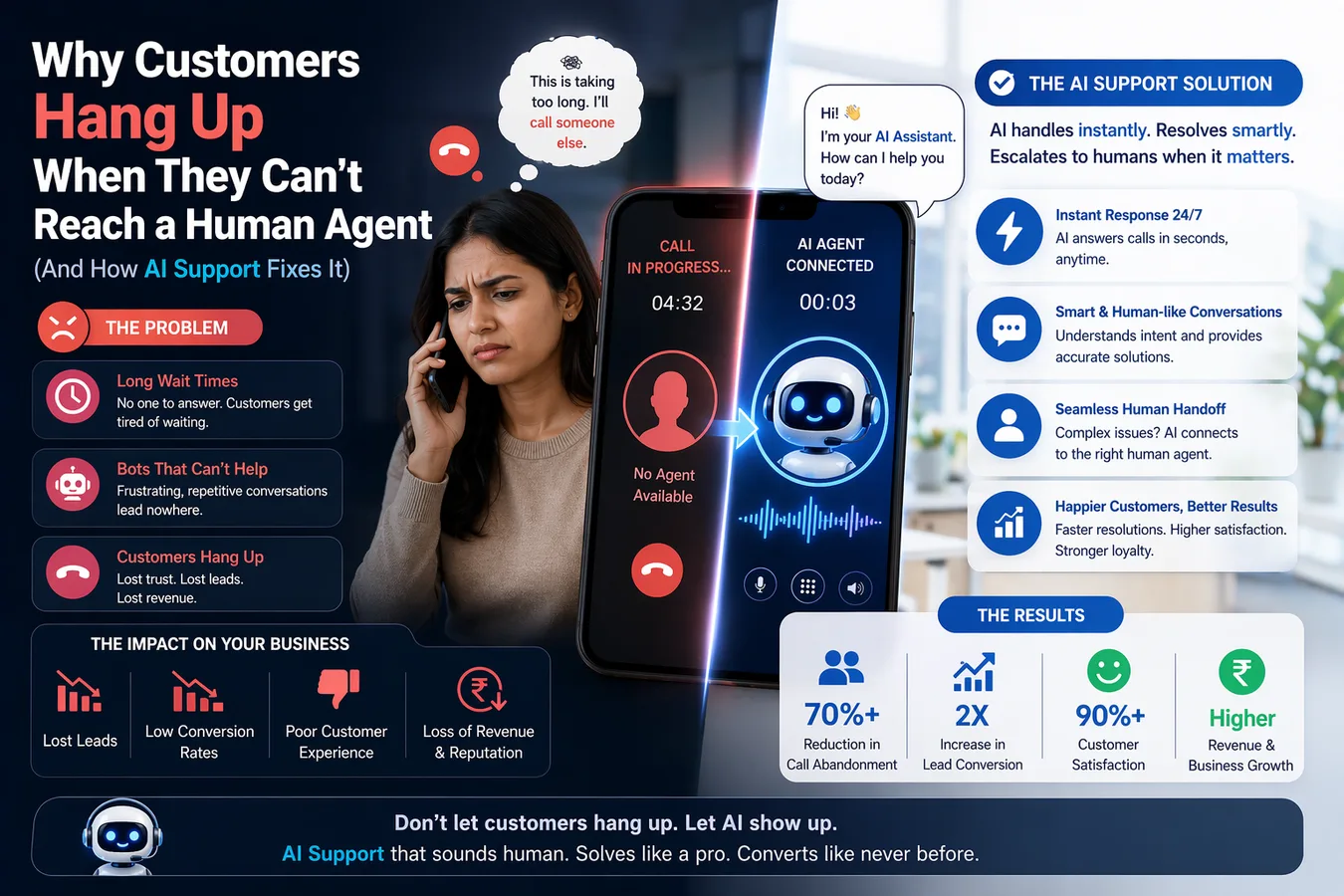
Customer call abandonment occurs when callers disconnect before resolution, often triggered by prolonged hold times, confusing IVR systems, and inability to reach a live representative when needed for complex or emotionally charged issues.
Introduction
When 60% of customers admit to hanging up on customer service agents [1], the problem extends far beyond long hold times. Research reveals that 34% of customers have yelled at support representatives [2], and 21% admit to cursing during service calls [2]—behavioral signals that point to deeper systemic failures in how businesses handle customer inquiries. The inability to reach a human agent when genuinely needed creates a frustration cascade: customers feel trapped in automated loops, dismissed by scripted responses, and anxious about whether their urgent issues will ever receive proper attention. EchoLeads addresses this challenge not by eliminating human agents, but by deploying AI customer support agents that intelligently triage inquiries, resolve routine questions instantly, and escalate complex cases to live representatives with full conversation context. This article examines the psychological and operational triggers that cause call abandonment, identifies which scenarios require human intervention, and explains how EchoLeads' intelligent AI triage reduces hang-ups while preserving the human connection customers demand for high-stakes interactions.
The Psychology Behind Customer Hang-Ups
Loss of Control and Perceived Dismissal
When customers call support, they're already experiencing a problem that triggered the need for help. Being unable to reach a human agent amplifies the original frustration by adding a secondary layer of helplessness. The customer feels dismissed—as if their issue isn't important enough to warrant personal attention. This perception of being devalued creates an emotional trigger that overrides rational patience. According to customer experience research, 43% of customers would rather clean a toilet than call customer support [2], a statistic that reveals the deep anxiety associated with modern support interactions. EchoLeads mitigates this by ensuring customers never experience dead-end automated loops; the AI customer care system acknowledges urgency signals in real time and escalates immediately when frustration thresholds are detected.
Fear of Misresolution and Wasted Time
Customers hang up not just because of wait times, but because they fear the interaction will waste their time without solving the problem. When trapped in IVR menus where none of the options match their issue, callers conclude the system cannot help them. Research shows that 79% of customers have repeatedly shouted 'Agent' or 'Representative' into automated systems before abandoning the call entirely [2]. This behavior reflects learned helplessness from past experiences where automation failed to understand nuanced requests. EchoLeads' AI voice support platform addresses this by using natural language processing to detect customer intent from the first sentence, bypassing rigid menu structures and routing callers based on what they actually need—not predefined categories that rarely align with real-world issues.
Trust Erosion From Repeated Transfers and Repetition
Being transferred multiple times—each time having to re-explain the problem—is one of the most cited reasons for call abandonment [3]. Every transfer signals to the customer that the previous agent either lacked authority, knowledge, or motivation to help. This creates compounding distrust: if the first agent couldn't solve it, why would the second? When customers finally disconnect, it's often a defensive decision to preserve their time rather than continue a conversation that feels unproductive. EchoLeads' intelligent call routing prevents this by capturing full conversation context during AI interactions and transferring only once—to the correct department with complete case history—eliminating redundant explanations and demonstrating organizational competence from the start.
Operational Failures That Trigger Hang-Ups
Excessive Hold Times Without Transparency
Long hold times cause abandonment, but lack of transparency makes it worse. When customers don't know how long they'll wait or whether they're making progress in the queue, anxiety spikes and patience erodes. Being placed on hold for over ten minutes only to be disconnected—whether by accident or system failure—instantly destroys trust [3]. EchoLeads eliminates hold-time uncertainty by providing instant engagement: AI inbound call handlers answer within seconds, acknowledge the customer's issue, and either resolve it immediately or provide a transparent timeline for human escalation with callback options if wait times exceed acceptable thresholds.
IVR Systems That Trap Rather Than Guide
Interactive voice response systems fail when they force customers into categories that don't match their actual needs. Poorly designed IVR menus create loops where no option leads to resolution, prompting customers to abandon the call rather than continue navigating a broken system. The frustration is compounded when 'speak to an agent' options are deliberately hidden or require navigating multiple menu layers. EchoLeads' conversational AI replaces rigid IVR trees with natural language understanding: customers describe their issue in their own words, and the system routes them intelligently without forcing them into predetermined boxes that rarely align with real support needs.
Agents Without Authority to Resolve Issues
When front-line agents lack the authority to make decisions, customers experience serial transfers to supervisors or specialized teams. This structural bottleneck frustrates both customers and agents, who understand the inefficiency but cannot bypass it [1]. The result is abandoned calls when customers conclude that no one they speak with can actually help them. EchoLeads addresses this through smart escalation logic: AI agents handle tier-1 queries autonomously with full resolution authority, while complex cases route directly to empowered human representatives—not to additional gatekeepers—ensuring the first human handoff goes to someone who can actually solve the problem.
When Customers Actually Need a Human Agent
High-Stakes Financial and Medical Issues
Certain issue categories inherently require human judgment: billing disputes, fraud alerts, insurance claims, medical triage, and cancellation requests. Customers facing these scenarios expect—and often legally require—human oversight because stakes are high and nuance matters. Forcing automation in these contexts increases abandonment because customers don't trust AI to handle sensitive decisions. EchoLeads' AI customer support platform recognizes high-stakes keywords and sentiment signals during conversations, automatically escalating to human agents when issues involve financial loss, health concerns, or account security—preserving trust by matching channel capability to problem complexity.
Emotionally Charged Complaints and Complex Technical Issues
When customers are angry, confused, or dealing with multi-layered technical problems, they need empathy and adaptive problem-solving—human strengths that AI cannot fully replicate. Attempting to resolve emotionally charged complaints through scripted automation escalates frustration and guarantees hang-ups. EchoLeads' sentiment analysis detects elevated emotional states in real time, triggering immediate human escalation before the customer reaches breaking point. This proactive intervention prevents the common scenario where customers endure increasingly frustrating automated interactions before finally demanding a supervisor—by which point trust is already damaged.
Preference for Human Connection in Relationship-Driven Contexts
Some customers simply prefer human interaction for relationship-driven businesses—financial advisory, healthcare, real estate. These callers aren't necessarily facing complex issues; they value personal connection and perceive automation as depersonalizing. Forcing AI-only channels alienates this segment and drives them to competitors who offer immediate human access. EchoLeads' multi-channel support accommodates preference by offering opt-out escalation: customers can request human agents at any point, and the AI transfers immediately with full context, respecting individual communication preferences rather than enforcing one-size-fits-all automation.
How AI Customer Support Agents Reduce Abandonment Without Replacing Humans
Instant Engagement Eliminates Initial Wait Frustration
EchoLeads' AI voice agents answer calls within seconds, eliminating the initial hold-time frustration that prompts early abandonment. The system engages immediately with natural-sounding voice, acknowledges the customer's issue, and begins intelligent triage while human agents handle other calls. This instant response signals competence and respect for the customer's time—psychological factors that reduce hang-up likelihood even if eventual human escalation is needed. For routine queries—password resets, order status, appointment confirmations—the AI resolves the issue entirely, freeing human agents to focus on complex cases that genuinely require their expertise.
Intelligent Triage Routes Issues to the Right Resource First Time
Misrouted calls waste customer time and guarantee transfers—a primary abandonment trigger. EchoLeads' AI triage system uses intent detection, account verification, and priority scoring to route customers to the correct department or agent on the first attempt. The system asks targeted qualification questions—budget authority, timeline urgency, issue classification—before escalating, ensuring human agents receive only cases they're equipped to handle. This precision routing reduces the serial-transfer problem that causes 60% of customers to hang up in frustration [1].
Context Preservation Prevents Redundant Explanations
When AI agents transfer to humans, EchoLeads provides full conversation transcripts, sentiment scores, and stated objections to the receiving representative. This eliminates the infuriating 'please explain your issue again' moment that destroys trust and prompts hang-ups. Human agents see exactly what the customer already discussed with AI, allowing them to continue the conversation seamlessly rather than restarting from zero. This context-aware handoff demonstrates organizational competence and respects customer time—two factors that directly correlate with call completion and satisfaction.
Designing Escalation Pathways That Preserve Trust
Escalation Trigger | AI Behavior | Human Handoff | EchoLeads Implementation |
|---|---|---|---|
High-stakes financial issue | Immediate transfer | Full context + priority flag | AI detects keywords (fraud, dispute, billing error) and routes to specialized team |
Emotional distress detected | Empathy acknowledgment + transfer | Sentiment score + transcript | Real-time sentiment analysis triggers human escalation before customer requests it |
Complex multi-step technical issue | Initial troubleshooting, then escalate | Diagnostic history + attempted solutions | AI attempts tier-1 fixes, documents results, transfers with full diagnostic log |
Customer explicitly requests human | Instant opt-out | No friction, full context | One-touch transfer with conversation history, no questions asked |
Routine inquiry (order status, hours) | Full AI resolution | No escalation needed | AI resolves completely, updates CRM, sends confirmation—no human involvement required |
Effective escalation design balances automation efficiency with human accessibility. EchoLeads' escalation logic uses deterministic triggers—not probabilistic AI guessing—to decide when human intervention is needed, ensuring compliance-critical and emotionally sensitive issues always reach live agents while routine queries resolve autonomously. This hybrid approach reduces overall call volume for human teams by 80% while maintaining 90% customer satisfaction [EchoLeads performance data], proving that the right escalation architecture increases both efficiency and trust simultaneously.
Frequently Asked Questions
Why do customers hang up even when AI agents answer immediately?
Immediate AI engagement reduces initial abandonment, but customers still hang up if the AI cannot understand their issue, forces them into irrelevant categories, or fails to offer clear human escalation. The key is intelligent triage that recognizes when AI has reached its capability limit and transfers proactively rather than trapping customers in unproductive loops. EchoLeads' natural language processing detects these situations and escalates before frustration peaks.
What types of issues should always be handled by human agents?
High-stakes financial disputes, medical triage, fraud alerts, cancellation requests with retention opportunities, and emotionally charged complaints require human judgment and empathy. Customers expect live agents for these scenarios because stakes are high and trust in automation is low. EchoLeads' escalation rules automatically route these issue types to human representatives with full context to ensure proper handling.
How does AI customer support handle customers who immediately demand a human agent?
EchoLeads offers instant opt-out: when customers request a human agent, the AI transfers immediately without friction, providing the receiving agent with full conversation history. This respects customer autonomy while still capturing context that prevents redundant explanations—a compromise that maintains efficiency without forcing unwanted automation.
Can AI support agents detect when a customer is about to hang up?
Advanced AI platforms use sentiment analysis, tone detection, and behavioral signals (repeated requests for agents, elevated frustration keywords) to predict abandonment risk in real time. When these indicators appear, EchoLeads' AI system can proactively offer human escalation, callback options, or expedited resolution paths before the customer disconnects, reducing actual abandonment rates significantly.
What happens if an AI agent transfers a customer to the wrong department?
Misrouted transfers recreate the serial-handoff problem that drives abandonment. To prevent this, EchoLeads uses skill-based routing with confidence thresholds: if intent classification falls below a certainty level, the AI asks clarifying questions before transferring rather than guessing. When transfers occur, receiving agents see classification rationale and can quickly reroute if needed—but proper triage design minimizes this scenario from occurring in the first place.
Related articles
6 Best AI Outbound Calling Solutions for Loan Verification
Compare AI outbound calling platforms that verify loan applications 24/7
5 Common Causes of Long Bank Loan Inquiry Call Wait Times
Why do bank customers complain about long wait times for loan inquiry calls? Learn the 5 Common Causes of Long Bank Loan Inquiry Call Wait Times.
4 Best AI Voice Lead Qualification Tools for Insurance
Compare AI voice platforms for insurance lead qualification through automated outbound calls.