
Why Do My Sales Reps Miss Hot Leads During After-Hours Calls?

Introduction
It is 9:47 PM. A customer who has spent the last two weeks researching SUVs online finally calls your dealership to ask about financing and a Saturday test drive. The phone rings six times.
Voicemail. The customer, unwilling to wait, dials your competitor before the morning alarm.
Your sales floor is empty, your team is asleep, and a high-intent, ready-to-buy lead has just evaporated. You will never know their name unless you fix the operational black hole that swallows your after-hours calls.
This silent revenue drain is not a staffing shortfall. It is a process failure. While you are closed, your best leads are shopping. The conflict between peak consumer shopping hours and standard business schedules creates a multi-lakh rupee leak that compounds monthly. The frustration of seeing web traffic spike at night with zero next-day appointments to show for it is a universal pain for Indian business owners.
You do not need a night-shift team you cannot afford. An integrated conversational AI voice agent can now answer inventory questions, provide precise pricing, and book a confirmed appointment into your CRM calendar before the customer hangs up. This guide breaks down the speed, technology, compliance, and economic framework to plug this leak permanently.
Key Takeaways
Before dissecting the operational mechanics, absorb the scale of the problem and the precision of the fix.
Speed dictates survival: Contacting a lead within 5 minutes makes them 21 times more likely to convert than waiting 30 minutes.
Volume is nocturnal: Between 56% and 60% of dealership leads arrive after your business hours, not during them.
The financial hemorrhage: With an average new-vehicle gross profit of $2,247, a stream of 400 monthly leads can leak an estimated ₹41 lakh in monthly gross profit directly through unanswered night calls.
The silent majority: 67% of customer calls happen outside traditional 9-to-5 hours, not just in automotive sales but across service businesses.
AI is the circuit breaker: An AI voice agent answers on the first ring, delivers vehicle-specific information from live inventory, and syncs the booking to a real-time pipeline without human intervention.
The After-Hours Revenue Gap: How Many High-Intent Leads You're Leaving Unanswered
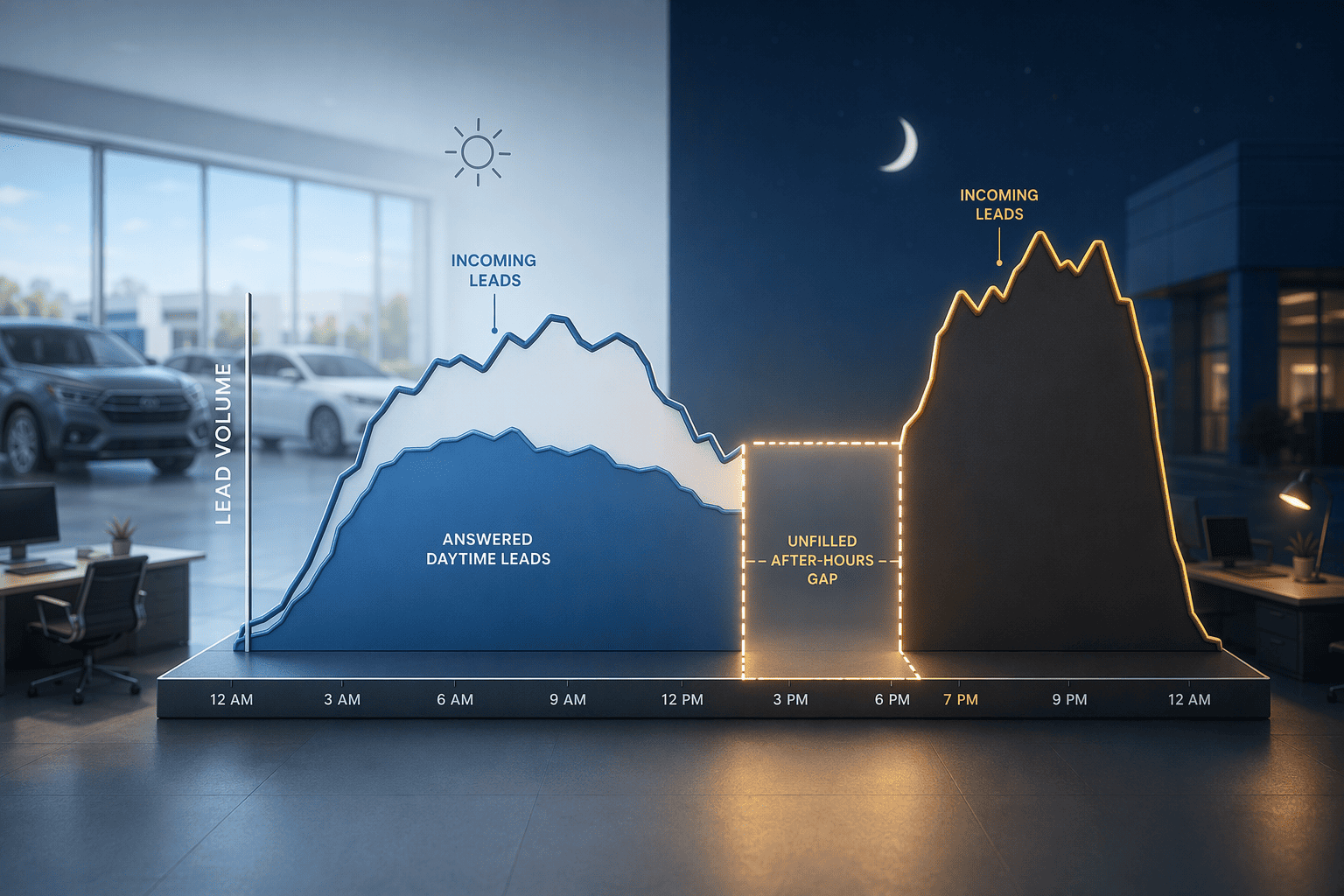
The clock does not stop being your enemy just because you turn off the office lights. Better Car People’s analysis of dealership lead patterns reveals a brutal truth: 56 to 60% of all dealership leads arrive when the BDC is closed. If your team clocks out at 7 PM, the majority of your potential revenue dials in after dinner, late at night, or during the early morning commute.
These are not casual browsers. A buyer who picks up the phone at 10 PM has already completed the heavy digital lifting. The data shows that 92% of consumers use digital channels to research vehicles and spend an average of 14 hours and 19 minutes online before making contact. By the time the call comes in, they have moved from consideration to intent. An unanswered ring is a rejection of their readiness to buy.
For Indian enterprises, this gap inflicts compound damage. While your physical lot is dark, a mobile-first consumer is scrolling inventory on their smartphone. The research phase ends with a call, not a form fill. The absence of an immediate, informative response forces the lead back into the open market where competitors are only a click away. You are not losing a lead; you are losing the result of a 14-hour, self-directed buyer journey.
Missed calls are not a metric to monitor. They are unrealized gross profit. Every silenced ring represents a fraction of a car sale leaving your pipeline for good.
The 5-Minute Window: Why Speed-to-Lead Dictates Conversion in the Indian Market
Contact attempts after 5 minutes are a form of lead disposal dressed up as follow-up. The landmark InsideSales.com and Harvard Business Review speed-to-lead study established the standard: an inbound lead contacted within 5 minutes is 21 times more likely to enter the sales cycle than one contacted after 30 minutes. The decay curve is exponential. At the 30-minute mark, you are no longer qualifying a lead; you are interrupting a prospect who has already given their attention to a faster dealer.
This urgency intensifies in the Indian market. Consumer attention is a depreciating asset in a high-choice, high-competition mobile environment. The Indian buyer demands immediacy and expects a real-time, context-aware interaction.
A brand that delegates an 11 PM call to a generic voicemail box fails to match the energy of the inquiry. When your rep returns the call at 10 AM the following day, the buyer has already experienced a full cycle of competition. The five-minute window is not a best practice here; it is the bare minimum barrier to entry for a valid sales conversation.
Root Causes: The Operational Failures That Miss Hot Leads Every Night
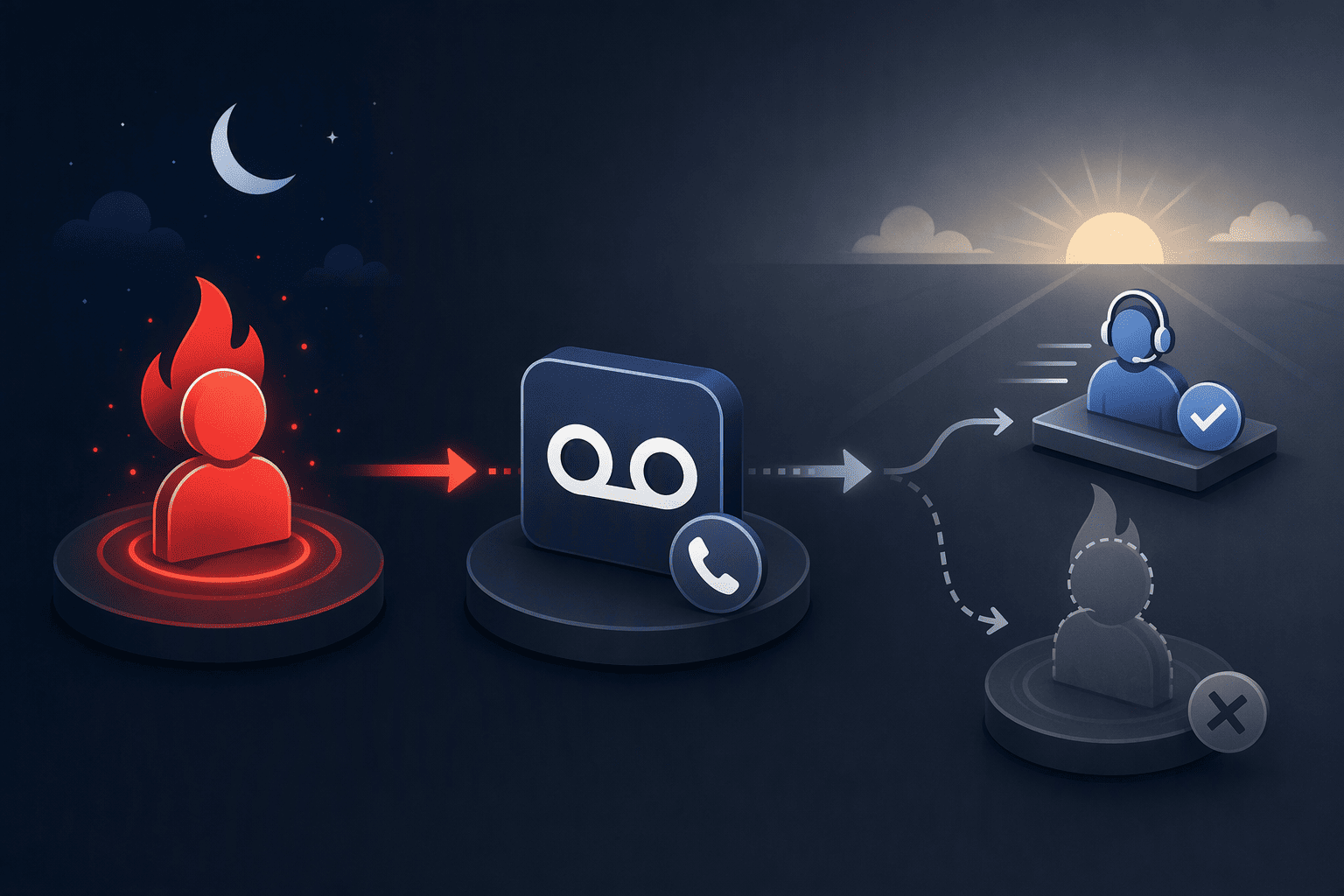
A buyer clicks 'submit' on a financing form at 9:43 PM after a marathon of research, but your systems treat that urgent signal like a Monday morning task. The breakdown happens in a predictable sequence.
Off-hours silence: Your store closes, and with it goes your ability to answer the phone. 56 to 60% of dealership leads arrive when your BDC is closed, each one hitting a voicemail that kills momentum.
Morning-delay bleed: By the time your team returns at 10 AM, competitors who answered instantly have already captured the buyer. A lead contacted within five minutes is 21 times more likely to enter the sales cycle than one reached at 30 minutes.
Pricing deflection: The human responder finally sends an email, but 74% of dealer responses omit a price quote. A buyer who spent 14 hours and 19 minutes researching online gets a vague invitation instead of a reason to stop searching.
Ghosting by apathy: 19% of dealers still take over an hour to respond, and 4% never respond at all. The silence turns high-intent buyers into the 43.2% of sales leads mishandled annually.
Lifetime value vaporized: A quiet CRM record isn't just one lost deal. It's a missed shot at 9.4 vehicles that the average customer buys over their lifetime, a relationship you never got to start.
How AI Voice Agents Deliver Sub-3-Second Answers That Close Deals 24/7
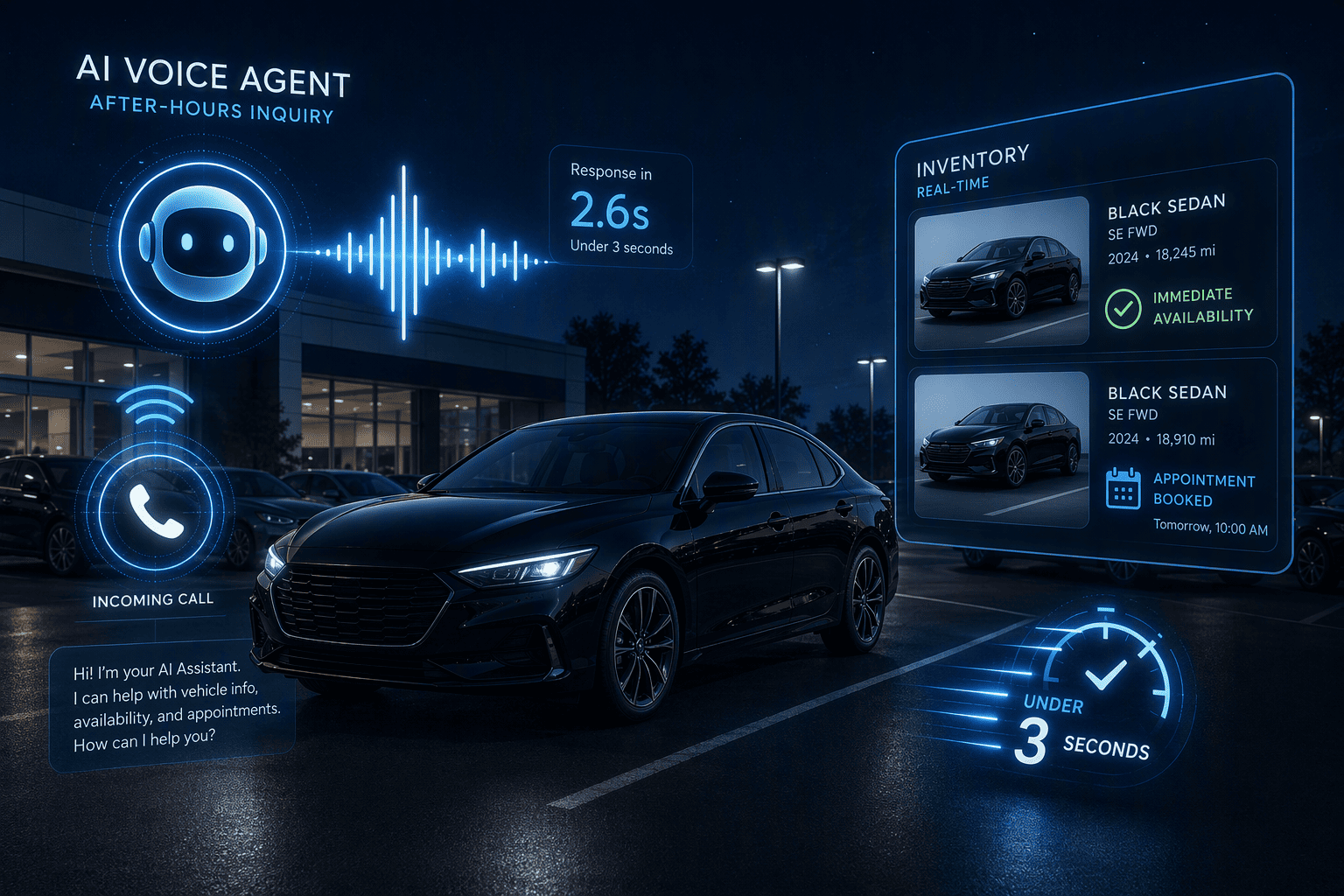
The phone rings at 10:15 PM and an AI voice agent picks up on the first ring. The caller asks whether the black sedan with the premium package is still on the lot. The agent checks live inventory, confirms it is available, and quotes the current price. The entire exchange starts within seconds. Platforms like EchoLeads, for instance, answer inbound calls in under three seconds and operate autonomously 24/7, turning after-hours inquiries into booked appointments synced directly to your Google Calendar, Outlook, or CRM scheduler.
This speed changes the economics of every missed call. Across industries, the drain is well-documented. Missing just five calls a day in a small business can bleed up to $1,500 per month in unrealized revenue assuming even a modest close rate. For a dealership with average gross profit of $2,247 per new vehicle, or a luxury store averaging $5,679 per unit, an AI agent capable of handling hundreds of simultaneous calls turns a cost center into an always-on revenue engine. The agent answers product questions with live inventory data, books test drives, and logs every interaction bi-directionally into your CRM of record.
For the Indian market, compliance is non-negotiable. Platforms must operate under TRAI rules for automated calling, with explicit consent handling and opt-out mechanisms. An effective deployment offers configurable voice scripts, multilingual support for regional languages, and instant CRM record syncing during live calls. The company emphasizes that these tools are not appropriate for emotionally charged conversations, and they are not replacements for human judgment in complex negotiations. They are the answer for the straightforward, high-intent inquiry at 11 PM that your sales team is currently missing.
The Non-Negotiable CRM Integrations: Syncing After-Hours Leads to Your Real-Time Pipeline
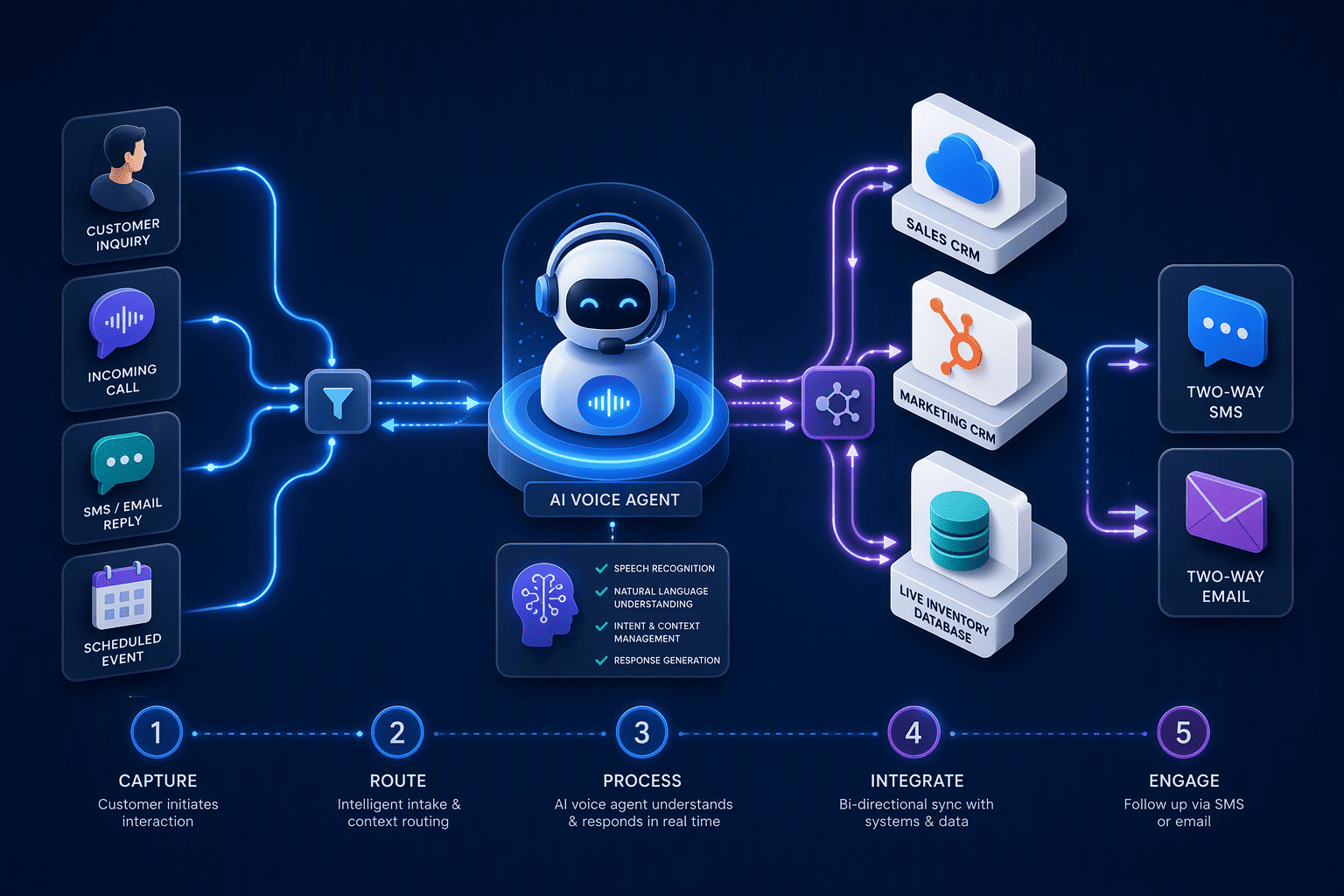
An answered call is worthless if the data from that call does not materialize in your sales pipeline before the next business day opens. You need a technical bridge between the voice layer and your operation. A platform like EchoLeads offers:
Bi-directional CRM sync: updates Salesforce and HubSpot records during live calls, so data flows both ways.
Live inventory pull: enables the AI to answer vehicle-specific questions accurately with current lot availability.
Automatic two-way calendar sync: writes a confirmed appointment into Google Calendar, Outlook, or your CRM scheduler without creating a conflict.
The moment the call ends, the lead object is enriched with a full transcript and categorized as a hot or warm prospect.
Calculating the Per-Lead Cost of Missed After-Hours Calls for Indian Businesses
Stop measuring missed calls and start measuring lost gross profit. The math personalizes the urgency.
Take an Indian dealership generating 400 total leads per month. Apply the benchmark that 56 to 60% of these arrive after hours, conservatively 224 nighttime leads. If your standard lead-to-sale conversion rate is 10%, that is 22 potential vehicle sales lost entirely to the voicemail void.
Now multiply by the unit economics. At a national average new-vehicle gross profit of $2,247, the total potential gross profit at risk for that single month is approximately $49,434 (over ₹41 lakh). If you sell luxury units averaging, gross profitper unit as seen with US benchmarks, the losses enter multi-crore territory swiftly.
Your current close rate is likely calculated only on the leads you actually receive during business hours. You are grading yourself on an artificially small denominator, ignoring the 224 leads that never entered the race. Plug in your own India-specific average gross profit, your monthly lead volume, and your BDC closing times. That bottom-line number is your cost of inaction.
Navigating TRAI Compliance: Consent, Scripts, and Local Language Mandates for Automated Calls
Automation does not exempt you from the Telecom Regulatory Authority of India (TRAI) regulations on commercial communication. Indian businesses deploying automated or pre-recorded voice calls for sales must operate inside a strict legal perimeter, or the penalties will far outweigh the revenue recovered. Key compliance requirements include:
Explicit consent: You must possess a record of the recipient's opt-in, with full traceability back to the digital consent medium, not a cold pitch based on scraped data.
Script adherence: The AI must announce its automated nature and the legal entity it represents at the call's opening, and it must never deviate into unapproved promises.
Functional opt-out mechanism: A mandatory option, such as pressing a specific key to disconnect and block future automated contact, must be active throughout the call.
For the Indian market, compliance has a language layer. Consent is considered meaningful only when delivered in the consumer's preferred language. Your AI platform must deliver fluid, natural speech in regional languages to obtain and execute a truly informed opt-in, not just a passive English script. A compliance-first platform ensures these TCPA and DNC frameworks are baked in. Your technology partner should provide a compliance package, not a legal disclaimer you have to build yourself.
Evaluating an AI Voice Platform for 24/7 Sales Coverage: A Capability Checklist
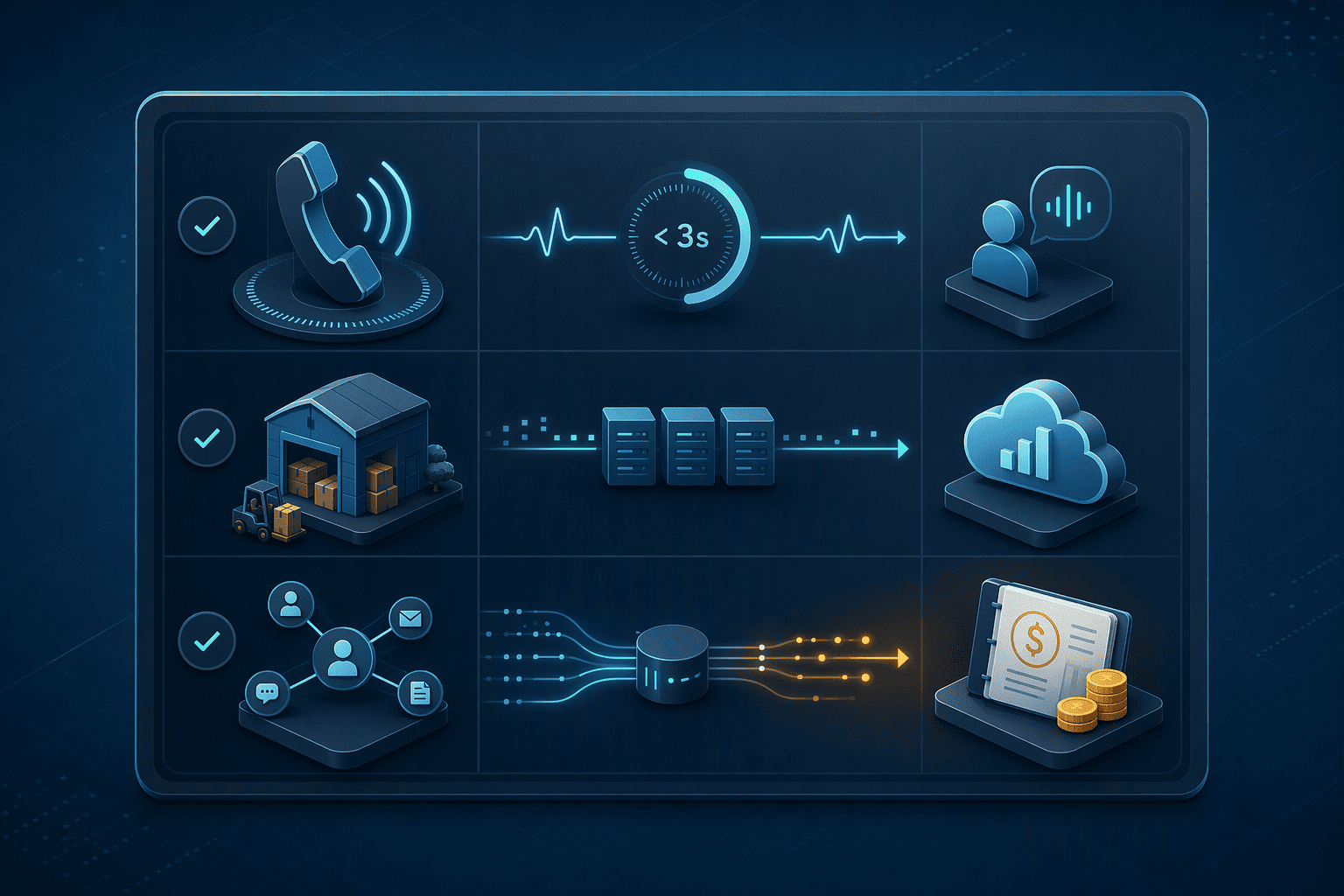
Use this framework to pressure-test vendors on their ability to turn night calls into next-day cash, not just log them.
Capability Dimension | Evaluation Criteria to Demand | Why It Blocks Revenue If Missing |
|---|---|---|
Answer Latency (Pickup Speed) | Confirmed sub-3-second answer on the first ring | Any delay beyond this mimics human hold times and kills an impatient after-hours buyer's engagement |
Live Inventory Sync (API Depth) | Bi-directional API access to real-time stock data, trim-level details, and location | Generic answers ("Let me check on that and get back to you") convert at a fraction of a specific, data-backed reply; see the 67% of leads lost after-hours stat for the baseline urgency |
CRM Handshake (Write-Back) | Native, real-time push of call transcripts, lead scores, and booked appointments into your CRM without middleware | Manual data entry erases the speed advantage. If the platform cannot write directly to your CRM, your team starts each morning with an admin backlog, not a hot lead list |
Caller Intent Detection | AI that classifies intent (urgent buy vs. part inquiry vs. wrong number) from the first 15 seconds of speech | Routing every call into the same script wastes live-transfer capacity on tyre-kickers and leaves real buyers waiting |
Regional Language & Dialect | Production-grade handling of Hinglish, code-switching, and major Indian languages, not just English with a token Namaste | A buyer who switches to Hindi or Telugu mid-call and gets a confused English reply drops off; India-specific platforms like FrontivaAI and Krid build for this reality |
Handoff Protocol | Intelligent escalation rules that page an on-call rep or schedule an immediate morning callback when the AI hits a confidence floor | An AI that stays on the line when it is confused creates a worse impression than voicemail. Clear handoff logic is the safety net |
Reporting That Drives Action | Daily summary: missed-call volume, conversion rate by hour, number of booked appointments, and revenue tagged | Without this, you are funding a black box. The cost of a missed call for a small business is already documented; you need the data to measure the fix |
Conclusion
Every missed after-hours call is a measurable drain on gross profit. You spend real money acquiring leads, then go silent during the 60% of the day when motivated buyers reach out. The math is not complicated: a 5-minute speed-to-lead window meets a 16-hour gap in coverage, and the revenue walks.
The leak is structural, not situational. Staffing cannot fix it because the economics of overnight shifts rarely close. An AI voice agent that reads live inventory, writes appointments straight into your CRM calendar, and respects TRAI consent rules completes the circuit that your current setup leaves open. Demand a sub-3-second, bi-directional integrated demo from any platform you evaluate, and run your own numbers through the gross profit loss formula first. That number will tell you exactly what the silence is costing.
Frequently Asked Questions
What operational gaps cause sales teams to miss hot leads during after-hours calls?
The primary gaps are absent call routing logic, voicemail that fails to capture intent, no automatic CRM lead creation from a missed call, and a complete absence of any automated follow-up sequence until the next business day begins.
How can AI voice agents prevent revenue loss from overnight and weekend inbound leads?
An AI voice agent answers on the first ring and performs a transactional conversation. It can pull live inventory, quote specific prices, and book a confirmed test-drive directly into a sales rep's calendar in real time, converting the query to a pipeline entry instantly.
What CRM integration capabilities are key for real-time lead capture after business hours?
A live inventory API pull is key so the agent confirms vehicle availability. Automatic, two-way calendar sync is also critical to book confirmed appointments without double-booking, ensuring the human sales team sees a ready-made schedule at the start of the day.
What compliance risks do Indian businesses face when using automated after-hours call handling?
Businesses risk violating TRAI regulations on unsolicited commercial calls. Automated contact requires obtaining explicit, traceable prior consent, an in-call mandatory opt-out mechanism, and scripts that do not deviate from the purpose the customer originally consented to.
How do after-hours lead response times impact conversion rates in the Indian market?
A lead contacted within 5 minutes is 21 times more likely to convert than one contacted at 30 minutes. In India, mobile-first buyers with high expectations will not wait for a next-day callback, making real-time, AI-driven response the only way to protect conversion rates.
What should Indian businesses look for when evaluating AI voice platforms for 24/7 sales coverage?
Demand confirmed sub-3-second pickup latency, native fluency in the region's local languages, a complete TRAI compliance package not requiring separate legal coding, and bi-directional CRM sync that writes enriched call summaries and appointments directly into the pipeline.
Related articles
8 Best Tools to Qualify Leads Automatically Over the Phone in 2026
Compare 8 tools that can automatically qualify leads, reducing tedious work for your sales reps.
Which AI Platforms Run Outbound Lead Qualification Calls 24/7 Without a Human Team?
Lear how certain AI platforms can automate lead qualification 24/7 without a human team.
Book More Appointments Without Hiring a Single New SDR: A 6-Step Hybrid Playbook
Lear how to employ sales automation platforms to automate appointment booking without losing leads after working hours.