
Which AI Platforms Run Outbound Lead Qualification Calls 24/7 Without a Human Team?
Introduction
Your marketing team just dropped a fresh batch of 500 inbound trial sign-ups at 1:45 AM IST. By the time your SDRs log in at 9:30 AM, more than 60% of those leads have already researched a competitor, filled a rival's callback form, or simply gone cold. Waiting until morning in modern demand generation is the equivalent of leaving the front door wide open while your best inventory quietly walks out the back.
Staffing a full-fledged 24/7 human inside-sales team across Indian night shifts and weekends is ruinously expensive. Once you factor in salaries, shift differentials, infrastructure, attrition, and idle time when dialing low-intent lists, the unit economics fall apart fast. AI voice agents have moved from an experimental curiosity to the lean, always-on answer to this specific pain point, capable of engaging, qualifying, and routing leads the moment they appear on your list, with a 40 to 60% reduction in outbound qualification cost compared to equivalent human bench strength.
It is not science fiction. Platforms specifically built for the Indian business environment now deploy voice-enabled large language models that listen, adapt scripts, handle interruptions, and decide in real time whether a lead is worth a salesperson's calendar slot. You do not need a graveyard shift team. You need the right platform, configured for your BANT criteria, with a rock-solid compliance wrapper. This article breaks down exactly which platforms do this, how they work under the hood, what they really cost, and where their limits lie, so you never lose another after-hours lead to silence.
Key Takeaways
AI voice agents change the economics and speed of outbound qualification entirely. Here is what matters most before you commit:
Platform options: Core players include Convin, Vodex, Vapi, Air.ai, and Retell AI, each built on LLM-driven conversational engines rather than static auto-dialers.
Cost envelope: Per-minute rates across Indian providers typically land between ₹0.80 and ₹2 when telephony and tokens are unbundled; fully bundled production-grade options can bring the all-in rate much lower.
Compliance lock: Mandatory TRAI compliance requires live DND scrubbing against the NCPR, explicit consent recording, and an active opt-out mechanism; platforms that automate this turn a legal risk into a configuration checkbox.
CRM sync: Bi-directional integration with Salesforce and HubSpot is table stakes, look for real-time call recording logs, lead scores, and transcript ingestion that update pipeline stages without manual effort.
Human boundary: AI cannot close complex, emotionally charged deals. The correct architecture keeps an escape hatch: keyword-triggered, sentiment-triggered, or score-triggered warm handoff to a human representative who inherits full call context.
What Is an AI Voice Agent for 24/7 Outbound Lead Qualification?
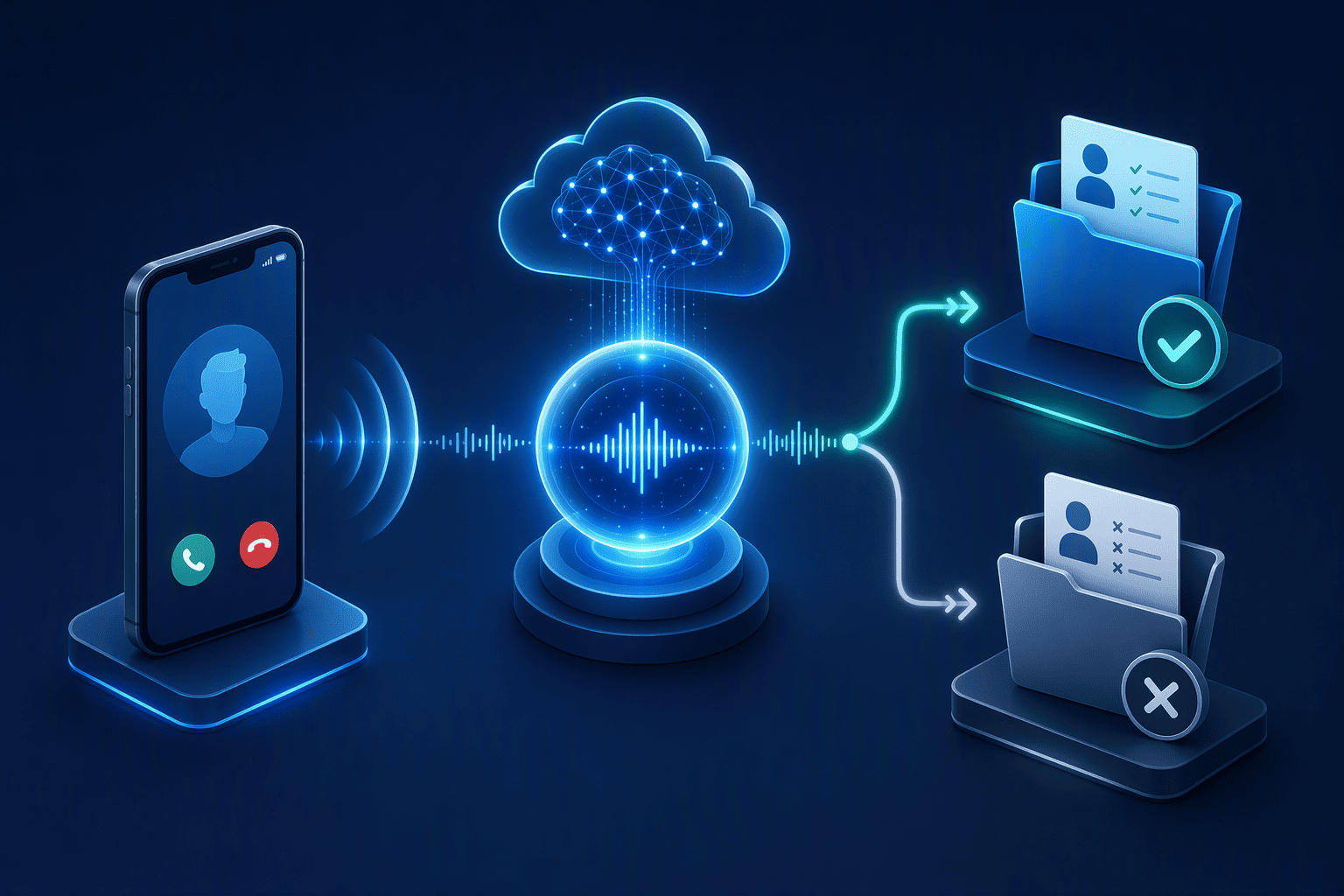
An AI voice agent for outbound lead qualification is a cloud-based software entity that initiates phone calls to prospects, evaluates their buying intent through a two-way spoken conversation, and decides in real time whether the lead meets predetermined criteria, all without a human touching the dialer. It layers a voice interface on top of a large language model to achieve dynamic, unscripted exchanges rather than robotic survey playback. While a traditional auto-dialer or IVR reads a fixed tree, an AI agent hears a hesitant pause, adjusts its tone, rephrases the question, and handles objections using contextual intelligence.
This agent listens, scores, and routes. The conversation flows naturally because the LLM generates sentences in response to what the prospect actually says, not where a dialpad press points. It can manage off-script tangents, qualify using BANT or custom frameworks, and update your CRM pipeline while the conversation is still in progress.
Think of it as a reasoning layer wearing a human-sounding voice. The automation is not about faster rote dialing; it is about giving the cognitive work of the early-stage qualification call, the listening, probing, and categorizing, to a machine that never stops.
The Core Platforms Powering Autonomous Outbound Calls
The platform landscape is crowded, but a handful of names surface consistently in Indian production deployments. Convin leans heavily into conversation intelligence baked into its voice gateway, making it a strong fit for teams that want deep post-call analytics layered on top of the dialer itself. Vodex carved out a niche by automating TRAI's DNC scrubbing and consent-recording workflow at the platform level, a major lever for Indian operators who cannot afford a compliance misstep. Vapi and Retell AI approach the market more as developer-first voice infrastructure layers: you bring the LLM prompt, and they provide the ultra-low-latency pipeline and API endpoints to assemble a custom voice agent, including direct integration paths into HubSpot.
Air.ai focuses on cloning brand-specific voice mannerisms and running long-duration humanlike conversations that stretch well past the typical 60-second qualification window.
Retell AI is a common starting point when engineering teams need to stand up a minimum viable voice agent fast. As HubSpot's own developer content notes, RetellAI provides the foundation for building a conversational interface and voice AI agent programming environment. The integration pattern they outline is instructive, a front end that triggers a serverless function to pull a call ID from Retell, another that stores the transcription as a ticket, and it reflects the modularity that most Indian SMBs need when fitting an AI dialer into an existing Salesforce or HubSpot instance.
Platforms like Voice Logica and Qfix further fill out the mid-market with turnkey offerings that prioritize end-to-end automation. From the first contact to the handoff to the sales team, the process is executed automatically by the AI Voice Agent, and predefined qualification criteria are applied inside the conversation to categorize each lead before CRM records are automatically updated with the outcome. The choice between them often comes down to whether your stack needs a purpose-built compliance wrapper, a developer playground, or a one-click managed service.
How the Qualification Engine Works Under the Hood
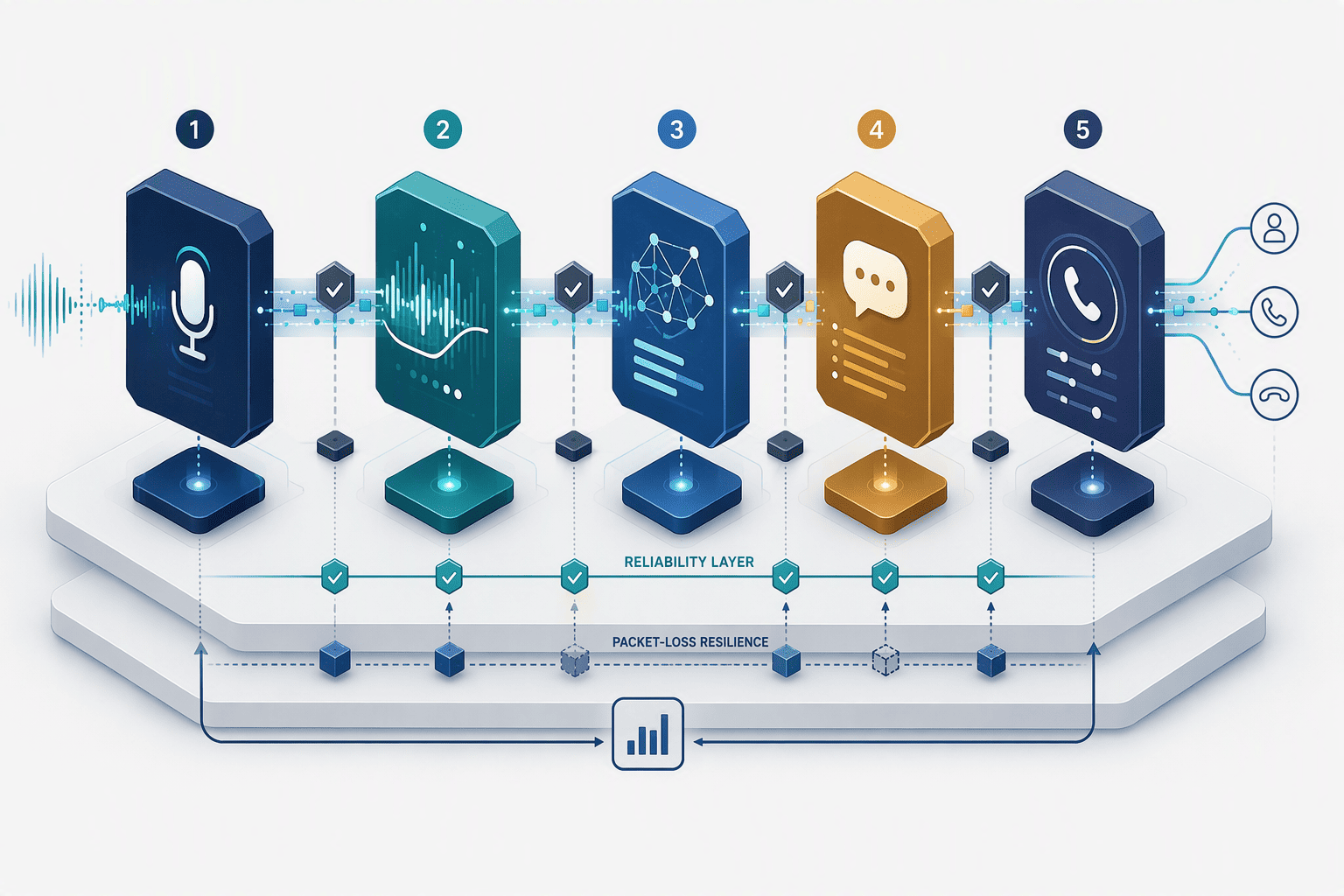
A polite voice call hides a chain of interdependent technical decisions.
Component | Reliable Production Agent | Brittle Proof-of-Concept |
|---|---|---|
Audio encoding | Uses low-bitrate codecs (Opus) with packet loss concealment to tolerate patchy Indian mobile networks | Defaults to uncompressed PCM audio, causing robotic breakup under real-world jitter and bandwidth constraints |
Voice activity detection | Runs an adaptive VAD model that distinguishes a prospect's thoughtful pause from a true end-of-turn, preventing mid-sentence cutoffs | Relies on a simple energy threshold that either truncates slow speakers or dead-airs into awkward silence |
Streaming speech-to-text | Processes audio in 100 ms chunks with interim results, enabling the agent to start composing a reply before the prospect finishes speaking | Waits for a full utterance boundary before transcribing, injecting latency that makes the conversation feel laggy and scripted |
Entity extraction layer | Applies a domain-specific NER model (tuned on Indian financial product names) to capture exact employer names, salary figures, and loan amounts from informal phrasing | Uses a generic off-the-shelf parser that misreads Indian-English code-switching and drops numeric qualifiers like 'around 8 lakhs CTC' |
Qualification logic microservice | Evaluates rules against extracted entities in a deterministic state machine; a hard 'no' from a core policy filter triggers an immediate graceful exit to save cost | Runs rules as post-processing on the raw transcript, meaning a call continues for 2 extra minutes only to fail qualification on a condition that was clear at the 30-second mark |
Text-to-speech synthesis | Uses a low-latency neural TTS model streamed via WebSocket, with SSML-tagged phrasing so the agent breathes naturally and emphasizes policy-critical questions (e.g., 'Are you currently in an active EMI?') | Plays static pre-generated MP3 prompts concatenated on-the-fly, producing an uncanny disjointed rhythm that signals 'robot' immediately to the prospect |
Telephony termination | Hooks into a tier-1 carrier's SIP trunk with local Indian DIDs and automatic STD code matching so the call appears from a local number in the prospect's city | Routes over an unoptimized VoIP aggregator; calls display as spam-likely 'Personal' or land out-of-state, dropping pickup rates below 5 percent |
Critical CRM Integrations for the Indian Ecosystem
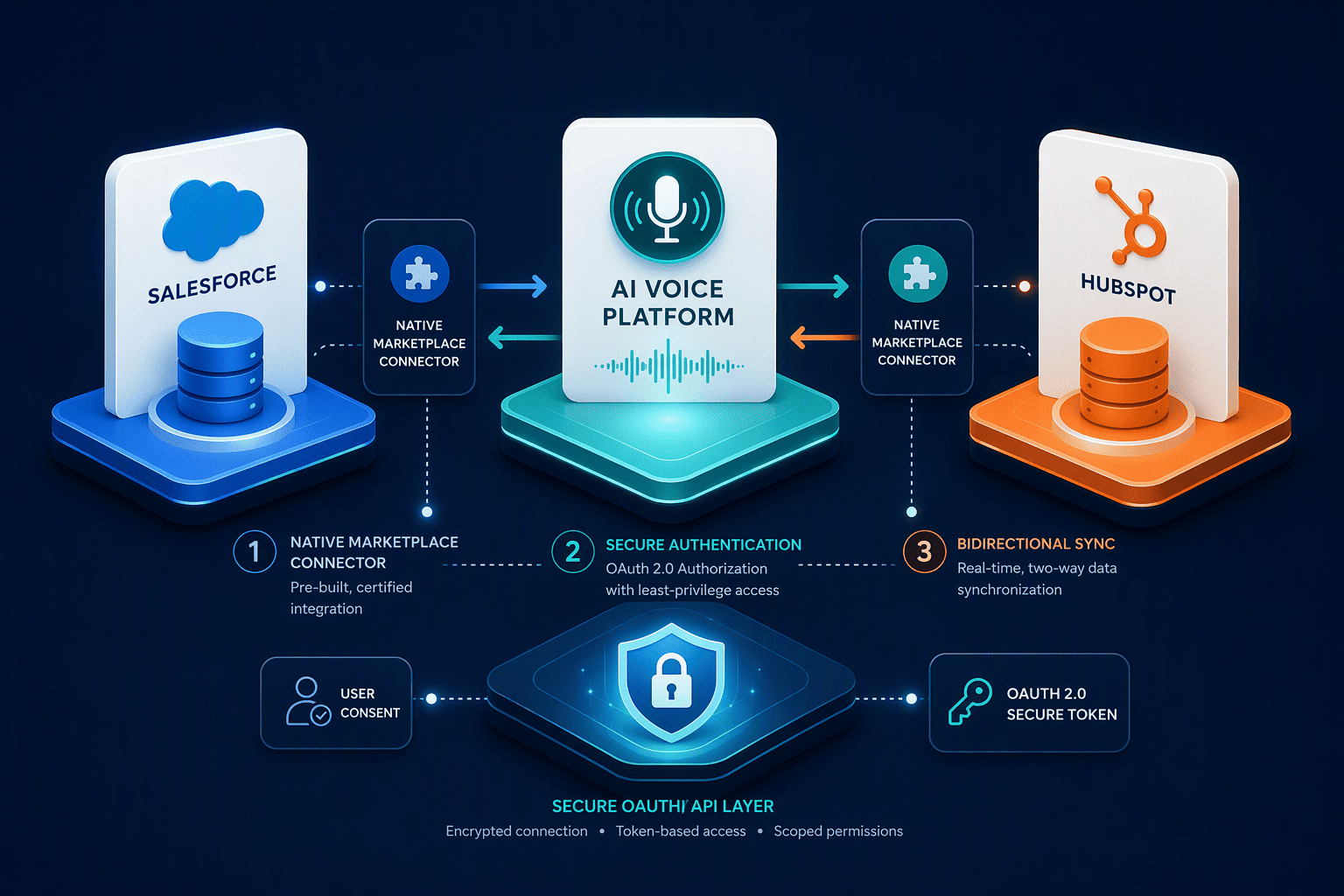
For an autonomous outbound agent, the CRM is not a post-call diary. It is the live nervous system. In the Indian mid-market, Salesforce and HubSpot dominate, and most qualifying platforms target them first. Here is how a well-architected integration ensures a lead never gets orphaned:
Establish the bi-directional connection via OAuth or an API key inside the platform’s native marketplace rather than a generic Zapier bridge. Direct connectors keep latency low enough to read the contact record while the phone is still ringing.
Sync the full contact object at the top of the call so the agent knows whether it is speaking to a fresh list entry or a recycled cold lead, avoiding the awkwardness of re-qualifying someone who spoke to your team last week.
Stream the call recording and the time-stamped transcript as an activity record attached to the relevant lead, contact, or ticket in real time. The architecture described in the HubSpot developer integration pattern uses a serverless function to retrieve the conversation transcription from the voice engine and store it as a new record with custom fields.
Push a qualification score and a status update that triggers a pipeline stage shift inside the CRM. If a lead crosses the score threshold, the CRM automation should fire the handoff notification to the assigned rep instantly.
Write the scheduled appointment directly into the CRM’s calendar object while simultaneously placing it on the salesperson’s Google Calendar or Outlook. EchoLeads, for example, books appointments directly into a team’s calendar using CRM-based schedulers, ensuring no double-booking occurs during autonomous after-hours operation.
Close the loop by syncing all post-call metadata back to the CRM’s activity history for attribution reporting. Call outcome, duration, and disposition code must flow into standard reporting views so that campaign ROI visibility does not require a separate analytics tool.
Navigating India’s Regulatory Maze: DND, Consent, and Data Privacy
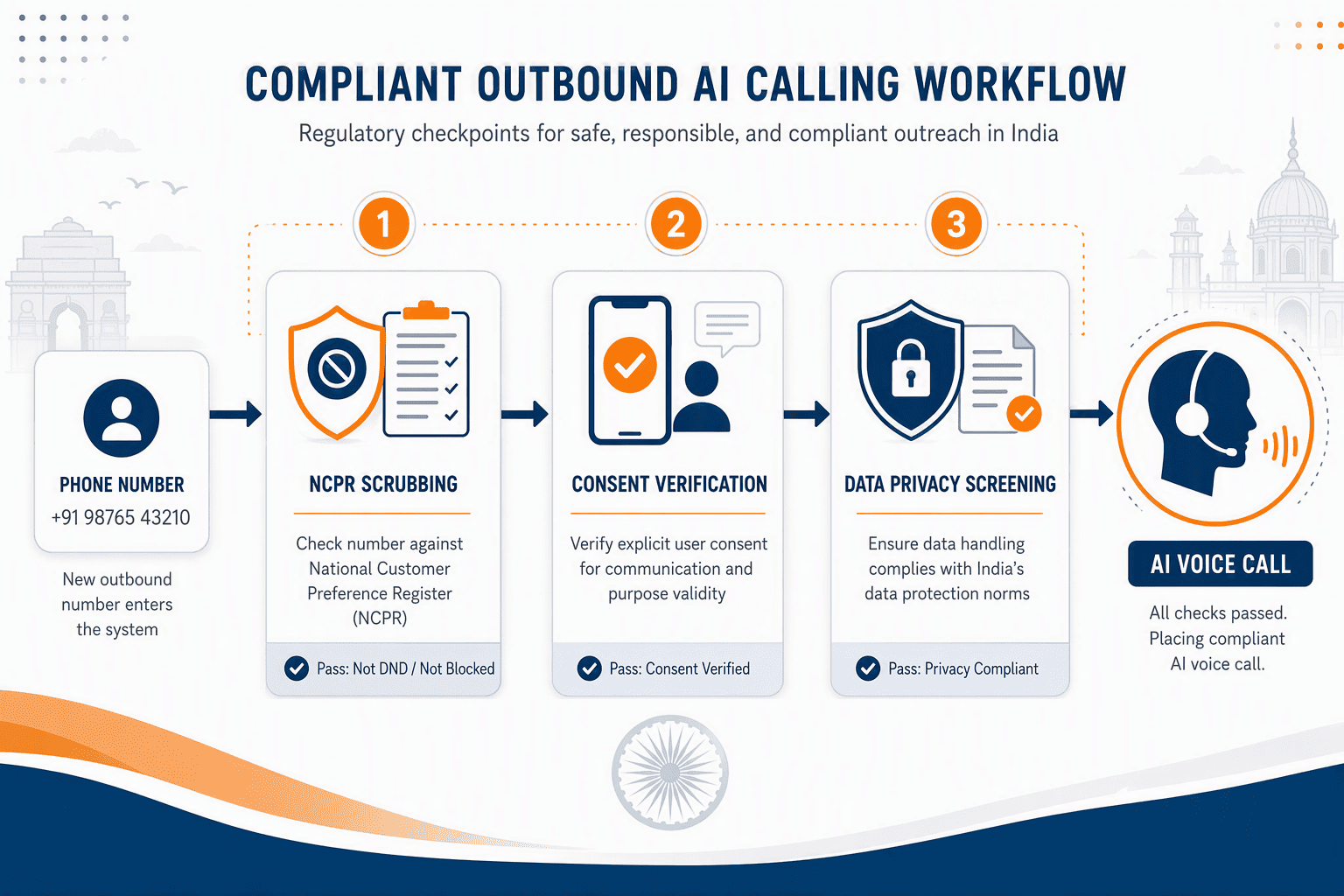
Operating an AI voice agent on Indian phone networks without tight compliance is not a gray area, it is an existential risk. The Telecom Regulatory Authority of India (TRAI) and the Department of Telecommunications impose hard requirements that the automated dialer must satisfy on every single outbound attempt. The three key compliance steps are:
National Customer Preference Register (NCPR) scrubbing: Before dialing, the platform must electronically scrub every target number against the updated DND list in near-real time, since the register constantly evolves.
Explicit recorded consent disclosure: At the very start of each call, the AI agent must deliver an identifying consent statement and capture the prospect’s affirmative verbal agreement before proceeding to a qualification script, retaining that audio as an immutable compliance log.
Functional opt-out mechanism: A clear verbal command that must remain available at every point, triggering immediate removal from the campaign and an automated mark in the CRM’s suppression list.
The regulatory frame is tightening further with the progression of the Digital Personal Data Protection (DPDP) Act, which adds data-minimization and purpose-limitation obligations on top of the telemarketing consent rules. For a business operating at scale, the safest path is a platform that bundles NCPR scrubbing, consent recording, and opt-out enforcement into a single compliance module, leaving no room for a midnight configuration drift to open a liability.
Designing the Human Handoff: When AI Passes the Baton
No autonomous voice agent closes every conversation. The real work is programming the exact moment silence ends and a warm transfer begins. The best architectures treat handoff as a core state inside the call flow, not an afterthought. Three conditions typically trigger it:
Keyword-based pivot: The agent detects an objection pattern it hasn't been trained to handle.
Negative sentiment vector: Sentiment crosses a negative threshold, signaling rising frustration.
Qualification-ceiling break: The lead's score hits a tier that needs a consultative sales conversation instead of a screener script.
EchoLeads, operating out of the Hyderabad ecosystem, lets businesses configure these handoff triggers directly. Escalation can fire on specific conversation keywords, real-time sentiment scoring, or an explicit request from the prospect to speak with a person. When the trigger fires, the system initiates a SIP warm transfer with full context injection. The human rep sees more than a ringing line. They get the conversation transcript up to that point, the lead's qualification score, the CRM record, and a short AI-generated summary of the objection that caused the escalation. The prospect simply continues one fluid conversation, with no restart.
The True Cost of Conversation: Pricing Models and Hidden Expenses
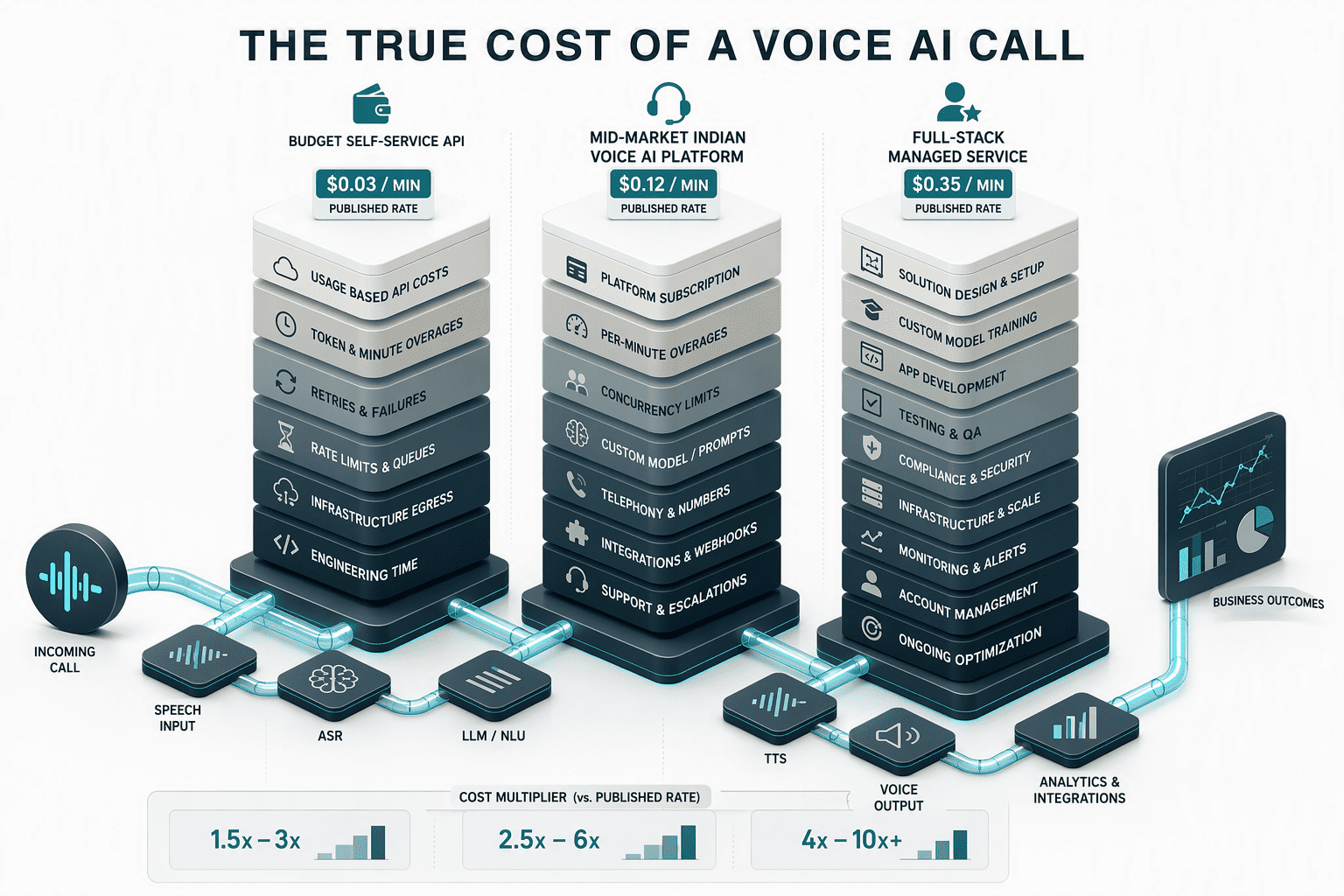
A headline per-minute rate quoted on a landing page is rarely the true blended cost of a production AI voice call.
Cost Component | Budget Self-Service API Provider | Mid-Market Indian Voice AI Platform | Full-Stack BPO-Style Managed Service |
|---|---|---|---|
Published per-minute rate | ₹0.50 to ₹1.20 per minute for bundled STT, logic, and TTS on shared infrastructure | ₹1.50 to ₹3.00 per minute including a dedicated telephony pipeline and basic qualification logic | ₹4.00 to ₹8.00 per minute bundled with a human-in-loop fallback and end-of-day lead dispatch |
Telephony carriage | None included; you bring your own SIP trunk or use a pay-as-you-go aggregator that adds ₹0.40 to ₹0.80 per connected minute | Included in the rate via a tier-1 carrier with local DID, though STD surcharges on inter-circle calls may apply separately | Fully absorbed, with real-time carrier failover, so you never pay for a dropped ring or a dead-air connect |
Concurrency and idle cost | Charges by audio length processed after VAD trimming; you pay full minute rate for the silence while a prospect puts the phone down to fetch a payslip | Charges by wall-clock call duration from pickup to hangup, incentivizing the platform to minimize dead air through tight turn-taking logic | Typically charges a fixed block (e.g., 3-minute minimum) but refunds or waives charges for calls under 20 seconds that hit a hard disqualifier |
Tooling and integration fee | Zero included; you build your own no-code flow, manage serverless function cold starts, and debug dropped webhooks through logs | A ₹25,000 to ₹75,000 one-time setup fee for CRM integration (Zoho, Salesforce, LeadSquared) plus a visual flow builder accessible to a sales ops manager | ₹1,00,000 to ₹3,00,000 onboarding fee covering custom integration, a dedicated solution engineer, and 2 weeks of live-call shadowing to tune the qualification script |
True blended cost at 5,000 calls/month | ₹8,000 to ₹15,000 monthly (₹1.60 to ₹3.00 per call) after factoring telephony, self-managed engineering hours, and wasted minutes from poorly trimmed silence | ₹45,000 to ₹75,000 monthly (₹9.00 to ₹15.00 per call) with no hidden telephony markup but a premium for deterministic qualification logic that stops unqualified calls early | ₹1,20,000 fixed monthly fee plus ₹4 per qualified lead pushed to your CRM, netting ₹24 to ₹40 per handled conversation when you account for fully burdened talk-time and human-loop costs |
Limitations and Risks in Complex Sales Dialogues
An autonomous voice agent that handles 80% of your qualification volume brilliantly can still damage a brand on the 20% it was not designed to navigate. The two primary risks are:
Emotional or complex conversational pitfalls: Current voice LLMs falter when a conversation veers into deeply emotional territory, a frustrated buyer raising their voice, layered sarcasm, or a technical objection requiring four domain-specific qualifications, risking generic deflection loops or, more dangerously, hallucinating discounts or capabilities the company cannot honor.
Indian linguistic complexity: A model that performs perfectly on Hindi and English can still stumble on thick regional accents, rapid code-switching between Tamil and English, or a heavy mix of colloquial banking terms in a vernacular language. While the underlying engine may claim support for over 10 Indian languages including Hindi, Tamil, Telugu, Kannada, and Bengali, accent robustness in production is a distinct, harder benchmark. Every platform must be tested on your own target dialect before scaling.
Conclusion
AI voice agents for outbound lead qualification work in India right now. They handle calls, qualify leads, and update records at any hour for a cost well below a human night-shift team. The technology is no longer a fragile prototype.
The return depends on three specific conditions. First, the platform must handle Telecom Regulatory Authority of India compliance in a way that does not add friction. Second, the CRM connection must treat the agent as a continuous data feed, not a batch log uploaded after the call ends. Third, the team needs a clear, unsentimental map of when a lead moves from AI to a human closer.
When those pieces are in place, the SDR role changes. It becomes a mix of AI supervision and high-trust sales consultation. The measurable outcome is a revenue engine that runs around the clock while skilled people spend their time on conversations that require judgment and relationships.
Frequently Asked Questions
What platforms offer AI voice agents that handle outbound lead qualification calls autonomously 24/7 without human intervention?
Key platforms include Convin, Vodex, Vapi, Air.ai, and Retell AI. Each uses voice-enabled large language models (LLMs) to make dynamic outbound calls. Voice Logica and Qfix also deliver turnkey autonomous qualification with automated CRM updates and handoff routines, enabling 24/7 operation without a live agent touching the dialer.
How does 24/7 AI outbound lead qualification integrate with existing CRM systems like Salesforce and HubSpot in the Indian market?
These platforms sync call recordings, transcripts, lead scores, and pipeline stage updates directly into Salesforce and HubSpot in real time. A typical integration stores the transcription as a CRM activity and updates the contact record during the call, enabling immediate follow-ups and eliminating manual data entry.
What are the compliance and regulatory requirements for deploying autonomous AI voice calling for lead qualification in India, including DNC and consent recording?
Indian telemarketing rules require real-time scrubbing of every number against the National Customer Preference Register (NCPR), an explicit recorded consent disclosure at the start of the call, and a functional opt-out mechanism on every call. Platforms like Vodex automate this DNC compliance loop to reduce regulatory risk.
What are the cost structures and pricing models for AI-powered outbound lead qualification platforms in India, and how do they compare to human-led SDR teams?
Indian AI voice platforms charge per-minute rates between ₹0.80 and ₹2 for unbundled usage, while bundled, production-grade options land around ₹4 to ₹5 per minute. Compared to a human SDR team, AI solutions can reduce outbound qualification costs by 40 to 60% by eliminating salary, infrastructure, and idle-time expenses.
What are the critical limitations and risks of using fully autonomous voice AI for outbound lead qualification, particularly in complex or sensitive sales scenarios?
AI agents struggle with emotionally charged objections, heavy sarcasm, and deeply technical rebuttals. They also risk hallucinating offers under pressure. Regional accent variance and rapid code-switching between Indian languages remain challenging. Too much unchecked autonomy can expose a brand to reputation and relationship damage.
How do businesses configure escalation and handoff triggers from an AI voice agent to a human representative during an outbound qualification call?
Escalation triggers are configured around keywords, sentiment scores, or explicit prospect requests. When the AI detects a blocker, it initiates a warm transfer that injects the full conversation transcript, lead score, and CRM record onto the human agent’s screen, enabling a smooth, context-rich handoff.
Related articles
8 Best Tools to Qualify Leads Automatically Over the Phone in 2026
Compare 8 tools that can automatically qualify leads, reducing tedious work for your sales reps.
Why Do My Sales Reps Miss Hot Leads During After-Hours Calls?
Learn how you can still take calls after working hours without hiring additional sales reps.
Book More Appointments Without Hiring a Single New SDR: A 6-Step Hybrid Playbook
Lear how to employ sales automation platforms to automate appointment booking without losing leads after working hours.