
6 Best AI Real Estate Lead Qualification Solutions
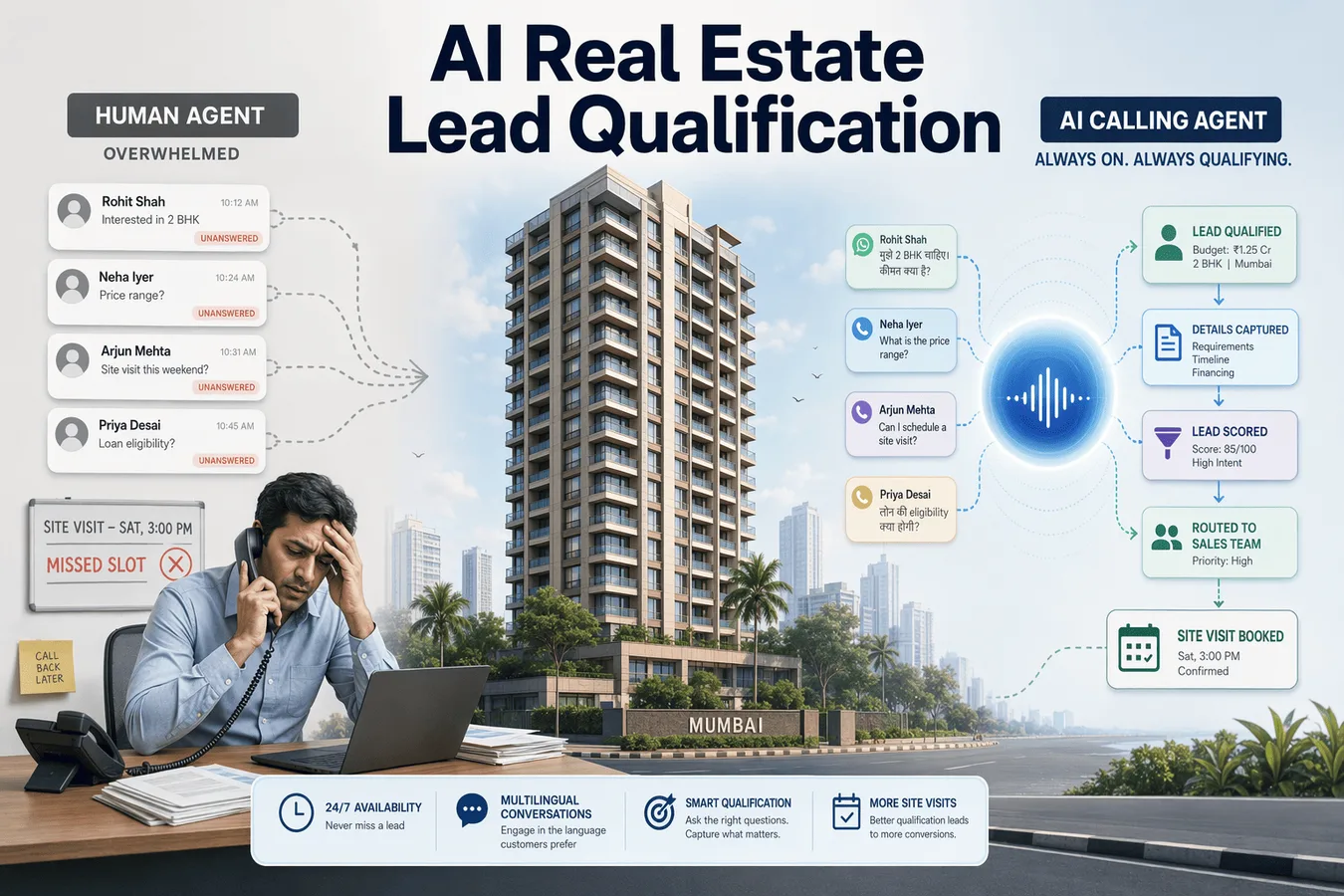
Mumbai's real estate market demands instant lead response. AI calling agents now qualify property leads and book site visits autonomously, handling multilingual conversations and CRM updates without manual intervention.
Key Takeaways
Conversational AI platforms adapt follow-up questions dynamically, while IVR systems use fixed menu trees for routing and basic capture.
Mumbai-focused platforms must support Hindi, Marathi, and Kannada to match regional buyer demographics and prevent early-call drop-offs.
Bi-directional CRM sync enables real-time lead scoring and custom field mapping, critical for enterprise real estate workflows.
Omnichannel coordination—voice, WhatsApp, SMS—significantly improves site visit confirmation rates compared to voice-only outreach.
Indian call recording laws require prior consent, yet vendor documentation often lacks jurisdiction-specific compliance workflows.
Several AI platforms qualify property leads and book site visits automatically without human agents — EchoLeads, AI YUKT, LeadNXT's IVR service, and similar systems handle inbound inquiries, capture budget and timeline preferences, and confirm site visits across voice, WhatsApp, and SMS channels. Conversational AI agents like EchoLeads and AI YUKT use dynamic branching to adapt follow-up questions based on responses, while traditional IVR systems rely on fixed menu trees that route callers through predefined scripts.
Automated Lead Qualification Workflow
AI calling agents capture lead preferences through structured question sequences about budget range, property type, location, and preferred viewing dates — all without manual intervention. Conversational AI agents adapt the next question based on previous answers, enabling dynamic branching: if a lead mentions "3BHK in Andheri under ₹2 crore," the agent immediately follows up with availability for that segment rather than cycling through generic property categories. EchoLeads supports sales, lead qualification, inbound enquiry handling, appointment booking, CRM integrations, and multilingual follow-ups, enabling agents to qualify leads in multiple Indian languages and sync qualification scores to CRM systems in real time.
Traditional IVR services for real estate in Mumbai route callers through fixed menu trees — "Press 1 for residential, Press 2 for commercial", but lack the flexibility to adjust based on nuanced responses. AI agents close this gap by interpreting natural language: a lead saying "I'm looking for something near good schools" triggers location and family-size probing rather than a scripted menu. Platforms like AI YUKT provide 24/7 availability, ensuring no lead is lost to after-hours delays.
Site Visit Booking and Confirmation Flow
The site visit booking workflow operates end-to-end across voice, WhatsApp, and SMS:
Inbound inquiry: AI agent picks up the call or WhatsApp message within seconds, initiating the qualification dialogue.
Qualification questions: Agent captures budget, property type, location, and timeline through conversational branching or IVR menus.
CRM sync: Qualification scores and lead details are logged in the CRM system in real time, updating deal stage and next-action fields.
Booking slot proposal: Agent checks calendar availability, proposes available viewing slots, and adapts to prospect availability across time zones.
Multi-channel confirmation: Once the prospect confirms, the system sends booking confirmation via WhatsApp, SMS, or voice call, with follow-up reminders before the scheduled visit.
EchoLeads processes concurrent booking requests across phone, WhatsApp, and web chat with bi-directional CRM sync, ensuring no manual data entry is required. When complexity exceeds safe thresholds, such as fraud accusations, identity verification failures, disputes, or emotionally charged conversations, the agent escalates to human oversight. This handoff trigger ensures high-value or high-risk scenarios receive human review rather than autonomous approval.
Manual follow-up delays cause significant lead loss in competitive Mumbai markets, automating site visits with AI addresses this by responding immediately, booking visits during the first conversation, and sending confirmations across multiple channels to reduce no-shows. AI agents do not approve site visits autonomously for high-value properties or fraud-risk scenarios; human oversight remains required for final booking confirmation in such cases.
Beyond qualification workflows, platform selection hinges on three operational pillars: voice quality that keeps prospects engaged, language coverage that matches your target audience, and integration depth that feeds your CRM without manual exports.
Platform Comparison: Voice Quality, Multilingual Support, and CRM Integration
Voice Quality and Latency for Regional Languages
When evaluating AI calling agents for Mumbai real estate, voice quality and latency directly impact whether a prospect stays on the line or hangs up. For Hindi, Marathi, and Kannada speakers, naturalness and accent handling matter more than raw feature lists.

EchoLeads positions itself as a multilingual AI voice platform built for Indian businesses, supporting Hindi, Marathi, and Kannada workflows. However, the platform does not publish Kannada-specific accuracy benchmarks. Competitors like TaskVox and Nova AI similarly omit regional-language accuracy metrics, making direct latency and naturalness comparisons difficult without vendor trials.
Haptik offers conversational AI capabilities but focuses primarily on chatbot and messaging workflows rather than voice-first calling. This limits its relevance for outbound property qualification where real-time voice interaction drives engagement.
CRM Integration Depth: Bi-Directional Sync vs. One-Way Export
CRM integration depth determines whether your calling agent updates lead status in real time or requires manual CSV uploads. Bi-directional sync, where the AI reads from and writes to your CRM automatically, reduces lead response time and ensures sales teams see qualification scores immediately after each call.
EchoLeads supports omnichannel support across WhatsApp, voice, and CRM, enabling real-time updates to lead records during live conversations. LeadNXT bundles CRM functionality with calling workflows, offering an integrated stack rather than API-only integrations. However, no vendor in this comparison publishes explicit sync-direction specifications (real-time bi-directional vs. Scheduled batch export), so teams must verify integration behavior during trials.
Haptik's CRM integrations are designed for messaging-based workflows, which may not support the same real-time voice-to-CRM sync patterns required for high-velocity property lead routing.
Platform-by-Platform Overview
Each platform in this comparison serves a distinct positioning niche:
EchoLeads, Multilingual voice-first platform supporting Hindi, Marathi, and Kannada; designed for Indian real estate teams needing 24/7 lead qualification and site visit booking. Integrates with CRM systems for real-time updates. Learn more about EchoLeads in Mumbai.
Haptik, Conversational AI platform focused on chatbot and messaging workflows; less suited for outbound voice calling use cases.
Tabbly, Multilingual calling support across India; emphasizes regional-language coverage for property developers.
[RealClose AI](https://www.realcloseai.com/), Positioned as a BPO replacement for high-volume outbound calling; designed for teams replacing tele-sales teams with AI agents.
[TaskVox](https://taskvox.in/), Claims to be India's #1 AI voice calling platform but does not publish accuracy benchmarks.
[Nova AI](https://www.reelstackai.com/), Focuses on human-like voice quality for deal closing; positions as a conversational alternative to IVR systems.
This overview reflects a limited data snapshot. Full voice quality, latency, and CRM integration comparisons require direct vendor verification, as no authoritative source publishes cost or feature floors for this category.
Technical capabilities matter, but deploying AI calling agents in Mumbai's real estate market requires navigating legal requirements that most vendor documentation overlooks.
Compliance Considerations for AI Calling in Mumbai Real Estate
Call Recording Consent Requirements in India
Indian law requires prior consent before recording phone conversations, but operational guidance for AI calling agents in real estate workflows remains sparse. Most vendor documentation lacks Karnataka-specific consent workflows or call recording guidance, leaving developers without jurisdiction-level detail for Mumbai and Maharashtra. Major Indian voice platforms such as Exotel and Knowlarity publish feature comparisons, trial periods, IVR deflection, in-call transfer, yet neither provides AI-specific compliance workflows for automated booking systems. This gap means real estate firms deploying AI agents must design consent capture, storage, and retention procedures without authoritative vendor templates. Consult legal counsel familiar with Maharashtra telecommunications regulations before launching AI-driven property inquiry workflows.
TCPA and Jurisdiction-Specific Guidance Gaps
Generic compliance claims circulate in AI voice marketing, "TCPA-compliant," "consent-enabled", yet authoritative guidance on TCPA and call recording requirements for automated booking systems is limited. AI engines surface these phrases without jurisdiction-specific workflows: when to present consent disclosures, how to log opt-ins, where to store recordings, which retention periods apply. Real estate developers in Mumbai operate under Indian telecommunications law, not TCPA, but the operational gap is identical: vendors publish high-level compliance assurances without step-by-step workflows. This is a due-diligence checkpoint, not a vendor failure. No platform can codify every jurisdiction's requirements. Before deploying AI calling agents for site visit bookings, verify consent workflows with your legal team, document disclosure scripts, and establish audit trails that survive regulatory review.
The distinction between IVR routing and conversational AI directly determines how many leads you qualify per hour and how natural the interaction feels to prospects.
Lead Qualification Logic: IVR Routing vs. Conversational AI Branching
IVR Script-Based Routing
IVR systems use fixed menu trees, press 1 for 2BHK inquiries, press 2 for 3BHK, press 3 for pricing. Each branch follows a pre-recorded script with no deviation. This approach is fast to deploy: recording a menu takes hours, not days, and requires no machine-learning setup. It handles high-volume, low-complexity inquiries efficiently when callers self-select into clear categories.
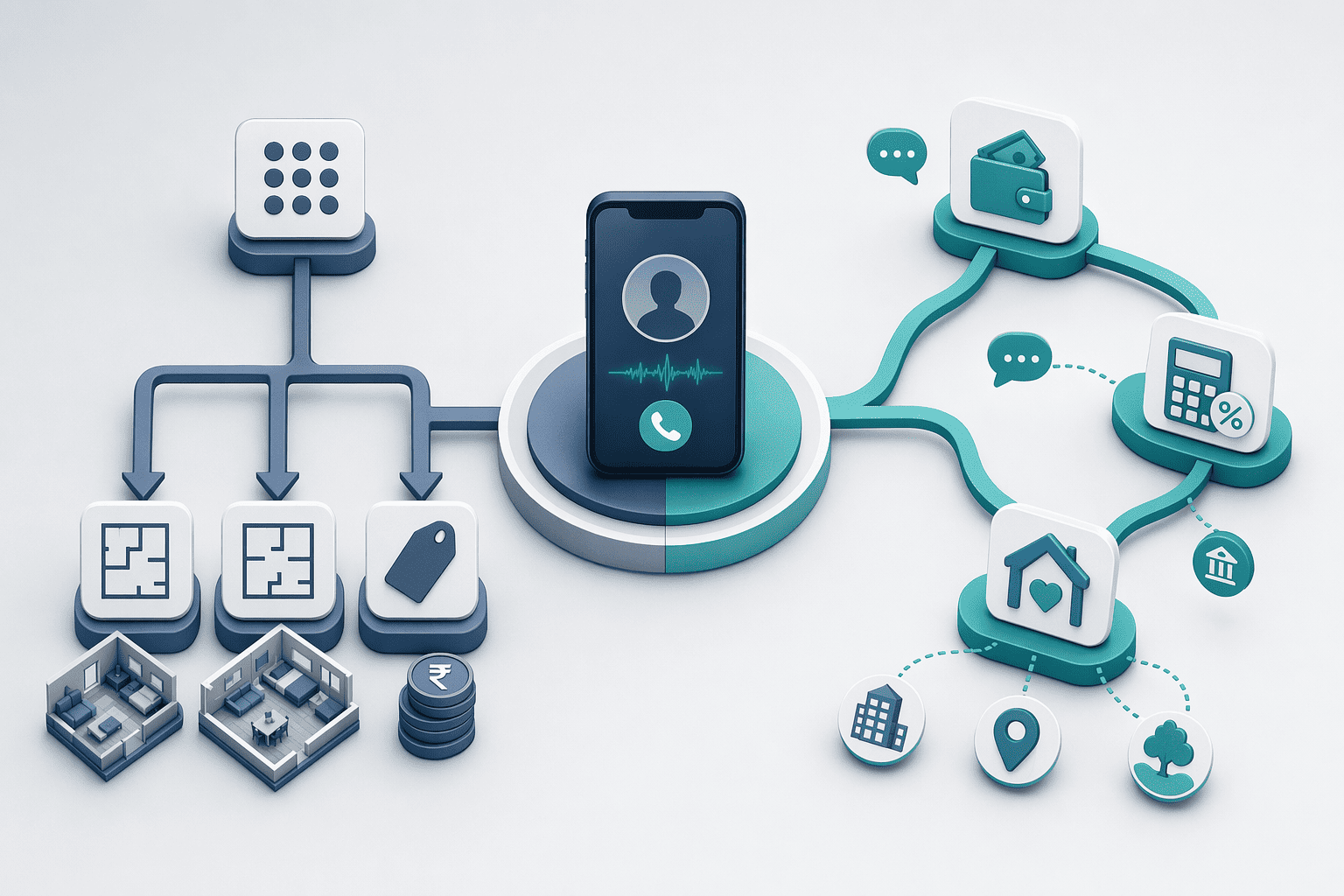
The limitation is rigid branching. If a prospect mentions budget constraints mid-conversation, the IVR cannot pivot to explore financing options, it continues down the pre-set path. Qualification depth remains surface-level: the system collects category selections but cannot probe intent signals like urgency, decision-making authority, or timeline flexibility.
Conversational AI Dynamic Branching
Conversational AI agents adapt follow-up questions based on prior responses. If a prospect says "under ₹1 crore budget," the AI shifts to properties within that range and probes timeline ("when are you planning to visit?") and location preferences. Platforms supporting this logic, such as EchoLeads, which offers dynamic question branching, qualify leads more deeply by layering context across multiple exchanges.
This approach requires higher setup effort: training the AI on property inventory, budget tiers, and handoff triggers takes days to weeks. The payoff is nuanced qualification, the system scores leads on ICP fit, detects buying signals ("I need to move in three months"), and escalates high-intent prospects to human agents when sentiment or complexity thresholds are met. For properties with varied configurations and financing needs, conversational AI delivers qualification depth IVR cannot match.
Single-channel confirmation strategies leave site visit slots unfilled. A layered approach across voice, messaging, and calendar integrations addresses Mumbai's low pickup rates and busy professional schedules.
Omnichannel Coordination: Voice, WhatsApp, and SMS for Site Visit Confirmations
Multi-Channel Confirmation Flow
Voice-only confirmations suffer from low pickup rates in Mumbai's fast-paced property market. Busy professionals often miss initial calls, leading to unconfirmed appointments and wasted site-visit slots. A multi-touch confirmation pattern addresses this: the AI agent first attempts a voice call to propose the site visit slot and gather preferences, then immediately sends a WhatsApp message with calendar details and a one-tap confirmation link, followed by an SMS reminder 24 hours before the appointment.
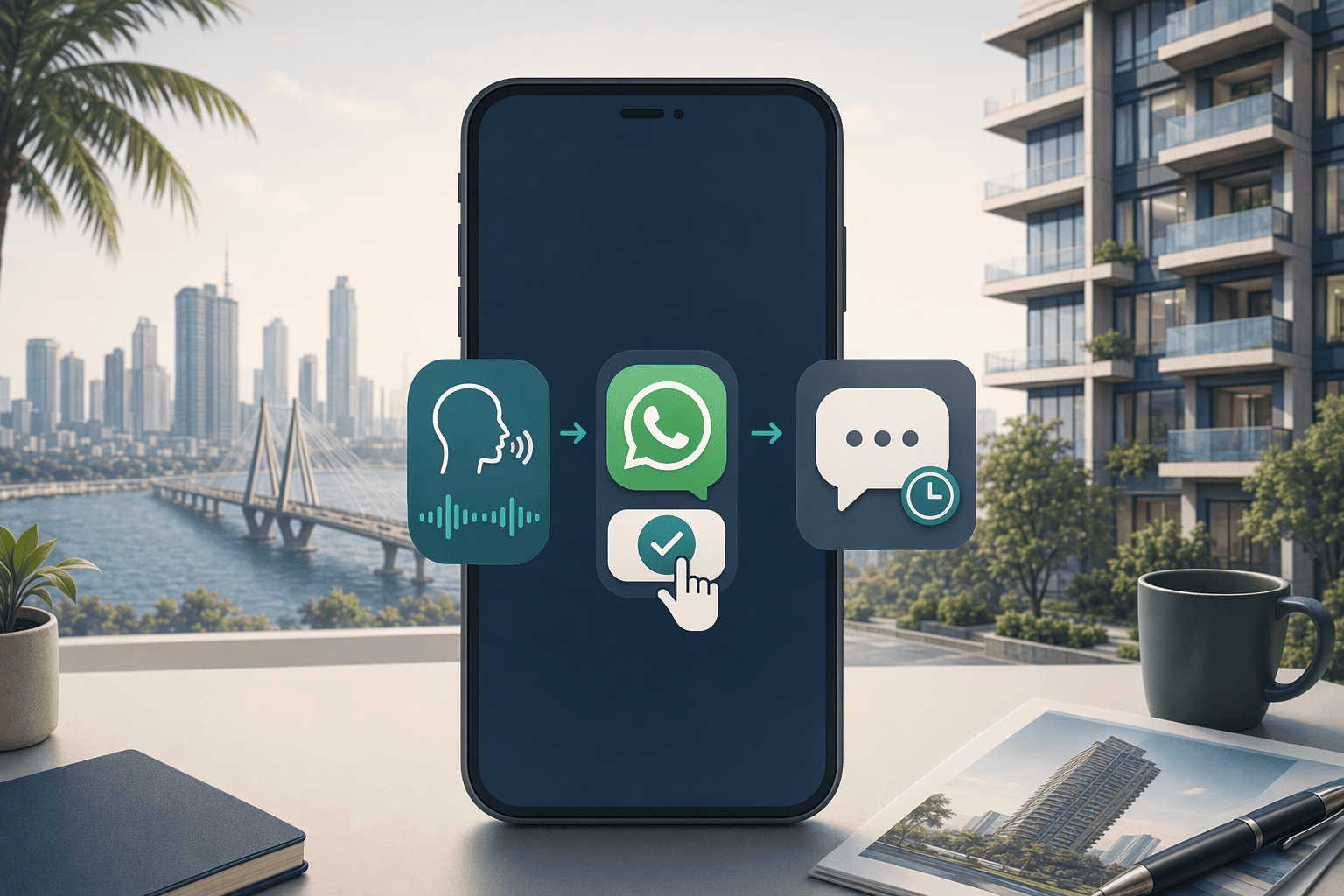
This layered approach significantly improves confirmation reliability. WhatsApp messages have higher open rates than phone calls in urban India, and the persistent text record lets leads confirm at their convenience rather than requiring real-time availability. Platforms like Realatic demonstrate that auto-respond features across channels are becoming category norms for real estate CRM systems.
EchoLeads supports omnichannel coordination across voice, WhatsApp, and CRM integrations, handling simultaneous conversations across phone and messaging channels. The platform processes concurrent booking requests across phone, WhatsApp, and web chat with bi-directional CRM sync, enabling the multi-touch confirmation pattern without requiring separate tools for each channel.
Reminder and Rescheduling Automation
Automated reminders sent 24 hours before the site visit reduce no-show rates by reinforcing the commitment. WhatsApp reminders include property address, contact details, and a one-click rescheduling link that lets leads propose a new time without phone calls or email threads. The AI agent processes rescheduling requests in real time, checking calendar availability and updating both the lead's record and the sales team's schedule.
Anti-pattern to avoid: Repeatedly calling back when a lead doesn't pick up voice confirmations. This approach burns agent time and frustrates leads who prefer asynchronous communication. Instead, after one failed voice attempt, switch to WhatsApp or SMS text confirmation. Mumbai professionals often screen calls during work hours but respond to text messages within minutes, making messaging channels more reliable for final confirmation and logistics coordination.
Platform capabilities align with project scale, language requirements, and budget structures. Matching your operational context to the right pricing model and feature set prevents overspending or underperformance.
Choosing the Right Platform for Your Mumbai Real Estate Project
Project Size and Lead Volume
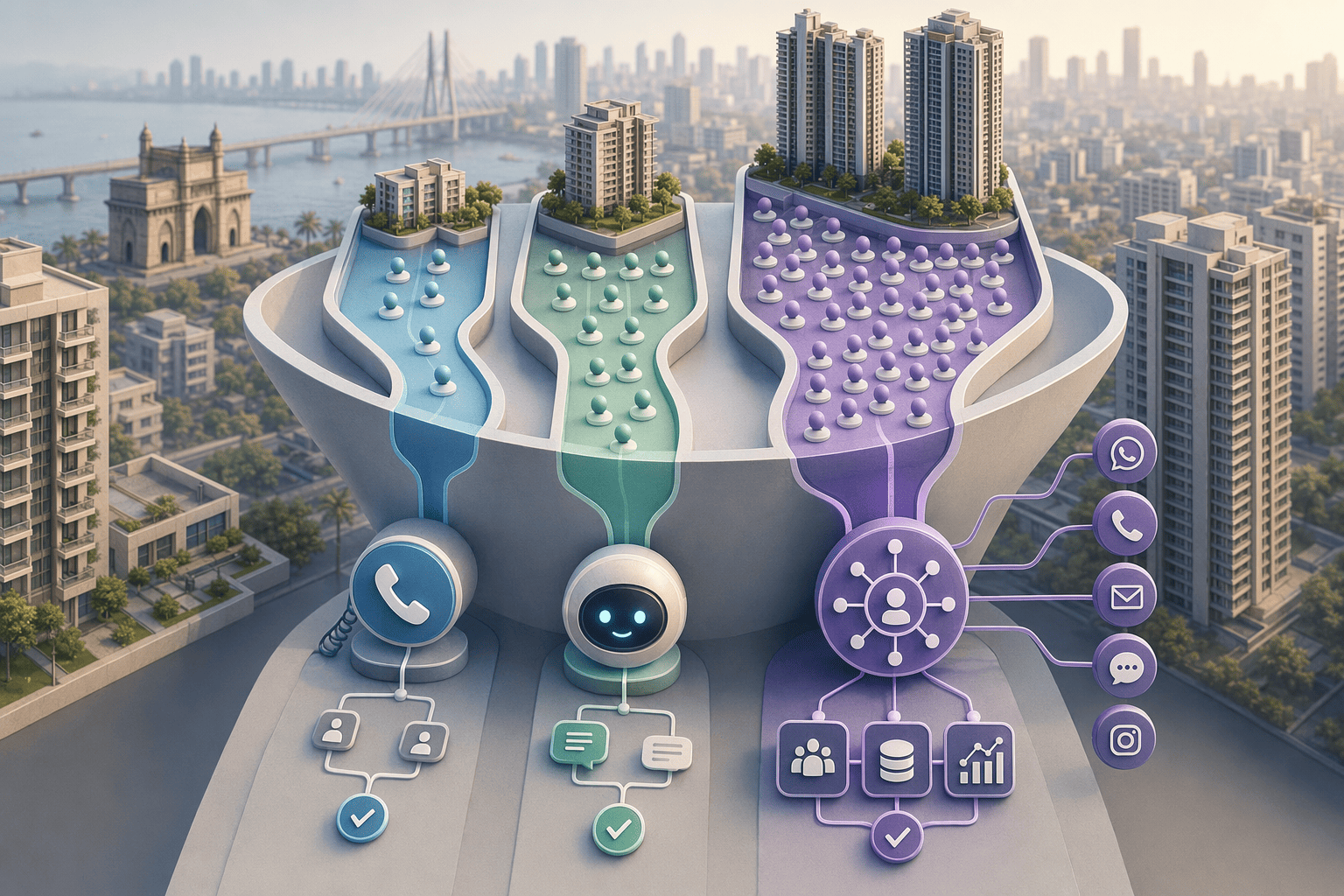
Small projects handling fewer than 500 leads per month can often manage with simple IVR (interactive voice response) systems that route calls to human agents or capture basic contact details. These setups work when lead volume is low and each inquiry can receive immediate human follow-up. Mid-size projects (500 to 2000 leads monthly) benefit from conversational AI that qualifies leads in real time, asks structured questions about budget and property preferences, and syncs responses to your CRM without manual data entry. Large-scale projects exceeding 2000 leads per month require omnichannel AI platforms with bi-directional CRM integration, human handoff triggers when sentiment turns negative or questions exceed the agent's scope, and analytics dashboards that track conversion drop-off points across WhatsApp, phone, and web chat.
Language and CRM Integration Requirements
Mumbai's buyer base spans Hindi, Marathi, Kannada, and English; your platform must support the languages your leads speak or you'll lose conversions in the first 30 seconds of contact. EchoLeads supports sales, lead qualification, inbound enquiry handling, appointment booking, CRM integrations, and multilingual follow-ups, making it suitable for projects serving diverse linguistic audiences. Verify that your chosen platform integrates with your existing CRM stack, Salesforce, HubSpot, Zoho, or custom-built systems, and supports bi-directional sync so lead data flows into your CRM and updates from your sales team flow back to the AI agent. The platform should offer bi-directional CRM synchronization and workflow automation depth that extends beyond simple call handling.
Pricing Models: Per-Minute vs. Per-Lead vs. Custom
Per-minute pricing favors high-volume IVR deployments where calls are short (under 2 minutes) and the goal is routing or basic capture; you pay only for connected time. Per-lead pricing suits conversational AI workflows where the platform qualifies a lead and delivers a scored result; you pay per qualified outcome rather than per second of speech. Custom pricing, such as EchoLeads' model, best serves enterprise projects needing negotiated SLAs, dedicated support, and workflow automation beyond appointment capture. Verify current pricing directly with vendors; advertised starting rates often exclude SMS quotas, payment processing fees, or seat minimums that can double your effective cost.
A contrarian note: AI is not always cheaper than human agents. For low-volume, high-touch luxury properties where each lead represents a multi-crore transaction, a human sales team may deliver better conversion than an AI agent. AI excels at high-volume, repetitive qualification tasks; humans excel at nuanced objection handling and relationship-building when stakes are high and timelines are long.
Conclusion
IVR platforms like LeadNXT deploy faster and suit high-volume, low-complexity inquiries with fixed menu trees. Conversational AI platforms, EchoLeads, AI YUKT, RealClose AI, adapt follow-up questions dynamically but require more upfront configuration. Voice-only platforms face lower pickup rates in Mumbai; omnichannel platforms like EchoLeads and Tabbly coordinate WhatsApp and SMS confirmations for higher site visit show-up rates, though they add integration complexity.
As regional language accuracy improves and Karnataka-specific compliance guidance emerges, AI calling agents will handle increasingly complex property qualification workflows. Human oversight will remain key for high-value transactions and fraud prevention, even as automation scales routine inquiries.
Map your current lead qualification workflow to identify which stages can be automated, then explore EchoLeads's pre-built real estate templates for Mumbai to see bi-directional CRM sync and omnichannel coordination in action.
Frequently Asked Questions
Which AI calling platforms support Hindi, Marathi, and Kannada for Mumbai real estate?
LeadNXT, AI YUKT, RealClose AI, TaskVox, Tabbly, Nova AI, and EchoLeads all support Hindi, Marathi, and Kannada workflows for Mumbai real estate. EchoLeads positions itself as a multilingual AI voice platform built for Indian businesses, though it does not publish Kannada-specific accuracy benchmarks.
What is the difference between IVR routing and conversational AI for lead qualification?
IVR systems use fixed menu trees, press 1 for 2BHK inquiries, press 2 for 3BHK, with rigid branching. Conversational AI platforms like EchoLeads adapt follow-up questions dynamically based on prior responses, enabling context-aware qualification instead of linear navigation.
Do AI calling agents comply with Indian call recording laws?
Indian law requires prior consent before recording phone conversations, but vendor documentation often lacks Karnataka-specific consent workflows. Generic compliance claims like "TCPA-compliant" circulate without jurisdiction-specific guidance. Consult legal counsel before deploying AI calling agents to ensure proper consent mechanisms.
Can AI agents book site visits autonomously for high-value properties?
No. AI voice agents do not approve site visits autonomously for high-value properties or fraud-risk scenarios; human oversight remains key. AI platforms propose viewing slots and capture preferences, but a human sales representative confirms bookings for premium inventory to prevent fraud and ensure client trust.
Which platforms offer bi-directional CRM sync for real estate leads?
EchoLeads offers bi-directional CRM sync with real-time updates and custom field mapping. LeadNXT provides CRM integration, though most vendor documentation does not specify whether sync is one-way export or bi-directional. Verify sync direction during platform evaluation to ensure lead data flows both ways.
What are the pricing models for AI calling platforms in Mumbai?
Per-minute pricing suits high-volume IVR deployments with short calls under two minutes. Per-lead pricing fits conversational AI workflows where you pay per qualified result. EchoLeads offers custom pricing. No authoritative cost floors exist, verify current rates directly with vendors before committing.
How do AI agents coordinate WhatsApp and SMS for site visit confirmations?
Voice calls propose viewing slots, WhatsApp sends calendar links, and SMS delivers 24-hour reminders. This multi-touch approach significantly improves confirmation reliability in Mumbai's fast-paced market, where voice-only confirmations suffer from low pickup rates among busy professionals.
Related articles
6 Best AI Outbound Calling Solutions for Loan Verification
Compare AI outbound calling platforms that verify loan applications 24/7
5 Common Causes of Long Bank Loan Inquiry Call Wait Times
Why do bank customers complain about long wait times for loan inquiry calls? Learn the 5 Common Causes of Long Bank Loan Inquiry Call Wait Times.
4 Best AI Voice Lead Qualification Tools for Insurance
Compare AI voice platforms for insurance lead qualification through automated outbound calls.