
7 Best Lead Response Automation Tools for Small B2B Sales Teams in India in 2026

Introduction
Your website form just captured a high-intent lead from a decision-maker at a target account in Mumbai. They downloaded your pricing guide and expect a conversation. Your best rep is in a client meeting, so the callback slips. By the time you dial, 45 minutes later, the lead has mentally moved on.
This speed gap is where revenue dies for small B2B teams. Contacting a lead within 5 minutes increases conversion odds by 9x compared to a 30-minute delay. For a team of three or four reps in India, no amount of hustle can beat the physics of a packed calendar.
Lead response automation bridges this gap. It instantly engages inbound leads via AI voice, SMS, or email, qualifies intent, and hands off only the warmest opportunities to a human rep. In 2026, it is a defensive layer that keeps your pipeline from leaking.
For Indian teams, the decision carries extra weight. The Telecom Regulatory Authority of India mandates that all principal entities sending bulk messages must fulfill regulatory requirements under TCCCPR, 2018. Automated calls without prior consent and DND scrubbing risk penalties of up to ₹25,000 per violation. Speed matters, but so does staying on the right side of the law.
Selecting a tool means balancing instant engagement, CRM integration, data enrichment, and compliance. The following seven options tackle this balance differently, and one will fit your team's stack and budget.
Key Takeaways
Here is what matters most when choosing a lead response automation platform for a small B2B team in India this year:
Pure speed wins deals: The 5-minute response window is the hard metric, tools that deliver sub-3-second AI voice answers or CRM-triggered dialing capture intent that colder calls cannot.
CRM integration is non-negotiable: Bi-directional sync with Zoho, HubSpot, or Salesforce must log call outcomes, update lead scores, and create tasks during live conversations, not after.
Compliance is a hard gate: TRAI's TCCCPR 2018 demands consent checks, DND scrubbing, and time-of-day filters, any platform that skips this exposes your business to ₹25,000 fines per violation.
Budget benchmarks are clear: Expect pay-as-you-go rates as low as ₹4/minute (EchoLeads) for variable volumes, seat licenses from $49/seat/month (Apollo), or quote-based bundles (Kixie), committed dialer fees running $500 to $1,500/month only make sense with predictable, high volume.
1. EchoLeads: Purpose-Built for Indian B2B Teams with Sub-3-Second AI Voice & Zoho-First Integration
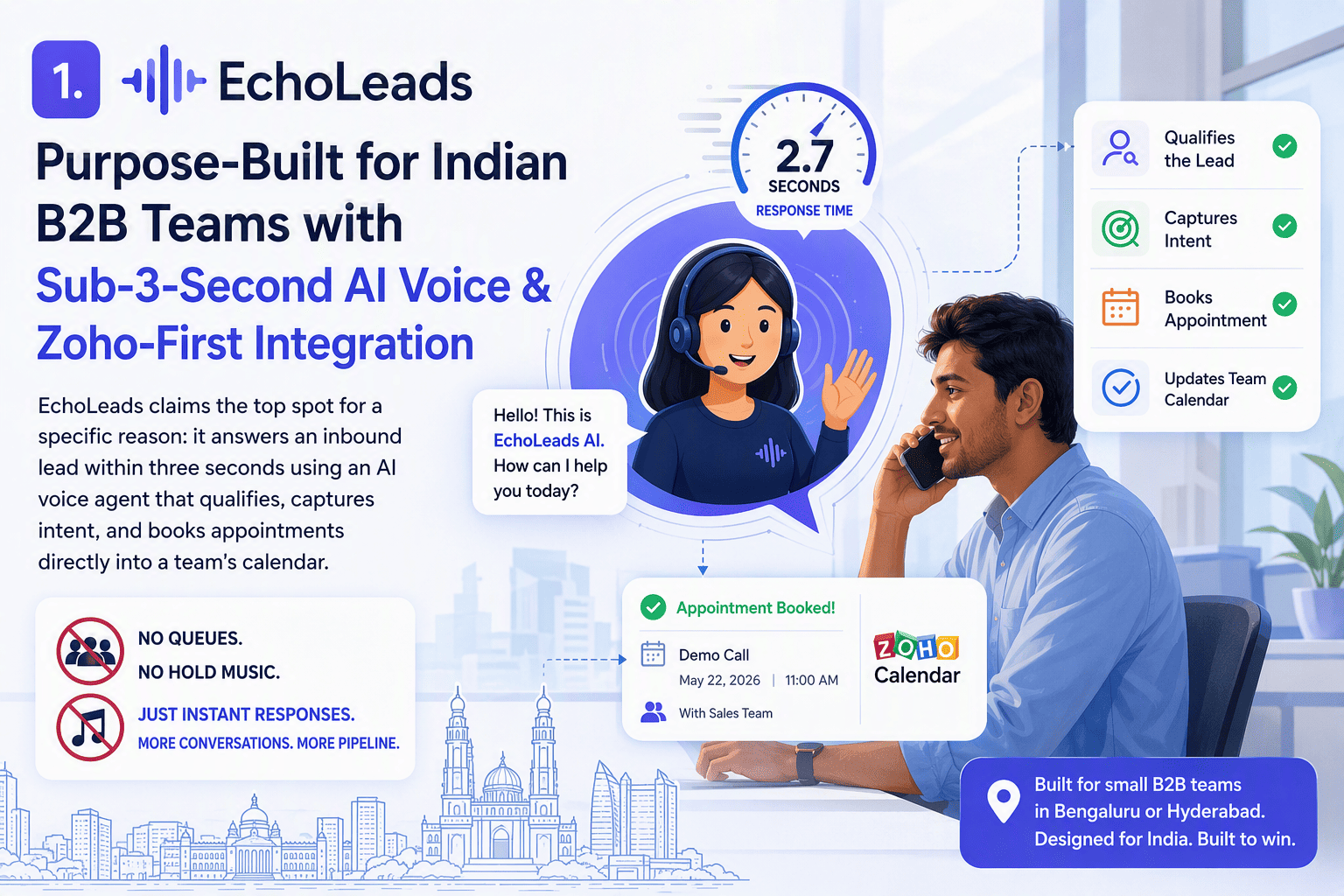
EchoLeads claims the top spot for a specific reason: it answers an inbound lead within three seconds using an AI voice agent that qualifies, captures intent, and books appointments directly into a team's calendar. No queues. No hold music. For a small team in Bengaluru or Hyderabad where even a 90-second delay cools a lead, that latency advantage is the difference between a booked meeting and a ghosted callback.
The platform's bi-directional Zoho CRM integration matters because Zoho One penetration in Indian SMBs runs deep. EchoLeads syncs CRM records during live calls, updates lead fields based on conversation keywords or sentiment scores, and triggers handoff to a human rep only when a prospect explicitly requests it or crosses a qualification threshold. That means your sales team spends zero time on data entry and all their time on conversations that are ready to close.
Pricing eliminates the biggest risk small teams face with dialer platforms: paying for capacity you never use. EchoLeads offers pay-as-you-go rates starting at ₹4/minute, with enterprise rates as low as ₹1.80/minute for committed agreements. For a team handling volatile inbound volume, you buy only the minutes you consume instead of locking into committed usage fees that routinely run $500, $1,500/month on legacy platforms.
2. Apollo.io: The Data-Rich Powerhouse with a Massive 210M+ Contact Database
Apollo.io takes the second slot because it answers a question that runs right alongside speed: who is this person, and what do we know about them? Its contact database of over 210 million records enriches inbound leads automatically the moment they land in your CRM. The enrichment covers three areas:
Firmographics: company size, industry, and revenue data.
Technographics: the tech stack the lead's company uses.
Direct dials: phone numbers appended before the first outreach fires.
That data flows directly into multichannel sequences where calls, emails, and LinkedIn touches launch from one workflow. When a lead submits a form, Apollo triggers an immediate email, queues a call task, and enriches the record before a rep ever opens their dashboard. For sales teams that run without a dedicated ops function, having enrichment baked into the response logic cuts the manual research that makes outreach drag. Pricing starts at $49 per seat per month billed annually, which fits a team of three to five reps without requiring a separate data vendor.
Bi-directional sync with Salesforce and HubSpot pushes call outcomes, email opens, and sequence progression into lead scores in real time. A rep does not stop to guess whether a lead is warm enough to call; the system has already tracked every interaction and surfaced the score. The limitation to know is that Apollo's strength sits in data and sequence orchestration, not native AI voice calling. Teams that need a sub-five-second voice response will pair it with a dialer or look at a different primary tool.
3. Kixie: CRM-Triggered Calling & Seamless Multi-Channel Workflows for HubSpot Teams
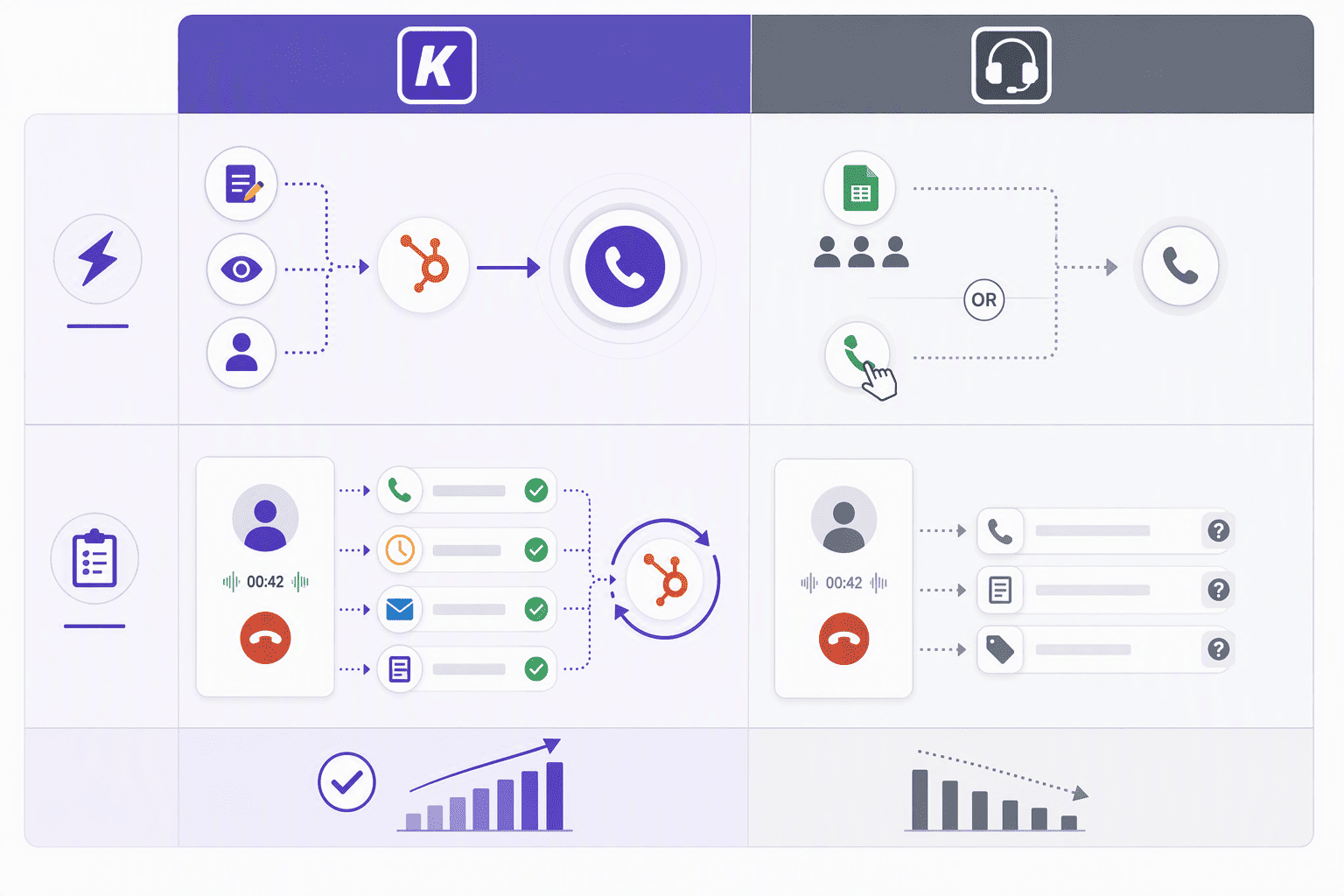
Feature | Kixie | Standard Auto-Dialer |
|---|---|---|
Trigger mechanism | CRM events (form fill, page visit) launch calls automatically | Manual list upload or click-to-call |
Activity logging | Automatic call disposition, notes, and outcome sync to HubSpot | Often requires rep notes or post-call data entry |
Pricing model | Quote-based with 7-day trial | Typically per-seat or per-minute with minimum commitments |
Integration depth | Native HubSpot embedded calling with bi-directional sync | Basic CTI connector or one-way log |
Kixie is built for the moment when a lead's interest peaks. Best Sales Engagement Platforms (August 2026) highlight its triggered calling architecture: a lead visits a pricing page or submits a HubSpot form, and Kixie instantly auto-dials the assigned rep. The rep picks up mid-ring and is already looking at a populated contact record. That event-driven architecture collapses the gap between intent signal and human conversation, the same gap where studies show reducing response times to under 30 minutes dramatically improves conversion rates.
4. VanillaSoft: Specialist Queue-Based Routing for High-Velocity Sales Floors
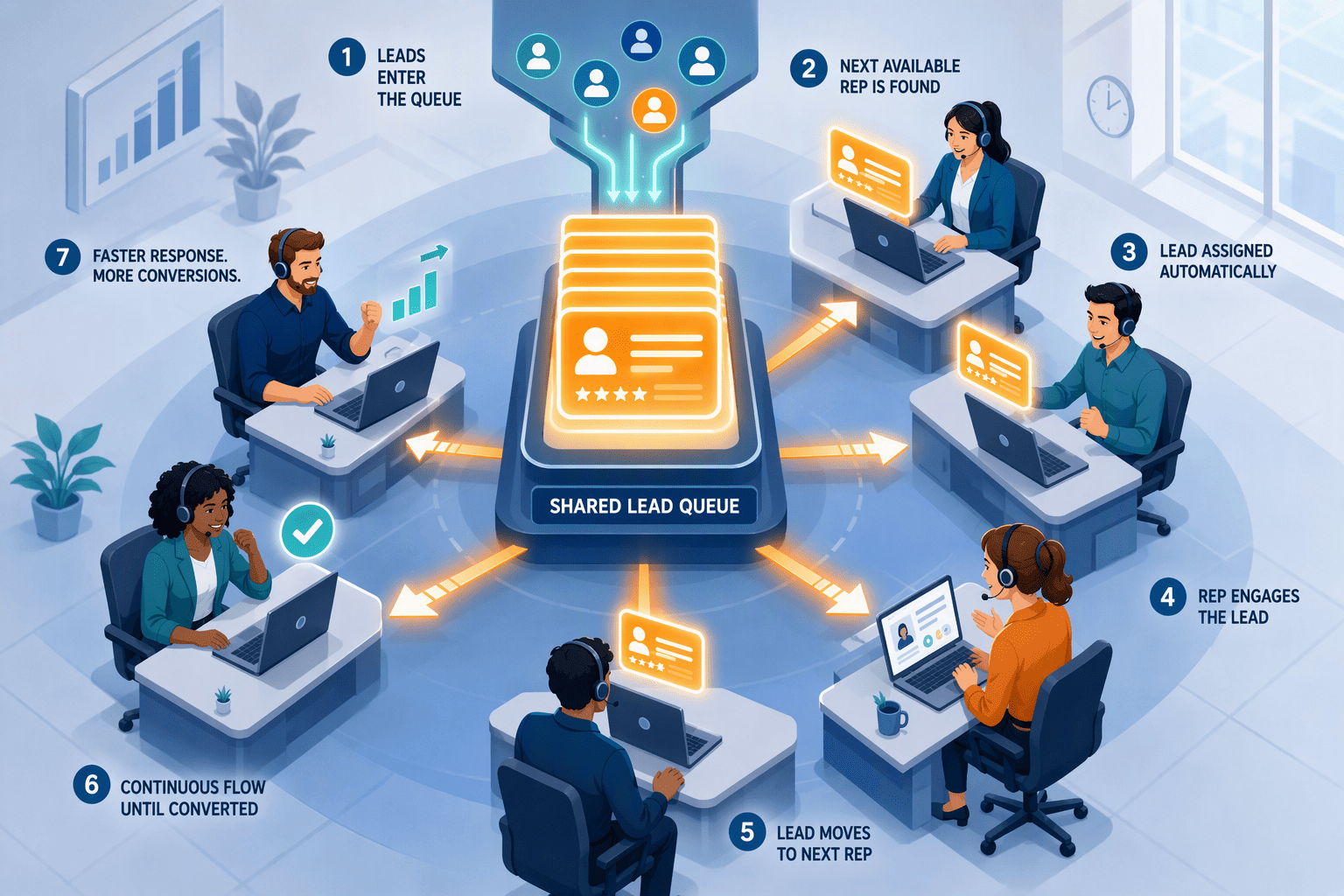
VanillaSoft fills a narrow but critical niche: small teams that behave like a high-velocity floor. If your inbound volume spikes unpredictably and you have three to eight reps handling a shared queue, queue-based routing beats round-robin every time.
Queue-based logic prevents cherry-picking: The system scans every waiting lead, scores urgency, and pushes the most time-sensitive prospect to the next available rep, no one grabs the warmest leads and ignores the rest.
Latency shrinks at scale: Standard round-robin assigns leads in order regardless of readiness; queue-based routing cuts average wait time because reps never sit idle while a viable lead waits.
Specialist call center DNA: Unlike general-purpose CRMs that bolt on dialer features, VanillaSoft's architecture was built for inside sales velocity, making it a fit when response speed is the sole differentiator.
Trade-off surfaces quickly: VanillaSoft lacks Apollo's data breadth and EchoLeads' native AI voice, so it demands pairing with enrichment and dialing layers, which a small team may not want to stitch together.
5. Exotel: India’s Cloud Telephony Leader with Native TCCCPR 2018 Compliance Guardrails
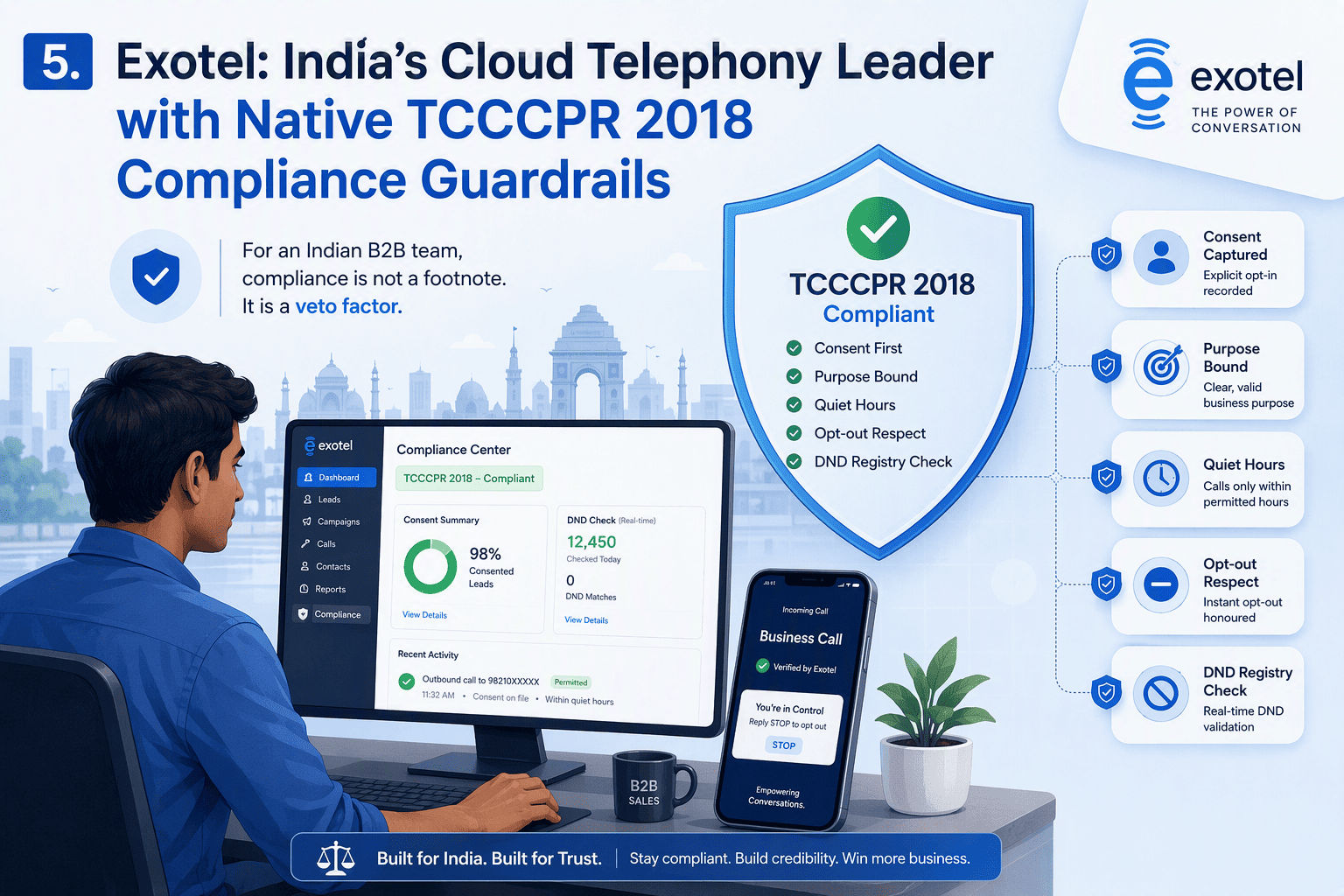
For an Indian B2B team, compliance is not a footnote. It is a veto factor.
Exotel's platform maps directly to the Telecom Commercial Communications Customer Preference Regulations, 2018 (TCCCPR), which requires that any commercial communication may only take place using registered headers assigned to the sender. The distinction between a promotional voice call (no explicit consent) and a service call (consent-based, tied to a prior transaction) is legally material here: promotional messages or promotional voice calls are commercial communications for which the sender has not taken any explicit consent from the intended recipient. Exotel enforces this boundary by scrubbing every outbound call against the DND registry, applying time-of-day filters, and requiring consent documentation before a call can fire.
The stakes are real. TRAI penalties can hit ₹25,000 per individual violation, and a bulk campaign can rack up fines faster than a small team can absorb. Exotel absorbs that regulatory lift so your team does not have to build compliance logic from scratch. It is not the flashiest tool for AI voice or sequence building, but for an Indian sales leader who has watched competitors get fined, it is the safest bet.
Where Exotel shows its limits is on the AI qualification side. It handles the telephony layer and compliance guardrails cleanly but expects you to layer on a separate qualification engine, which means managing two contracts as a small team.
6. Aircall: User-Friendly Cloud Phone System with Conversational AI Add-Ons
Aircall earns a place for non-technical founders who need an intuitive phone system they can set up in an afternoon. The interface strips away the IT overhead of traditional telephony with three features:
Drag-and-drop IVR builders: no coding required to set up call routing.
Click-to-call from CRM records: works with HubSpot or Zoho.
Centralized inbox: consolidates call logs and voicemails.
The AI add-ons make it relevant for lead response. Aircall's ecosystem includes conversational AI partners that transcribe calls, analyze sentiment, and auto-tag outcomes. A lead who mentions a competitor or a pricing objection gets flagged in the CRM before the rep ends the call, allowing immediate routing to a closing sequence. The 20% of teams that measure success through objection handling and conversation skills development over time will find that Aircall's call intelligence feeds exactly those coaching loops.
The catch is that Aircall is a cloud phone system with AI bolted on, not a purpose-built lead response automation engine. The 'power dialer' remains a separate capability from the AI suite, and teams needing sub-3-second AI voice response with handoff logic will find the add-on path more fragmented than a unified platform like EchoLeads.
7. JustCall: All-in-One Calling & SMS Platform for Small Teams Starting Up in India
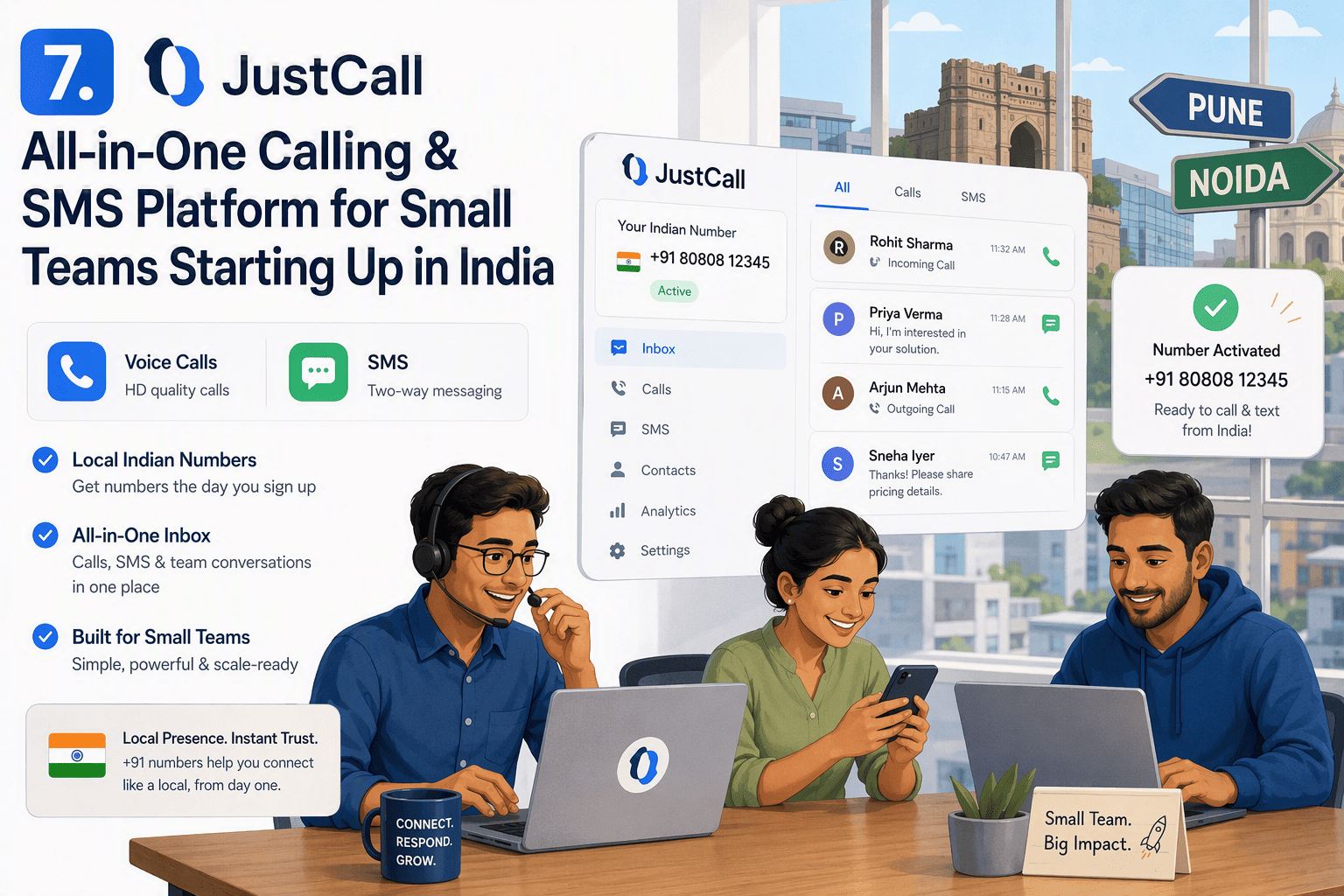
JustCall lands in the seventh spot as the most accessible on-ramp for a team of two to five reps who need voice and SMS under one roof without stitching together APIs. The platform provides local Indian mobile numbers the day you sign up, so a startup in Pune or Noida can present a legitimate domestic presence immediately.
The bundled pay-per-use credits cover outbound calls and SMS, letting a small team control spend as volume fluctuates without committing to monthly dialer minimums.
Dual-channel outreach matters in India, where a WhatsApp or SMS follow-up after a missed call often gets a higher response than a second call. JustCall's SMS workflows trigger automatically when a call goes unanswered, so the lead receives a templated message with a callback link, all logged to the same CRM record. Integrations with Pipedrive and HubSpot keep the activity feed clean, though the integration depth falls short of the bi-directional field-level sync you get with deeper CRM-native platforms.
The limitation you will run into as you scale: JustCall's AI qualification capabilities are lighter than what EchoLeads or Aircall's add-ons provide, so teams outgrowing manual qualification within six to nine months will face a re-platforming decision.
Conclusion
The right lead response automation tool for your small B2B team in India is a trade-off, not an absolute. Choose EchoLeads if sub-3-second AI voice response and deep Zoho sync are non-negotiable. Choose Apollo.io if you need a 210M+ contact database feeding your response engine. Choose Exotel if regulatory compliance keeps you up at night. Choose JustCall if budget and local SMS presence matter most.
What you cannot afford is a 30-minute gap between an inbound lead and your first touch. The 9x conversion advantage within 5 minutes holds firm. The penalty for ignoring TRAI consent requirements, up to ₹25,000 per violation, is equally non-negotiable. Pick the tool that closes the speed gap and keeps your team on the right side of the law, then run it relentlessly.
Frequently Asked Questions
What is lead response automation and why does speed matter for small B2B sales teams?
Lead response automation instantly engages inbound leads via AI voice, SMS, or email and routes qualified prospects to reps. Speed matters because contacting a lead within 5 minutes increases conversion odds by 9x compared to a 30-minute delay, according to sales research cited by HubSpot.
Which lead response automation tools are best suited for small B2B teams in 2026, especially in the Indian market?
EchoLeads leads with sub-3-second AI voice and Zoho integration. Apollo.io brings a 210M+ contact database. Kixie offers CRM-triggered calling for HubSpot teams. Exotel provides TRAI compliance guardrails. JustCall delivers an affordable voice and SMS bundle for startups.
How does AI voice agent technology handle lead qualification and handoff to human reps?
AI voice agents call or answer inbound leads within seconds, ask qualification questions using natural-language scripts, and capture intent signals. They hand off to a human rep based on configurable triggers such as conversation keywords, sentiment scores, or explicit prospect requests.
What compliance requirements must Indian B2B teams follow when automating lead calls?
Under TRAI's TCCCPR 2018, all commercial communications must use registered sender headers. Promotional calls require explicit consent, and calls must be scrubbed against the DND registry with time-of-day filters. Penalties reach ₹25,000 per violation.
What is the cost of implementing lead response automation, and how does pay-as-you-go compare to committed usage for small teams?
Costs range from pay-as-you-go rates like EchoLeads' ₹4/minute to monthly seat licenses like Apollo's $49/seat. Pay-as-you-go suits variable volume without waste, while committed dialer fees can run $500, $1,500/month and only make sense with predictable, high call volumes.
How do these tools integrate with CRMs like Salesforce, HubSpot, and Zoho to update records automatically during live calls?
Tools like EchoLeads and Apollo sync bi-directionally, automatically logging call outcomes, updating lead scores, capturing notes, and creating tasks within the CRM during live conversations. This eliminates manual data entry so reps can move immediately to the next qualified lead.
Related articles
Your Website Leads Are Cooling in 42 Hours, Here’s How to Respond in Seconds Without Hiring Anyone
Websites leads go cold after 24 hours, learn how AI voice agents can instantly respond and engage with them.
After-Hours Leads Don't Wait: AI Voice Agents Can Now Close Them for You at 3 AM
Learn about how AI voice agents can be deployed to close leads even at 3 AM
Why Inbound Leads Go Cold Before Your Sales Team Can Follow Up, and How to Win the 100x Window
Learn why inbound leads go cold and how businesses can employ AI voice agents to automate lead engagement even after working hours.