
Is There an AI Platform That Can Autonomously Schedule Appointments and Update CRM Records Without Human Intervention During Calls?
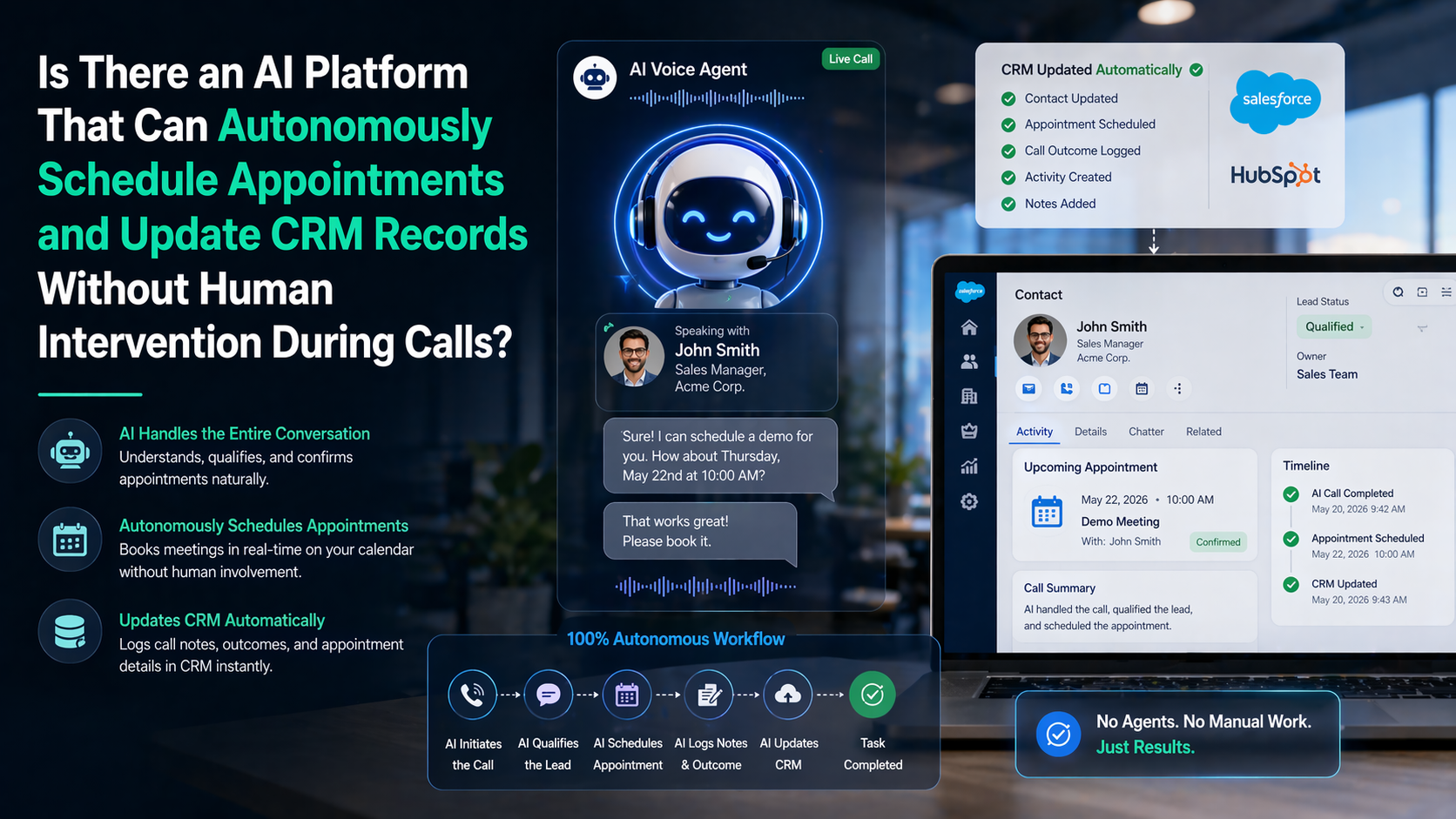
AI calling agents now handle live appointment scheduling and CRM field updates during active conversations, eliminating post-call admin work and enabling real-time pipeline accuracy across B2B and B2C workflows.
Introduction: The Gap Between Call Completion and CRM Updates
When a sales rep finishes a promising call where the prospect mentions budget, timeline, and pain points, those details often vanish into scribbled notes or unreviewed recordings [2]. Manual CRM entry creates a 20-minute lag between call completion and data availability, during which competitor follow-ups arrive first and opportunity context disappears. Research confirms that 78% of buyers purchase from the vendor who responds first, making response speed the decisive conversion factor [1]. EchoLeads solves this by deploying AI calling agents that schedule appointments and update CRM records during the live conversation, not after. Unlike post-call summarization tools, EchoLeads' autonomous AI voice agents execute booking confirmations, calendar writes, and CRM field updates before the call ends—eliminating the admin gap entirely. The platform handles intent detection, availability checking, conflict resolution, and opportunity stage progression in real time, ensuring your pipeline reflects actual buyer status the moment they agree to next steps. This guide answers whether true live-call autonomy exists, how it works technically, and which operational safeguards prevent errors when AI controls scheduling and data workflows without human approval.
How AI Calling Agents Execute Autonomous Appointment Scheduling During Live Calls
Real-Time Intent Detection and Booking Workflow Initiation
AI calling agents monitor live conversations for scheduling intent signals—phrases like "let's set up time next week," "when can we meet," or "I'd like a demo"—and immediately initiate booking workflows without waiting for human confirmation [6]. EchoLeads detects these signals using natural language processing trained on thousands of sales conversations, identifying not just direct requests but implied readiness based on tone, urgency indicators, and qualification criteria completion. When intent is detected, the system transitions from qualification dialogue to scheduling mode in under one second, asking clarifying questions about preferred dates, time zones, and meeting format while simultaneously querying calendar availability. This reflexive workflow means the AI decides when to begin booking based on conversational context, not scripted triggers. For businesses running high-volume inbound campaigns, EchoLeads' AI appointment scheduling processes thousands of concurrent booking requests across phone, WhatsApp, and web chat without degrading response quality or requiring queue management. The platform's sub-30-second average booking time [7] ensures prospects confirm availability before interest fades, capturing appointments that manual coordination would lose to delay-induced drop-off.
Live Calendar Integration and Conflict Resolution
Autonomous scheduling requires real-time calendar access to prevent double-bookings and availability mismatches. EchoLeads integrates bi-directionally with Google Calendar, Outlook, and CRM-based schedulers, querying open slots and writing confirmed appointments during the conversation [2]. The system handles time zone conversions automatically, detects conflicts across multiple team member calendars when using round-robin routing, and applies buffer time rules to prevent back-to-back overload. When a prospect requests a time that's unavailable, the AI offers the next three open slots without putting the caller on hold or requiring callback coordination. This deterministic workflow approach ensures calendar writes occur only after verbal confirmation from the prospect, using structured validation steps rather than open-ended AI reasoning that could misinterpret ambiguous responses. For compliance-sensitive industries, EchoLeads' enterprise security infrastructure logs every booking action with timestamps, participant confirmation records, and modification audit trails—meeting SOC 2 Type II and ISO 27001 requirements for data handling during automated workflows [1]. The platform also supports automated rescheduling when prospects call back to change appointments, updating calendar entries and sending revised confirmations via voice, SMS, or email without requiring human approval for straightforward date swaps.
Instant CRM Field Mapping and Opportunity Stage Updates
While booking the appointment, AI agents simultaneously extract key information from the conversation and map it to CRM fields in real time. EchoLeads updates contact details, qualification scores, next steps, and opportunity stages based on what the prospect says during the call—before hanging up [4]. This includes MEDDIC/MEDDPIC element capture (Metrics, Economic Buyer, Decision Criteria, Decision Process, Identify Pain, Champion), technical requirements mentioned in passing, budget signals detected through sentiment analysis, and timeline commitments that trigger automated follow-up sequences. The system performs bi-directional CRM operations, meaning it both reads account history to personalize the conversation and writes new data to keep records current without manual logging. A 2024 Tenali AI analysis found that autonomous CRM updates during calls eliminate up to 30% of admin work for sales reps, translating to 2.4 hours saved per rep per day in teams that previously relied on post-call data entry [4]. EchoLeads' AI SDR capabilities ensure that every conversation outcome—qualified lead, demo booked, objection recorded, or disqualification reason—syncs to Salesforce, HubSpot, Pipedrive, or Zoho before the next call begins, maintaining pipeline accuracy without human intervention. For enterprises concerned about AI making incorrect stage progressions, the platform supports confidence thresholds that trigger human review when conversation clarity falls below preset accuracy levels, balancing autonomy with risk management.
Operational Boundaries: Full Autonomy vs. Human-in-the-Loop Workflows
When AI Handles End-to-End Booking Without Approval
True autonomy means the AI completes scheduling and CRM updates without requiring human confirmation before execution. EchoLeads operates in full-autonomy mode for routine use cases: standard demo bookings, product inquiry follow-ups, appointment confirmations, and tier-1 qualification workflows where the conversation follows predictable patterns [2]. The system applies business rules defined during setup—allowed meeting durations, eligible time slots, required qualification criteria, and CRM field validation logic—to ensure autonomous actions stay within operational boundaries. For businesses running 24/7 global operations, this autonomy captures after-hours inquiries that would otherwise go unanswered, with the AI booking appointments across time zones and updating opportunity records while human teams sleep. Salesforce reports that its Agentforce Contact Center handles customer interactions with AI agents maintaining conversational context for seamless human handoffs when complexity requires escalation [7]. EchoLeads uses similar architecture, allowing reps to review completed bookings in morning pipeline reviews rather than individually approving each one, trusting the AI's logic for standard scenarios while reserving human judgment for edge cases. The 95% booking success rate reported by enterprise scheduling platforms [7] demonstrates that autonomous workflows achieve higher consistency than manual coordination, which suffers from rep fatigue, inconsistent qualification, and delayed follow-through.
Escalation Triggers and Human Handoff Logic
Not every call should be fully autonomous. EchoLeads' customer support AI includes intelligent escalation logic that transfers conversations to human agents when complexity, sentiment, or compliance risk exceeds safe autonomy thresholds. Triggers include: prospect requests for custom pricing outside standard ranges, technical questions requiring product roadmap discussion, negative sentiment detection indicating frustration, or explicit requests to speak with a human representative. When escalation occurs, the AI provides the human agent with full conversation context—transcript, qualification score, stated objections, and CRM updates already written—eliminating the need for prospects to repeat themselves and preserving deal momentum [6]. For regulated industries like healthcare and financial services, EchoLeads' HIPAA-compliant infrastructure enforces mandatory human review for appointments involving sensitive data discussions, protected health information, or high-value contract negotiations where legal review is required before commitment. The platform logs escalation reasons and tracks resolution outcomes to continuously refine which scenarios can safely remain autonomous versus which consistently require human judgment, improving autonomy coverage over time without increasing error rates.
Platform Comparison: Autonomous Scheduling and CRM Sync Capabilities
Platform | Live Booking During Call | Real-Time CRM Write-Back | Autonomous Mode | Starting Price |
|---|---|---|---|---|
EchoLeads | Yes, confirms and books before call ends | Bi-directional read/write to Salesforce, HubSpot, Pipedrive, Zoho | Full autonomy with confidence thresholds | $25/month flat rate |
Yes, via phone agent ($0.29/min) | Calendar sync only, limited CRM depth | Voice-based autonomous booking | $0.29/minute usage | |
Salesforce Agentforce | Yes, with Einstein AI routing | Native Salesforce integration with Data Cloud | Autonomous with human handoff | $125/user/month |
Retell AI | Yes, sub-second response | API-based CRM sync (requires custom integration) | Developer-configured autonomy | $99/month base |
monday CRM AI | Partial, requires workflow triggers | Native platform updates with AI blocks | Hybrid automation | $12/user/month |
EchoLeads differentiates through transparent flat-rate pricing and native CRM bi-directional sync without requiring custom API development. While Salesforce Agentforce offers enterprise-grade autonomy, its $125/user/month cost [3] and complexity requiring dedicated administration make it prohibitive for mid-market teams. Cal.ai provides innovative voice-based booking but lacks the deep CRM field mapping that EchoLeads' B2B lead generation platform uses to update opportunity stages, qualification scores, and next-step workflows during live calls. Retell AI delivers strong real-time conversation handling but requires technical resources to build CRM integrations that EchoLeads provides pre-configured [2]. For businesses evaluating autonomous scheduling platforms, the key differentiator is whether the system performs both calendar booking and CRM updates during the call, or only handles one operation while leaving the other for post-call manual work.
Compliance and Risk Management for Autonomous Call Workflows
Call Recording Consent and TCPA Adherence
Deploying AI calling agents requires strict adherence to call recording laws, TCPA consent requirements, and Do Not Call list management to avoid regulatory penalties that exceed implementation costs [1]. EchoLeads automates compliance workflows by triggering disclosure statements at call initiation ("This call may be recorded for quality and training purposes"), logging verbal consent before proceeding, and maintaining opt-out handling that immediately removes numbers from future campaigns when requested. The platform integrates with DNC list providers to scrub contact lists before dialing and supports state-specific consent rules for two-party recording jurisdictions that require explicit permission before capturing conversations. For businesses operating across multiple regulatory environments, the system applies jurisdiction-appropriate disclosures based on area code detection, ensuring compliance without requiring reps to manually select rules per call. The automated audit trail captures consent timestamps, disclosure delivery confirmation, and opt-out requests with immutable logging that satisfies legal discovery requirements during regulatory reviews. This compliance-first architecture protects businesses from the $500-$1,500 per-violation TCPA fines that can accumulate rapidly in high-volume outbound campaigns [1].
Data Governance for CRM Automation
Autonomous CRM updates introduce data governance challenges: how do you ensure AI writes accurate information, respects field-level permissions, and maintains data quality standards without human review? EchoLeads' enterprise security infrastructure addresses this through role-based access controls that limit which CRM fields the AI can modify, validation rules that reject writes failing format or range checks, and confidence scoring that flags low-certainty updates for human verification before committing to the database. The platform supports zero-retention mode for sensitive conversations where transcripts must not persist after CRM extraction completes, meeting GDPR right-to-deletion requirements and healthcare data minimization standards [1]. For financial services deployments, EchoLeads enforces deterministic workflow steps that prevent AI from accessing protected customer data until identity verification completes, using structured validation rather than open-ended reasoning that could bypass security controls. The system logs every CRM write operation with before/after field values, enabling compliance officers to audit AI decision-making and roll back incorrect updates without data loss. This governance framework allows enterprises to scale autonomous workflows while maintaining SOC 2 Type II certification and regulatory audit readiness across global markets.
Implementation Considerations: Deployment Speed and Integration Requirements
EchoLeads deploys autonomous calling agents in 72 hours using pre-built industry templates for real estate, insurance, B2B SaaS, and financial services [1]. Setup requires three configuration steps: defining ICP qualification criteria and booking rules, connecting calendar and CRM integrations via OAuth, and training the AI on your FAQ database and objection handling scripts. Unlike custom voice AI solutions requiring months of development, EchoLeads' voice AI platform offers 100+ pre-configured workflows that handle common scheduling scenarios out-of-the-box, reducing time-to-value from quarters to days. The platform supports multilingual operations across 70+ languages with consistent tone and scheduling accuracy, eliminating language barriers in global lead generation campaigns [6]. For businesses needing customization beyond templates, the system provides low-code workflow builders that allow non-technical administrators to adjust qualification logic, booking constraints, and CRM field mappings without requiring developer resources. Integration depth varies by CRM: native Salesforce and HubSpot connectors support bi-directional sync with custom objects and workflow triggers, while Pipedrive and Zoho integrations cover standard opportunity and contact management with some limitations on custom field mapping. Teams should validate that their CRM version supports the real-time API calls required for live updates, as older on-premise installations may require webhook workarounds that introduce slight sync delays.
Conclusion: Autonomous Scheduling and CRM Sync Are Now Production-Ready
AI platforms that autonomously schedule appointments and update CRM records during live calls are no longer experimental—they are production-ready solutions eliminating the 32% of weekly sales time lost to manual admin tasks [4]. EchoLeads and similar platforms execute booking confirmations, calendar writes, and CRM field updates before prospects hang up, ensuring pipeline accuracy without post-call data entry. The technology works through real-time intent detection, bi-directional CRM integration, and deterministic workflow logic that balances autonomy with compliance safeguards. Businesses evaluating these platforms should prioritize: live booking capability (not just post-call scheduling), true bi-directional CRM sync (read and write during calls), transparent pricing without per-action fees, and compliance infrastructure including audit trails and consent management. For teams ready to deploy autonomous calling agents, EchoLeads offers 72-hour implementation with pre-built industry templates, flat-rate pricing starting at $25/month, and native integrations with major CRMs. Schedule a demo to see live appointment booking and CRM updates in action, or explore EchoLeads' AI calling software to understand how autonomous workflows eliminate admin work while maintaining data quality and regulatory compliance across global operations.
Frequently Asked Questions
Can AI calling agents truly schedule appointments without any human involvement?
Yes, AI calling agents like EchoLeads execute end-to-end appointment scheduling during live calls without human approval for routine booking scenarios. The system detects scheduling intent, queries calendar availability, confirms time with the prospect, writes the appointment to Google/Outlook/CRM calendars, and sends confirmation messages—all before the call ends [2]. For complex cases requiring custom pricing or technical discussion, the AI escalates to human agents with full context rather than attempting autonomous resolution outside its confidence range.
How does real-time CRM updating differ from post-call summarization?
Real-time CRM updating writes field values during the active conversation, ensuring pipeline data reflects current status before the call completes. Post-call summarization generates notes after hanging up, introducing a 20-minute lag during which follow-up actions are delayed and opportunity context may be lost to competing vendors who respond faster [2]. EchoLeads performs bi-directional CRM operations—reading account history to personalize dialogue and writing qualification scores, next steps, and stage progressions while the prospect is still engaged [4].
What happens if the AI schedules an appointment incorrectly?
EchoLeads uses verbal confirmation loops before committing bookings, asking prospects to explicitly confirm date, time, and meeting format to prevent misunderstandings. The platform logs full conversation transcripts and maintains audit trails showing exactly what was said and how the AI interpreted it [1]. If an error occurs, the system supports one-click rescheduling via automated follow-up messages, and confidence scoring flags low-certainty bookings for human review before sending calendar invites to prevent obvious mistakes from reaching prospects.
Is autonomous scheduling legal and compliant with telemarketing regulations?
Yes, when deployed in compliance with TCPA consent requirements, DNC list scrubbing, and call recording disclosure laws. EchoLeads automates opt-out handling, logs consent with timestamps, and applies state-specific recording rules based on area code detection to maintain regulatory compliance across jurisdictions [1]. The platform is SOC 2 Type II and ISO 27001 certified, with end-to-end encryption and zero retention mode options for sensitive conversations requiring data minimization.
Which CRM platforms support live AI updates during calls?
EchoLeads integrates bi-directionally with Salesforce, HubSpot, Pipedrive, and Zoho for real-time field updates during conversations [2]. The platform supports both standard objects (contacts, opportunities, accounts) and custom fields, with API-based sync ensuring sub-second write latency. For enterprises using custom CRMs or on-premise installations, webhook-based integration provides near-real-time updates with slight delays compared to cloud-native connectors.
Related articles
6 Best AI Outbound Calling Solutions for Loan Verification
Compare AI outbound calling platforms that verify loan applications 24/7
5 Common Causes of Long Bank Loan Inquiry Call Wait Times
Why do bank customers complain about long wait times for loan inquiry calls? Learn the 5 Common Causes of Long Bank Loan Inquiry Call Wait Times.
4 Best AI Voice Lead Qualification Tools for Insurance
Compare AI voice platforms for insurance lead qualification through automated outbound calls.