
Best AI Scheduling Tools for Complex CRM-Integrated Appointment Workflows (2026)
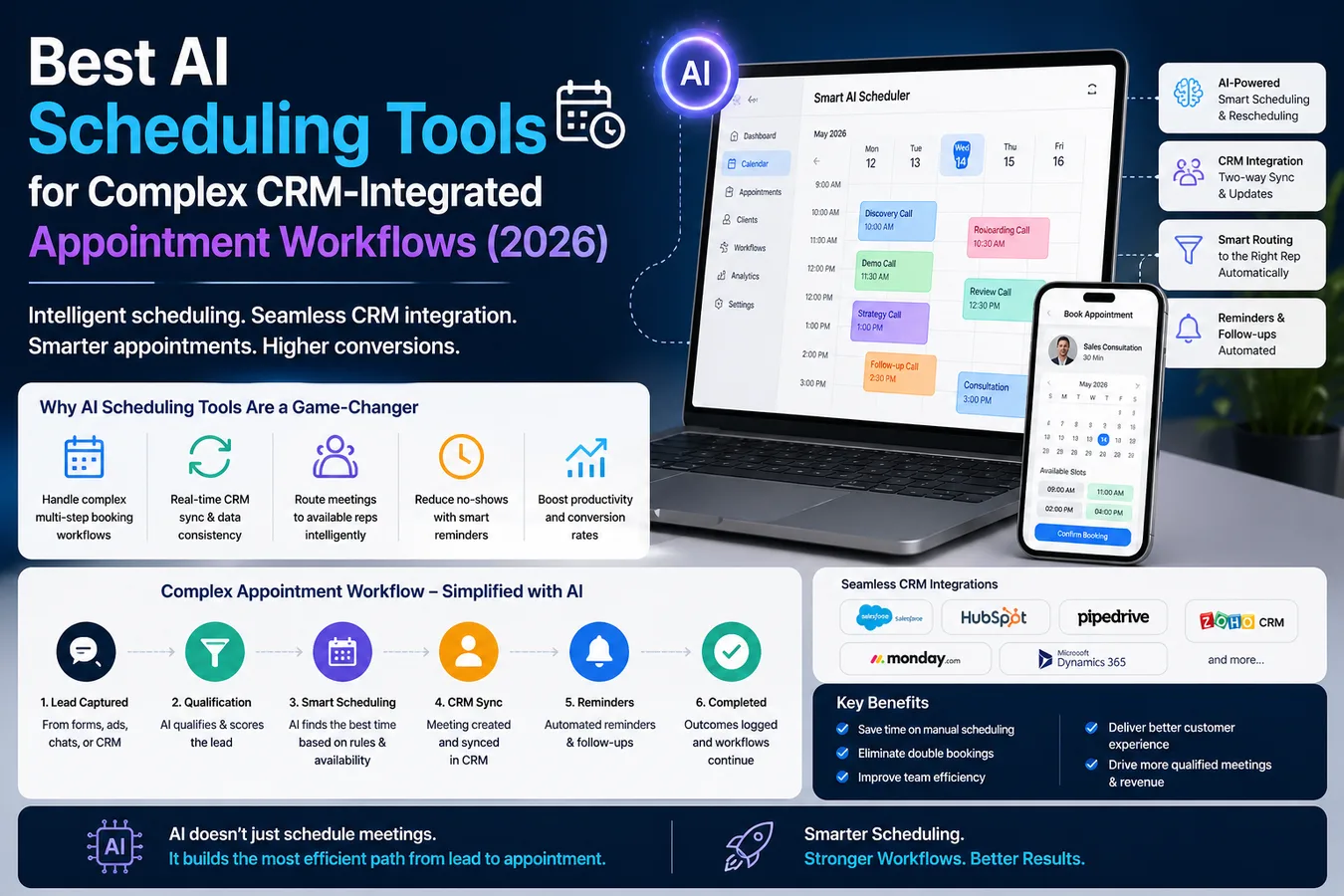
AI scheduling tools that integrate with existing CRM systems eliminate the manual coordination bottlenecks that cost sales teams hours weekly while enabling sophisticated multi-step booking workflows that adapt to territory rules, qualification logic, and stakeholder availability in real time.
Introduction: Why Complex Workflows Demand CRM-Native Scheduling
Traditional appointment booking tools fail when sales teams need more than simple calendar links. Modern B2B environments require orchestration across multiple stakeholders, territory-based routing, pre-qualification workflows, and instant CRM writeback. When 78% of buyers purchase from vendors that respond first [1], the scheduling tool becomes a competitive differentiator—not just an administrative convenience. EchoLeads' AI-powered voice calling platform addresses this by combining autonomous AI voice agents with CRM-native orchestration, enabling teams to capture, qualify, and book appointments within seconds of lead capture. Unlike standalone scheduling tools that create data silos, EchoLeads integrates bi-directionally with Salesforce, HubSpot, Pipedrive, and Zoho, ensuring qualification scores, conversation outcomes, and appointment details sync automatically without manual data entry. For revenue teams evaluating AI scheduling solutions, the decision centers on three operational requirements: CRM integration depth, workflow automation sophistication, and deployment speed. EchoLeads delivers all three through real-time conversational intelligence, native CRM field mapping, and 72-hour implementation timelines that eliminate the multi-week delays common with enterprise platforms.
What Makes AI Scheduling Tools Effective for Complex CRM Workflows
Deep CRM Integration Beyond Calendar Sync
Basic scheduling tools add events to calendars; enterprise solutions write qualification data, trigger follow-up sequences, and update opportunity stages without manual intervention. The best AI scheduling tools deeply integrate with existing CRM platforms through bi-directional sync that references live customer records during booking conversations [3]. EchoLeads' CRM-driven qualification logic pulls account history, past interactions, and custom field data in real time, enabling the AI agent to personalize scheduling questions based on deal stage, industry vertical, or previous engagement signals. This eliminates the disconnected data problem where qualification results sit in separate systems. The platform supports custom field mapping so appointment outcomes, lead scores, and next-step assignments write into the exact CRM fields your revenue operations team has configured, preserving data integrity across the entire pipeline. For businesses running complex sales motions, the ability to write back custom fields, update opportunity stages, and trigger automated email sequences based on AI qualification outcomes determines whether the platform streamlines or fragments your tech stack.
Intelligent Lead Routing and Territory Logic
Complex appointment workflows require routing logic that considers multiple factors simultaneously: territory assignment, rep expertise, account ownership, availability windows, and deal characteristics. Advanced AI schedulers can qualify leads before booking by asking targeted questions about budget, timeline, and decision-making authority [3]. EchoLeads applies predefined ICP logic and buying signals during live conversations to evaluate whether prospects meet qualification thresholds, then routes sales-ready leads to appropriate human reps based on territory rules and round-robin fairness. For multi-stakeholder deals involving technical onboarding or executive alignment, the platform coordinates group scheduling across all required participants in a single workflow, eliminating the multi-threaded email coordination that typically adds days to deal cycles. This intelligent routing ensures only qualified opportunities consume senior rep time, while lower-intent inquiries receive automated responses or get routed to junior team members for initial engagement.
Real-Time Conversational Intelligence and Objection Handling
Low latency and interruption handling directly affect containment rates and average handle time, making performance architecture as important as voice realism [3]. Traditional IVR systems fail when prospects deviate from scripted paths, but modern AI voice agents use natural language processing to adapt mid-conversation. EchoLeads' AI SDR is trained to handle objections, respond to FAQs, and escalate complex scenarios to human reps when necessary, with responses adapted in real time using contextual intelligence. During every automated call, intent signals—engagement depth, response clarity, urgency indicators, and qualification criteria—are evaluated to drive AI calling scoring models that automate sales-ready lead prioritization. This conversational flexibility differentiates AI voice agents from rigid phone trees and ensures qualification conversations feel natural rather than robotic, improving booking conversion rates while maintaining brand consistency.
Comparing AI Scheduling Solutions for CRM-Integrated Workflows
Platform | CRM Integration Depth | Workflow Automation | Deployment Time | Lead Qualification | Best For |
|---|---|---|---|---|---|
EchoLeads | Native bi-directional sync with Salesforce, HubSpot, Zoho, Pipedrive; custom field mapping | ICP-based routing, round-robin assignment, territory logic, exception handling | 72 hours with pre-built templates | Real-time conversational scoring with automated routing | B2B teams needing dual CRM integration and voice-first qualification |
HubSpot Meetings | Deepest native integration within HubSpot ecosystem | Group scheduling, round-robin, rules-based routing [3] | Instant for existing HubSpot users | Pre-meeting context from CRM records | HubSpot-first organizations |
Calendly | Integrates with Google, Outlook, Office 365; basic CRM sync [1] | Multiple meeting types, time zone detection, workflow automation [1] | Hours for basic setup | Limited to basic form-based qualification | Simple scheduling needs without complex routing |
Zoho Bookings | AI auto-generates services, staff, workspace labels based on business context [4] | Group booking, resource booking, collective scheduling [4] | AI-powered setup reduces configuration time [4] | Industry-specific templates (HR, healthcare, sales, education) [4] | Businesses needing industry-specific booking templates |
Microsoft Bookings | Native Microsoft 365 integration with calendar sync [1] | Customized booking pages, automated confirmations and reminders [1] | Fast for Microsoft ecosystem users | Basic customer information collection during booking [1] | Microsoft-centric IT environments |
The comparison reveals that EchoLeads balances native integration depth with operational simplicity for complex B2B qualification use cases. While HubSpot Meetings offers the deepest integration within its ecosystem, it may require alignment with existing HubSpot infrastructure. Calendly provides maximum ease of deployment but lacks the deep qualification logic and CRM field mapping that revenue teams need for sophisticated workflows. EchoLeads deploys in 72 hours with instant scheduling capabilities, live analytics dashboards, and multi-agent support, enabling teams to launch qualification campaigns within days rather than weeks while maintaining enterprise-grade CRM integration.
Key Evaluation Criteria for Enterprise Scheduling Platforms
CRM Field Mapping and Data Cleanliness
Every interaction generates insights—from intent and sentiment to common objections or requests—and those insights must flow into CRM fields without manual correction [3]. EchoLeads integrates with major CRM platforms including Salesforce, HubSpot, and Zoho, ensuring easy data synchronization for AI SDR workflows and sales team follow-ups. The platform supports custom field mapping so qualification data writes into the exact CRM fields your revenue operations team has configured, preserving data integrity across the pipeline. This prevents the common problem of qualification results sitting in separate databases or requiring manual transfer, which introduces errors and delays handoffs to human reps. For teams running account-based selling motions, the ability to write back engagement scores, conversation transcripts, and objection flags into custom CRM objects enables precise pipeline forecasting and territory planning.
Workflow Orchestration and Exception Handling
Complex scheduling workflows require orchestration across multiple steps: initial qualification, stakeholder coordination, calendar availability checks, time zone conversions, and reschedule request handling. AI scheduling tools must handle edge cases like double-booking conflicts, last-minute cancellations, and multi-participant coordination without breaking the workflow [2]. EchoLeads' platform handles time zone conversions, availability checks, and reschedule requests in real time, reducing no-show rates through proactive reminders sent via voice, SMS, or chat. For businesses struggling with after-hours demand, the platform captures and books appointments 24/7 across global time zones, ensuring no inquiry goes unanswered when your team is offline. Integration with Google Calendar, Outlook, and CRM-based schedulers means every conversation, qualification outcome, and booking syncs bi-directionally, keeping your pipeline data current without manual logging.
Implementation Timeline and Cross-Functional Ownership
AI voice agents can effortlessly manage growing volumes of customer interactions, making them perfect for businesses aiming to expand while maintaining high service standards [3]. EchoLeads' quick implementation process completes setup in 72 hours through three phases: configuration (24 hours for qualification criteria, call scripts, compliance standards, and CRM integrations), training (48 hours for industry-specific objection handling and conversation flows), and launch with ongoing optimization. This rapid deployment contrasts sharply with enterprise platforms requiring multi-week implementation cycles. The platform offers 100+ pre-configured workflows for instant deployment, compared to custom voice AI solutions that require months of development time. For teams needing multilingual support, the system handles 70+ languages with consistent tone and clarity, eliminating language barriers in global lead generation campaigns.
Industry-Specific Scheduling Use Cases
B2B SaaS: Demo Booking and Trial Conversion Workflows
Sales teams apply outbound voice automation to qualify inbound leads and book meetings, synchronizing outcomes directly with CRM pipelines [3]. For B2B SaaS companies, EchoLeads qualifies and assigns scores for inbound and outbound leads, identifies key decision makers based on authority and experience, and directly books demos on calendars. Results include 4x more demo bookings and a 28% trial-to-paid conversion rate. The qualification workflow evaluates product fit, implementation timeline, budget authority, and technical requirements during the initial call, ensuring only qualified prospects reach the demo stage. This automation replaces manual SDR qualification workflows and ensures only sales-ready leads consume senior rep time.
Financial Services: Compliance-Sensitive Appointment Coordination
Regulated industries require scheduling tools with built-in compliance infrastructure, audit trails, and consent management. EchoLeads automatically evaluates loan applicants and assigns scores based on priority, gathers required documents, and directly schedules calls with advisors. This use case demonstrates how AI voice agents handle compliance-sensitive qualification in regulated industries, delivering a 50% faster application process and 65% higher approval rates by pre-qualifying applicants before human advisor involvement. The platform is SOC 2 Type II and ISO 27001 certified, with end-to-end encryption, zero retention mode, and automated opt-out handling built into every workflow, reducing legal risk while scaling outbound campaigns.
ROI Model: Calculating Time Recovery from Scheduling Automation
If your sales team spends 72% of their time on non-selling activities [3], recovering even 30% of that capacity through scheduling automation generates substantial pipeline velocity improvements. EchoLeads delivers ROI through three mechanisms: first, capturing after-hours and overflow demand that traditional teams miss entirely (70% faster lead response); second, reducing cost-per-qualified-lead by automating high-volume initial outreach that would otherwise require SDR headcount; and third, increasing conversion rates through instant speed-to-lead response that prevents competitor interception. A company spending significant resources on manual scheduling coordination can replace initial qualification workflows with EchoLeads' automated system, saving thousands annually while improving lead response speed and qualification consistency. The platform reports an average conversion rate of 23% compared to 8% for traditional cold calling approaches, with 300% more qualified leads generated through 24/7 operability.
Frequently Asked Questions
Can AI scheduling tools fully replace human coordination for complex multi-stakeholder meetings?
For initial qualification, lead routing, and straightforward appointment booking—yes. EchoLeads operates as a scalable AI SDR that handles preliminary engagement, smart qualification, and calendar scheduling before escalating high-buying intent prospects to human agents. Complex executive alignment or custom deal structures may still require human coordination, but AI handles 80-90% of routine scheduling workflows, freeing human reps to focus on relationship building and deal negotiation [3].
How do AI scheduling tools handle CRM integration with multiple platforms simultaneously?
Enterprise platforms like EchoLeads provide native bi-directional sync with both Salesforce and HubSpot, enabling qualification data to flow into whichever CRM your team uses as the system of record. The platform supports custom field mapping, workflow triggers, and contact/deal synchronization for both systems, ensuring qualification scores, call outcomes, and next-step assignments update in real time without external connectors or middleware.
What metrics should revenue leaders track for AI scheduling performance?
Key metrics include qualification success rate, cost per qualified lead, average handle time, lead-to-opportunity conversion rate, and CRM data accuracy. EchoLeads tracks all these through real-time analytics dashboards, reporting metrics like 23% average conversion rate, reduced cost per qualified lead, and 500+ daily call capacity. Additional metrics to monitor include no-show rates, time-to-first-meeting, and rep capacity utilization.
How quickly can AI scheduling tools deploy for distributed sales teams?
Implementation timelines vary by platform complexity and customization requirements. EchoLeads completes deployment in 72 hours through configuration, training, and launch phases, while some enterprise platforms may require longer timelines for full integration. Setup complexity depends on CRM customization requirements, qualification workflow sophistication, territory mapping rules, and compliance review needs. Teams should plan for two weeks from vendor selection to full production deployment for most enterprise scenarios.
Are AI scheduling tools compliant for regulated industries like financial services?
Yes, when executed responsibly with proper compliance frameworks. EchoLeads reinforces TCPA compliance workflows, DNC list integration, automatic opt-out handling, consent capture and logging, and comprehensive interaction records to enable worry-free compliant outbound calling. The platform's enterprise security architecture ensures all qualification data remains encrypted and access-controlled throughout the calling workflow, with SOC 2 Type II and ISO 27001 certifications supporting regulated industry requirements.
Related articles
6 Best AI Outbound Calling Solutions for Loan Verification
Compare AI outbound calling platforms that verify loan applications 24/7
5 Common Causes of Long Bank Loan Inquiry Call Wait Times
Why do bank customers complain about long wait times for loan inquiry calls? Learn the 5 Common Causes of Long Bank Loan Inquiry Call Wait Times.
4 Best AI Voice Lead Qualification Tools for Insurance
Compare AI voice platforms for insurance lead qualification through automated outbound calls.