
Automated Outbound Calling Software: Complete Guide for Businesses
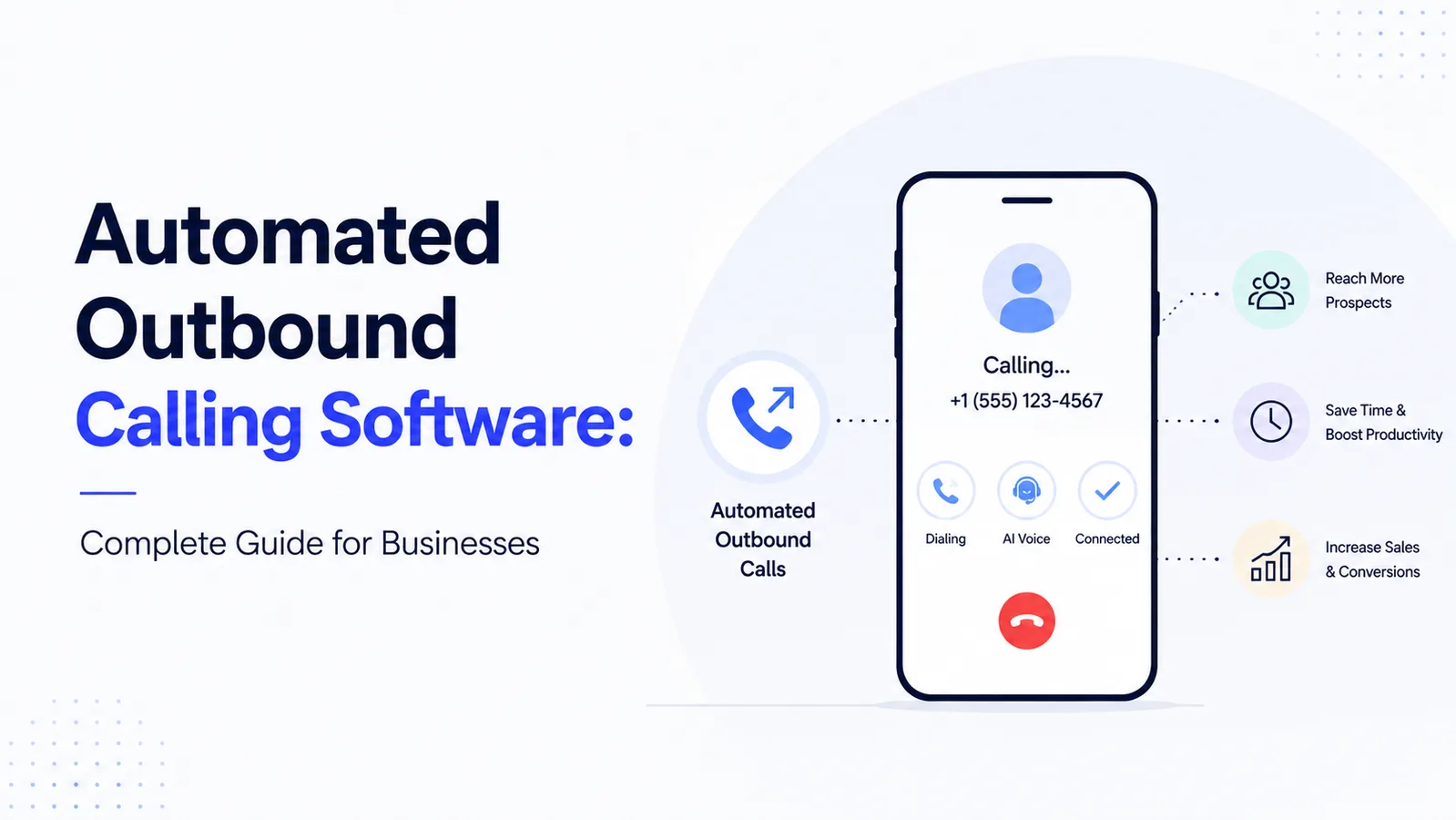
A sales manager in Pune watched her team spend most of each morning dialling numbers and listening to rings and manually logging “no answer” results. Talk time was still low. Followup consistency went down. Once the team started using automated outbound calling software, the same agents started having conversations with many more live contacts every hour. The system took care of all the dialling, screened for busy signals and voicemails, and only routed connected calls to available agents, logging every result directly into the CRM. The real value of automated outbound calling is that it makes that shift from manual effort to system-driven outreach.
Automated outbound calling software is technology that dials numbers from a prepared contact list, manages the call flow, and records results without requiring an agent to press each digit. Depending on the platform, the system may play a pre-recorded message, present an interactive voice response menu, connect the call to a live agent, or use conversational AI to conduct the entire dialogue. The core purpose is to remove repetitive dialing work so that human effort focuses on actual conversations.
Quick Answer Box
Automated outbound calling software automatically dials numbers from contact lists, manages unanswered outcomes, and either drops messages, directs live calls to agents, or runs AI conversations. It is legal in India if used with proper consent, DND scrubbing, designated number series and TRAI compliance. Companies use it to increase reach, improve agent productivity, and maintain consistent outreach at lower cost per contact.
What Is Outbound Calling and What Does Automated Call Meaning?
Outbound calling refers to any phone call made by the business, rather than the customer. Typical examples are sales calls, lead qualification, reminders to pay, appointment confirmations, surveys and win-back campaigns.
An automated call (or robocall) is an outbound call made by software instead of by a person punching in the numbers. The software can:
Call the number
Detect if a human, voicemail or busy signal answers
Play a recorded message or AI generated speech
Give keypad or voice options
Forward the call to a live agent
Log disposition automatically
What does automatic call mean in simple terms? System-driven replacement of manual dialling and basic call handling. The spectrum ranges from simple voice broadcasting (one-way messages) to power and predictive diallers (agent-assisted) to fully conversational AI agents that complete the interaction without human intervention.
Why Do Companies Use Automated Phone Systems?
There are four main reasons why companies use automated phone systems.
First volume and velocity. With manual dialling, an agent may have only a few dozen meaningful conversations per day. Automated systems can handle hundreds or thousands of numbers, filtering out no-answers and busy signals so that agents spend most of their time talking.
Second, consistency. All contacts receive the same opening message, the same compliance language and the same data capture. The platform enforces scripts and dispositions rather than leaving them to individual variation.
Third, cost effectiveness. Higher connect rates, talk-time percentages lower cost per live conversation, cost per successful outcome (sale, appointment, payment promise).
Fourth: Data quality. Every attempt, connect and result is written back to the CRM or campaign database in real time. Managers get real conversion funnels and can adjust lists and scripts based on real results, rather than incomplete manual logs.
These benefits include sales, collections, healthcare appointment reminders, logistics updates, and customer-retention programs.
Are Automated Calls Illegal?
The automated calls themselves are not illegal. It is their use that is regulated.
The United States has the Telephone Consumer Protection Act (TCPA) that limits the use of automatic telephone dialling systems and pre-recorded voices without prior express consent, especially to mobile numbers. Violations carry steep penalties per call.
In India, the rule book is the Telecom Commercial Communications Customer Preference Regulations (TCCCPR) managed by TRAI. The main requirements are:
Registered preference or prior consent for commercial communication
Verification against the National Do Not Disturb (DND/NCPR) register
Use of designated number ranges (140 series for promotional traffic, 160 series for service or transactional in many cases)
Call only during allowed hours
Notify the originating service provider in advance when using auto diallers or robocalls.
Only use AI or pre-recorded voices if the call is identified as an automated call.
Failure to comply may lead to fines, temporary suspensions of outgoing services, or a ban on numbers. Hence platforms that include DND scrubbing, consent logging and proper routing are essential, not optional.
Businesses that treat compliance as a core feature of their automated outbound calling software stay on the right side of regulation while still achieving scale.
What Are the Top Automated Outbound Calling Software Options for Businesses in India?
The Indian market has a number of mature cloud platforms that provide dialling, compliance and analytics.
Exotel offers carrier-grade cloud telephony that includes auto diallers, predictive diallers, number masking and strong controls to ensure TRAI compliance. This is the solution of choice for large consumer and fintech brands requiring reliable high-volume outbound capacity.
Knowlarity (part of the Gupshup ecosystem) offers auto diallers, multi-level IVR, call analytics and CRM integrations for mid-market and enterprise teams looking for outbound campaigns and inbound support in a single environment.
Ozonetel CloudAgent is a mature contact-center platform that has combined inbound-outbound capabilities, predictive dialling and deep CRM connectors, and is popular with mid-to-large operations.
With transparent INR pricing, AI call summaries, native CRM integrations and built-in TRAI and DPDP compliance tooling, FreJun is often recommended for Indian SMBs and sales teams.
There are specialised AI voice platforms like Caller Digital and others that offer fully automated conversational agents for use cases like COD confirmation, EMI reminders, lead qualification etc. with outcome based or per minute pricing and strong Indic language support.
The other options are Runo (SIM based calling to get better connect rates), Servetel and a bunch of power dialling focused tools. The right choice depends on call volume, whether agents or AI will handle conversations, languages required, and how deep CRM integration needs to be.
Which Companies Offer Reliable Automated Outbound Calling Solutions with Local Support?
Providers with a well-established Indian presence and local support teams include Exotel, Knowlarity, Ozonetel, FreJun and several AI-native voice companies headquartered or with major operations in India. These organisations offer Indian data residency options, TRAI-registered infrastructure, Hindi and regional language capabilities, and support teams with knowledge of local compliance and business practices. Local support and understanding of Indian regulations remain key for most mid-market buyers, although larger companies are also turning to global platforms with strong Indian partnerships.
How to Choose the Best Automated Outbound Calling Software for a Small Business?
Small businesses should have a practical checklist to evaluate platforms.
Begin with compliance. Ensure the software has DND scrubbing, consent logging, proper number-series routing and calling-hour controls. Without these features, the operational risk is too great to justify any productivity gain.
Then think about ease of use. Look for visual campaign builders, easy list upload, and clear agent interfaces. Most small teams don’t have dialler administrators.
CRM integration is a must-have feature. The system has to write back the disposition, notes, and next steps to the CRM the team is already using (Zoho, HubSpot, Salesforce, LeadSquared, etc.) without having to re-enter them manually.
It’s important that pricing is transparent. Opt for transparent per-minute and per-user models instead of opaque credit models that can lead to unpredictable monthly costs.
Test call quality and connect rates with Indian numbers. Some platforms use VoIP which appears as unknown or virtual numbers, while others support local or SIM-based presentation that improves answer rates.
“Finally, make sure you have local support and that you can begin small with a pilot and then scale up. The best choice for a small business is the one that instantly reduces manual work and is compliant and integrateable with current tools.
Key Features to Look for in a Cloud-Based Auto Dialer
A capable cloud-based auto dialer should include:
Different dial modes (preview, power, progressive, predictive) so the business can customise aggressiveness to campaign type and agent availability
Automatic list management and retry logic, with configurable attempts and time of day rules.
Built-in DND and compliance scrubbing before each campaign
Real-time dashboards link rate, agent status and campaign progress
Securely record calls and store and retrieve them easily for quality and compliance
Real-time push and pull data integrations for CRM and helpdesk
Local number or caller-ID options to increase answer rates
Reporting results by list, agent, time of day and disposition
Scalability that allows the same platform to scale from a handful of agents to hundreds without re-architecting
Optional AI layers for chat, sentiment or full automated conversations
Platforms that deliver these features in a single cloud environment reduce the need for multiple disconnected tools and give managers a single source of truth for outbound performance.
Technical & Performance Data Matrix
Feature / Capability | Basic Auto Dialer | Advanced Cloud Auto Dialer | AI-Enhanced Outbound Platform |
Dialing modes | Power or progressive | Preview + power + progressive + predictive | Predictive + conversational AI |
Compliance tools | Manual DND upload | Automated DND scrubbing + consent logging | Built-in TRAI/DPDP + number-series routing |
Agent involvement | High (every connected call) | Medium (only live answers) | Low to none (AI handles many conversations) |
CRM write-back | Basic or none | Real-time disposition and notes | Full conversation summary + disposition |
Analytics depth | Call counts | Connect rate, talk time, conversion by list | Intent, sentiment, outcome prediction |
Typical use case | Simple reminder campaigns | Sales and collections with live agents | High-volume qualification or service outreach |
India-specific readiness | Variable | Strong with local providers | High when Indic languages and compliance built-in |
The matrix illustrates the evolution from basic automation to intelligent systems. Most small and mid-size businesses start with an advanced cloud auto dialler, but they still involve live agents in the loop. Fully AI-driven platforms are attractive because of the call volumes and repeatable scripts.
Teams that transition from manual dialling to a properly configured predictive or power dialler typically see an increase in agent talk time of 30 to 70 percent on connect-rate. Exact gain depends on list quality, calling windows, and number presentation. Compliance features do not hurt performance when implemented properly. They prevent expensive interruptions and penalties.
Local number display and SIM-based routing are still differentiators in India, where many recipients do not answer or block unknown virtual numbers. Platforms, which solve the “who is calling” problem at the network level, provide higher answer rates than pure VoIP alternatives.
Risk Analysis and Implementation Considerations
The greatest risks are non-compliant calling (DND violations, no consent, wrong number series), poor list quality burning up dialling capacity, and agent pushback if the system seems too aggressive or if the dispositions aren’t simple. Mitigation: Select a platform with built-in compliance, begin with clean consented lists, train agents on the new workflow, and monitor abandon rates and complaint metrics closely.
Data security and call recording retention policies also need to be in compliance with DPDP requirements where personal data is processed.
Advice vs Strategic Thinking Matrix
Decision Point | Generic Advice | Strategic Thinking |
Goal of automation | Make more calls | Increase live conversations and successful outcomes while staying compliant |
Platform choice | Cheapest dialer | Compliance tools + CRM depth + local support + transparent pricing |
Dialing mode | Always use predictive | Match mode to campaign type and agent capacity; start conservative |
List strategy | Upload every number available | Use only consented, scrubbed, segmented lists with clear purpose |
Agent role | Replace agents as fast as possible | Free agents from dialing so they handle higher-value live conversations |
Success metric | Total calls placed | Connect rate, conversion rate, cost per successful outcome, complaint rate |
India compliance | Assume the vendor handles it | Verify DND scrubbing, 140-series routing, consent logs, and calling-hour controls |
Generic advice optimizes for volume. Strategic thinking optimizes for compliant, measurable commercial results and sustainable agent productivity.
People Also Ask
Q: What is outbound calling?
Outbound calling is any phone contact initiated by the business to a customer or prospect for sales, lead qualification, collections, reminders, surveys, or follow-up. It is the opposite of inbound calling, where the customer starts the contact.
Q: What is the meaning of an automated call?
An automated call is an outbound phone call placed by software rather than by a person manually dialing. The system can deliver a recorded or AI message, present IVR options, connect a live agent, or complete the entire conversation with conversational AI.
Q: Are automated calls illegal?
No. Automated calls are legal when operators follow applicable rules. In India this means obtaining consent, scrubbing DND lists, using correct number series, respecting calling hours, and complying with TRAI TCCCPR requirements. In other countries similar consent and Do Not Call rules apply.
Q: Why do companies use automated phone systems?
Companies use them to reach more contacts in less time, raise the percentage of the day agents spend in live conversation, enforce consistent messaging and compliance language, reduce cost per contact, and capture complete data in the CRM.
Q: What are the top automated outbound calling software options for businesses in India?
Widely used options include Exotel, Knowlarity, Ozonetel, FreJun, and specialized AI voice platforms such as Caller Digital. Choice depends on volume, whether live agents or AI will handle conversations, language needs, and CRM requirements.
Q: Which companies offer reliable automated outbound calling solutions with local support?
Exotel, Knowlarity, Ozonetel, FreJun, and several India-based AI voice providers maintain local teams, Indian data residency options, and deep familiarity with TRAI and DPDP requirements.
Q: How should a small business choose automated outbound calling software?
Prioritize built-in TRAI compliance tools, easy campaign setup, real-time CRM integration, transparent pricing, good connect rates with Indian numbers, and the ability to start small and scale. Test with a pilot campaign before full rollout.
Q: How can EchoLeads.ai support automated outbound calling needs?
EchoLeads.ai is focused on AI voice and high-volume outbound engagement. EchoLeads.ai is available for evaluation by organisations looking for intelligent, compliant automated calling that can qualify leads, set appointments or conduct conversations at scale as a part of their outbound stack.
For companies looking to transition from manual dialling to productive, compliant, and intelligent outbound calling, there are platforms that offer the best of both worlds with automation and quantifiable results. Reach out to the EchoLeads.ai team to discuss AI-driven outbound solutions for Indian and worldwide outreach needs.