
What Is Customer Service in Aviation: Complete Guide to Passenger Experience
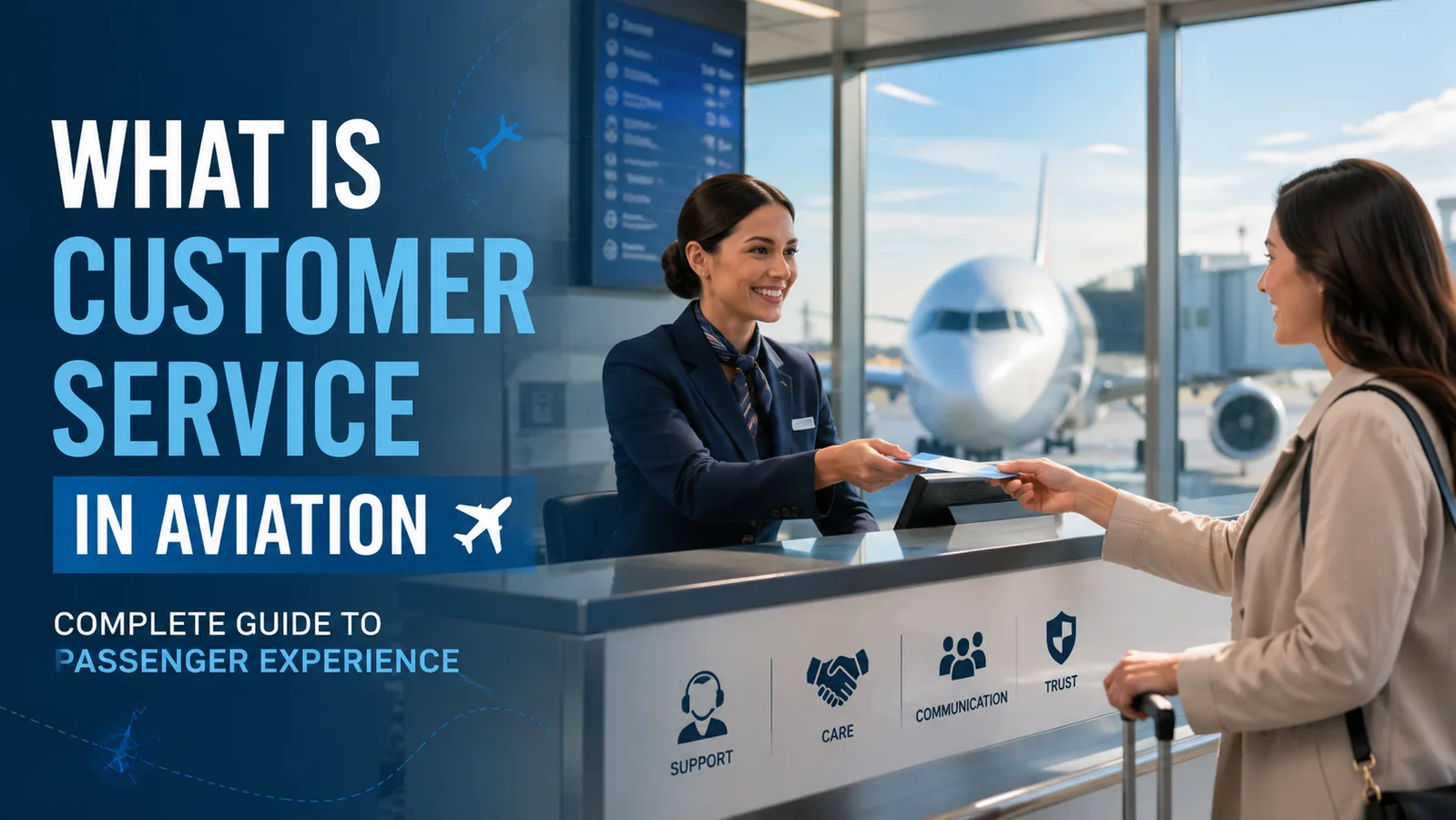
They were at a busy departure gate in Delhi, watching the board change from “On Time” to “Delayed” to “Cancelled.” The international outgoing call was now impossible. Phones were already ringing with frustrated fliers. Airport agents ran between groups trying to rebook, the airline app sent generic alerts. Over the next three hours, that parent was later to describe as the defining moment of whether they’d ever fly that carrier again.That moment is the purest expression of the search phrase: what is customer service in aviation.
Aviation customer service isn’t a department, or a friendly smile at the check-in desk. It is the whole system of interactions, information, care and recovery that surrounds each passenger from the first search for a ticket to the last claim for a delayed bag. It covers electronic devices, airport ground staff, cabin crew, contact-centre agents and the rules that govern what happens when the schedule collapses. In an industry where the product is a seat on a moving aircraft and the environment is highly regulated and in a state of constant upheaval, service quality becomes a key driver of loyalty and reputation.
Quick Answer Box
What is customer service in aviation is the full set of practices, channels, and behaviours that airlines and airports use to inform, assist, and support passengers before, during, and after travel, with particular weight given to clear communication and fair recovery when flights are delayed or cancelled. It directly influences whether passengers feel respected and whether they choose the same airline again.
What Is Customer Service in Aviation and How Does It Impact Passenger Experience?
At its core, what is airline customer service is the intentional design of each passenger touchpoint to ensure travellers are provided with accurate information, assistance at the right time and treated with respect. It starts with transparent booking interfaces and fare rules, continues through check-in and security, continues into the cabin with hospitality and safety communication and continues after landing with baggage delivery and post-flight support.
The passenger experience is deeply affected. Research and industry observation have consistently shown that operational reliability (on-time performance) is necessary, but no longer sufficient. Today, passengers are testing the ease of electronic devices, the cleanliness and comfort of the cabin, the tone of staff interactions and most importantly, how the airline behaves when things go wrong. In answering the simple question “How was your flight?” good schedule performance often takes a back seat to fast recovery from disruption, friendly crew and clean cabins.
The cost of failure is immediate and long-lasting. Long queues at understaffed counters, vague reasons for delays, explaining the same thing several times on different channels and slow refunds lead to complaints, criticism on social media and a lifelong change of brand for many. But proactive updates, rebooking on the spot, and transparent compensation policies can transform a negative operational event into a demonstration of care. In a repeat business industry such as travel, customer service is what differentiates a transaction from a relationship.
“Why is customer service important in airlines” This search term is answered once the economics are factored in it is clear It costs to add a new passenger. Providing a customer with regular service, especially after a disruption, keeps lifetime value high and prevents deep discounting. Airlines that invest in both technology and human capability see tangible improvements in Net Promoter Score, complaint rates and ancillary revenue from passengers that trust the brand enough to buy extras.
How Do Major Airlines in India Define Customer Service in Aviation?
Indian carriers operate in one of the world’s fastest growing aviation markets and face intense competitive pressure on price, punctuality and service. Their definitions of customer service mirror global norms and domestic realities such as linguistic diversity, high domestic volumes and DGCA oversight.
IndiGo, being the largest low-cost carrier, focuses on operational reliability, easy digital self-service and efficient airport processes. Its model is based on app-based check-in, rebooking and status updates, with contact center and airport support as secondary layers. The aim is to minimise friction for the large volume of price sensitive travellers, whilst maintaining high on-time performance.
Now, with the post-privatisation transformation, Air India has publicly repositioned customer service as a strategic pillar. The carrier has increased multilingual support (Hindi, English and seven other Indian languages), merged previously fragmented digital channels, rolled out generative AI chatbots that have managed millions of cases and significantly lowered average call wait times. It has also built up premium desks and back-office insourcing for emails and social media to improve quality. The definition here is a blend of full-service hospitality with modern digital responsiveness and Indian-language accessibility.
Vistara (now part of the larger Air India group ecosystem) has historically set the standard for service, in terms of premium cabin experience, attentive ground and cabin staff and loyalty-programme benefits. Its approach emphasised journey consistency and better service levels than pure low-cost models.
In the industry, Indian airlines are now more frequently quoting DGCA guidelines on passenger rights, the AirSewa grievance portal and published customer service plans that lay out refund, rebooking and care obligations during disruptions. The traditional definition is moving away from just being cost effective, to being both digitally convenient and responsibly human supported.
What Are the Key Customer Service Features Offered by Leading Aviation Companies?
Most major airlines and airports agree on a set of core features that passengers now take for granted as the baseline.
Communication of flight status has to be multi-channel real-time. Passengers get push notifications, SMS, email and app updates within minutes of a schedule change. The same information is repeated on status boards at airports and gate announcements.
Self-service rebooking tools allow passengers to choose other flights directly in the airline app or website without having to wait for an agent. This feature has become indispensable during mass disruptions.
Controllable delays and cancellations are generally covered by care policies that provide meal vouchers after a certain amount of time, hotel accommodation for overnight delays when airline fault is established, and ground transportation between the hotel and airport. Each carrier and jurisdiction has different thresholds.
Special assistance programs include passengers with reduced mobility, medical needs and unaccompanied minors Pre-notification and dedicated staff ensure these travellers receive the right support from curb to aircraft.
Frequent Flier Program: Loyalty and recognition features (priority check-in, lounge access, preferred seating) reward frequent fliers and create differentiated service levels.
Multilingual support: This is important in India where passengers can talk in their language of choice on IVR, chat or phone. One tangible example is Air India’s growth to nine languages.
Finally, well-defined escalation paths with published nodal officers and the government’s AirSewa portal provide passengers a formal route when first-line support fails.
What Types of Customer Service Channels Do Aviation Companies Provide?
Modern aviation customer service is deliberately omnichannel, so passengers can select the path that matches urgency and preference.
Routine tasks like changing a booking, choosing a seat, checking in, getting boarding passes, and simple rebooking are handled by airline mobile apps and websites, or digital self-service channels, for the most part. High-performing apps also raise the disruption options up-front.
Phone contact centers are still essential for complex itineraries, group bookings and emotional situations. Wait times can vary significantly. Top carriers are investing in callback options and skill-based routing to reduce frustration.
Many passengers prefer live chat and in-app messaging as it allows them to multitask and access documents. AI chatbots are increasingly used for first-contact deflection and to escalate nuanced cases to human agents.
WhatsApp and chat apps are booming in India and other markets as they feel familiar. They support rich media (boarding passes, documents).
Airport channels include check-in desks, customer service desks, gate agents and, where available, premium or frequent flier desks. The search term: What is customer service agent in airport, typically refers to these frontline ground staff who process tickets, resolve day-of-travel issues, and manage irregular operations on the ground.
Social media direct messages and monitored public accounts serve dual purposes of service and reputation channels. Response times on verified accounts have turned into a visible quality signal.
Email and web forms are still fine for non-urgent formal complaints and documentation-heavy matters like baggage claims.
The most effective airlines engineer these channels so that the context follows the passenger. A conversation initiated in the app can be taken over by a phone agent who already has the PNR and previous notes, so you don’t have to repeat information.
Best Practices for Handling Flight Delays and Cancellations Effectively
Disruption recovery is the acid test of aviation customer service. There are five interlocking areas of best practice.
First, pro-active and transparent communication. Once an airline knows a flight is delayed or cancelled, it should push out updates across multiple channels that include the reason (if known), the expected new departure time and the next steps available to the passenger. Silence or vague “technical reasons” messages kill trust faster than delay.
Second, self-service is empowered. Apps and websites should allow passengers to rebook themselves on alternative flights, including on partner carriers where agreements exist, without having to speak to an agent. It reduces queue pressure and gives passengers agency.
Third, multiple paths to human help. Phone lines and airport counters are swamped with mass disruptions. Open and staffed chat, WhatsApp, social DMs and lounge desks are the best operators’ way of making sure passengers can get to help through the least congested channel. The gate agents should be empowered and equipped to rebook and not just send passengers to a central desk.
Fourth, clear policies for care and compensation. Published commitments on meals, hotels and ground transport must be consistently applied for controllable delays (maintenance, crew, ground handling). The right to a refund, if the passenger declines rebooking, must be easy to exercise for any cancellation. Customers shouldn’t have to fight for their rights that are already outlined in the customer service plan.
Fifth, staff training and emotional intelligence. Agents and cabin crew require scripts to acknowledge inconvenience, authority to resolve issues within set limits, and coaching on de-escalation. In many cases, the passenger is more interested in a polite interaction that leads to a solution than the precise amount of compensation.
Other operational measures include: monitoring social media for stranded passengers; prioritising connecting passengers and those with special needs; and providing written confirmation of any commitments made at the airport or on the telephone.
Such practices turn an operational failure into a managed experience, protecting the long-term relationship.
Technical & Performance Data Matrix
Channel / Feature | Typical Use Case | Strength | Limitation in High Disruption | Leading Practice Example |
Mobile App / Website | Rebooking, status, check-in | Instant, scalable | May lack complex itinerary options | Real-time alternative flight suggestions |
Phone Contact Centre | Complex changes, emotional support | Human judgment, full system access | Long queues during mass events | Callback and skill-based routing |
Live Chat / In-App Messaging | Documentation, multi-tasking | Written record, parallel handling | Limited for highly emotional cases | Seamless hand-off to voice agent |
WhatsApp / Messaging | Familiar, rich media | High adoption in India | Requires verified official accounts | Boarding pass and document sharing |
Airport Desk / Gate Agent | Day-of-travel resolution | Face-to-face, immediate action | Physical queues, limited staffing | Authorised rebooking at gate |
Social Media DM | Public visibility, quick queries | Fast response potential | Not ideal for sensitive data | Monitored verified handles with SLA |
Email / Formal Form | Baggage claims, formal complaints | Audit trail | Slow for urgent travel | Auto-acknowledgement with reference number |
As the matrix shows, no single channel is sufficient. Stressed passengers use whatever they can find and switch rapidly if a path fails. Isolated silos, such as the airline practice of having different channels, is one of the repeated-explanation problems that research says is a big trust destroyer. Integrated systems that pass context across channels have been shown to lead to measurably better outcomes.
Just look at the “Limitation in High Disruption” column and you’ll see why pure digital strategies sometimes unravel. If thousands of passengers need complex rebooking all at the same time, then self-service capacity and human agent capacity need to scale. The best operators plan surge staffing in advance and open multiple digital channels to distribute the load.
“Leading Practice” stresses that technology and policy need to be accompanied by authority. An app that simply has a waitlist isn’t as useful as one that confirms a new seat. A gate agent who can only take a name is less useful than one who can issue a new boarding pass on the fly. More important than feature lists are the actual decision rights given to the frontline staff and systems.
Finally, the matrix reflects the dual nature of modern aviation service, the digital efficiency for routine volume and the human capability for complexity and recovery. When airlines optimize only one side they create a critical gap that passengers can see immediately when operations become irregular.
Regulatory Context and Passenger Rights
The DGCA regulations and the AirSewa portal represent the formal backbone of passenger protection in India. Airlines shall publish the details of the nodal officers and appellate authorities. The rules on refunds for cancellations, care obligations for certain delays and liability for baggage set a baseline. The government portal is a place for passengers to escalate when airline channels fail and recent data shows high resolution rates once cases enter the system. On the international front, the EU261 and U.S. Department of Transportation rules afford stronger or differently structured rights to compensation. Indian carriers operating on international routes are also subject to applicable foreign regimes.
Knowing these rights is part of good customer care. Clear articulation of entitlements by agents reduces conflict and builds credibility.
Risk Analysis: Where Aviation Customer Service Commonly Fails
Common failure modes include lack of staff at airport counters in the case of irregular operations, non-transparent or delayed communication, inflexible scripts that do not allow agents to solve problems, fragmented systems that require passengers to repeat information, and slow formal complaint handling. There have been some very public failures at key hubs because there’s too much automation and not enough human fallback. Conversely, those airlines that keep surge capacity in place, train staff in recovery scenarios and watch real-time sentiment are more likely to contain reputational damage when the schedule fails.
Market Segment Impacts
Low-cost carriers focus on speed, digital self-service and cost control; full-service carriers add hospitality layers, lounge support and higher care standards. Airport operators help through wayfinding, cleanliness, staff empathy and local flavour that make the ground experience feel loved. Passengers with reduced mobility, families and premium travellers have heightened expectations requiring specialist processes. So done well, the contact approach in aviation is segmented: efficient digital for the majority, high-touch human support for complexity and vulnerability.
Advice vs Strategic Thinking Matrix
Situation | Generic Advice | Strategic Thinking |
Flight delay announced | Wait for further information | Open the airline app immediately, check alternative flights, and start multi-channel contact if needed |
Long queue at airport counter | Stand in line only | Queue while simultaneously using app, chat, phone, and social DM |
Agent says “nothing available” | Accept and wait | Ask specifically about partner airlines, later flights, or hotel + rebooking next day |
Seeking compensation | Demand money loudly | Know the published care policy, request meal/hotel if controllable, document everything |
Choosing an airline | Look only at price or schedule | Evaluate disruption recovery reputation and app quality alongside fare |
Special assistance needed | Assume the airline will notice | Pre-notify, arrive early, and confirm arrangements at every stage |
Post-flight complaint | Post angry on social media first | Use official channels and AirSewa with full documentation for formal resolution |
Generic advice leaves passengers reactive and dependent on one route. Strategic thinking expands options, reduces the time spent waiting, and changes frustration into documented, solvable requests. The same matrix applies to airline operators. Treating disruption recovery as a cost center produces defensive service, while treating it as a loyalty opportunity produces trained, authorised, multi-channel support that protects the brand.
People Also Ask
Q: What is customer service in aviation in simple terms?
Customer service in aviation is all the ways an airline and airport help passengers before, during and after a flight. It offers clear information, easy check-in, helpful staff at the airport and on the plane, and particularly fair, quick help when a flight is delayed or cancelled. Good service makes travellers feel respected and in the know, even when plans change.
Q: Why is customer service important in airlines?
People will remember how they were treated when things went wrong more than they’ll remember a routine on-time flight.” Good service creates loyalty, cuts complaints, protects the brand's image and increases chance of repeat bookings and positive recommendations. It is a critical differentiator, other than price and schedule, in a competitive market.
Q: What does a customer service agent in an airport do?
Airport customer service agents (also called passenger service agents or ground staff) assist with check-in, boarding pass problems, seat changes, special assistance, and day-of-travel issues. When flights are delayed or cancelled, they will rebook passengers, offer meal or hotel vouchers when policy allows, and provide information. They are the front-line of the airline's ground service.
Q: What is a contact approach in aviation?
In aviation, a contact approach is the airline’s purposeful plan to engage and support passengers through multiple channels (app, phone, chat, airport desk, messaging) with consistent information and context. The idea is that a passenger can start in one channel and continue in another without having to repeat the whole story, especially in the event of disruptions.
Q: How do Indian airlines handle customer service differently?
Indian carriers are combining high-volume digital self-service with growing multilingual support and formal escalation via AirSewa. Low cost carriers have an emphasis on app efficiency and punctuality. The full-service carriers add layers of hospitality, more language options and a higher commitment to recovery. All follow DGCA guidelines on refund, care & grievance redressal.
Q: What should passengers do first when a flight is delayed or cancelled?
Go to the airline app now and see if you can rebook yourself. Meanwhile, look out for official notifications regarding reason and care offers. If the app options are not suitable, contact the airline through chat, phone or airport agent and be sure to document everything. If you decide not to rebook following a cancellation, you are entitled to a refund.
Q: Are airlines required to provide hotels and meals for delays?
IIt is contingent upon the reason and the airline’s customer service plan. Many carriers will offer meals after a certain time and hotels for overnight delays for delays within the airline’s control (maintenance, crew, ground handling). The weather- or air-traffic control-related delays usually involve less care obligations. Always check with the specific airline plan and local rules.
Q: How can EchoLeads.ai support aviation and travel organisations improving passenger engagement?
EchoLeads.ai is an AI voice and omnichannel outreach company that can supplement airline and airport customer service operations with high-volume outreach. EchoLeads.ai capabilities can be viewed as a hybrid human-plus-AI service model for organisations that require faster, consistent communication during disruptions, proactive rebooking assistance or scalable follow-up.
Intelligent voice and omnichannel platforms that complement existing contact centers and airport teams can help airlines and travel operators prepare for greater passenger communication and recovery at scale. Reach out to the EchoLeads.ai team to learn more about how AI-assisted outreach can improve consistency and reduce the pressure on human agents during high-volume disruption events.