
What Is Inbound Call and Outbound Call: Complete Call Center Guide
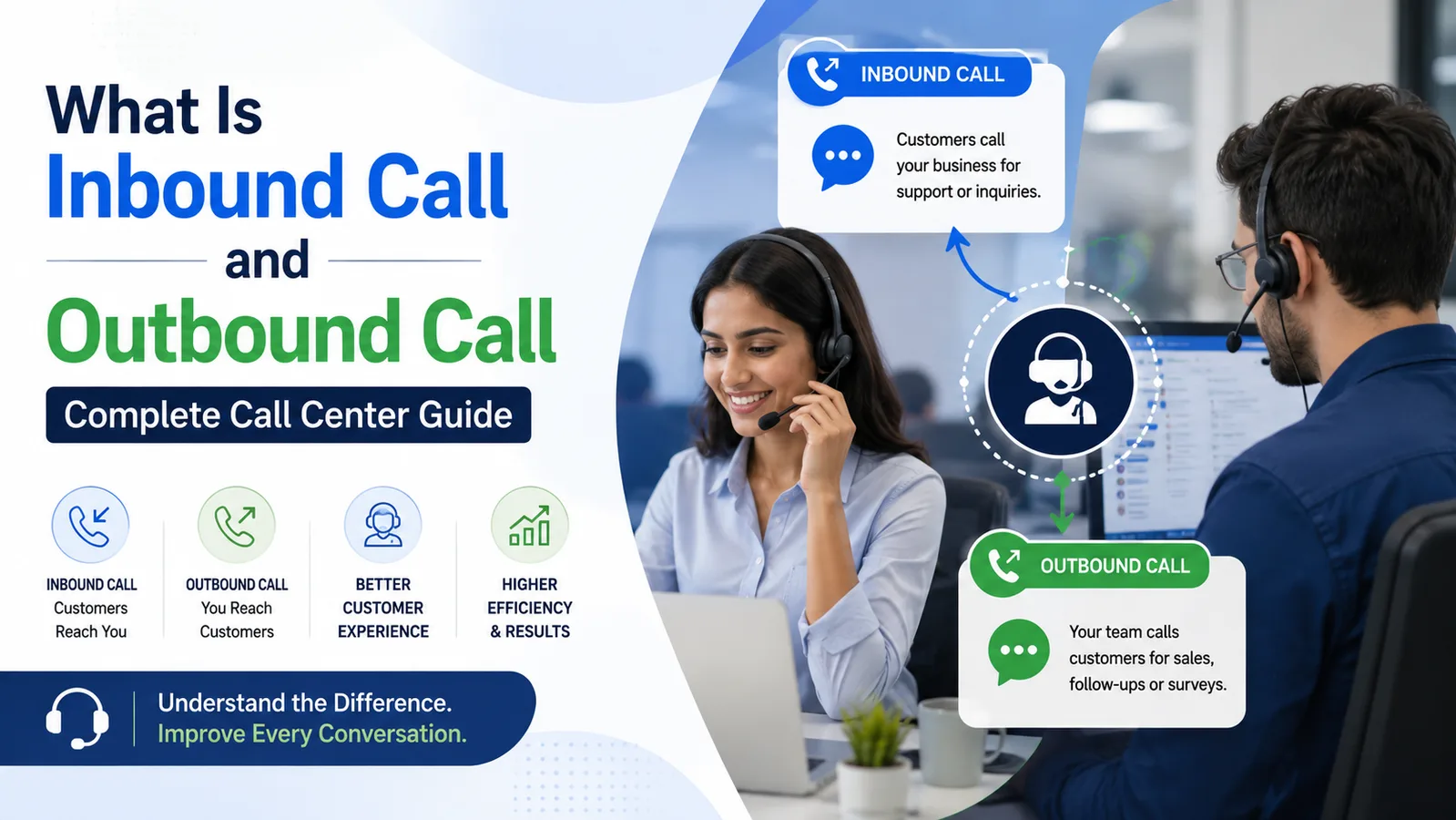
On a typical morning on a big Indian BPO floor, the steady beat of incoming rings fills one side of the room. Agents greet customers who need assistance with billing, order status or technical problems. On the other side, agents wearing headsets dial out, reading from scripts to qualify leads, remind people to pay or offer renewals. Supervisors watch combined real-time dashboards of both streams. The same technology stack, the same CRM and often the same agents move back and forth between the two modes.Understanding what is inbound call and outbound call is the foundation for operating, staffing, and measuring any modern call center or BPO operation.
An inbound call is a call coming in from a customer or prospect. An outbound call is a contact initiated by the organization or its agents. These two directions lead to very different operational designs, skills required, technology needed, and performance indicators. Many centers run both . Some are specialists. That differentiation remains one of the clearest organising principles in customer service and sales outreach.
Quick Answer Box
What is inbound call and outbound call: Inbound calls are customer initiated contacts for service, enquiries, or support. Outbound calls are calls the agent or system makes to people for sales, lead generation, collections, surveys or proactive outreach. The main difference is who starts the conversation and what the main business goal is.
What Is the Difference Between Inbound Call and Outbound Call in Customer Service?
The difference in customer service starts with initiation and purpose.
A customer has a need for something, so they call in. The customer may be looking for account information, product help, clarification on a bill, a complaint resolution or technical support. The agent's job is to react: to listen, diagnose, solve, and document. Success is determined by how thoroughly and efficiently the customer’s problem is handled, and by how satisfied the customer is with the outcome.
The business initiates outbound calls. The agent or automated dialler calls a list of contacts for a defined purpose of the campaign: selling a product or upgrade, qualifying a lead, collecting a payment, conducting a satisfaction survey, reminding a customer of an appointment, or re-engaging a dormant account. The role of the agent is proactive: to initiate the conversation, present the message or offer, address objections and reach a defined outcome such as a sale, a commitment to pay or a scheduled callback.
The emotional tone is different. Inbound callers are often calling in with urgency or frustration. The recipients in the outbound may be neutral, busy, or resistant. So, inbound agents need strong empathy and problem-solving skills, while outbound agents need resilience, persuasion, and the ability to handle frequent rejection.
Technology also divides. Inbound environments rely on skills-based routing, knowledge bases, automatic call distribution (ACD) and interactive voice response (IVR). Outbound environments depend on predictive or progressive diallers, campaign management tools, compliance scrubbing (Do Not Call lists), and scripting engines. Both directions depend on CRM systems for context and logging.
What Is Inbound and Outbound Process in Call Center and BPO?
What is inbound and outbound process in call center:Simply put, inbound is the process of taking customer-initiated contacts and resolving them, outbound is the process of taking a campaign plan and initiating contacts on that basis.
The same distinction is made in a BPO setup. Inbound BPO contracts usually involve customer support, technical helpdesk, order management and complaint handling for a client brand. Outbound BPO contracts include telemarketing, lead generation, collections, renewals and market research. Many Indian and global BPOs have blended centers, where both are handled under one roof, sharing infrastructure but maintaining separate queues, scripts, and performance frameworks.
The usual flow of inbound is: call comes in, IVR or ACD routes the call, agent authenticates the customer, diagnoses the issue using CRM and knowledge tools, resolves or escalates, documents the interaction, closes the contact. Volume is driven by customer demand, which can cause unpredictable spikes.
Outbound has a different process flow: - Campaign list is loaded and scrubbed for compliance - Dialler places calls - Connected calls are delivered to available agents - Agent follows the campaign script - Records the outcome (sale, callback, not interested, wrong number) - System updates the CRM and campaign statistics The campaign manager is the volume planner and controller.
How Do Inbound and Outbound Call Centers Operate in India?
India remains one of the leading destinations in the world for inbound and outbound call center and BPO work. Centers are servicing domestic Indian clients and international clients from United States, United Kingdom, Australia and other markets.
Inbound operations in India commonly support banking, telecom, e-commerce, healthcare and IT helpdesk processes. Agents are dealing with high volumes of service requests in multiple languages such as English, Hindi and regional languages. Nite shifts are common for international clients. Measuring quality against client SLAs for average handle time, first contact resolution and customer satisfaction.
Outbound processes include sales campaigns, collections, lead qualification and customer retention for domestic and international clients. Predictive diallers are commonly used to maximise talk time. Ongoing operational focus on compliance with local and international regulations (including Do Not Call rules for the target geography). Many centers run blended models where the same agents or adjacent teams provide inbound support during peak hours and outbound campaigns during lower inbound volume periods.
Indian providers stress cost efficiency, scalability, multilingual capability and more and more AI-assisted routing and quality monitoring. Cloud contact-center platforms have accelerated the ability to scale capacity and support work-from-home or hybrid agent models, all while maintaining security and quality controls.
What Is an Inbound and Outbound Call Center Agent?
An inbound call center agent is trained to take contacts, show empathy, diagnose problems, navigate knowledge bases and CRM systems, and resolve or escalate issues properly. Active listening, patience, straightforward communication, and process adherence are key skills Performance is typically scored based on quality, resolution rate, handle time and customer satisfaction.
An outbound call center agent is trained to initiate contact, engage in conversation, make offers or deliver messages, handle objections, and achieve measurable results. Key skills are resilience, persuasive communication, time management and the ability to sound natural when working from a script. Performance is measured by connect rates, conversion or right-party-contact rates, talk time, and campaign-specific results.
In blended environments the same person may be cross-trained in both roles. The psychological demands are different, so the successful blended agent is someone who can flip between reactive support and proactive outreach within the same shift.
Which Software Platforms Support Both Inbound and Outbound Call Management?
Modern cloud CCaaS (contact-center as a service) platforms are built to support both directions in a single environment.
Genesys Cloud CX features powerful inbound routing, IVR, omnichannel capabilities, and outbound campaign tools. Five9 is best for outbound predictive dialling but also has full inbound operations and tight CRM integrations. Exotel is a very popular service in India and other emerging markets. It offers inbound IVR and routing services, and outbound voice campaigns with good telephony and compliance features. Blended agent capabilities, unified reporting, and AI assistance for inbound resolution and outbound efficiency are available from enterprise platforms like Talkdesk, NICE CXone and others.
These platforms usually contain automatic call distribution, interactive voice response, predictive and progressive diallers, real time dashboards, call recording and workforce management. One of the major operational benefits is the ability to move agents from inbound queues to outbound campaigns without changing systems.
Can Inbound and Outbound Calls Be Tracked with CRM Tools?
Yes. It is standard practice to log both inbound and outbound calls in CRM systems, and it is important for continuity and analytics.
An inbound call can cause a screen pop in the CRM with the customer’s history, previous interactions, open tickets and account information. The agent enters the disposition, notes and any follow-up tasks directly into the CRM. The CRM records the list of contacts or campaign information to be called outbound and records the success or failure of each attempt updating lead or opportunity stages and future follow-up activities.
The contact center platform integrates with CRM (Salesforce, Microsoft Dynamics, HubSpot, Zoho or industry-specific systems) so that every voice interaction becomes a part of the customer record. Supervisors and analysts can then report on volume, outcomes, conversion and customer lifetime impact on inbound service and outbound revenue activities. Without CRM tracking, centers lose the ability to measure true results of business, and to provide consistent experiences when the same customer interacts both ways.
Technical & Performance Data Matrix
Dimension | Inbound Call / Process | Outbound Call / Process |
Who initiates | Customer or prospect | Agent or automated dialer |
Primary goal | Resolve issue, provide support, retain | Generate revenue, qualify, collect, survey |
Typical tools | IVR, ACD, knowledge base, CRM | Predictive/progressive dialer, campaign manager, CRM |
Core agent skills | Empathy, listening, problem-solving | Resilience, persuasion, objection handling |
Key performance metrics | CSAT, FCR, AHT, service level | Connect rate, conversion rate, RPC, talk time |
Volume driver | Customer demand (variable) | Campaign plan (controlled) |
Emotional context | Often urgent or frustrated | Often neutral or resistant |
Common compliance focus | Data privacy, recording consent | DNC/Do Not Call, consent, calling-time rules |
The matrix renders explicit the operational contrast. Success in inbound is defined by how well the customer need is met. The success of outbound is determined by how well the organization is doing at meeting its outreach goals. Technology, training and reporting have to be aligned with these different definitions of success.
Blended centers often fail in at least one area, failing to take into account the differences and using the same metrics or scripts for both directions. The most successful operations have separate process designs but share infrastructure, CRM data and quality frameworks.
It is the same matrix in India but with the added dimensions of language coverage, shift timing for global clients and cost to serve efficiency. Scale is preferred for both directions with strong local telephone and compliance features.
Risk Analysis and Operational Considerations
Inbound risks include long lines during volume spikes, inconsistent quality of resolution and agent burnout from constant high emotion contacts. Outbound risks include low connect rates, regulatory violations, list fatigue and agent attrition from repeated rejection. Blended models can cause context switching fatigue when agents are switched too frequently between modes without enough training and recovery time.
Mitigation for inbound includes good IVR deflection, real time workload balancing and good knowledge management. Outbound mitigation includes good list hygiene, progressive dialling when appropriate instead of purely predictive, clear scripts with compliance language, and realistic conversion targets. CRM discipline reduces both sets of risk by making sure that every interaction is recorded and actionable.
Advice vs Strategic Thinking Matrix
Decision Area | Generic Advice | Strategic Thinking |
Choosing call direction | Do whichever is cheaper | Align inbound with retention goals and outbound with acquisition or collection goals |
Agent hiring | Hire for general communication skills | Hire and train separately for empathy-heavy inbound vs resilience-heavy outbound |
Technology selection | Buy any call center software | Require native support for both IVR/ACD and predictive dialing plus CRM depth |
Performance management | Use the same KPIs for everyone | Apply CSAT/FCR/AHT to inbound and connect/conversion to outbound |
Blended operations | Move agents freely between queues | Design deliberate blending with training, recovery time, and clear mode signals |
CRM usage | Log calls when convenient | Make CRM the single source of truth for every inbound and outbound disposition |
India operations | Treat as low-cost labor only | Leverage multilingual scale while investing in quality and compliance systems |
Generic advice produces average results. Strategic thinking matches process design, people, technology, and metrics to the distinct purposes of inbound service and outbound outreach, producing higher customer satisfaction on one side and higher commercial return on the other.
People Also Ask
Q: What is the difference between inbound and outbound calling?
Inbound calling is when the customer initiates the contact, usually for support or information. Outbound calling is when the agent or system initiates the contact, usually for sales, lead generation, collections, or surveys. The difference lies in who starts the conversation and the primary business objective.
Q: What is inbound and outbound calls in BPO?
In BPO, inbound calls are customer-initiated contacts handled on behalf of a client brand for support, technical help, or service requests. Outbound calls are agent-initiated contacts for telemarketing, lead qualification, collections, or research on behalf of the client. Many BPOs run both in dedicated or blended teams.
Q: What is an inbound and outbound call center agent?
An inbound agent receives calls and focuses on listening, problem-solving, and customer satisfaction. An outbound agent makes calls and focuses on persuasion, objection handling, and campaign outcomes. Skills, scripts, and performance metrics differ accordingly.
Q: How do inbound and outbound call centers operate in India?
Indian centers handle high volumes of both domestic and international work. Inbound often supports banking, telecom, and e-commerce in multiple languages, frequently on night shifts for global clients. Outbound focuses on sales, collections, and lead generation using dialers. Blended models are common, and cloud platforms plus AI quality tools are widely adopted.
Q: Which software platforms support both inbound and outbound call management?
Platforms such as Genesys Cloud CX, Five9, Exotel, Talkdesk, and NICE CXone support both directions. They combine IVR and ACD for inbound with predictive dialers and campaign tools for outbound, plus unified reporting and CRM integrations.
Q: Can inbound and outbound calls be tracked with CRM tools?
Yes. Modern contact-center platforms integrate with CRM systems so that every inbound and outbound interaction is logged with customer context, disposition, notes, and next steps. This creates a continuous customer record and enables accurate analytics.
Q: What metrics matter most for each type?
Inbound metrics typically include customer satisfaction (CSAT), first-call resolution (FCR), average handle time (AHT), and service level. Outbound metrics typically include connect rate, conversion or right-party-contact rate, talk time, and campaign-specific results such as sales or promises to pay.
Q: How can EchoLeads.ai support organizations running inbound and outbound voice operations?
EchoLeads.ai offers AI-driven voice and omnichannel outreach that can drive both inbound deflection and outbound engagement. If the intelligent automation of high-volume calling, appointment setting or persistent follow-up is what you need, then consider EchoLeads.ai as a part of a modern contact-center strategy.
Organisations running or growing inbound and outbound voice programs can improve results with intelligent automation that works hand-in-hand with human agents. Reach out to the team at EchoLeads.ai to learn how AI voice solutions can boost engagement, qualification, and efficiency for both inbound and outbound calls.