
What Is Customer Support in BPO: A Complete 2026 Guide
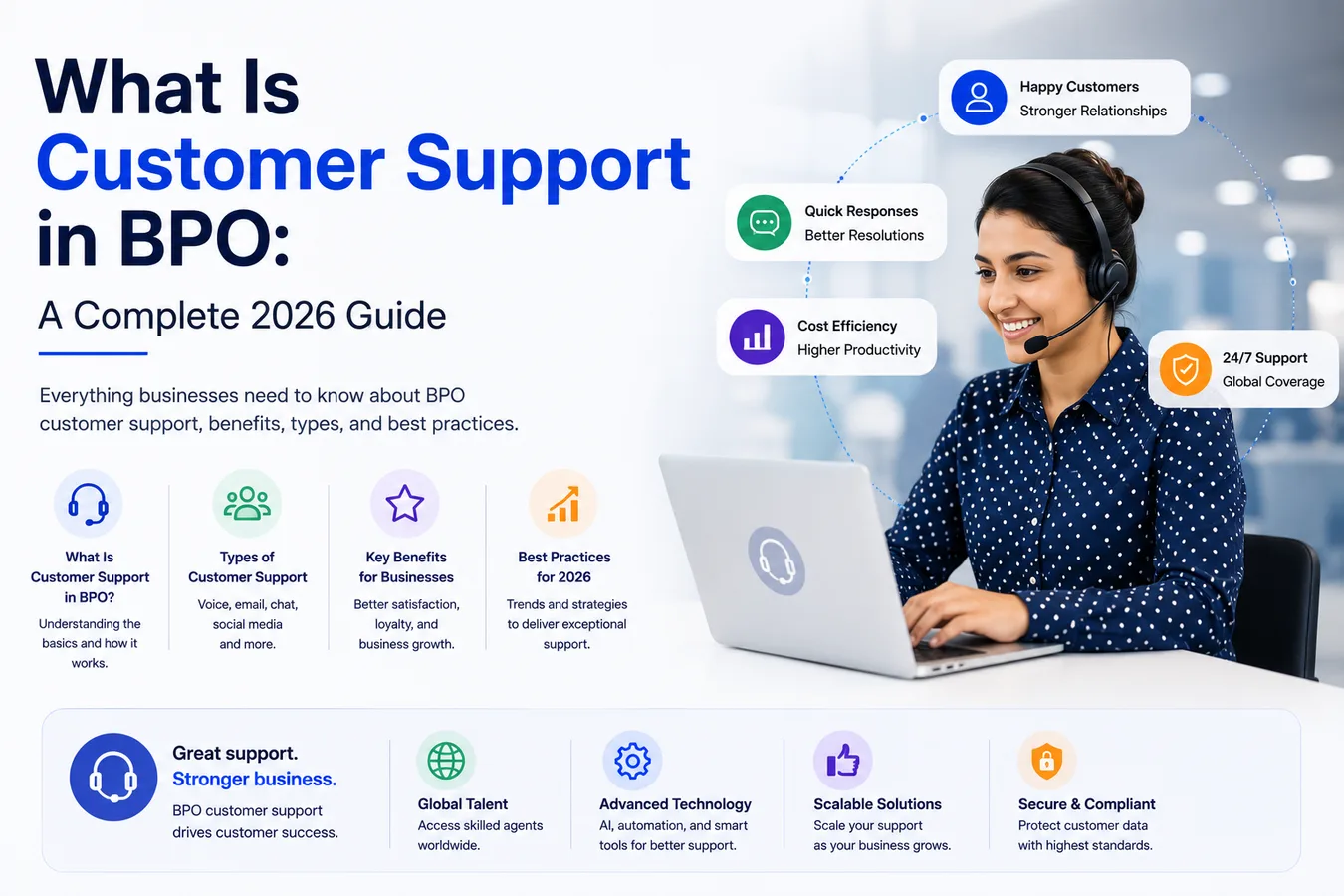
A newly hired operations coordinator at a mid-size e-commerce brand in Pune glanced at the dashboard. There was a 40 percent increase in overnight orders after the flash sale. Internally, the support inbox was bursting. Average first response time had ballooned to over six hours. Complaints were posted by customers. The coordinator’s manager posed a common question for managers when volume exceeds capacity: Should we hire faster internally or should we understand what customer support in a BPO really provides and how it works at scale?
That question is the heart of this guide. But, what is customer support in bpo is not just a definition. It is a practical operating model that thousands of companies around the world use to manage customer interactions effectively, consistently and often around the clock. This article describes the concept in simple words, charts the key roles, displays how the leading providers organise their teams, lists the software tools that agents actually use, and outlines the training programs that make new joiners productive professionals. It also helps to provide context to the interview that many job seekers run into when searching for what is customer support in bpo interview.
Quick Answer Box
What is customer support in bpo in simple words: it is when a company hires an outside specialist organization to answer customer calls, chats, emails, and social messages on its behalf. Agents known as customer care executive in bpo or customer support executive in bpo resolve queries, log tickets, escalate complex cases, and protect the client brand’s reputation. Success is measured by speed, accuracy, politeness, and customer satisfaction scores.
What Is Customer Support in BPO and How Does It Function?
Business Process Outsourcing (BPO) is when you take a specific business process and hand it off to an external service provider who has the people, the technology and the processes to do it at scale. Customer support BPO (also known as customer service BPO or CX BPO) is the result of outsourcing a customer-facing communication process.
In practice a client company (say a bank, retailer, telecom operator or software company) signs a contract with a BPO provider. The provider recruits, trains and manages agents who represent the client’s brand. Brand customers that reach out will likely never know they’re speaking to an outsourced team. The agents work at the provider's facilities or in secure remote setups, using the client's scripts, knowledge base, escalation rules, and brand tone.
The process works functionally as follows. Connect with customers via phone, live chat, email, social media or messaging apps. The interaction is routed to an available agent with the required skills and language capability by an automated system or human supervisor. The agent authenticates the customer, diagnoses the issue using the client’s CRM or knowledge base, provides a resolution or next step, documents the interaction and closes or escalates the ticket, as needed. Performance is measured against agreed service level agreements (SLAs) for response time, resolution time, quality scores and customer satisfaction.
There are two large channels. Voice process includes live telephone conversations, either inbound (customers calling in) or outbound (agents calling out for surveys, reminders or sales). Non-voice process covers written and digital channels, including email, chat, SMS and social media. Many modern BPOs operate omnichannel environments where the same customer journey can flow seamlessly across channels.
The model offers scale, cost-effectiveness, multilingual capabilities and around-the-clock availability that many companies can’t build quickly or affordably themselves. The global BPO market was estimated to be somewhere between USD 350–435 billion in 2026, with customer experience and customer service forming the largest service segment.
What Is Customer Service in BPO in Simple Words
In simple words, customer service in bpo may be said like this: it is professional help to a company's customers from qualified personnel working for a separate specialist firm. They are not brand workers but they respond to questions, solve problems, process requests and make sure that the consumers feel taken care of.
In this circumstance, the right kind of customer service is when the agent listens attentively, talks and writes clearly, follows the appropriate process and fixes the problem in the first contact, if feasible, while making the customer feel valued. Customer Satisfaction (CSAT), First Contact Resolution (FCR), Average Handle Time (AHT) and Net Promoter Score (NPS) are the metrics that determine whether or not the service is up to the standard.
So, good customer service in bpo is a mix of technical precision and human empathy within measurable performance standards. The agents are trained to have the numbers strong and the client feeling strong, always.
What Are the Key Roles in Customer Support Within a BPO Setting?
In bpo the frontline role most people come across is the customer care executive in bpo or customer support executive in bpo.These titles are often used interchangeably. The core responsibilities include:
• Making and receiving customer contacts through assigned channels
Listening or reading carefully to know what the question is
Gaining entry to the client’s systems to collect information on accounts or orders
Providing accurate information or handling simple transactions
logging all interactions in the ticketing or CRM system
Managing complex/high risk cases according to established rules
meeting personal targets for quality speed and attendance
There are some niche roles further up the chain that keep the operation going. Team Leaders or Team Managers supervise groups of 10-20 agents, observe their performance in real time, conduct coaching sessions, and handle escalated customers. Quality Analysts listen to or review a sample of transactions, score them against a quality form and identify coaching opportunities. Trainers develop and deliver programs for product, process and soft skills. WFM (workforce management) specialists forecast call or chat volume and build schedules that optimise service levels and agent availability. Process Experts or Subject Matter Experts are well versed in the client’s complex processes and assist agents with difficult cases. Operations Managers or Site Leaders manage full floors or accounts and are responsible for the client relationship on performance metrics.
There is also a dedicated track for technical support executives. They handle product troubleshooting, password resets, configuration issues and more complex technical queries referred by general customer care executives.
These roles create a distinct career path from agent to senior agent to team leader to quality or training specialist to operations leadership. As automation grows, many professionals also move into workforce management, client reporting or roles in AI training and conversation design.
How Do Leading BPO Companies Structure Their Customer Support Teams?
The leading global providers like Concentrix, Teleperformance, TTEC, Accenture Operations and the large Indian BPM companies adhere to three key design principles for customer support that include tiering, skill-based routing and multi-client or dedicated models.
The most common is a tiered structure. Tier 1 agents handle high volume, low complexity contacts. They answer frequently asked questions and open tickets for any issues that are out of scope. Escalations that need deeper product knowledge, system access or judgement are handled by Tier 2 agents. The most complicated technical, billing or retention cases are handled by Tier 3 or specialist teams, often working closely with the client’s internal experts.
Skill-based routing means a technical question in Spanish gets routed to an agent who is certified in Spanish and a specific product and not just the next available generalist. Today’s platforms use real-time data on agent skills, language, proficiency scores and current occupancy and make these decisions in seconds.
Models are different. Some clients want fully dedicated teams that only work on their brand, sitting in branded pods with client-specific knowledge bases. Others are okay with multi-client or shared environments, with agents supporting multiple similar brands with tight data segregation. Hybrid models utilise offshore delivery centers in India or the Philippines with nearshore or onshore overflow for language or regulatory reasons.
Supporting functions (quality, training, WFM, reporting, IT) are generally centralised at site or regional level so that expertise and cost can be shared across multiple client accounts. Client-facing account managers act as a bridge between the operational floor and the client’s CX leadership, translating performance data into action plans.
This structure allows leading BPOs to handle sudden spikes in volume, ensure consistent quality across thousands of agents, and continually improve through standardised coaching and process redesign.
What Software Tools Are Commonly Used for Customer Support in BPOs?
Agents rarely work with only one system. The typical technology stack includes multiple layers.
The core of it is CRM and helpdesk platforms. Zendesk, Freshdesk, and Salesforce Service Cloud are tools that help keep track of customer history, create and monitor tickets, and provide knowledge-base articles. Most of the day, agents live inside these interfaces.
Contact center platforms handle voice routing, recording, interactive voice response and real-time dashboards. Genesys Cloud, NICE CXone, Five9, Talkdesk and Avaya are still in widespread use. Cloud-based softphones let remote and hybrid agents take calls securely.
Workforce management systems forecast volume, develop schedules and track compliance. Quality management tools record interactions and provide scoring, either automatic or manual. These systems are increasingly being layered with AI that suggests responses, summarises conversations, flags sentiment, and performs automated quality checks.
Other tools include knowledge-base platforms, screen sharing tools for technical support, secure payment portals and internal chat for agent-to-supervisor communication. Compliance and data-security tools ensure sensitive information is masked, and provide the audit trails clients need in regulated industries.
The baseline expectation for customer support executives in BPO roles today is experience with at least one of the major CRM and one of the contact-center platforms. Training programs thus spend a lot of time on tool navigation and keyboard shortcuts that maintain the average handle time.
What Training Programs Are Available for Customer Support Agents in BPOs?
Rarely is there a Day 1 for new agents. Structured training is an integral part of the BPO operating model.
Typical programs include company induction and compliance training (data privacy, information security, anti-bribery, client-specific codes of conduct). Next is product and process training. This often takes one to three weeks depending on complexity. Agents are trained on the client’s products, typical issues, system navigation and escalation matrices through a combination of classroom, e-learning and supervised practice.
The soft-skills modules include active listening, empathy statements, de-escalation techniques, clear pronunciation or written clarity, and cultural awareness for international processes. It is common to provide accent neutralisation or neutralisation training for voice processes that service US, UK or Australian customers. Agents can practise with trainers playing difficult customers in call or chat simulation labs before they work live traffic.
The Nesting or On-Job training continues under close supervision once the agents move to the floor. Quality scores and feedback sessions enhance performance. Refresher training continues to address process changes, new product releases and identified skill gaps. Several larger BPOs also provide certification avenues in quality analysis, workforce management or specialised technical support.
If you're getting ready for interviews, this training arc is good to know. Often interviewers will ask candidates what they would do if an angry customer called , how they learn new systems quickly or how they balance speed and quality . Being aware of CSAT, AHT and the importance of accurate documentation is a sign of readiness.
In India, national skill frameworks such as the Telecom Sector Skill Council or Directorate General of Training formalise curricula for Customer Care Executive – Call Centre roles including communication, CRM tools and professional skills over several hundred hours of basic and on-job training.
Macro Trend Analysis: AI and the Changing Shape of BPO Support
AI voice and chat agents are increasingly handling routine Tier-1 work (order status, password resets, simple account queries). Human agents are therefore moving towards higher-complexity problem solving, emotional support, retention conversations and AI supervision roles like conversation design and quality training of AI models. You can command a premium price if you have multilingual skills and knowledge of specialised subjects (healthcare, fintech, technical support). The demand for pure script reading jobs is going down, but the demand for flexible, empathetic, system-fluent professionals is going to stay.
Regulatory and Compliance Considerations
Business process outsourcing firms that handle customer data must adhere to the client’s security standards, applicable data protection laws, and industry-specific regulations (e.g., financial or health care). Agents are required to complete information security training, and systems are configured with role-based access and data masking. Clients audit on a regular basis. Knowing these requirements is training, as well as interview preparation.
Technical & Performance Data Matrix
Role | Primary Focus | Typical Channels | Key Performance Metrics | Common Tools | Career Path Next Step |
Customer Care / Support Executive | Resolve routine queries, log tickets | Voice, chat, email | CSAT, AHT, FCR, Quality Score | Zendesk, Freshdesk, CRM | Senior Agent / Team Lead |
Technical Support Executive | Product troubleshooting, L1/L2 | Voice, chat, remote tools | Resolution rate, AHT, CSAT | CRM + diagnostic tools | Specialist / Tier 2 |
Team Leader | Coach agents, handle escalations | All + floor management | Team CSAT, attrition, adherence | Real-time dashboards, WFM | Operations Manager |
Quality Analyst | Score interactions, identify gaps | Recorded calls / chats | Calibration accuracy, coaching impact | QM platforms, speech analytics | Training Lead / Process Expert |
Trainer | Design and deliver learning programs | Classroom / virtual | Training effectiveness, nest scores | LMS, simulation tools | L&D Manager |
Workforce Management | Forecast, schedule, track adherence | Backend | Service level, occupancy | WFM systems | Planning Lead |
It shows you how specialised roles help the frontline customer care executive in BPO. Different roles have different metrics and tools, but they’re all working toward the same client outcomes: faster resolution, higher satisfaction, and controlled cost. If an organization is looking at BPO partners, they should not only look at the number of agents but also at the depth of the supporting functions because quality and consistency are very dependent on those.
You can see the progressionpath clearly looking across the rows And agents who master both metrics and soft skills can move into leadership or specialist tracks within 18–36 months at high-performing centers. The existence of dedicated quality and training functions is also a sign of process maturity. Providers who treat these roles as an afterthought often have a hard time being consistent as volume or complexity grows.
Knowledge of tools is still a real differentiator in the hiring process. Candidates who have worked on any of the following major CRM or helpdesk platforms to minimise ramp time: Likewise, agents comfortable with live dashboards adjust faster to the performance culture of modern BPOs.
Finally, the metrics column alludes to the fact that good customer service in bpo is never entirely subjective. It is driven by agreed numbers to balance speed, accuracy and customer feeling. Agents who understand this balance do better in day-to-day work as well as in interviews.
Risk Analysis and Implementation Considerations
Companies that decide to outsource their customer service are subject to several risks: loss of direct control over the brand voice, exposure to data security risks, cultural or language mismatches, and over-dependence on one provider. Mitigation measures include clear SLAs with financial implications, periodic calibration sessions between client and provider quality teams, dual-shore or hybrid delivery models and contractual audit rights. The key risks from an agent perspective include high attrition environments, inflexible scripts that limit problem solving, and lack of training on complex products. Quality providers invest in the well-being of their agents and in continuous learning to preserve quality.
Market Segment Impacts
Domestic Indian processes often focus on Hindi and regional languages and cost efficiency. International jobs require higher English skills, cultural adjustment and availability for night shifts and generally pay more. Vertical differences matter BFSI processes require strict compliance training Healthcare processes require empathy and privacy sensitivity E-commerce processes reward speed and order-system fluency Candidates should match their strengths to the segment they are targeting.
Advice vs Strategic Thinking Matrix
Area | Generic Advice | Strategic Thinking |
Understanding the Role | Memorize a one-line definition | Map daily tasks, metrics, and escalation paths so you can speak from real process knowledge |
Interview Preparation | List soft skills | Prepare concrete examples of de-escalation, system learning, and metric improvement |
Choosing a BPO Employer | Look only at salary | Evaluate training quality, career ladder clarity, and tool modernity |
Measuring Good Service | Focus only on politeness | Balance CSAT with FCR, AHT, and quality scores as the provider does |
Career Growth | Stay in the same role indefinitely | Seek exposure to quality, training, or AI-related tasks early |
Tool Learning | Wait for company training | Build basic familiarity with common CRMs before joining |
Handling AI Change | Fear replacement | Position yourself for higher-value work that AI cannot yet perform well |
Generic advice gives you the same answers you hear interviewers respond to every day. Strategic thinking yields specific, process-aware answers that suggest readiness for the real operating environment of a modern BPO.
FAQs
Q: What is customer support in BPO in simple words?
BPO Customer Support Customer support in BPO is when a specialised company handles customer calls, chats, emails, and messages for another brand. The agents are employed by the BPO but represent the client company. They answer questions, find solutions and keep customers satisfied so the client can concentrate on its core business. It is a defined quality standard of outsourced customer service that is scaleable.
Q: What does a customer care executive in BPO do every day?
A customer care executive begins the shift by logging into the CRM and contact platform, reviewing any updates, then handling a constant flow of customer contacts. Every interaction requires listening or reading the query, checking systems for information, providing a resolution or next step, documenting the contact and moving to the next customer while meeting quality and speed targets. Typical week includes coaching sessions and briefings.
Q: What is the difference between customer support executive and customer care executive?
In most BPO environments, the terms are used interchangeably. Both refer to the front-line role that directly interacts with customers. Some organisations use “customer care” for general service and “customer support” for more technical tracks, but the core responsibilities of resolving queries and documenting interactions are the same.
Q: How is good customer service measured in a BPO?
The most common metrics are Customer Satisfaction (CSAT) scores from post-interaction surveys, First Contact Resolution (FCR), Average Handle Time (AHT), quality scores from monitored interactions and adherence to schedule. Additionally, the best programs monitor Net Promoter Score and customer effort. Good service = high satisfaction + efficient use of time.
Q: What skills are needed for a customer support role in a call center?
Strong verbal and written communication skills, active listening skills, basic computer and CRM navigation skills, patience when under pressure, problem solving within guidelines, ability to follow processes accurately. For international processes, often a neutral accent or strong written English is required. Also need to be willing to work shifts.
Q: What training do new BPO agents receive?
New agents typically receive training in induction and compliance, product and process (ranging from one to several weeks), some soft-skills and de-escalation modules, system navigation practice and supervised nesting on the floor before they become fully productive. Employment provides ongoing coaching and refresher sessions.
Q: What should I say in a BPO interview when asked “What is customer support?”
Customer support is the process of helping customers resolve issues and answer questions so they are happy with the brand. Then add that in a BPO setting, the work is done by trained agents for client companies, measured on CSAT, quality and efficiency metrics, and with structured training and tools. Offer a short example of how you would handle a common query.
Q: How can EchoLeads.ai support organizations looking to improve or scale customer engagement beyond traditional BPO models?
EchoLeads.ai offers AI-enabled voice and omnichannel outreach capabilities to complement traditional BPO customer support. Organisations looking to automate routine interactions, improve follow-up consistency or add intelligent outbound engagement as part of a hybrid human-plus-AI service strategy can evaluate the EchoLeads.ai solutions.
To learn more about production-ready platforms that can complement your existing BPO or in-house teams and modernise customer engagement with intelligent voice and omnichannel capabilities, organisations are ready. Reach out to the team at EchoLeads.ai to learn how AI-assisted outreach can increase resolution rates and reduce repetitive tasks for human agents.