
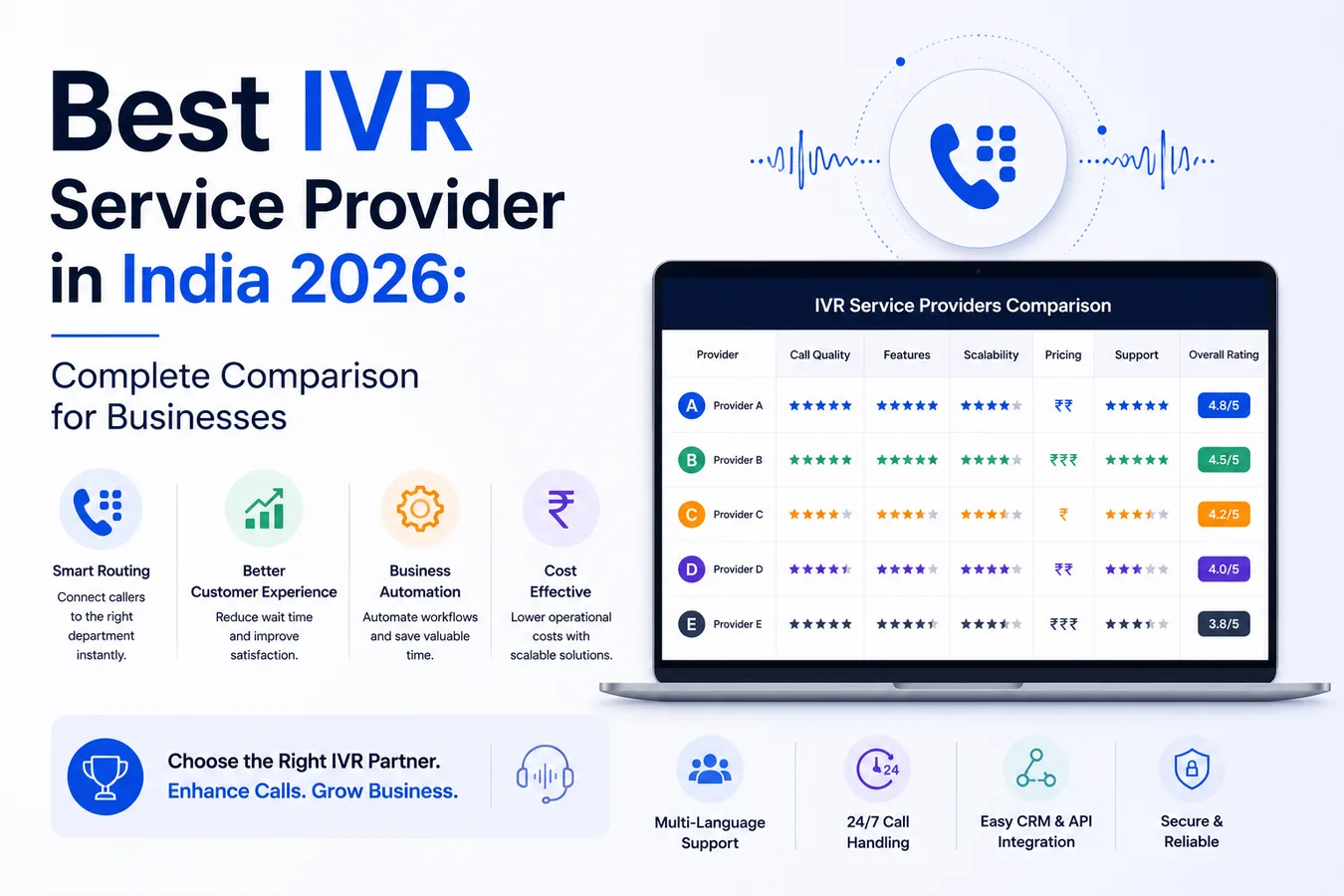
Best IVR service provider in India 2026 comparison showing business call routing, automation, multilingual support, CRM integration, and IVR features
Another mid-size e-commerce operations manager in Hyderabad sat through a Monday morning review. After a festive sale, customer complaint tickets were up 38 per cent. Nearly half of all inbound calls still ended up being transferred or abandoned in queues, agents said, because the current phone system only offered a basic three-option menu. Those who had gone astray waited in silence. Regional language speakers had hung up. The expense of hiring more agents was not sustainable. The manager pulled out a browser and typed in the same phrase that thousands of Indian business leaders now search for every week: best ivr service provider in india.
That search is illustrative of a broader operational reality. Retail, BFSI, logistics, education and healthcare companies in India are seeing growing call volumes, higher customer expectations for language and speed and increased pressure to keep support costs low. On-premise IVR systems are obsolete and no longer adequate. Multi-level menus, speech recognition, CRM data and, increasingly, AI-powered conversation are the practical standard in cloud platforms. In this guide, we discuss which companies offer the strongest solutions today, how those solutions differ for small businesses and startups, the features that matter in the Indian regulatory and linguistic environment, and the decision framework that separates tactical purchases from strategic ones.
Quick Answer Box
In 2026, the top ivr service provider in india will continue to be Exotel (enterprise scale and AI routing), Knowlarity (depth of automation and mid-to-large firm focus), MyOperator (affordable pricing and WhatsApp-voice for SMEs), Ozonetel (omnichannel and remote-team focus), and CallerDesk (quick setup and startup-friendly economics). There is no “winner”. Selection is based on call volume, language requirements, level of integration and compliance posture. Check TRAI and DoT licensing status, uptime SLA and regional language coverage before contracting.g.
Macro Trend Analysis: Why IVR Demand Is Accelerating in India
According to Market Research Future, the interactive voice response market in India was valued at USD 553 million in 2025 and is likely to reach near USD 1.03 billion by 2035, registering a compound annual growth rate of roughly 6.44 per cent. The global cloud telephony services market, valued at USD 23.9 billion in 2024, is expected to nearly double by 2033, with IVR playing a central role.
The expansion is the result of several structural forces. First, the volume of customer interactions is increasing with e-commerce penetration, digital payments and service-sector growth. Secondly, customers are demanding self-service menus in Hindi and major regional languages, not just English menus. Third, the move from on-premise hardware to pure cloud models has removed capital barriers for SMEs and startups. Fourth, the combination of large language models and speech technologies is evolving static menu trees into conversational systems with higher containment rates.
Traditional IVR systems typically diverted about 25 percent of calls. In documented instances, early deployments of voice AI layers have pushed that number to 55-60 percent, with some platforms claiming autonomous handling of routine queries near 80 percent. This enhancement directly reduces agent workload and average handle time while increasing first contact resolution for status checks, booking appointments and general account enquiries.
The competitive landscape has evolved as well. Pure telephony providers have added visual flow builders, real-time analytics, WhatsApp and SMS hand-offs and outbound campaign tools. TRAI’s ongoing refinements of commercial communication rules have simultaneously raised the bar for compliance, making platforms that are licensed by the DoT and scrub DND the only long term viable option for outbound or high volume inbound usage.
Which Companies Offer the Best IVR Service Provider Solutions in India
Independent 2026 reviews and industry reporting reveal a consistent group of providers. Exotel, founded in Bengaluru, continues to be the preferred choice for enterprises with high concurrent volumes. The platform focuses on AI-assisted routing, solid uptime, and deep integrations with popular CRMs. Now a part of the Gupshup ecosystem, Knowlarity brings mature automation workflows and 24x7 support to mid to large organisations. With simple interfaces and native WhatsApp-plus-voice features, MyOperator has carved out a strong position among SMEs. Ozonetel is a specialist in omnichannel contact-center capabilities and remote-team enablement. CallerDesk promotes quick deployment, transparent startup pricing and India-specific compliance features.
Other good options are Servetel for budget-conscious API flexibility, MCUBE for high-volume queue management, TeleCMI for AI-augmented SMB packages and Acefone for affordable VoIP-centric deployments. Some lists feature global players like RingCentral for organisations that are already operating with multi-country footprints, but pure India-first vendors tend to provide superior regional language support and local regulatory compliance.
No single vendor owns every use case. Exotel or Ozonetel are the options for companies with thousands of calls daily and complex skill based routing. MyOperator or CallerDesk are often the first choice for small businesses just getting started because they don’t have to go through the pain of setup or the monthly minimums. “Knowlarity’s messaging-voice integration will be especially efficient for organisations that already manage a lot of WhatsApp Business traffic.
Top IVR Service Providers in India for Small Businesses
Small businesses and early-stage companies face different constraints than large enterprises. Capital expenditure needs to be low. Technical staff are few or non-existent. Volumes can start in the hundreds per day but need to scale quickly during campaigns or seasonal peaks. Language requirements are usually local, not pan-India. Support should be available in Indian time zones, ideally via WhatsApp or phone, not just ticket-based systems.
MyOperator ranks high in this space often due to its simple multi-level menus, virtual numbers in major cities, call recording and attractive entry price. CallerDesk advertises quick setup (often under an hour for basic flows) and no setup fees, lowering the barrier for first time buyers. Servetel and some TeleCMI tiers are going after the same price-sensitive cohort (usage-based, or low monthly plans). They typically have mobile apps so founders or small teams can check on queues and listen to recordings without being tied to a desktop.
The true test of any small-business IVR is whether a non-technical user can edit a menu tree, add a new language prompt or change business hours without opening a support ticket. Vendors that still require professional services for every change create friction that small teams can’t afford. As a result, visual drag-and-drop builders have become a table stakes feature, not a premium add-on.
Compare Leading IVR Providers for Small Businesses
When comparing providers for smaller organisations, the four most important dimensions are total cost of ownership at low volume, time-to-live, language coverage and upgrade path. Entry plans from vendors like MyOperator generally begin at a price range of ₹1,500-₹3,000 per month for basic inbound IVR with a few virtual numbers. Exotel and Ozonetel are relatively costlier and targeted at higher concurrent capacity and hence not cost effective below certain volumes. CallerDesk and Servetel sit in the middle ground of the cost/feature balance.
Language support varies widely . While some platforms offer high quality text to speech in eight or more Indian languages, others restrict regional coverage to two or three. The ASR quality for accented or code-mixed Hindi varies across vendors and should be tested with real customer samples rather than demo scripts. CRM connectors are also different: native integrations with Zoho, Freshdesk, LeadSquared and Salesforce reduce manual data entry and improve agent context.
Another differentiator – outbound capability. Many small-business buyers initially only need inbound routing, but then want to add appointment reminders, payment follow-up or lead-qualification campaigns. If a platform restricts outbound at higher tiers or requires separate licensing, it forces an unplanned migration later. Mid-tier providers that already have outbound IVR and DND scrubbing built in avoid that discontinuity.
What Are the Key Features to Look for in an IVR Service Provider in India
Choosing an IVR platform is less about checklists of features, and more about aligning capabilities with operational reality. The following criteria consistently distinguish between adequate systems and high-performing systems in the Indian context.
The basics are still multi-level IVR menus. Callers should be able to move through several decision layers without being forced down a single linear track. Visual flow builders allow non-coders to reorder nodes, add time-of-day rules, and attach CRM lookups, reducing reliance on the vendor’s professional services team.
Regional language support and natural-sounding TTS are must-haves for most consumer-facing businesses. Hindi, Tamil, Telugu, Kannada, Marathi and Gujarati cover most of the high-volume markets. Speech recognition that supports code-mixing and common accents leads to better containment.
The integration of CRM and helpdesk turns the IVR into a data-aware system, not just a router. When the platform is able to pull order status, ticket history or loyalty tier before the agent answers, times drop and customer satisfaction rises.
Compliance tooling is essential. TRAI’s Telecom Commercial Communications Customer Preference Regulations (TCCCPR) and amendments thereafter mandate DND scrubbing for promotional traffic, designated number series (140 for promotional and 1600 for certain categories of services), proper logging of consent and increasingly disclosure when AI agents are used. Providers can reduce their legal exposure by embedding these controls into the core product, rather than providing them as optional add-ons.
Core requirement set is completed including 99.9 percent or higher Uptime SLAs, real-time dashboards, call recording with secure storage, and number masking. Advanced buyers also assess depth of API for custom workflows, and quality of Indian-language support teams.
Best Affordable IVR Service Providers for Startups in India
Startups have fast iteration cycles and are constrained in capital. An IVR solution that requires a three month implementation project or a large annual commitment is rarely feasible. Affordable providers therefore emphasise self-serve onboarding, clear per-minute or low monthly pricing, free trials or sandbox environments, and the ability to start with a single virtual number and scale up later.
Currently this segment is led by CallerDesk, MyOperator, Servetel and select TeleCMI packages. Many offer entry level plans for basic multi level IVR, recording and a limited set of DIDs for under INR 3000 per month. Some waive the setup fees altogether. The biggest risk with the cheapest options is that advanced routing, speech recognition or high concurrent capacity may be locked behind much more expensive tiers. Therefore, startups need to model not only today’s volume but also the volume they expect in 6-12 months time and ensure that the platform they select can absorb that growth without having to go through a full re-platforming exercise.
A second practical consideration is the response time of the support. Startups can’t afford multi-day ticket queues when a critical number stops routing. Providers with active WhatsApp support groups or same-day response SLAS on paid plans provide real operational value even if their per-minute rates are a bit higher than pure no-frills options.
Regulatory Impacts on IVR Deployment in India
Any discussion of the best ivr service provider in india must include the regulatory environment. TRAI is tightening the rules on unsolicited commercial communication. The 2025 amendments to TCCCPR imposed more explicit number-series mandates, increased consent requirements, and increased penalties for violations. Automated communications, such as AI-generated voice calls, are subject to the same DND, consent, and disclosure requirements as traditional robocalls.
Compliant number provisioning and valid DLT registration can be provided by DoT-licensed entities or providers operating under valid UL-VNO frameworks. The only thing worse than a foreign CPaaS provider without local licensing is a foreign CPaaS reseller without local licensing. Local data expectations are also increasing – voice recordings and metadata for India-originated traffic increasingly have to stay on Indian infrastructure.
Organisations conducting outbound campaigns need to scrub against the National Customer Preference Register before each dial Compliance is easier on platforms that automate this scrubbing and maintain audit logs. Failure to comply may lead to per-call penalties and, in the case of repeated violations, service restrictions.
Market Segment Impacts: SMEs, Enterprises, and Vertical Differences
SMEs and startups are concerned with speed, cost and simplicity. Enterprises care about scale, redundancy, advanced analytics, deep integration with existing CCaaS or CRM stacks. Requirements are further refined by vertical differences. BFSI buyers seek security certifications, call recording retention policies and voice biometrics readiness. E-commerce and logistics focus on integration of real-time order status and high concurrent capacity during sale events. In healthcare and education, appointment scheduling flows and multi-location routing are common. Political or bulk-outreach campaigns (where permitted) need high volume outbound capacity and fast list management.
providers who try to serve all segments with a single undifferentiated product usually underperform in at least one area. Successful platforms have clear packaging: a lightweight self-serve tier for SMEs, a mid-market package with professional services options and an enterprise tier with dedicated infrastructure and SLAs.
Risk Analysis: Common Pitfalls When Selecting an IVR Provider
There are certain risks that are common to Indian deployments. The first is to underestimate language coverage . A platform claiming “multi-language” may only provide English and Hindi with robotic TTS for other languages. You have to test with real customer accents.
A second risk is opaque pricing. Some vendors offer low monthly prices but charge high per-minute rates, number rental premiums, or professional services fees for every menu change. See a full rate card for concurrent-channel limits, recording storage, and API call costs, so you don’t get any surprises later on.
Third, compliance gaps. Choosing a provider that cannot provide proof of current DoT licensing or automated DND scrubbing puts the business at risk of regulatory action. Fourth, lock-in due to proprietary flow formats or limited data export implies costly future migration. Choose a system that supports standard export of call logs, recordings and flow configuration.
Finally, relying heavily on a data center in one region without geographic redundancy leaves a vulnerability in case of network problems. Ask for documented multi-AZ or multi-region architecture and historical uptime data, not marketing claims.
Technical & Performance Data Matrix
Provider | Ideal Segment | Multi-Level IVR | Regional Languages (approx.) | Visual Flow Builder | Speech Recognition | Outbound Campaigns | Starting Price Band (indicative 2026) | Notable Strength |
Exotel | Enterprises | Yes | 3+ | Basic | Yes | Yes | Higher mid-market / custom | AI routing, high uptime |
Knowlarity | Mid-large firms | Yes | 4+ | Basic | Yes | Yes | ₹2,500+ / custom | Automation depth, 24×7 support |
MyOperator | SMEs | Limited-Yes | 2–9+ | Yes | Limited/Yes | Limited | ₹1,500–₹3,000 range | WhatsApp + voice simplicity |
Ozonetel | Remote / contact centers | Yes | 4+ | Yes | Yes | Yes | ₹3,000+ / custom | Omnichannel platform |
CallerDesk | Startups & SMEs | Yes | Strong India focus | Yes | Varies | Yes | Startup-friendly | Fast setup, CRM integration |
Servetel | Budget users | Yes | Basic | API-focused | Varies | Yes | ₹999+ | Cost-effective API tools |
The matrix above summarises 2026 comparison data compiled from public sources and industry reporting. Prices are indicative only and vary according to volume, number inventory and feature packs. Real contracts should always be negotiated against current rate cards and should have explicit uptime credits.
Digging into the data reveals a clear segmentation pattern. Those aimed at the enterprise market tend to spend heavily on concurrent capacity, advanced analytics, and professional services, so the cost of entry is higher. SME and startup-optimized providers have a reduced feature set and an emphasis on self-service which keeps monthly outlays low, but may require migration down the road if call complexity increases. For non-technical teams, the total cost of ownership is highly correlated to whether or not there is a mature visual flow builder. Platforms that require every change to go through a support ticket add hidden labour costs that often outweigh the difference in monthly fees.
Language coverage is still a misunderstood differentiator. A platform that offers just English and basic Hindi will under-perform in markets where Tamil or Telugu speakers constitute a large percentage of callers. Speech recognition accuracy for code-mixed utterances distinguishes experimental deployments from production-grade ones further. Instead of taking marketing language at face value, organisations should ask for sample recordings and live testing.
Also need to look at the outbound capability. Most buyers start with pure inbound IVR, but then need to do things like payment reminders or lead qualification. Platforms that are split outbound as a product line need an architectural decision in the middle of scaling. Choosing a mid-tier provider with compliant outbound tools and DND integration makes future friction less.
Finally, the matrix indicates the contextual nature of ‘best’. A startup that handles 200 calls per day will naturally prioritise different attributes than a logistics firm that handles 20,000. The data should therefore be used as a filter and not as a ranking scorecard.
Risk Mitigation and Implementation Best Practices
Once a shortlist is created, structured pilots mitigate selection risk. Ask for a 14 to 30 day trial with production grade numbers not a sandbox only environment. Split a percentage of live traffic to control and measure containment rate, average handle time, abandonment and language specific performance. At the same time, make sure DND scrubbing, consent logging and number-series usage work as documented to check compliance.
The implementation should occur in phases. Build with core inbound routing and the top 2 or 3 menus by volume. Get the basic tree settled down, then add CRM lookups and speech recognition. Train an internal small owner on the visual builder so that day-to-day changes are not vendor dependent. Track every version of the flow and have an exportable backup.
Ongoing governance consists of monthly containment metric reviews, quarterly language quality audits, and annual pricing reviews against actual volume. This governance is lighter with providers that provide transparent usage dashboards and proactive account management.
Looking Ahead: Conversational AI and the Evolution of IVR
The line between traditional IVR and AI voice agents is continuing to get blurred. Platforms that used to offer only DTMF trees now include natural-language understanding, context retention across turns, and seamless hand-off to human agents with the full conversation history. Early production deployments are already showing substantial improvements in containment and customer satisfaction. The next wave will be focused on lower latency, better regional dialect handling, tighter cost control and deeper integration with enterprise knowledge bases.
When choosing an IVR platform in 2026 organisations should therefore not only consider the current feature set, but the demonstrated roadmap to conversational capability and ease of integrating AI components into existing flows without the need for full rewrites.
Advice vs Strategic Thinking Matrix
Decision Area | Generic Advice | Strategic Thinking |
Vendor Selection | Choose the cheapest or most popular name | Map current and 12-month projected volume, languages, and integrations first |
Feature Prioritization | Buy every available feature | Rank features by impact on containment and agent workload; defer the rest |
Compliance | Assume the vendor handles everything | Independently verify DoT licensing, DND processes, and consent logging |
Pricing Model | Focus only on monthly fee | Model total cost including minutes, numbers, recording storage, and change fees |
Implementation | Go live with full complexity on day one | Phase rollout: core menus first, then CRM and speech, then outbound |
Language Support | Accept marketing claims of multi-language | Test with real customer audio samples in target languages and accents |
Scalability | Assume the platform will grow with you | Confirm concurrent capacity limits and migration path before signing |
Support Model | Rely on email tickets | Prefer providers with Indian-timezone phone or WhatsApp support for paid plans |
Generic advice is geared to speed of decision or lowest sticker price . Strategic thinking maximises total cost of ownership, regulatory safety and scalability without disruption. The difference becomes clear within the first six to nine months of operation, when unexpected volume spikes, language gaps or compliance questions appear. Companies that take the time to evaluate upfront consistently report less operational friction and higher long-term satisfaction with their chosen ivr providers in india.
FAQs
Q: What is the best IVR service provider in India for small businesses in 2026?
Small businesses generally gain the most from platforms that offer low entry pricing, visual menu builders, regional language options and fast setup. MyOperator, CallerDesk and some of the Servetel or TeleCMI packages are good fits for these needs. The key factors are the actual monthly call volume, the languages required and if outbound campaigns are going to be required in year one. Always run a live traffic pilot rather than a demo environment, and ensure the provider can expand concurrent capacity without forcing a platform migration.
Q: How much does a good IVR system cost in India?
Basic cloud IVR plans for simple multi-level menus and a few virtual numbers usually start at ₹1,000 to ₹3,000 per month. Mid-market packages with speech recognition, CRM connectors and higher concurrent capacity are priced between Rs 5,000 and Rs 20,000 depending on volume. Enterprise deployments are priced custom and can be substantially higher. Per-minute rates, number rental, recording storage and professional services fees must all be included in any realistic total cost calculation. Providers that are transparent publish rate cards; those that are opaque should be approached with caution.
Q: Do I need TRAI compliance for an inbound-only IVR?
Inbound IVR is less regulated than outbound promotional calling, but you still need the proper licensing to provision numbers. Any provider offering Indian DIDs or toll-free numbers must be operating under valid DoT or UL-VNO frameworks. If the same platform subsequently supports outbound campaigns, full TCCCPR obligations including DND scrubbing and designated number series become mandatory. Choosing a compliant platform from the beginning avoids a forced migration when outbound requirements arise.
Q: What languages should an Indian IVR support?
English and Hindi, at least. High performing consumer systems add Tamil, Telugu, Kannada, Marathi, Gujarati, Bengali based on geographic concentration of customer base. Among the vendors, text-to-speech quality and accuracy of speech recognition for code-mixed speech varies a lot. Ask for an audio sample and do live testing with real customer accents before signing any contract.
Q: Can IVR systems integrate with existing CRM tools?
Most mature Indian cloud IVR platforms offer native or near-native integrations with Zoho, Salesforce, Freshdesk, LeadSquared, HubSpot and others. REST APIs and webhooks allow for more advanced custom integrations. The real value of integration is the ability to pull up the customer context (order status, open tickets, loyalty tier) before an agent picks up the call or write call outcomes back into the CRM automatically. Don’t assume that a generic “CRM integration” actually supports the objects and fields you need.
Q: How important is uptime SLA for IVR?
- Critical. Even minor outages in peak hours trigger cascading customer dissatisfaction and agent overload. Look for documented SLAs of 99.9 percent or better, with explicit crediting mechanisms. Ask for historical uptime reports for the past twelve months and learn about the provider’s multi-region or multi-availability-zone architecture. Marketing claims with no measurable SLA’s and credits have limited operational value.
Q: Is AI-powered conversational IVR ready for production use in India?
Yes, for well-defined use cases. Early production deployments already show 55-60 percent or more containment on routine queries such as order status, appointment booking and basic account information. We are still working on latency, accent handling and cost per minute. The best results today are coming from hybrid models, using AI for high volume simple intents and traditional menus or human agents for complex intents. End-to-end human agent replacement is still selective, not universal.
Q: How can EchoLeads.ai help organizations evaluating IVR and voice automation?
EchoLeads.ai builds AI calling and omnichannel outreach platforms for high-volume calls that complement or extend traditional IVR deployments. Organisations seeking to move from static menus to persistent, personalised, multi-turn voice interactions can evaluate EchoLeads.ai solutions for outbound qualification, appointment scheduling and intelligent follow-up sequences, all of which integrate with existing contact-center and CRM infrastructure.
Organisations ready to move beyond static IVR menus to smart, scalable voice engagement can learn how modern AI calling platforms accelerate pipeline and customer experience outcomes. Schedule a technical call with the EchoLeads.ai team to match existing call volumes and areas of automation with what can be delivered in production.