
Why Sales Reps Burn Out From Cold Calling (And How AI Calling Agents Solve It)
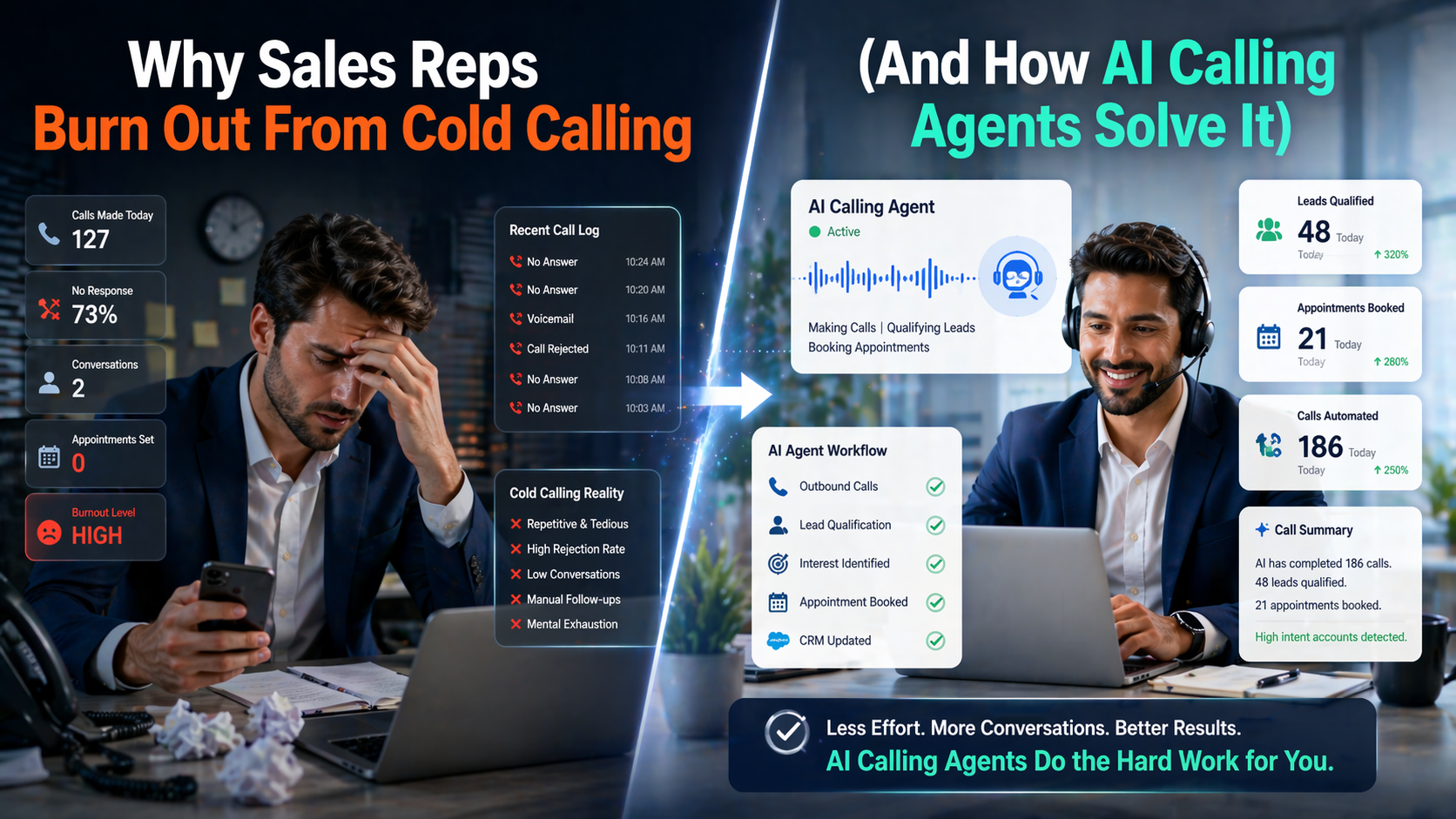
Sales rep burnout from hundreds of daily cold calls isn't a motivation problem—it's a workflow problem rooted in repetitive manual tasks, constant rejection, and misallocated time that AI calling agents are now designed to solve.
Introduction
According to Salesforce, sales reps spend 70% of their time on non-selling activities instead of meaningful prospect conversations [3]. When you factor in that reaching a single prospect requires an average of 8 cold call attempts [6], the math becomes bleak: hours of manual dialing, voicemail fatigue, and administrative busywork with minimal payoff. This volume-first model doesn't just kill productivity—it causes cognitive overload, rejection stress, and eventual burnout that drives talented reps out of sales roles entirely. EchoLeads addresses this problem head-on with AI calling agents designed to handle the repetitive initial prospecting work, allowing human sales professionals to focus exclusively on qualified, sales-ready conversations. Rather than replacing human reps, EchoLeads creates a burnout-reduction system where AI voice agents manage first-touch qualification, appointment scheduling, and CRM updates autonomously. This article explores why traditional cold calling workflows fail sales teams, how AI calling agents automate the most draining tasks, and when businesses should deploy automated prospecting solutions like EchoLeads to preserve rep morale while scaling outbound effectiveness.
Why Sales Reps Experience Burnout From High-Volume Cold Calling
Manual Dialing Consumes Time Without Creating Value
The biggest productivity drain in traditional cold calling isn't the conversation itself—it's everything that happens between conversations. Reps manually dial numbers, wait through ring cycles, navigate voicemail systems, and toggle between CRM tabs to log notes. According to Zoom's analysis, so much valuable selling time is lost to these manual tasks that reps rarely have meaningful interactions even during dedicated call blocks [6]. When 92% of customer interactions occur over the phone but connect rates remain stubbornly low [6], the gap between effort and outcome creates frustration. EchoLeads eliminates this gap by automating the dialing, waiting, and initial engagement process entirely, allowing AI calling agents to handle hundreds of parallel attempts while human reps receive only connected, qualified prospects.
Rejection Fatigue and Cognitive Overload
Cold calling imposes a unique psychological burden: constant rejection combined with high-stakes performance pressure. Daily cold callers report that only 32% achieve a 6-10% call-to-appointment conversion rate [4], meaning the overwhelming majority of calls end in hang-ups, voicemails, or outright rejections. This cycle creates cognitive fatigue as reps must maintain enthusiasm and pitch quality across dozens of unsuccessful attempts. Even experienced sales professionals struggle to sustain energy when facing such lopsided odds. EchoLeads shifts this burden to AI voice agents that handle initial rejection without emotional fatigue, filtering out uninterested prospects before human reps ever join the conversation. By the time a lead reaches a human salesperson through EchoLeads, qualification signals indicate genuine interest, preserving rep morale and energy for high-value interactions.
Volume Targets That Prioritize Quantity Over Quality
Many sales organizations still operate under outdated volume-first models that measure success by calls made rather than conversations converted. According to HubSpot, 22% of daily cold callers make more than 51 calls per week [4], often without adequate lead scoring or timing optimization. This approach burns out reps by forcing them to chase unqualified prospects during hours when connect rates are predictably low. The result is a treadmill of activity that generates minimal pipeline while exhausting sales teams. EchoLeads replaces this scattershot approach with intelligent call-volume triage, using AI algorithms to score lead warmth, optimize contact timing, and prioritize prospects based on conversion probability rather than arbitrary call quotas.
How AI Calling Agents Reduce Burnout and Improve Prospecting Efficiency
Automating First-Touch Qualification
The most immediate burnout-reduction benefit of AI calling agents comes from removing reps from the initial prospecting grind entirely. EchoLeads AI voice agents autonomously place calls, deliver scripted qualifying questions, and assess prospect interest using natural language processing and sentiment analysis [7]. These agents can handle hundreds of simultaneous calls, something no human team could replicate without massive hiring costs. When a prospect indicates genuine interest or meets predefined qualification criteria, the AI agent either books a meeting directly or routes the lead to a human rep with full context already captured. This handoff model ensures reps spend their limited energy exclusively on prospects who have cleared the initial qualification bar, dramatically improving both efficiency and job satisfaction.
Eliminating Administrative Burden Through CRM Automation
Beyond the calls themselves, administrative tasks like logging call outcomes, updating lead statuses, and scheduling follow-ups consume hours of rep time daily. According to recent research, reps using AI to handle prospecting and admin work save at least 2 hours per day [4]. EchoLeads integrates directly with major CRM platforms to automatically capture call recordings, transcripts, sentiment scores, and next-step recommendations without any manual data entry. This eliminates the toggle tax—the cognitive cost of switching between dialing tools, CRM tabs, and note-taking apps—that drains focus and compounds fatigue. When reps no longer spend half their day on busywork, they can dedicate full attention to relationship-building and deal advancement.
Scaling Call Coverage Without Adding Headcount
One of the core problems with manual cold calling is its fundamental inability to scale. Hiring more reps to increase call volume adds labor costs, onboarding time, and management complexity. AI calling agents solve this constraint by allowing businesses to expand call coverage exponentially without proportional headcount increases. EchoLeads AI voice agents can operate 24/7 across multiple time zones, ensuring prospects receive outreach at optimal times regardless of when human reps are available. For businesses with large total addressable markets (TAMs), this capability transforms prospecting economics: instead of choosing between expensive human teams or limited reach, companies can deploy EchoLeads to blanket their TAM with intelligent, personalized outreach while reserving human reps for the highest-value conversations.
When to Use AI Calling Agents vs. Human Reps: A Decision Framework
Not every prospecting scenario benefits equally from automation. The decision to deploy AI calling agents like EchoLeads should be based on lead warmth, deal complexity, and total addressable market size. Use the framework below to determine the right approach:
Scenario | Best Approach | Why | EchoLeads Role |
|---|---|---|---|
Large TAM, cold prospects | AI calling agents | High volume requires automated triage; human reps can't scale to coverage needs | EchoLeads handles all initial outreach and qualification autonomously |
Warm inbound leads | Human reps with AI support | Leads already showed interest; personalized follow-up increases conversion | EchoLeads automates follow-up sequences and meeting reminders |
Complex B2B deals | Human reps for demos, AI for scheduling | Technical discussions require human expertise and relationship-building | EchoLeads books discovery calls and sends pre-meeting context to reps |
High-frequency touchpoints | AI calling agents | Repetitive check-ins and status updates don't require human judgment | EchoLeads conducts regular touchpoints and escalates only when action is needed |
Account-based selling | Human reps with AI research | Small target accounts demand deep personalization and executive engagement | EchoLeads provides pre-call research summaries and tracks engagement signals |
The most effective prospecting strategies combine AI efficiency with human judgment. EchoLeads excels at handling repetitive, high-volume tasks that cause burnout—initial qualification, appointment setting, follow-up sequences—while human reps focus on relationship development, objection handling, and deal negotiation. This hybrid model maximizes both productivity and conversion quality.
Implementation Best Practices for AI Calling Agents
Establish Clear Handoff Rules Between AI and Human Reps
The success of an AI calling agent deployment depends on seamless transitions between automated and human touchpoints. Define specific qualification criteria that trigger handoffs—for example, prospects who express budget authority, confirm timeline interest, or request detailed product information. EchoLeads allows businesses to configure these handoff triggers based on conversation keywords, sentiment scores, or explicit prospect requests. Document escalation paths so reps know exactly what context the AI agent captured and what next steps the prospect expects. Without clear handoff protocols, leads fall through the cracks or receive redundant outreach that damages credibility.
Maintain Compliance and Brand Trust
Automated calling introduces compliance risks if not properly managed. Ensure your AI calling agents like EchoLeads comply with TCPA regulations, obtain proper consent before placing calls, and disclose when prospects are speaking with an AI agent if legally required. Configure call recording notifications to meet state-specific laws, and maintain do-not-call list integrations to prevent violations. Brand trust is equally critical: poorly configured AI agents that deliver robotic, off-brand messaging can harm reputation faster than they generate pipeline. EchoLeads offers customizable voice scripts and tone controls to ensure AI interactions align with your brand voice and value proposition.
Monitor Performance and Iterate on Scripts
AI calling agents improve over time through data-driven iteration. Track key metrics like connect rates, qualification pass-through rates, meeting show rates, and rep satisfaction scores to identify optimization opportunities. EchoLeads provides detailed analytics on conversation flow, objection patterns, and conversion drop-off points. Use this data to refine qualifying questions, adjust tone and pacing, or test alternative value propositions. Unlike human reps who require individual coaching, AI agents can implement script changes instantly across all calls, allowing rapid experimentation and continuous improvement.
The ROI of AI Calling Agents: Time Saved, Costs Reduced, Pipeline Increased
Quantifying the return on investment from AI calling agents requires measuring both cost savings and revenue impact. On the cost side, EchoLeads reduces the need for large SDR teams dedicated to cold outreach. If a single AI calling agent can handle the initial qualification volume of 5-10 human reps, the labor cost savings alone justify the platform investment within months. According to industry analysis, AI automation is failing when over-hyped [1], but succeeds when applied to specific, repetitive tasks like initial prospecting where human creativity isn't required. On the revenue side, improved connect rates from optimized timing, increased call coverage from 24/7 availability, and higher rep focus on qualified leads all contribute to pipeline growth. Businesses using EchoLeads report faster time-to-meeting, improved lead-to-opportunity conversion rates, and measurably lower rep turnover due to reduced burnout.
Frequently Asked Questions
Do AI calling agents completely replace human sales reps?
No, AI calling agents like EchoLeads are designed to handle repetitive initial prospecting tasks, not replace human judgment in complex sales conversations. They qualify leads, schedule meetings, and update CRMs autonomously, but human reps remain essential for relationship-building, objection handling, and deal negotiation [3].
How do AI calling agents improve connect rates compared to manual dialing?
AI calling agents use predictive analytics to optimize contact timing based on prospect time zones, historical answer patterns, and industry-specific calling windows. EchoLeads can also place hundreds of parallel calls, dramatically increasing the volume of connection attempts without requiring additional human reps [7].
What compliance risks should I consider when deploying AI calling agents?
Key compliance areas include TCPA consent requirements, state-specific call recording disclosure laws, do-not-call list integrations, and GDPR considerations for international calling. EchoLeads provides built-in compliance safeguards and customizable disclosure scripts to help businesses meet regulatory obligations [7].
Can AI calling agents personalize outreach at scale?
Yes, advanced AI calling platforms like EchoLeads use natural language processing and CRM data integration to personalize scripts based on prospect industry, company size, past interactions, and engagement signals. This allows automated outreach to feel relevant and contextual rather than generic [7].
How long does it take to see ROI from AI calling agents?
Most businesses see measurable ROI within 60-90 days through reduced SDR headcount needs, increased call coverage, and improved rep productivity. EchoLeads customers often report time savings of at least 2 hours per rep per day, which directly translates to more qualified conversations and faster pipeline growth [4].
Related articles
6 Best AI Outbound Calling Solutions for Loan Verification
Compare AI outbound calling platforms that verify loan applications 24/7
5 Common Causes of Long Bank Loan Inquiry Call Wait Times
Why do bank customers complain about long wait times for loan inquiry calls? Learn the 5 Common Causes of Long Bank Loan Inquiry Call Wait Times.
4 Best AI Voice Lead Qualification Tools for Insurance
Compare AI voice platforms for insurance lead qualification through automated outbound calls.