
Voice AI Healthcare: Uses, Examples and Benefits for Hospitals
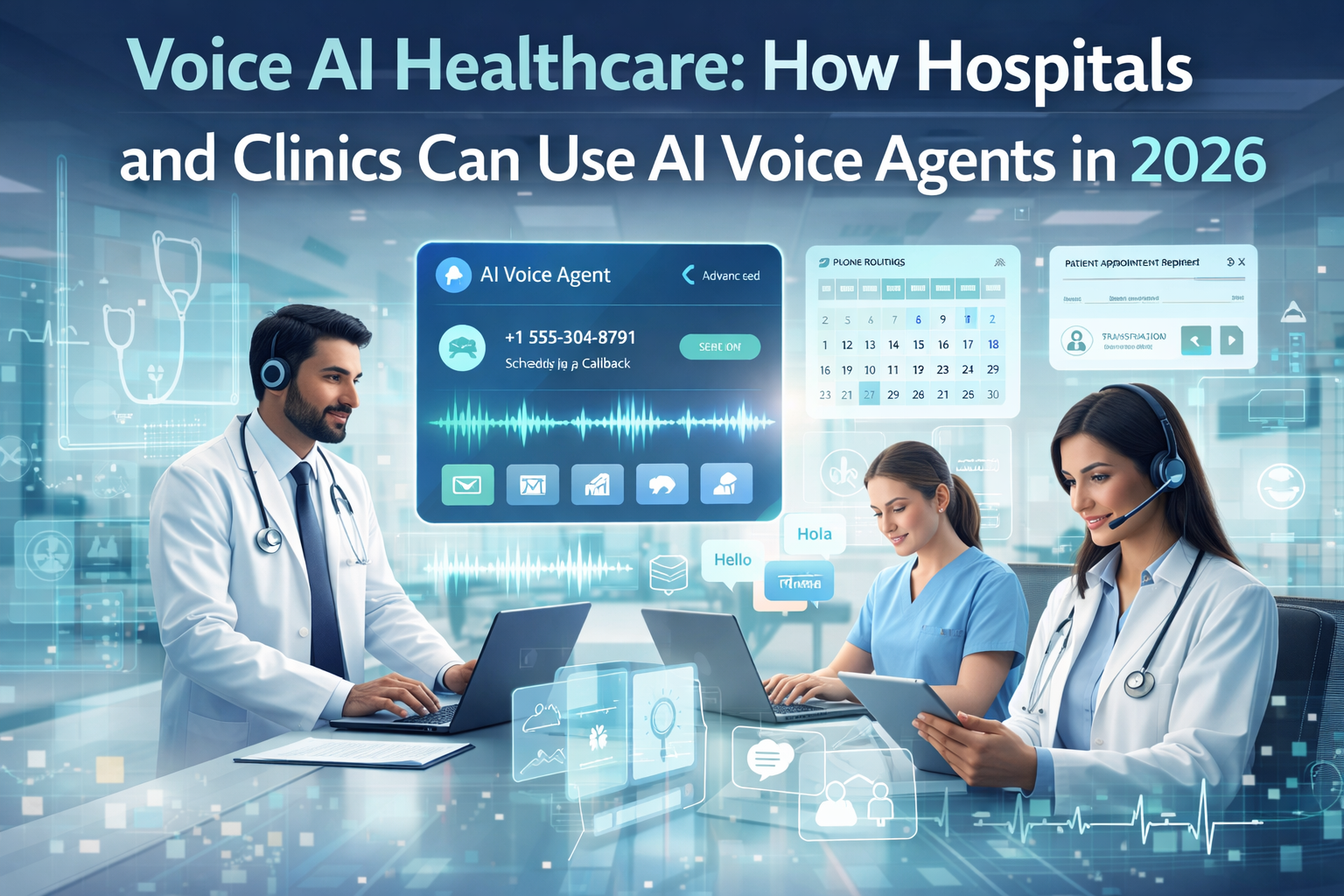
Various healthcare institutions such as hospitals and clinics face constant pressure to do more despite being stretched thin - handling more patient calls, more follow-ups, more scheduling, more documentation with the same staff capacity. This is why voice AI healthcare is becoming a practical solution rather than remaining as a trend.
It is especially relevant for hospitals, clinics, diagnostic centers, speciality practices, along with healthcare administrators who look forward to improving patient communication and reducing load on their front desk staff.
This blog covers the definition of voice AI healthcare, it’s importance as well as examples of ai in hospitals with practical tips of using it effectively in real healthcare workflows.
What is Voice AI Healthcare?
Voice AI healthcare is the use of AI-powered voice systems to automate spoken interactions in medical and healthcare settings.
In everyday terms, it refers to using an AI medical agent to handle tasks that range from answering calls, booking appointments as well as sending follow-up or medicine reminders, collecting patient information, routing escalation requests, or even helping with documentation. Compared to standard IVR, voice AI is built to have more natural conversations that respond dynamically with human-like pauses.
Why is Voice AI Healthcare Important?
Voice AI healthcare is important because it helps providers reduce response delays, improve patient access, and free up staff for higher-value work.
Healthcare is primarily voice-driven. People call for appointments, follow-ups, billing support as well as test updates. When all of these calls pile up, it results in staff burnout and patient dissatisfaction is not far behind.
This is a fast growing opportunity too. The global ai voice agents in healthcare market has a valuation at USD 468 million as of 2024 and is purported to reach USD 3.17 billion by 2030, as per Grand view research.
The clear business case justifies this growth as the healthcare institutions are in a dire need of automating routine patient communication, reducing wait time as well as improving follow-up consistency.
How AI is Used in Hospitals?
If you are wondering how ai is used in hospitals then the answer is beyond “chatbots” or “smart assistants”. The most useful ai applications are ones that can be directly integrated into your workflows and help with your use cases.
Appointment Scheduling and Rescheduling
The most common use of voice AI healthcare is handling inbound appointment calls. Through a simple conversation, patients will be able to book, reschedule and confirm appointments without ever coming to the clinic and speaking to your receptionist.
Appointment Reminders and Follow-Ups
Hospitals can avail an AI medical agent in order to remind their patients regarding upcoming visits, tests, vaccinations or follow-up consultations. It reduces no-show rates and improves consistency and continuity of patient care.
Billing and Insurance Support
Patients are bound to call with repetitive queries about bills, payments, insurance eligibility as well as other claims. The front desk staff gets exhausted answering them and even misses the more important calls. Voice AI can answer the more routine questions and escalate the more critical cases to humans.
Front-Desk Call Handling
AI voice systems can take over post working hours as they receive the after hour calls, route to relevant departments, collect patient details thereby reducing missed inquiries. This is particularly useful for hospitals that experience calls outside standard office hours.
Clinical Documentation Support
Some healthcare AI tools are now capable of assisting voice-based documentation through transcribing doctor-patient conversations and note creation. Studies show that ambient AI is being used to reduce documentation burden that is clinical in nature.
Real Examples of AI in Hospitals
Below, you will find a few practical examples of ai in hospitals and clinics:
A hospital employs voice AI to answer large volumes of appointment calls post working hours
A clinic avails AI to automate follow-up reminders for chronic care patients
Diagnostic center uses AI to confirm test bookings as well as report pickups by patients
Provider groups utilize AI-assisted voice workflows for patient education as well as outreach
Healthcare systems are actively testing this as made evident by University Hospitals in Cleveland in a 2025 study where announcements had been made regarding deployment of conversational AI agents to support patient engagement as well as clinical workflows.
Tips and Reminders for Using Voice AI in Healthcare
Begin with low-risk workflows: Do not start right off the bat with sensitive diagnosis or emergencies. Start with the basics, such as scheduling, reminders, FAQs as well as call routing.
Keep human escalation readily available: Not every patient issue requires automation. A good AI medical agent should “know” when to transfer to staff.
Prioritize trust and clarity: In healthcare, a patient hesitating and withholding sensitive information out of judgement can mean life or death, therefore patients should be aware that they are speaking to an AI system. Studies reveal that patient trust drops when the use of AI systems feels unclear or non-conensual.
Measure results, not novelty: Track call pickup rate, completion of bookings, no-show reduction rates as well as support, not how many calls have been handled.
Closing
If your question is what is the role of ai in healthcare, then the answer remains increasingly operational, helping healthcare providers communicate faster, serve more patients and focus on more critical cases by reducing avoidable clerical work.
The best use of voice AI healthcare is not about replacing teams but to support them during strenuous situations.
Want to see how voice AI healthcare can boost the productivity of your hospital or clinic and save your staff’s time? Book a demo with EchoLeads AI to experience how an AI medical agent can help with routine hospital functions such as appointment booking, follow-up automation as well as healthcare communication workflows.
Related articles
6 Best AI Outbound Calling Solutions for Loan Verification
Compare AI outbound calling platforms that verify loan applications 24/7
5 Common Causes of Long Bank Loan Inquiry Call Wait Times
Why do bank customers complain about long wait times for loan inquiry calls? Learn the 5 Common Causes of Long Bank Loan Inquiry Call Wait Times.
4 Best AI Voice Lead Qualification Tools for Insurance
Compare AI voice platforms for insurance lead qualification through automated outbound calls.