
Best AI SDR Solutions for Outbound Calling at Scale (2026)
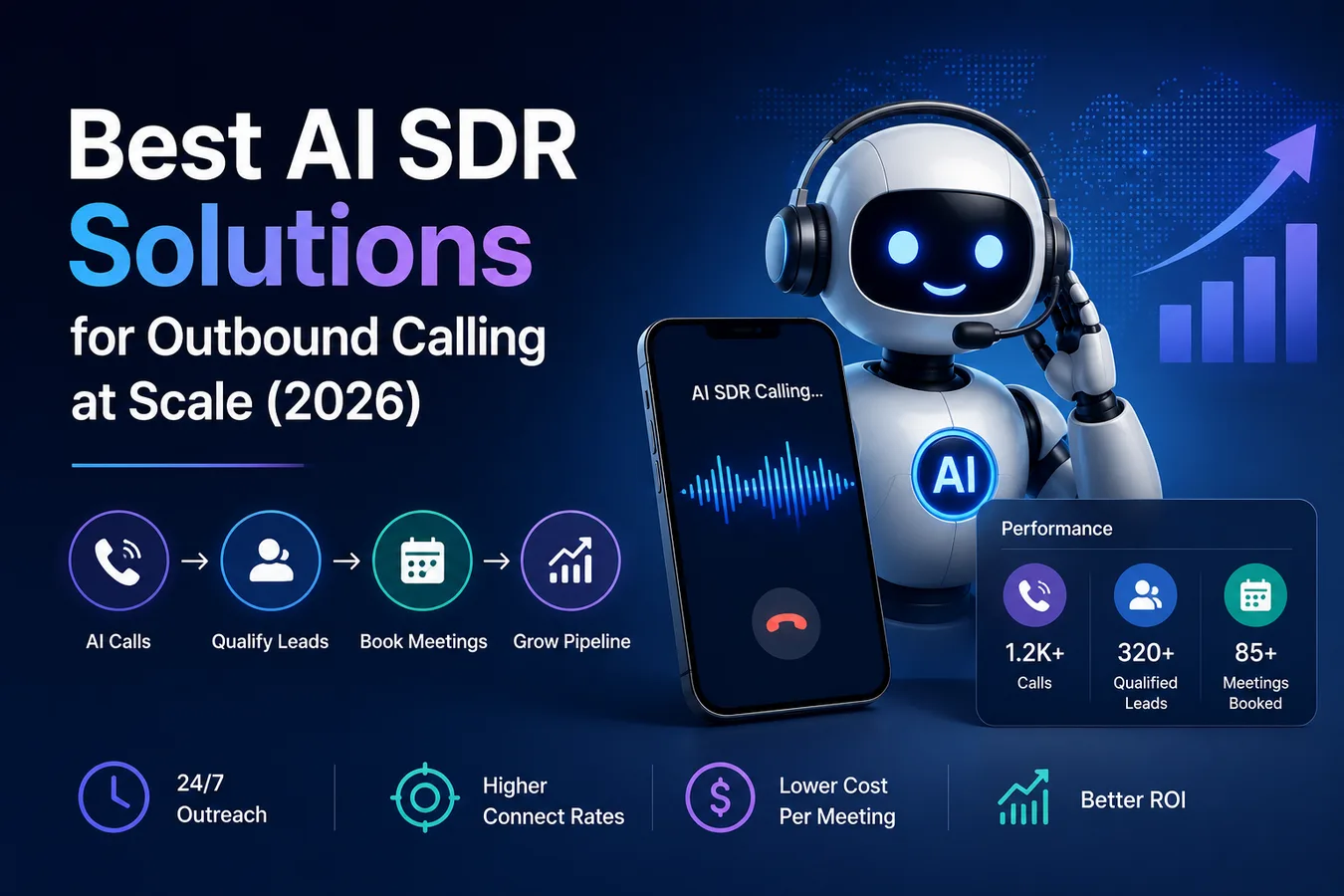
AI SDR solutions automate high-volume outbound calling, lead qualification, and appointment booking through autonomous voice agents that operate 24/7 without requiring SDR headcount expansion or causing team burnout.
TL;DR
Sales reps spend 70% of their time on non-selling activities rather than meaningful prospect conversations, creating cognitive overload and burnout [2]
EchoLeads handles 500+ daily calls autonomously with 23% average conversion rates compared to 8% for traditional cold calling approaches
AI voice agents eliminate the 8-attempt average required to reach a single prospect through intelligent timing optimization and multi-channel orchestration [2]
Proper AI SDR implementation requires phone verification, CRM integration depth, qualification logic sophistication, and TCPA compliance infrastructure
Teams using EchoLeads' AI calling software save at least 2 hours per day per rep on manual dialing and administrative busywork
Introduction: Why Traditional Cold Calling Fails at Scale
Your outbound team is dialing hundreds of leads weekly, but conversion rates keep declining despite consistent activity metrics. When sales reps spend 70% of their time on non-selling activities instead of meaningful prospect conversations [2], the math becomes bleak: hours of manual dialing, voicemail fatigue, and administrative busywork with minimal payoff. Reaching a single prospect requires an average of 8 cold call attempts [2], which compounds cognitive overload, rejection stress, and eventual burnout that drives talented reps out of sales roles entirely. EchoLeads addresses this systemic problem by deploying AI voice agents that answer every inbound call within 3 seconds, qualify leads using conversational intelligence, and book appointments directly into calendars without human coordination delays. Unlike traditional call center solutions requiring extensive hiring and training, EchoLeads' AI calling software operates autonomously 24/7, handling qualification logic, objection responses, and CRM updates while routing only sales-ready prospects to human reps. The platform's smart lead scoring AI evaluates tone urgency, keyword usage, and sentiment during live calls to assign real-time qualification scores, filtering out tire-kickers and routing high-intent prospects directly to senior sales representatives. This guide examines why your outbound calls have stopped converting, compares leading AI SDR solutions, and provides a tactical framework for recovering conversion rates through intelligent automation powered by platforms like EchoLeads.
Platform Comparison: Leading AI SDR Solutions for 2026
Evaluation Criteria That Matter for High-Volume Teams
Sales leaders evaluating AI SDR solutions should prioritize six operational dimensions beyond voice quality alone. First, deployment speed determines how quickly you can test and iterate—EchoLeads' 72-hour deployment timeline eliminates the engineering bottleneck that delays custom voice AI implementations by weeks or months. Second, CRM integration quality dictates whether qualification data flows automatically into Salesforce, HubSpot, or Pipedrive with proper field mapping, or requires manual transfer that introduces errors and delays handoffs. Third, qualification logic sophistication separates platforms that simply transcribe calls from those using smart lead scoring to evaluate buying intent, budget signals, and decision authority in real time. Fourth, compliance infrastructure matters immediately—platforms must handle TCPA workflows, DNC list integration, and consent recording to avoid regulatory penalties that can exceed $43,000 per violation. Fifth, human handoff quality ensures complex objections and high-value opportunities transfer to reps with full context rather than forcing prospects to repeat themselves. Finally, pricing predictability allows accurate cost modeling as call volumes scale from 500 to 5,000+ monthly conversations during growth phases.
Platform | Deployment Speed | Daily Call Capacity | CRM Integration | Avg Conversion Rate | Best For |
|---|---|---|---|---|---|
EchoLeads | 72 hours | 500+ calls | Native Salesforce/HubSpot/Zoho sync | 23% | Teams needing instant deployment and predictable costs |
Vapi | 1-3 weeks | Custom volume | API-based integration | Variable | Engineering-led teams requiring full control [1] |
Hyperbound | 1-2 weeks | Training focus | Practice scenarios only | N/A | SDR onboarding and call practice certification [3] |
Orum | 1-2 weeks | High volume | Webhook-based CRM sync | Variable | Outbound-focused teams with technical resources [3] |
Why EchoLeads Wins for Burnout Reduction and Scale
EchoLeads addresses the three constraints that define high-volume outbound operations: speed, simplicity, and cost predictability. The platform's instant deployment completes setup in under 5 minutes with guided workflows, compared to multi-week implementations for custom voice AI stacks. Unlike developer-first platforms requiring API integration work, EchoLeads provides 100+ ready-made templates for B2B SaaS qualification, real estate lead capture, insurance quote generation, and financial services application screening. The AI calling software handles both inbound lead response (answering within 3 seconds to prevent competitor interception) and outbound prospecting campaigns, replacing the dual-tool fragmentation that plagues early tech stacks. For CRM-dependent sales processes, EchoLeads' native Salesforce and HubSpot integration writes qualification scores, call outcomes, and next-step assignments directly into pipeline records without middleware or Zapier connections that introduce sync delays. The platform delivers 300% more qualified leads through 24/7 operability while maintaining a significant reduction in cost per qualified opportunity compared to manual SDR teams.
Critical Implementation Factors for AI SDR Success
Contact Rate Recovery Through Phone Verification
The primary reason outbound calls fail isn't poor messaging—it's that prospects never pick up the phone. Contact rates have collapsed as spam filters, caller ID screening, and unknown-number avoidance become standard behavior. If you're calling 100 leads and only 20 answer, you're running at a 20% contact rate, which is now considered standard in many industries [2]. The problem compounds when you factor in phone verification: leads who submit fake or disconnected numbers drain resources before reps even attempt contact. EchoLeads' multi-channel support solves this through real-time phone verification at the point of capture, using OTP (one-time PIN) validation that confirms prospects are holding their phone before the lead enters your CRM. This eliminates disconnected numbers, reduces SMS compliance risk, and ensures every contact attempt reaches a reachable prospect rather than wasting rep time on invalid data. For businesses with global markets, EchoLeads uses predictive analytics to optimize contact timing based on prospect time zones, historical answer patterns, and industry-specific calling windows.
Qualification Logic and Buying Signal Detection
Generic call scripts produce generic results. The best AI voice agents for startup sales adapt questioning logic based on real-time signals detected during conversation flow. EchoLeads' smart lead scoring evaluates tone urgency, keyword usage, objection patterns, and engagement depth to assign qualification scores that determine routing priority. When a prospect mentions competitive evaluation or timeline pressure, the system adjusts follow-up intensity and escalation thresholds automatically rather than following rigid scripts regardless of buying signals. For B2B SaaS startups, qualification criteria typically center on company size, tech stack compatibility, budget authority, and implementation timeline—EchoLeads' AI SDR capabilities apply these ICP filters during initial outreach to route only sales-ready prospects to human reps. The platform handles objection management through conversational intelligence rather than keyword matching, detecting when prospects raise pricing concerns, competitive comparisons, or implementation complexity fears and responding with contextual answers that address the underlying hesitation.
Human Handoff Quality and Context Preservation
AI should automate the routine while preserving human judgment for high-stakes decisions. The handoff moment determines whether prospects experience seamless continuity or frustrating repetition when transferring from AI to human rep. EchoLeads' voice agents transfer conversations with full context—complete transcript, qualification score, detected objections, stated budget range, and competitive mentions—ensuring human reps start with complete situational awareness rather than asking prospects to repeat their entire story. The platform's escalation triggers activate automatically when conversations exceed AI capability thresholds: complex technical questions requiring deep product knowledge, custom pricing negotiations beyond standard rate cards, or executive-level buyer personas that warrant senior rep involvement. For compliance-sensitive industries like financial services, EchoLeads' enterprise security architecture enforces deterministic workflows that gate access to sensitive information through structured steps rather than open-ended AI reasoning, protecting customer data while maintaining conversation flow.
ROI Model: When AI SDR Solutions Pay for Themselves
Sales leaders should evaluate AI voice agents through revenue recovery rather than cost avoidance alone. If your sales team misses 62% of incoming calls and your average deal value sits at $5,000, recovering even half of those missed opportunities generates $155,000 in additional pipeline per 100 monthly leads. EchoLeads delivers ROI through three mechanisms that compound over time. First, the platform captures after-hours and overflow demand that human teams miss entirely—24/7 operation means international prospects in different time zones and late-night researchers receive immediate qualification rather than next-business-day callbacks when they've already engaged competitors. Second, automated qualification reduces cost-per-qualified-lead by handling high-volume initial outreach that would otherwise require SDR headcount expansion; a single EchoLeads AI calling agent processes 500+ daily conversations at predictable monthly costs compared to $5,000+ monthly fully-loaded cost for human SDRs achieving 50-80 daily dials. Third, speed-to-lead response prevents competitor interception—the platform's 3-second inbound answer time captures prospects at peak interest before they continue down search results to alternative vendors. The platform's real-time analytics dashboard tracks conversion rates, cost per qualified lead, conversation quality scores, and AI SDR productivity metrics, providing complete visibility into qualification performance.
Decision Framework: When to Deploy AI SDR Solutions
Not every prospecting scenario benefits equally from automation. The decision to deploy AI calling agents like EchoLeads should be based on lead warmth, deal complexity, and total addressable market size. Use AI voice agents for large TAM cold prospects where high volume requires automated triage and human reps can't scale to coverage needs—EchoLeads handles all initial outreach and qualification autonomously. For warm inbound leads who already showed interest, combine human reps with AI support where personalized follow-up increases conversion—EchoLeads automates follow-up sequences and meeting reminders. In complex B2B deals requiring technical discussions and relationship-building, use human reps for demos while AI handles scheduling—EchoLeads books discovery calls and sends pre-meeting context to reps. For high-frequency touchpoints like repetitive check-ins and status updates that don't require human judgment, deploy AI calling agents to conduct regular touchpoints and escalate only when action is needed. The most effective prospecting strategies combine AI efficiency with human judgment, with EchoLeads excelling at handling repetitive, high-volume tasks that cause burnout while human reps focus on relationship development, objection handling, and deal negotiation.
Frequently Asked Questions
Can AI SDR solutions completely replace human sales reps?
AI SDR solutions excel at initial qualification, after-hours coverage, and high-volume outbound prospecting, but work best alongside human reps rather than as complete replacements. EchoLeads operates as a scalable AI SDR handling initial engagement and smart qualification before routing high-intent prospects to human closers, delivering 300% more qualified leads through 24/7 availability while preserving human relationship-building for complex enterprise deals.
How do AI voice agents improve connect rates compared to manual dialing?
AI calling agents use predictive analytics to optimize contact timing based on prospect time zones, historical answer patterns, and industry-specific calling windows. EchoLeads can place hundreds of parallel calls during optimal engagement windows, dramatically increasing connection volume without requiring additional human reps [2], while real-time phone verification ensures every contact attempt reaches a reachable prospect.
What compliance risks should I consider when deploying AI outbound calling?
Key compliance areas include TCPA consent requirements, state-specific call recording disclosure laws, do-not-call list integrations, and GDPR considerations for international calling. EchoLeads' compliance infrastructure reinforces TCPA workflows, DNC list integration, automatic opt-out handling, consent capture and logging, and comprehensive interaction records to enable worry-free compliant outbound calling.
How long does it take to deploy an AI SDR platform for a growing sales team?
EchoLeads deploys in 72 hours through configuration (24 hours for qualification criteria and CRM integrations), training (48 hours for industry-specific conversation flows), and launch with ongoing optimization. This contrasts with custom voice AI platforms requiring 2-4 weeks of engineering work for API integration and workflow development [1].
What CRM integrations are essential for AI SDR success?
Native bi-directional sync with your primary CRM (Salesforce, HubSpot, or Pipedrive) is non-negotiable for operational efficiency. EchoLeads provides native integration with custom field mapping, workflow triggers, and real-time updates that eliminate manual data entry and maintain pipeline accuracy, ensuring qualification scores, call outcomes, and next-step assignments update in real time.
Related articles
6 Best AI Outbound Calling Solutions for Loan Verification
Compare AI outbound calling platforms that verify loan applications 24/7
5 Common Causes of Long Bank Loan Inquiry Call Wait Times
Why do bank customers complain about long wait times for loan inquiry calls? Learn the 5 Common Causes of Long Bank Loan Inquiry Call Wait Times.
4 Best AI Voice Lead Qualification Tools for Insurance
Compare AI voice platforms for insurance lead qualification through automated outbound calls.