
Which Phone Call Tool Handles Student Admission Inquiries?
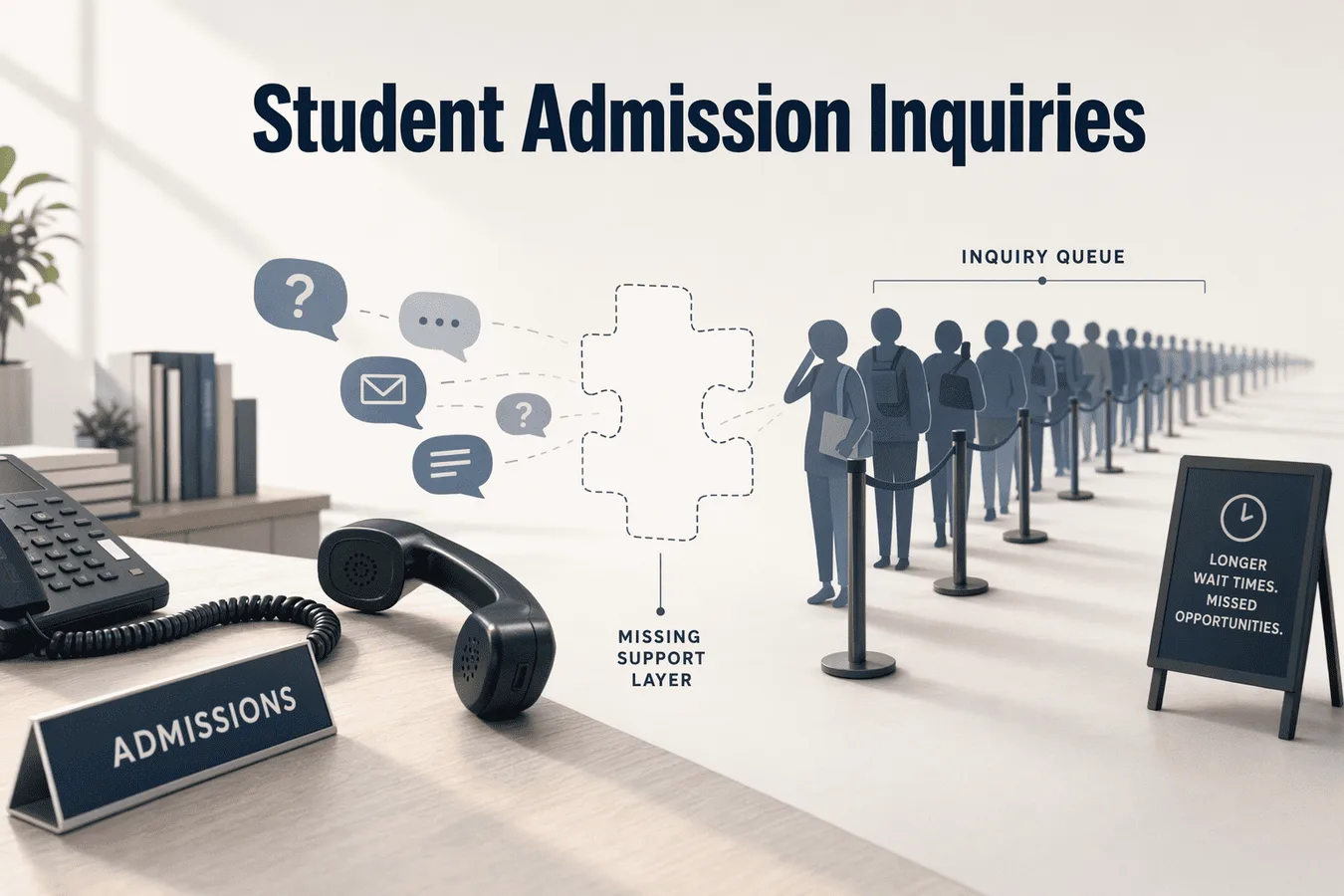
Educational institutions receive thousands of admission inquiries during peak enrollment seasons, overwhelming staff and delaying responses to prospective students.
Voice AI platforms and traditional IVR systems now automate call handling, but selecting the right tool requires matching capabilities to institutional needs.
Key Takeaways
Voice AI handles multi-turn conversations and complex eligibility questions autonomously, while IVR suits structured menu navigation for simple inquiries
Multilingual support for Hindi, Kannada, Telugu, and Urdu is critical for Indian institutions serving diverse regional student populations
CRM integration architecture determines whether voice agents can personalize responses using prior application history and enrollment status
Usage-based pricing fits seasonal admission cycles, while flat-rate models suit universities with consistent 500+ daily calls year-round
TRAI compliance and state-specific call recording laws require documented consent workflows and secure transcript storage
What Makes a Phone Call Tool Effective for Student Admissions?
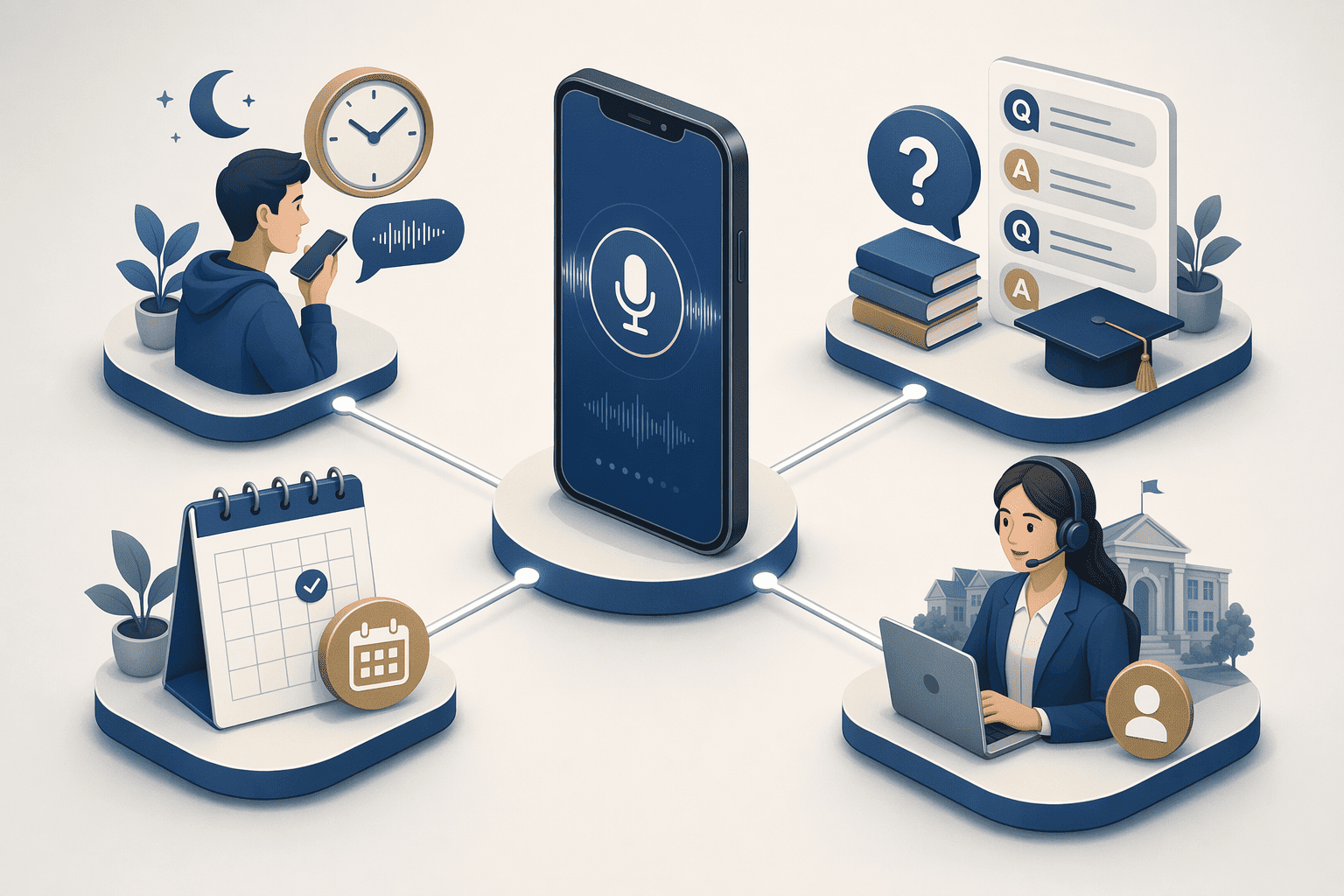
Yes, several platforms handle student admission inquiries autonomously: AIOnCalls, TaskVox AI, Voicory, and Vyora AI deploy voice agents for education workflows. These systems answer FAQs, confirm deadlines, and schedule counseling sessions. Effectiveness depends on institution size, inquiry complexity, and whether the platform supports human handoff when conversations exceed automation thresholds.
Core Requirements for Admission Call Handling
Three capabilities are non-negotiable. First, 24/7 availability during peak cycles (CAP rounds, early-action deadlines) ensures no inquiry goes unanswered outside office hours. Second, multilingual support for regional languages (Hindi, Tamil, Telugu) accommodates diverse applicant pools. Third, human escalation triggers activate when conversations involve fee disputes, document fraud verification, or rejection appeals — scenarios requiring judgment beyond automation's safe threshold.
Institution Size and Inquiry Volume as Selection Filters
Small coaching institutes handling 50–200 calls/day prioritize cost per call and same-day setup. Mid-size colleges (200–500 calls/day) need CRM integration and real-time analytics dashboards. Universities fielding 500+ concurrent inquiries require platforms that handle thousands of simultaneous conversations without degradation. Inquiry complexity also determines fit: simple FAQs (eligibility criteria, application deadlines) suit full automation, while multi-step verifications (transcript reviews, conditional offers) still benefit from AI-assisted human review.
When Voice AI Is NOT Suitable
Emotionally charged conversations — fee waiver appeals, deferral requests, fraud accusations, require human empathy and discretion. Multi-step document uploads (recommendation letters, transcripts with conditional formatting) exceed voice agents' current capability to verify file integrity or interpret nuanced formatting. Platforms should route these cases to admissions staff immediately, preserving automation for high-volume, structured inquiries. Learn workflow mechanics in AI Voice Agents for Student Admission Inquiries (2026).
Understanding these foundational capabilities sets the stage for evaluating specific platforms tailored to educational workflows.
Top AI Voice Calling Platforms for Educational Institutions
Platform Overview and Target Buyer Profiles
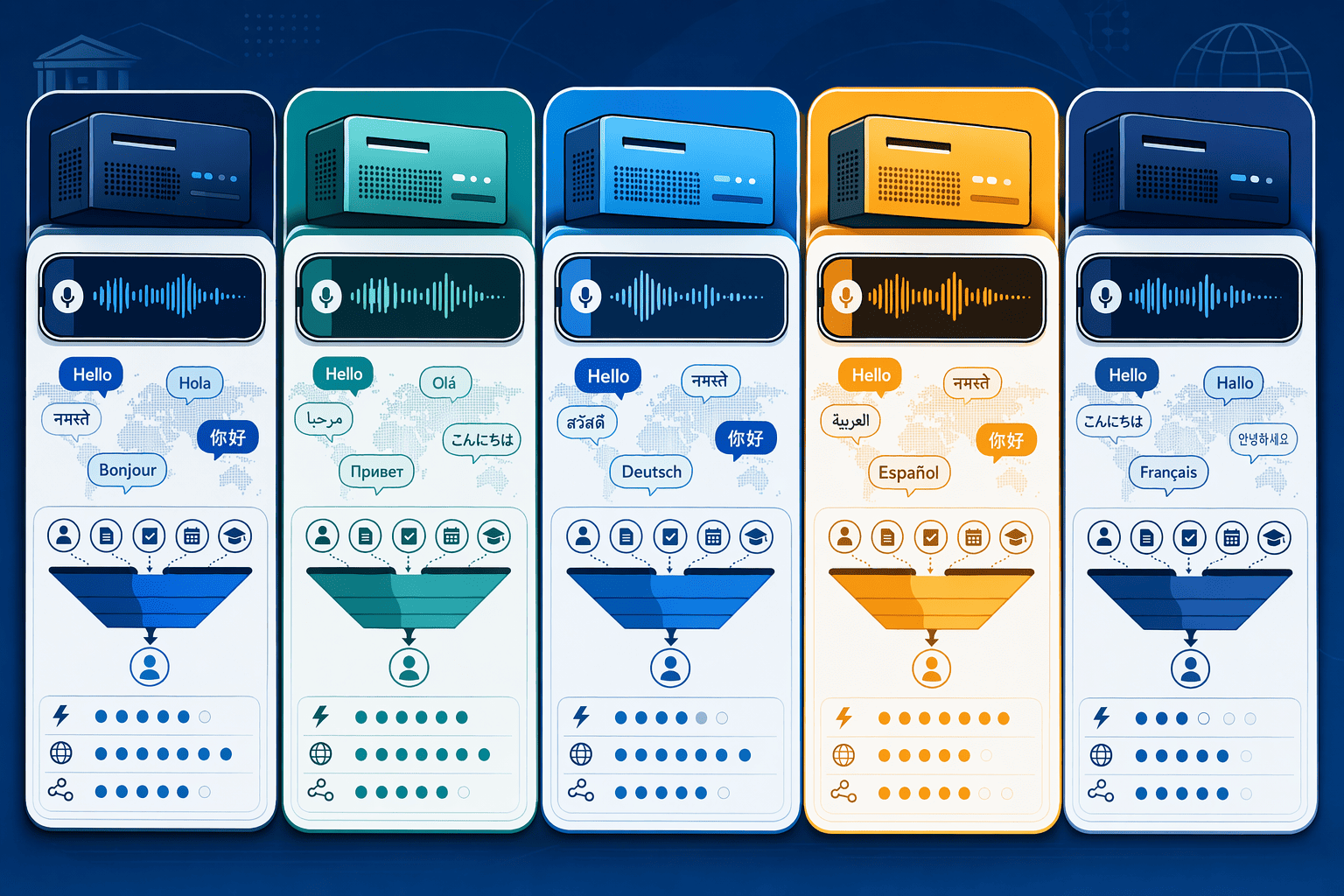
Five platforms serve the student admission inquiry space with distinct regional and institution-size fits. TaskVox AI positions itself as India's #1 AI voice platform, offering 30-second setup and 10+ Indian languages including Hindi, Tamil, and Telugu. Bolna AI powers over 1,000 companies across 10+ vernacular Indian languages including Hinglish, Hindi, Tamil, and Telugu, and claims deployment from idea to live calls in minutes. Voicory provides AI voice and chat agents for phone and WhatsApp in 15+ Indian languages with pay-as-you-go pricing from $0.08/min and no monthly fees. AIOnCalls offers education-specific AI calling software starting at $49/month, handling 10,000+ calls/day concurrently and supporting Hindi, Marathi, Tamil, Telugu, Kannada, and English. EchoLeads delivers enterprise-grade sales and lead qualification with bi-directional CRM sync across major platforms, multilingual follow-ups, and 24/7 inbound enquiry handling.
Side-by-Side Comparison: Key Dimensions
Platform | Multilingual Support | CRM Integration | Pricing Model | Handoff Configuration |
|---|---|---|---|---|
TaskVox AI | Hindi, English, 10+ regional languages including Tamil, Telugu, Bengali, Marathi, Gujarati, Kannada, Malayalam, Punjabi | API & webhooks push call results to CRM in real time | Pay-as-you-go; 100 free credits, no monthly fees | Custom webhooks trigger on call events |
Bolna AI | 10+ vernacular Indian languages: Hinglish, Hindi, Tamil, Telugu, regional dialects | Not publicly disclosed | Contact for pricing | Context-aware escalation to human teams |
Voicory | 15+ Indian languages: Hindi, English, Bengali, Telugu, Marathi, Tamil, Gujarati, Kannada, Malayalam | Webhooks & integrations connect to CRM, booking systems, APIs | $0.08/min voice calls, no monthly fees | Custom system prompts define escalation rules |
AIOnCalls | 5+ Indian languages: Hindi, Marathi, Tamil, Telugu, Kannada, English | Real-time dashboard tracks call performance, student responses, conversion rates | Starts at $49/month | Not publicly disclosed |
EchoLeads | 70+ languages including Hindi, Kannada, Telugu, Urdu, regional Indian languages | Bi-directional sync with Salesforce, HubSpot, Zoho; writes back qualification scores, transcripts, next-step recommendations | Usage-based; contact for pricing | Configurable handoff triggers on keywords, sentiment scores, explicit prospect requests |
Free tiers often have hidden limits, verify SMS quotas, payment processing fees, and seat minimums with each vendor during evaluation.
Platform selection depends on matching technological sophistication to your institution's inquiry complexity and daily call volume.
Voice AI vs. Traditional IVR: When Each Works Best
Traditional IVR Strengths: Structured Menu Navigation
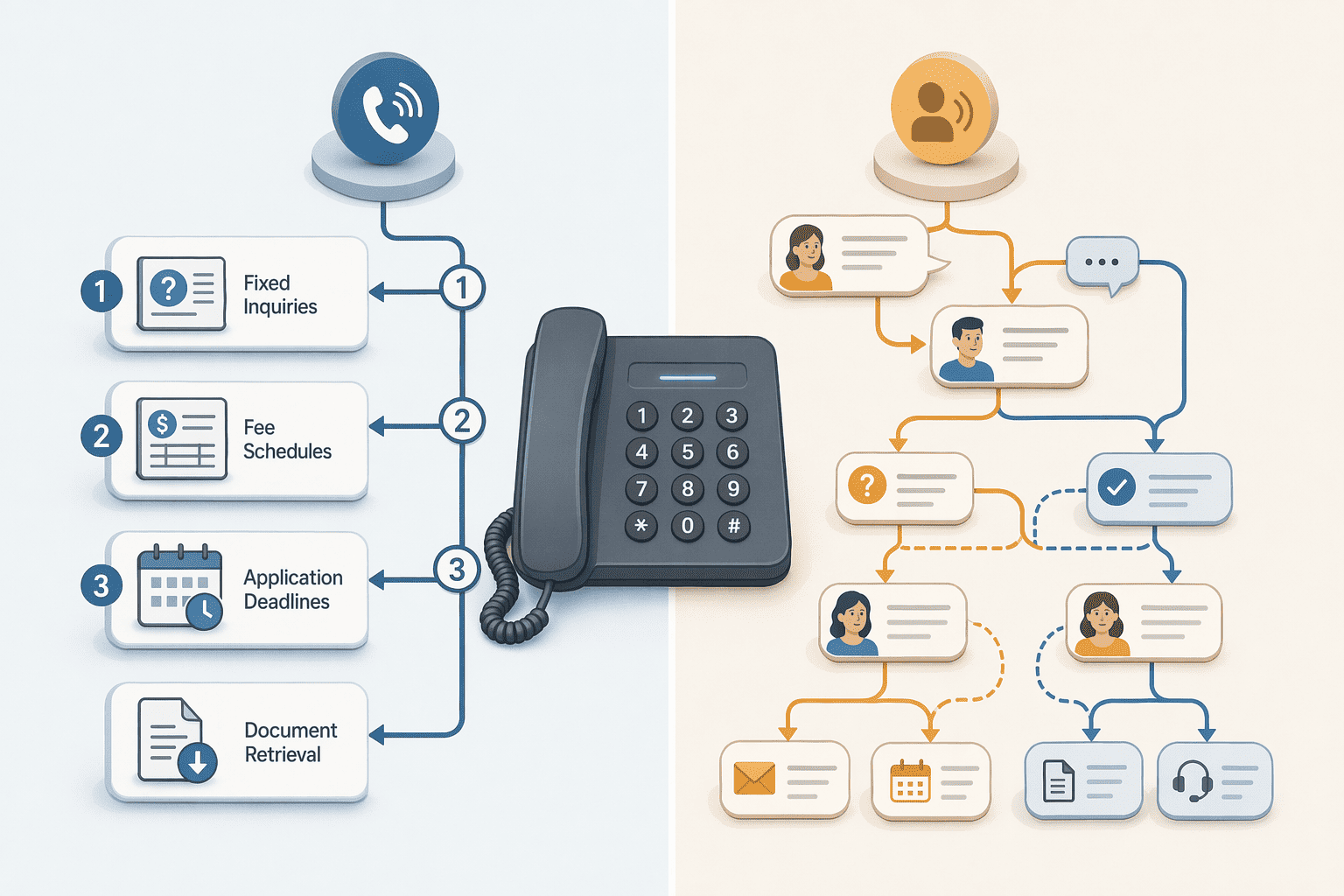
Touch-tone IVR excels at structured, single-step tasks: press 1 for fee schedules, press 2 for application deadlines, press 3 for document retrieval. For small coaching institutes handling fewer than 50 calls per day with predictable inquiry patterns, IVR remains cost-effective. It requires no natural language processing overhead and works reliably when callers know exactly what they need.
Voice AI Advantages: Natural Language and Context Retention
Voice AI handles natural, two-way conversations that adapt in real time, critical when students ask multi-turn questions like "What are the eligibility criteria?" followed by "Do I qualify with a 75% score?" IVR's static menu tree cannot clarify ambiguous questions, retrieve CRM data mid-call, or handle deadline exceptions. Voice agents reason about the conversation in real time and escalate to a human when the situation calls for it.
Hybrid Approach: When to Use Both
Universities managing 500+ calls daily across admissions, finance, and academics often deploy hybrid architectures: IVR routes callers to departments (press 1 for admissions), then voice AI handles the admission-specific conversation, clarifying eligibility rules and booking counseling sessions. This structure isolates voice AI deployment costs to high-complexity inquiry paths. Readers comparing agent types can review the AI Voice Calling Agent vs Customer Support Agent guide for role-specific trade-offs.
Beyond choosing between voice AI and IVR, three operational capabilities separate effective tools from underperforming ones.
Key Features to Evaluate: CRM Integration, Multilingual Support, and Handoff Triggers
Selecting a phone call tool for student admission inquiries requires evaluating three operational capabilities most vendors list but few explain in depth: CRM integration architecture, regional language accuracy, and escalation workflow configuration. These features determine whether the system fits into your existing enrollment stack, serves your student population's linguistic diversity, and routes complex cases to human staff without conversation loss.
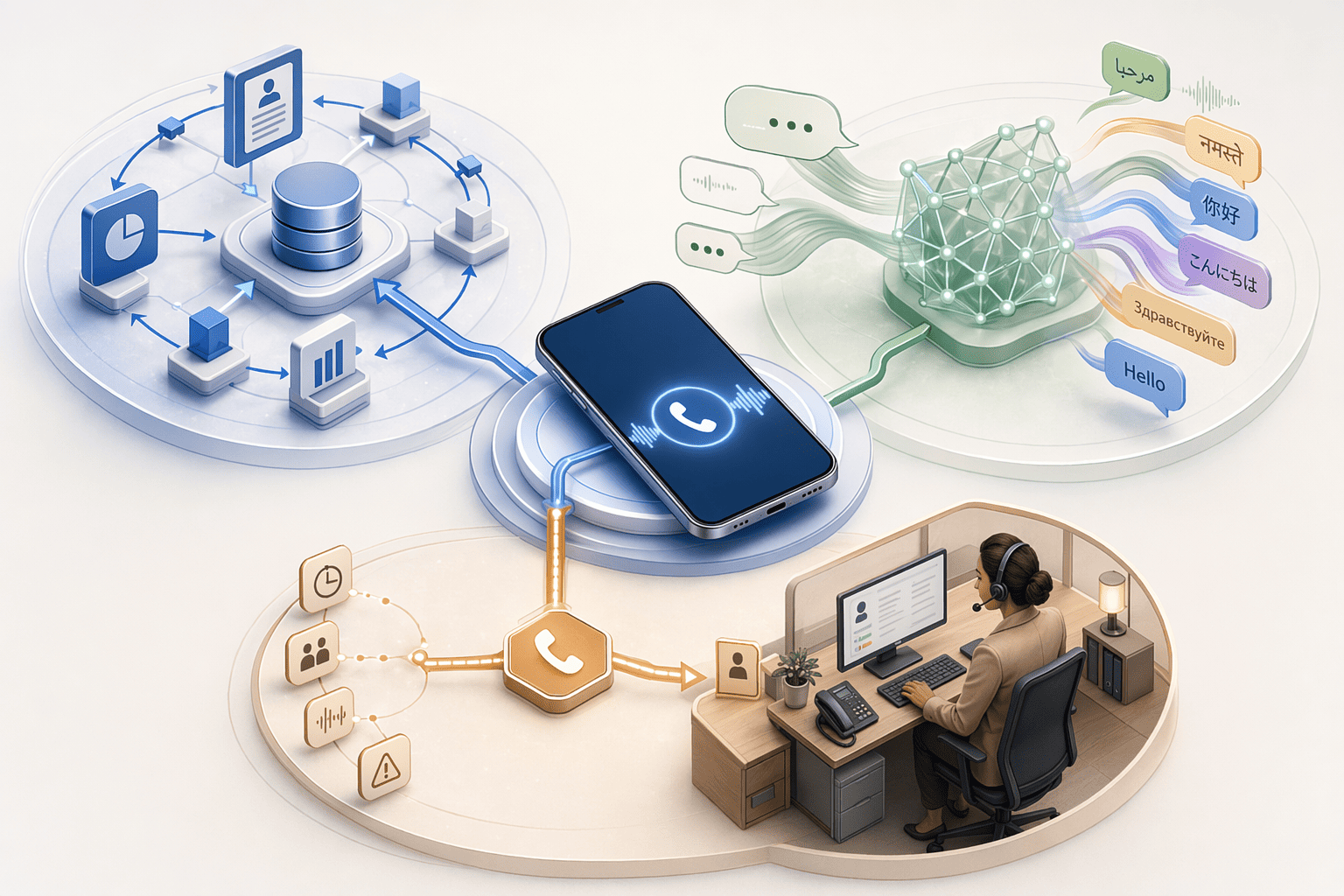
CRM Integration: Bi-Directional Sync Requirements
Bi-directional CRM sync means the voice agent writes inbound call data, conversation transcripts, qualification scores, sentiment analysis, directly into your CRM contact record, while also reading prior application history, past inquiries, and enrollment status from the CRM to personalize responses in real time. EchoLeads provides bi-directional CRM sync with major platforms, writing back qualification scores, conversation transcripts, and next-step recommendations without manual data entry. Many platforms advertise 'open APIs,' but some require developer support contracts for full integration, verify whether self-service setup or developer-assisted configuration is included before committing.
Multilingual Support: Regional Language Accuracy
Institutions serving diverse student populations need voice agents that handle Hindi, Kannada, Telugu, Urdu, and English fluently. EchoLeads supports sales, lead qualification, inbound enquiry handling, appointment booking, CRM integrations, and multilingual follow-ups. Published accuracy benchmarks for regional language speech recognition remain scarce across the category, most vendors list language support without disclosing word error rates or accent-handling performance. Pilot testing with real admission call recordings in your target languages is the most reliable way to verify production quality before institution-wide deployment.
Human Handoff Triggers: Escalation Workflow Configuration
Escalation workflows route complex inquiries to human staff when the agent's confidence falls below safe autonomy thresholds. Configurable triggers include conversation clarity thresholds (agent confidence <70% triggers handoff ), keyword-based routing (terms like 'complaint,' 'refund,' 'speak to human' escalate immediately), and multi-turn question loops (agent asks clarifying question 3+ times without resolution ). EchoLeads allows businesses to configure handoff triggers based on conversation keywords, sentiment scores, or explicit prospect requests. The depth of trigger customization, whether you can set thresholds per inquiry type or only globally, determines how well the system balances automation coverage with escalation quality.
Regulatory frameworks and data protection obligations shape how institutions deploy phone call tools across different states and student demographics.
Compliance and Call Recording Requirements for Education
TRAI Regulations for Automated Calling
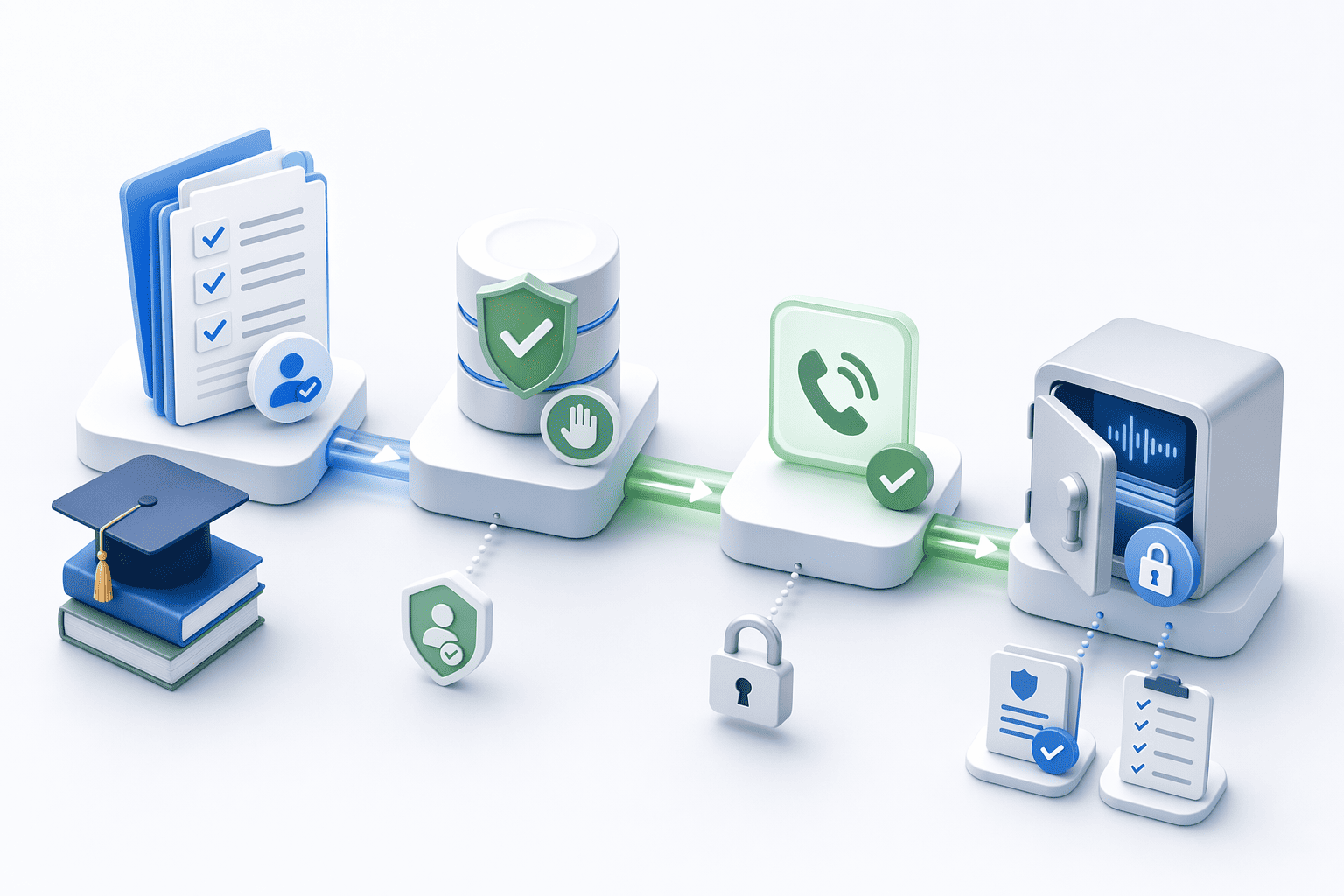
TRAI's Do Not Disturb (DND) registry mandates that automated outbound calls for student recruitment require prior express consent before dialing. Inbound admission inquiries, calls initiated by prospective students or parents, carry different compliance obligations; institutions still need documented consent workflows for follow-up calls. Platforms like CarmaOne and Tenori Labs integrate consent-capture mechanisms and automated DNC list synchronization for TRAI compliance. EchoLeads operates with compliance-first architecture that maintains audit trails and transparent disclosures for all automated admission calls.
State-Specific Call Recording Laws
Karnataka allows single-party consent for call recording, one party (the institution or the platform acting on its behalf) may record without notifying the caller. Other states require all-party consent before recording conversations. Institutions should verify local regulations and ensure their chosen platform supports region-specific consent announcements ('This call is being recorded for quality assurance') before deploying at scale.
Data Retention and Student Privacy
Call transcripts containing sensitive information, fee details, family income, application status, require secure storage and access controls standards. EchoLeads maintains audit trails and secure handling of applicant information aligned with compliance directives. Institutions should request compliance certifications during platform evaluation; vendor documentation often lacks state-specific guidance on retention policies.
Budget predictability requires understanding how pricing models align with your institution's seasonal admission patterns and call volume fluctuations.
Cost Structures: Usage-Based vs. Flat-Rate Pricing Models
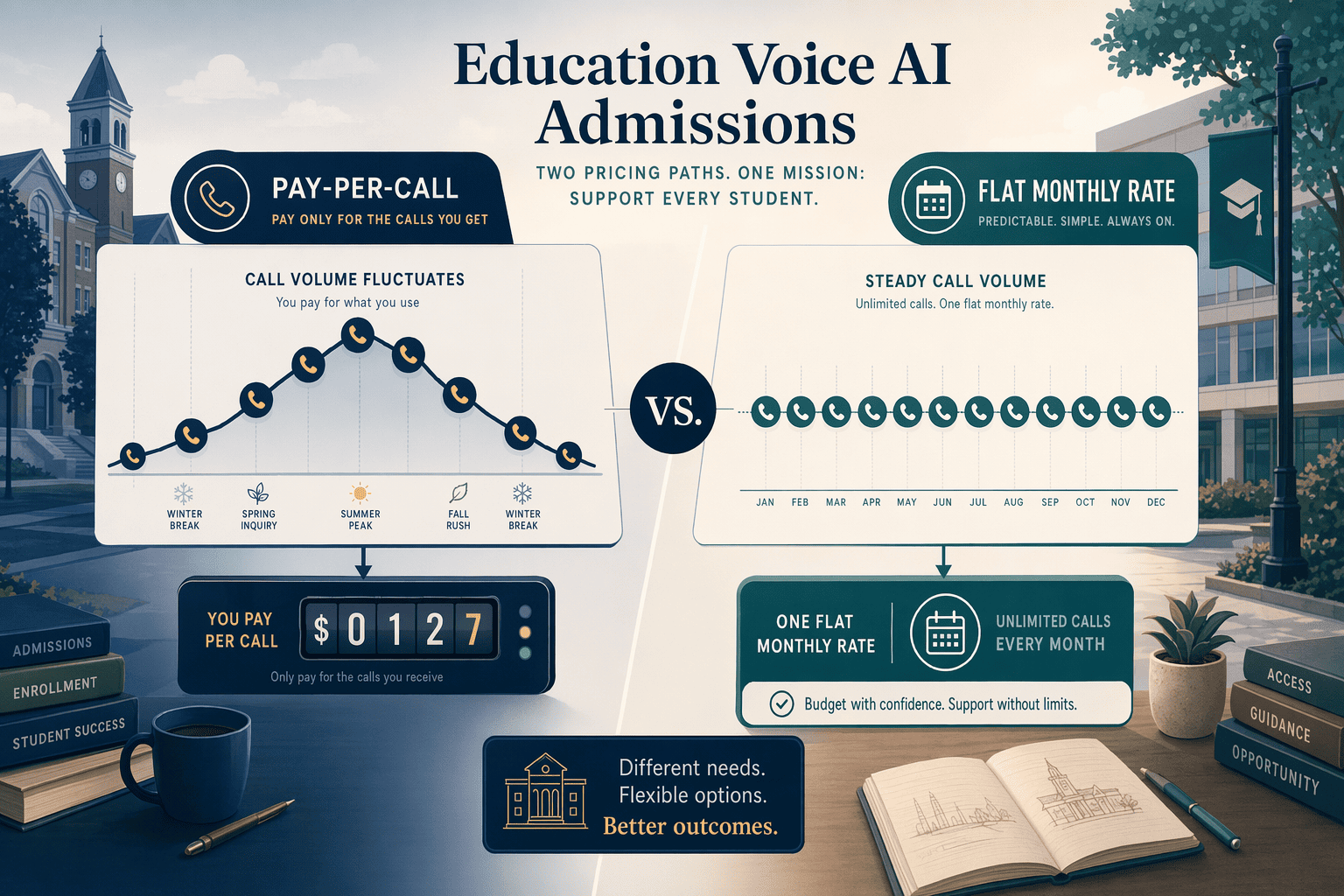
Educational institutions evaluating voice AI for admission inquiries face two pricing models, each suited to different call-volume patterns. The choice hinges on whether your admissions cycle is seasonal or year-round, and whether the vendor discloses all costs upfront.
Usage-Based Pricing: When It Makes Sense
Usage-based models charge per minute or per call, avoiding capacity waste during off-peak months. A college with a 3-month admission surge followed by 9 months of maintenance-level inquiries pays only for active usage. Vyora AI, for instance, offers 50 free credits to pilot the model before committing to paid tiers. This structure aligns cost with demand but requires monitoring to avoid surprise overages during peak periods.
Flat-Rate Models: Predictable Budgets for High-Volume Institutions
Flat-rate plans (monthly or annual) suit universities handling 500+ calls daily year-round. EchoLeads, for example, offers a $25/month flat rate, fixing costs regardless of volume, beneficial when usage-based charges would exceed the flat fee. Calculate your break-even threshold: if per-call cost at X volume equals the flat rate, higher volumes favor flat pricing. Synthflow AI, serving over 1,000 enterprise clients in finance, healthcare, and education, integrates into existing telephony systems, a setup compatible with predictable monthly billing.
Hidden Costs in Free Tiers
Free tiers often carry undisclosed limits. Verify SMS quotas for follow-up messages (e.g., 100 SMS/month included, $0.05/SMS beyond), payment processing fees for paid add-ons, and per-seat minimums for team access (free tier = 1 user, $20/seat for additional users). EchoLeads' usage-based model avoids per-seat charges, but institutions should confirm all cost components during trials to prevent budget surprises at scale.
Matching platform capabilities to institutional size and inquiry volume determines whether voice AI delivers ROI or becomes underutilized overhead.
Choosing the Right Platform for Your Institution Size and Inquiry Volume
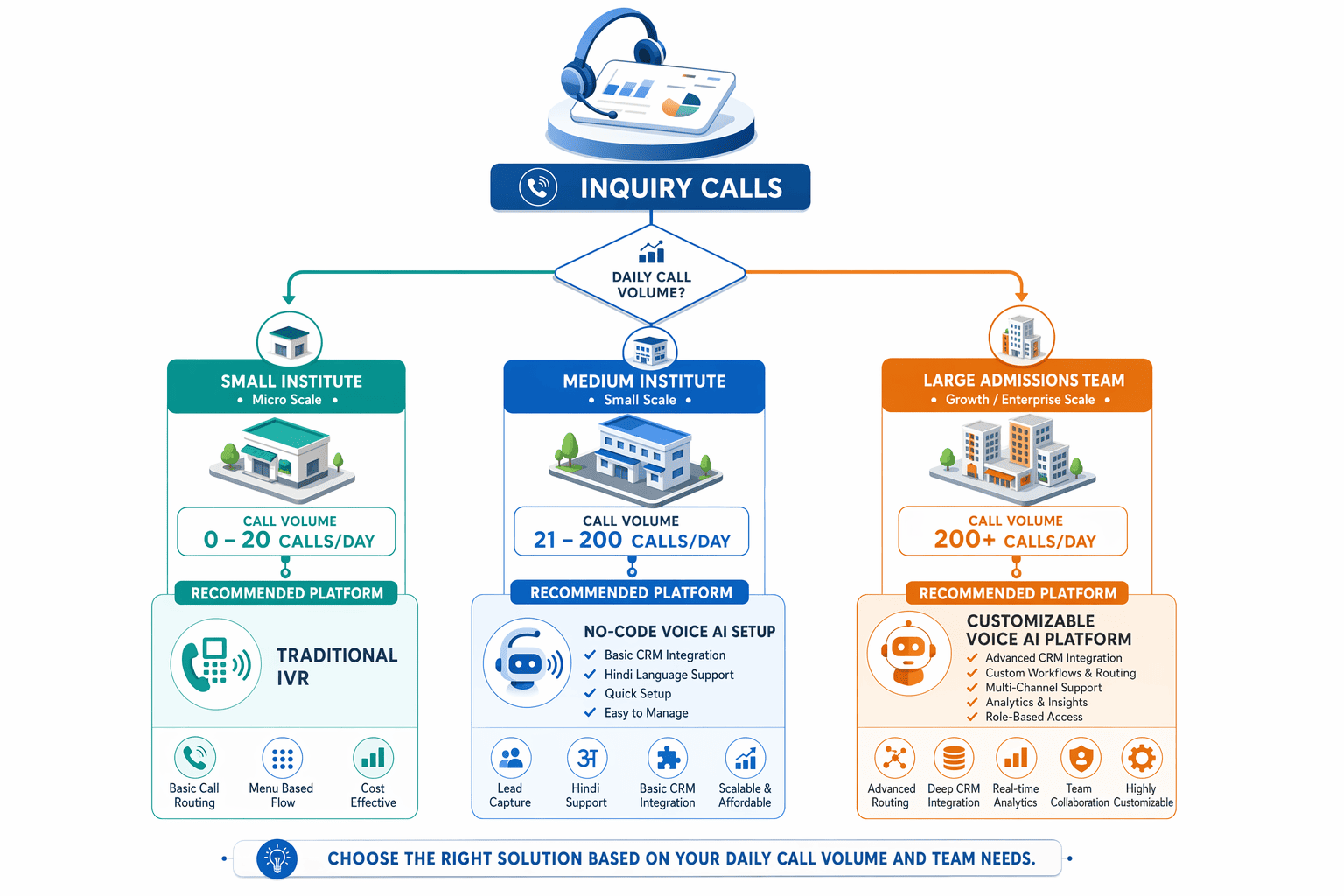
Small Coaching Institutes: <200 Calls/Day
Coaching centers fielding fewer than 200 daily calls often find no-code platforms with basic CRM integration and Hindi support sufficient. Prioritize single-day setup, pay-as-you-go pricing, and simple appointment booking workflows. For institutes below 50 calls per day, traditional IVR systems or dedicated human staff remain cost-effective, voice AI deployment overhead may exceed savings at micro scale.
Mid-Size Colleges: 200 to 500 Calls/Day
This volume bracket represents the voice AI sweet spot. Look for platforms offering Hindi plus 1 to 2 regional languages, bi-directional CRM sync, and handoff triggers that route high-intent inquiries to human counselors. EchoLeads handles hundreds of simultaneous calls, TaskVox provides 10+ Indian language support with live transcripts, and Bolna emphasizes vernacular accuracy across multiple concurrent sessions. Readers can compare feature matrices in the Agent Comparison resource.
Large Universities: 500+ Calls/Day
Enterprise-scale institutions require multi-department routing (admissions, finance, academic affairs), advanced analytics dashboards, compliance certifications, and dedicated support contracts. Hybrid IVR + voice AI architectures suit this scale, IVR handles simple queries (office hours, fee schedules) while AI agents manage qualification and booking workflows, reducing load on human teams during peak admission cycles.
Choosing the Right Phone Call Tool for Your Admissions Process
Usage-based pricing platforms like EchoLeads avoid paying for unused capacity during off-peak admission months but require monitoring call volume to manage costs; flat-rate platforms offer predictable budgets but may overpay during low-inquiry periods. No-code setup platforms suit small institutions without technical teams but may limit advanced customization; API-first platforms offer flexibility but require developer support contracts for integration.

As regional language accuracy improves and compliance frameworks mature, voice AI adoption in Indian educational institutions will accelerate beyond Tier-1 cities, expect multilingual support for 15+ regional languages and state-specific compliance certifications to become table stakes by 2027.
Pilot test EchoLeads alongside TaskVox or Bolna with 50-100 real admission call recordings this week to verify multilingual accuracy and handoff trigger performance before your next admission cycle. This real-world validation ensures the platform you select can handle your institution's specific inquiry complexity and regional language requirements.
Frequently Asked Questions
Can AI voice agents handle regional Indian languages like Kannada and Telugu for student admission calls?
Yes, platforms like EchoLeads, Bolna, and Voicory support Hindi, Kannada, Telugu, and Urdu for regional student populations. However, published accuracy benchmarks remain scarce. Institutions should pilot test with real call recordings to verify language quality before full deployment, particularly for nuanced eligibility questions requiring context retention across languages.
What happens when the voice agent can't answer a student's question?
Voice AI platforms use human handoff triggers: conversation clarity thresholds (agent confidence <70%), keyword-based routing ('speak to human', 'complaint'), and multi-turn question loops (agent asks clarifying question 3+ times). Escalation workflows route complex inquiries to human staff when the agent's confidence falls below safe autonomy thresholds, ensuring students receive accurate answers.
Are there hidden costs in free tiers of AI calling platforms?
Yes, free tiers often carry undisclosed limits. Verify SMS quotas for follow-up messages (e.g., 100 SMS/month included, $0.05/SMS beyond), payment processing fees for paid add-ons, and per-seat minimums for team access (free tier = 1 user, $20/seat for additional users). These costs can accumulate quickly during high-volume admission periods.
Do educational institutions need to comply with TRAI regulations for voice AI calls?
Yes, TRAI's DND registry applies to automated outbound calls, requiring prior express consent before dialing. Inbound admission inquiries carry different obligations; institutions still need documented consent workflows for follow-up calls and must verify state-specific call recording laws, such as Karnataka's single-party consent rule, to ensure compliance with regional regulations.
How do I choose between usage-based and flat-rate pricing for my institution?
Usage-based pricing (per-minute/per-call) suits institutions with seasonal admission cycles (3-month peak + 9-month low volume). Flat-rate models suit universities handling 500+ calls daily year-round. Calculate the break-even point: if usage-based cost at X calls/day equals the flat-rate cost, flat-rate becomes the predictable budget choice above that threshold.
When should an institution use traditional IVR instead of voice AI?
Traditional IVR works best for small coaching institutes with <50 calls/day handling simple menu navigation (press 1 for fees, press 2 for deadlines) where conversational AI is overkill. Voice AI outperforms IVR for multi-turn eligibility questions, deadline exceptions, and complex inquiries requiring context retention across the conversation.
Can voice AI platforms integrate with our existing CRM system?
Most platforms support bi-directional CRM sync: inbound call data → CRM, CRM contact history → voice agent context. However, some platforms advertise 'open APIs' but require developer support contracts for integration. Verify self-service vs. Developer-assisted setup during evaluation, EchoLeads, TaskVox, and Bolna offer varying levels of CRM integration complexity.
Related articles
6 Best AI Voice Phone Calling Agents in Hindi
Compare the 6 best Hindi AI voice phone calling agents in 2026.
7 Best AI Chatbot Tools for Lead Collection
Compare 8 AI chatbot platforms for website lead generation in 2026.
How to Automate Appointment Scheduling Without Losing Personal Touch (2026)
Learn how conversational AI scheduling automation maintains personalization via context driven processing.